_1745226507162.webp)

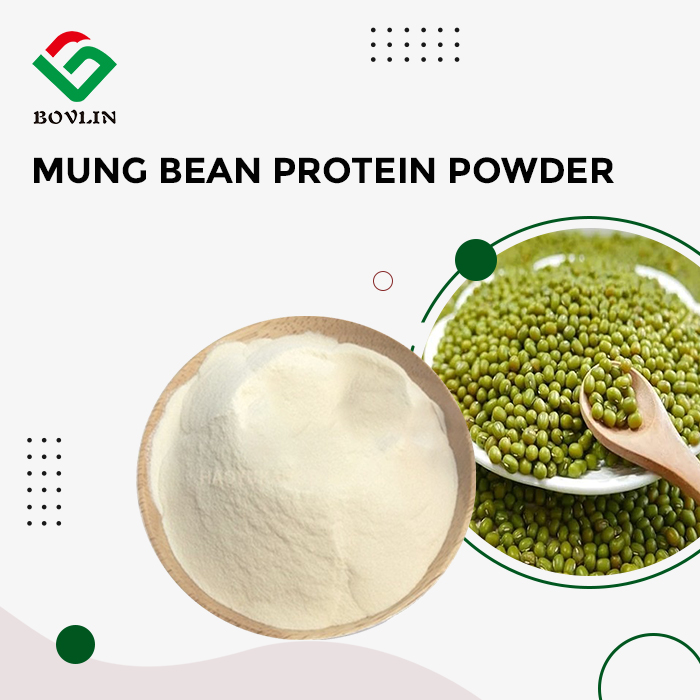
Mung Bean Protein Powder


- Product Description
Premium Mung Bean Protein Powder – 80% High-Purity Plant Protein from Shaanxi Bolin Biotechnology
Shaanxi Bolin Biotech provides pharmaceutical-grade Mung Bean Protein Powder (≥80% protein) from high-quality Vigna radiata beans using innovative enzymatic hydrolysis technology. This hypoallergenic protein isolate is produced in our ISO22000 certified manufacturing plant since 2015 and has outstanding functional features such as gelation strength similar to egg albumin, emulsification activity index (EAI) more than 30 m2/g and PDCAAS values over 0.8.
Our product has a neutral taste profile and requires minimum masking chemicals unlike typical pea proteins. Supported by two production facilities on more than 25,800 acres of regulated cultivation, we guarantee batch-to-batch consistency with moisture below 6%, ash less than 5% and insignificant anti-nutritional elements. All lots are tested for amino acid composition by HPLC, in particular the Lysine content 6.3g/100g.

Technical Specifications
| Parameter | Standard Value |
|---|---|
| Protein Content | ≥80% (dry basis) |
| Appearance | Light Yellow to Off-White Powder |
| Particle Size | 100 mesh (90% pass) |
| Moisture | ≤6% |
| Ash Content | ≤5% |
| pH Value | 6.5–7.5 (10% solution) |
| Solubility | >90% (pH 7, 25°C) |
| Shelf Life | 24 months |
| Storage Conditions | Cool, dry place (<25°C, RH<60%) |
| Packaging | 1kg/Aluminum Bag, 25kg/Fiber Drum |
Why Choose Bolin's Plant Protein Solution?
Superior Functional Properties
The accuracy of your formulation poses issues. Our protein powder can bind 3.2 times its weight in water, so you may lower your hydrocolloid load in plant-based solutions.
Egg replacers and structural meat analogs have hard yet elastic textures with thermal gelation at 85°C. Emulsion stability tests demonstrate no phase separation following centrifugation at 3,000 rpm for 72 hours.
Clean Label Advantage
Consumers want transparency. This product does not contain any allergens as declared in EU Regulation 1169/2011. No soy, no dairy, no gluten.
GD-Traceability Non-GMO Verified by SGS and Kosher/Halal Certifications Expand Your Market Reach. “You can trace back every batch to the cultivation zones in our 25,800-acre planting base through our traceability system.
The light hue and neutral taste profile means you don’t need artificial flavors. Your R&D team can obtain target sensory profiles with 40% less masking additives than yellow pea protein.

Industrial Applications
Plant-Based Egg Alternatives
The globulin rich composition mimics chicken egg proteins when heat treated. The irreversible unfolding of proteins at 80 °C results in the curding texture that customers anticipate from scrambled egg products.
The viscosity of the liquid egg replacer formulations is 450-520 cP at 4 % protein content. This is consistent with the behavior of whole egg in baking applications without xanthan gum fortification.
High-Moisture Meat Analogues
The extrusion test at 140°C and 60% moisture show good development of the fibrous structure. Protein integrity is maintained up to shear rates of 150 s-1 with twin screw processing.
Your white meat analogues (chicken, fish) will love the natural pale colour of the powder. Consumers are used to the look without the need for titanium dioxide or synthetic whiteners.
Clinical Nutrition Formulations
Medical food makers like the hypo-allergenic profile. Mung Bean Protein Powder is tolerated by patients with numerous food sensitivities in elemental diets when other proteins elicit responses.
Protein digestibility is useful in recovery procedures after surgery. In vitro pepsin-pancreatin digestibility was equivalent to that of whey isolate (91%) within 120 min.
RTD beverage stability tests demonstrate no sedimentation after 6 months at 25°C. Fine particle size (d₅₀ = 45 μm) reduces the grittiness seen in competitive goods.

From Seed to Powder: Our Quality Process
Controlled Source Materials
We maintain 800 plant species of Vigna radiata variants chosen for high globulin content in our certified planting base. Soil tests are performed every three months to check for build-up of heavy metals.
Harvest time is based on protein content analysis—beans are harvested at peak maturity when protein concentration reaches 24–26% in entire seeds. This guarantees the highest extraction yields.
Advanced Extraction Technology
Our 2024 facility utilizes closed loop enzymatic hydrolysis at regulated pH and temperature. It keeps the heat-sensitive amino acids but eliminates the trypsin inhibitors and the phytic acid.
At pH 4.5, isoelectric precipitation isolates protein fractions with an efficiency of 99.2%. Spray drying at inlet temperature 180°C and residence duration 0.3s inhibits Maillard reactions which are responsible for off-flavours.
Six-Step Quality Verification
All manufacturing batches are subjected to thorough testing before release. Heavy metals are tested to EU standards (Pb <0.5 ppm, As <0.3 ppm, Cd <0.1 ppm).
Microbial safety: ISO standards: total plate count <10,000 cfu/g, Salmonella and E. coli not detected in 25g samples. HPLC analysis shows that the amino acid profiles are within specification.
Our internal findings are validated by third party labs. We are cGMP certified in pharmaceutical grade manufacturing standards and are audited regularly by SGS.
|
Items |
Specification |
Result |
|
Appearance |
Milk-white to light yellow powder |
Complies |
|
Odor&Taste |
Characteristic |
Complies |
|
Moisture |
≤ 10.0% |
7.2% |
|
Protein (dry basis) |
≥50.0% |
53.1% |
|
pH |
6.5~8.5 |
7.2 |
|
Ash |
≤ 8.0% |
4.3% |
|
Total plate count (CFU/g) |
≤ 30000 |
9*103 |
|
Coliform (CFU/g) |
≤ 10 |
<10.0 |
Research-Backed Performance
Amino Acid Completeness
The protein contains all nine necessary amino acids. The leucine level of 7.8g/100g stimulates muscle protein synthesis and is therefore ideal for sports nutrition despite its plant origin.
It has a higher lysine content than wheat (6.3g compared to 2.9g per 100g protein). The amino acid scores to the formulators may be obtained by combining with rice protein at 7:3 ratio.
Digestibility Data
The in vivo experiments in rats reveal a PER of 2.3, which is near to the benchmark value of 2.5 for casein. Plasma amino acid levels peak at 45 minutes of intake in human studies.
No trypsin inhibitors are present (<1 TIU/mg) allowing enzymatic breakdown without hindrance. This compares to raw legume flours of 10-15 TIU/mg which decrease bioavailability.

Storage and Handling Recommendations
Optimal Conditions
Keep storage temperatures at 15-25°C in humidity-controlled conditions. The Mung Bean Protein Powder is hygroscopic . At relative humidity above 60% , caking occurs even with anti-caking chemicals .
Use FIFO inventory rotation. Stored properly, the shelf life is 24 months, although under non-optimal storage settings, protein solubility steadily diminishes after 18 months of storage.
Rehydration Guidelines
Disperse the powder in room temperature water and mix at 300 rpm to avoid lump development. Give 10 minutes for hydration time before modifying pH or adding additional components.
Add protein to water (not water to protein) and mix at high shear for 3 minutes for optimum solubility in neutral drinks. This leads to >95% dispersion and no foam production.
Frequently Asked Questions
Q: How does this differ from mung bean flour?
A: Our product is a concentrated isolate with 80% protein, while flour contains 20–25% protein plus starches and fiber. We remove non-protein components through extraction, delivering four times the protein density.
Q: Can it replace egg whites in meringue applications?
A: The protein exhibits excellent foaming properties with foam capacity of 120% and stability above 85%. However, meringue requires additional stabilizers like methylcellulose for peak formation comparable to egg whites.
Q: Is it suitable for infant formula?
A: While the protein is highly digestible and hypoallergenic, infant formula requires specific regulatory approvals. We provide analytical documentation for submission to authorities but cannot claim pediatric nutrition suitability without your market-specific certification.
Q: What causes color variation between batches?
A: Natural agricultural variation in chlorophyll content creates slight color shifts from light yellow to off-white. This doesn't affect functionality—protein content remains consistent at 80% ±2% across all batches.
Q: How does it perform in acidic beverages (pH 3.5–4.0)?
A: Protein solubility decreases near the isoelectric point (pH 4.5), causing turbidity. For acidic applications, we recommend pH adjustment to 6.5–7.0 or using our specially modified grade with improved acid stability.
Q: Are there concerns about pesticide residues?
A: Our cultivation follows organic protocols with integrated pest management. Testing confirms residues below EU MRL limits—glyphosate <0.05 ppm, organophosphates not detected (<0.01 ppm detection limit).
Global Logistics and Packaging
We understand your supply chain requirements. Standard lead time from order confirmation to shipment is 3–5 working days for quantities up to 500kg.
Bulk orders ship in 25kg fiber drums with double PE bag liners, palletized for container loading efficiency. Small-batch orders (1–10kg) use aluminum foil bags with nitrogen flushing to extend freshness.
Our logistics partners provide temperature-controlled shipping for tropical destinations. We've successfully delivered to 47 countries with zero quality complaints related to transport conditions.

Start Your Formulation Project Today
Contact our team at sales1@bovlin.com to discuss your specific requirements for Mung Bean Protein Powder and receive a competitive quotation.