_1745226507162.webp)

Application of Red Dragon Fruit Powder as a Natural Colorant in Fruit Pastilles and Gummies
Red dragon fruit powder is a great natural way to color fruit pastilles and sweets. It gives them vivid magenta colors and adds antioxidants like betalains to the mixtures. This freeze-dried plant ingredient meets the requirements for clean labels and gives food makers a plant-based option instead of synthetic colors. Its steady color and nutritional benefits make it very appealing to brands that want to reach health-conscious customers who want to know where their ingredients come from and how their products are made.
Understanding Red Dragon Fruit Powder as a Natural Colorant
The process of making this colorful element starts with picking the right Hylocereus cactus fruit. Manufacturers pick mature red-fleshed dragon fruit when it is at its ripest to get the most color out of it. Freeze-drying technology is used on the pulp, which keeps bioactive chemicals and color density much better than other drying methods. This process keeps the molecular integrity of betalain colors and makes them last longer on the shelf.
Production Methods That Preserve Nutritional Value
Freeze-drying works in a vacuum and at very low temperatures, usually between -40°C and -50°C. This method keeps heat-sensitive antioxidants from breaking down while lowering the moisture level to less than 5%. According to food science study that compared different dehydration methods, the powder that is made still has about 95% of the betacyanin amount of the original fruit. This keeps the colorant stable so that formulators always get a strong colorant that can also be used as a useful element.
Vegan and Organic Credentials in B2B Markets
Supplement and candy brands today are under more and more pressure to show that they are environmentally friendly and use ethical materials. Organic approval is proof from a third party that manmade pesticides and chemical fertilizers are not used in farming. A lot of sellers now offer vegan society approvals along with USDA Organic and EU Organic badges. These credentials make following the rules easier in many places, and they also appeal to people who read ingredient labels carefully to make sure they match their own values.
Comparative Advantages Over Synthetic and Natural Alternatives
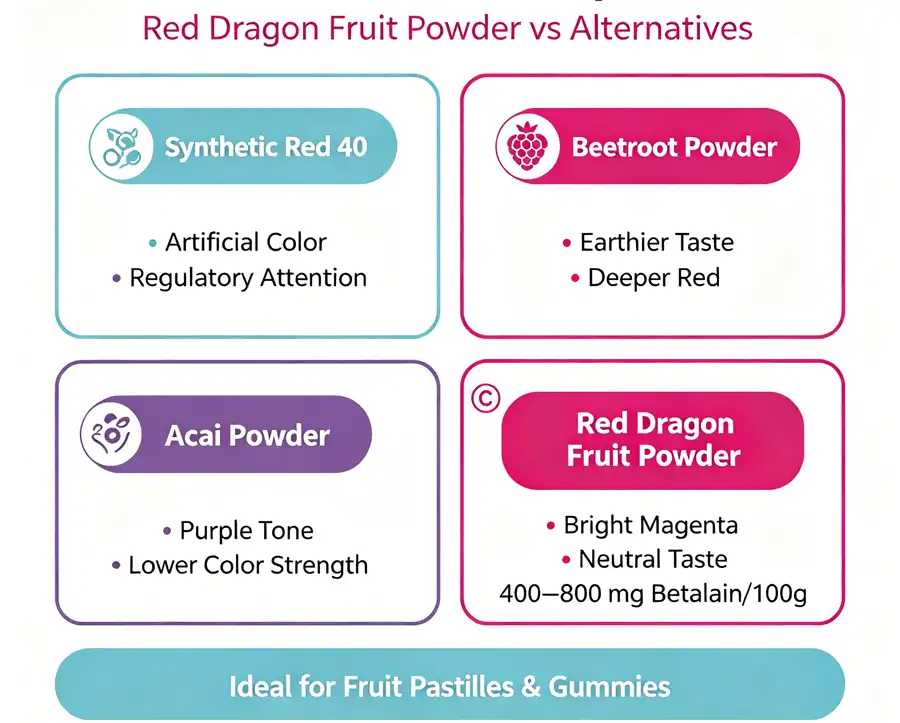
Synthetic colors like Red 40 and Red 3 used to be widely used in candy, but consumers and regulators are becoming more skeptical of them. Natural options, such as beetroot powder, give off reddish tones but often have earthy tastes that don't go well with fruit flavors. Acai powder has antioxidants, but the color it usually gives off is purple instead of a bright pink-red. Red dragon fruit powder stands out because it has a bright pink color and a neutral taste that won't mess up the recipe for fruit pastilles. It has between 400 mg and 800 mg of betalain per 100g, which is a lot more than most other plant colorants.
Core Benefits and Challenges in Using Red Dragon Fruit Powder for Fruit Pastilles and Gummies
When formulating sweets with plant colorants, scientists have to think about a lot of different things. Teams can make rules that maximize benefits while minimizing possible problems when they know both the pros and cons.
Vibrant Coloration and Antioxidant Enhancement
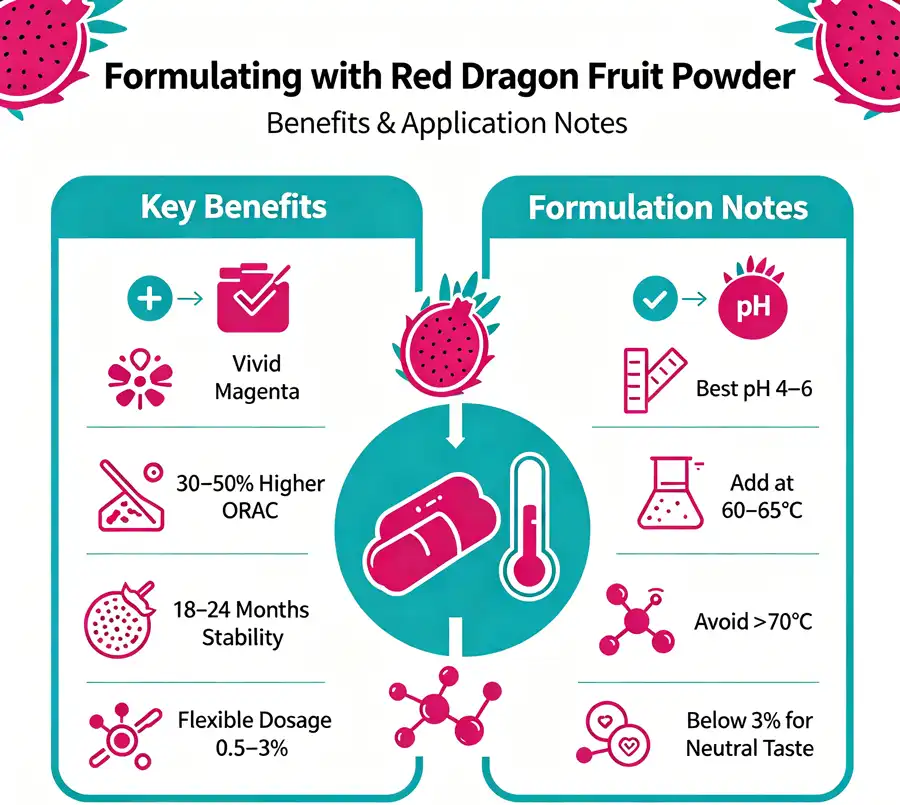
The betalain pigments that give plants their color are also very good at fighting free radicals and are known to be strong antioxidants. This two-in-one feature lets marketing teams stress both the product's good looks and health perks. Studies that measure ORAC values have shown that products that use organic red dragon fruit powder can have 30–50% higher antioxidant levels than the same products that use manmade colorants. This creates real value propositions that go beyond just looks, which is especially helpful when going after nutritional outlets.
Shelf Life Considerations and Formulation Flexibility
Powder that has been properly prepared is very stable when kept in a cool, dry place out of direct sunlight. Studies on accelerated aging show that goods with a moisture level below 8% lose little to no color over 18 to 24 months. This stability applies to different kinds of sticky structures, like those made from gelatin, pectin, and carrageenan. Formulators can change concentration amounts from 0.5 to 3% based on the color strength they want, which gives them a lot of room to be creative.
pH Sensitivity and Flavor Impact Management
Betalains change color depending on the pH level, and they look best in slightly acidic (pH 4-6) settings with pink tones. When the pH level is higher, colors may change to a yellow-orange tone. Because they contain citric acid or malic acid, most fruit pastilles and candies naturally have a pH level that is close to 7. But when formulation teams mix with alkaline ingredients or buffers, they need to test the safety of the mixture. At suggested usage rates, there isn't much of an effect on the flavor, but amounts above 3% may add faint earthy notes that need to be hidden.
Regulatory Compliance and Allergen Considerations
Under 21 CFR 73.250, the FDA says that fruit and veggie drinks, including dragon fruit, are not required to have color added to them. Compared to approved synthetic colors, this classification makes it easier for regulators to approve them. The item does not have any common allergy designations and meets the requirements for a clean label. If a company wants to sell its goods in the EU, it should make sure that its sellers show proof that they follow the E-number rules and, if necessary, the Novel Food evaluations.
Application Techniques of Red Dragon Fruit Powder in Fruit Pastilles and Gummies
To integrate well, you need to pay attention to the process factors and mixing methods. It's helpful for production teams to know about tried-and-true methods that make sure results are the same for all batch sizes.
Dosage Optimization and Mixing Protocols
Commercial-grade colorants that can be used on store items are usually made at concentrations between 0.8 and 2.0%. Lower ranges make pale tones that are good for simple branding, while higher amounts make deep magenta that is good for premium positioning. By mixing the powder with a little sugar or glucose syrup ahead of time, you can make a paste that spreads out more evenly when you mix the main batch. This method stops clumping and makes sure that the colors are spread out evenly in the end grid.
Temperature and Timing Considerations
Betalain's stability goes down at temperatures above 70°C, which makes the time of absorption very important. Adding the colorant after the main cooking stages keeps the pigment's full color. A lot of companies add the red pitaya powder while the chewy bases are being tempered, which is when they cool to 60–65°C. This method finds a good mix between processing speed and color stability. By planning production well, you can keep things from being exposed to heat for long amounts of time during waiting periods.
Quality Control and Batch Consistency
Spectrophotometric analysis is used by top makers to make sure that colors stay the same from one production run to the next. By using Lab* values to set accepted color ranges, objective quality assessment can be done without relying on subjective eye assessment. Keeping careful records of powder lot numbers, how much is used, and the matching color measures builds institutional knowledge that makes process control better over time. This paperwork is very helpful for figuring out why batches are different or for comparing suppliers.
Procurement and Quality Considerations for B2B Buyers
Decisions about strategic buying affect the standard of products, how much they cost, and how reliable the supply chain is. When choosing plant ingredient partners, procurement teams should look at a number of factors.
Certification Standards and Third-Party Testing
Comprehensive providers give out records of analysis that show that they have tested for microbes, heavy metals, and pesticide residues. Organic certification should be up-to-date and can be checked through the records of certified bodies. Other signs of quality include non-GMO certification, kosher certification, and halal approval, based on the market. Reliable partners keep up with ISO 22000 or FSSC 22000 food safety management systems, which show that they do more than just test each product individually to make sure the quality is good.
Supplier Evaluation and Relationship Building
In addition to certificates, buyers should look at how well the company can provide expert support, help with formulation, and samples for development projects. More recipe options are available when suppliers offer custom powder specs, like changed mesh sizes or a standard amount of betalain. Communication responsiveness and quality of documents are often better indicators of long-term relationship success than original price systems.
Logistics and Minimum Order Requirements
Getting information about wait times, minimum order amounts, and different packaging choices can help procurement and production plans work together better. Most of the time, bulk amounts are shipped in 25 kg fiber drums with food-grade polyethylene covers. However, some suppliers can handle smaller initial orders to help with product development. Offering fast shipping choices and product holding services can help even out the yearly changes in demand that are common in the candy market.
Future Trends and Sustainable Opportunities with Red Dragon Fruit Powder
As customer tastes turn toward openness and caring for the environment, the market continues to change. Forward-thinking brands put themselves in a good situation by predicting these paths.
Clean-Label Market Growth and Consumer Demand
According to experts in the field, the market for natural food colorants will grow at rates higher than 8% per year until 2028. This growth shows that people are willing to pay more for goods that have well-known chemicals that come from plants. Millennials and Gen Zers really like it when brands are clear about what ingredients they use. This gives makers who change their recipes to avoid fake additives a chance to make more money.
Innovation in Processing and Stability Enhancement
Researchers are looking into microencapsulation technologies that might make betalain even more stable over a wider range of temperatures and pH levels. These improvements may allow apps that are currently limited by processing limits to be used. Agricultural optimization and selected breeding programs also try to make raw fruit have more pigments, which could lower the number of times it is used and make it more cost-effective.
Sustainability and Ethical Sourcing Initiatives
Growing dragon fruit usually needs less water than growing many other foods, which helps with water saving goals for organic red dragon fruit powder. Adopting fair-trade and regenerative agriculture methods helps suppliers stand out in markets where corporate social responsibility affects buying choices. Packaging choices that can be broken down and shipped in a way that doesn't release carbon are two more benefits for brands that care about the environment.
Conclusion
Natural colorants from red-fleshed dragon fruit represent more than aesthetic solutions—they embody the convergence of consumer wellness trends, regulatory evolution, and sustainable sourcing imperatives. When formulators work with fruit pastilles and gummies, they get a flexible ingredient that makes the product look good and supports the clean-label approach. Technical issues like pH sensitivity and heat safety need to be thought about, but they can be handled by following standard procedures. As more people want plant-based ingredients, the first companies to use botanical colorants like these gain a competitive edge that lasts throughout the lifespan of a product and the growth of a business.
FAQs
What concentration of red dragon fruit powder achieves optimal color in gummies?
To get bright pink tones, most commercial formulas use between 0.8 and 2.0% by weight. At 0.5 to 0.8%, lighter colors show up, and at 2.5% or higher, you might start to taste faint flavor notes. Due to changes in the matrix that affect how light bends and how colors are seen, pectin-based candies usually need a little higher amounts than gelatin-based systems.
Does this natural colorant meet FDA requirements for dietary supplements?
According to FDA rules, the ingredient is an exempt color agent, so it doesn't need to be certified. It meets the requirements of GRAS (Generally Recognized As Safe) when it comes from reputable sources who can show the right paperwork. Manufacturers should make sure that certain sources follow current Good Manufacturing Practices and give them records of analysis that prove the products are pure.
How does storage affect the powder's coloring properties?
When properly prepared powder is kept in sealed cases away from water, light, and heat, the color stays stable for 24 months. Caking can happen when the humidity level is above 60%, and long-term light exposure can fade colors over time. Refrigerated storage makes things last longer, but they need to be brought back to room temperature before they can be used so that condensation doesn't cause problems when they are being weighed and mixed.
Partner with Bolin Biotechnology for Premium Natural Colorant Solutions
Shaanxi Bolin Biotechnology Co., Ltd. delivers pharmaceutical-grade plant products to companies around the world that make supplements and useful foods. Our operations as a red dragon fruit powder provider focus on tracking from the time the fruit is grown until it is packaged. Each batch goes through a thorough quality check. We keep our organic credentials and ISO 9001, GMP, and HACCP certifications up to date. This way, you can be sure that your formulations meet the strictest legal standards. Our expert team can help you with formulation and help you find the best dose and connection methods for your production systems. Whether you're making new gummy supplements or changing the way current pastille lines are made, our flexible minimum order amounts and fast supply chain can help you with both small-scale production and large-scale development. Email our team at sales1@bovlin.com to talk about your unique needs and ask for samples that show the high quality that makes our botanical ingredient collection stand out.
References
Rodriguez-Amaya, D.B. "Natural Food Pigments and Colorants." Current Opinion in Food Science, Vol. 7, 2016, pp. 20-26.
Gandía-Herrero, F., et al. "Betaxanthins as Pigments Responsible for Visible Fluorescence in Flowers." Planta, Vol. 227, 2008, pp. 853-862.
Stintzing, F.C., and Carle, R. "Functional Properties of Anthocyanins and Betalains in Plants, Food, and in Human Nutrition." Trends in Food Science & Technology, Vol. 15, 2004, pp. 19-38.
Herbach, K.M., et al. "Stability and Color Changes of Thermally Treated Betalain Solutions." Journal of Agricultural and Food Chemistry, Vol. 54, 2006, pp. 390-398.
Azeredo, H.M.C. "Betalains: Properties, Sources, Applications, and Stability—A Review." International Journal of Food Science & Technology, Vol. 44, 2009, pp. 2365-2376.
Castellanos-Santiago, E., and Yahia, E.M. "Identification and Quantification of Betalains from the Fruits of 10 Mexican Prickly Pear Cultivars by High-Performance Liquid Chromatography." Journal of Agricultural and Food Chemistry, Vol. 56, 2008, pp. 5758-5764.