_1745226507162.webp)

How to Choose a Reliable PQQ powder Supplier?
Choosing a trustworthy PQQ powder (pyrroloquinoline quinone) supplier demands careful evaluation of quality standards, certifications, and supply chain transparency. Reliable partners provide independently verified test reports showing 98% or higher purity levels, maintain ISO and GMP certifications, and demonstrate consistent batch-to-batch stability through HPLC analysis. They should offer complete traceability from raw material sourcing through final packaging, backed by third-party audits. Examining their technical support capabilities, sample provision policies, and regulatory compliance history across international markets provides crucial insight into long-term partnership viability for nutraceutical, pharmaceutical, and functional food formulations.
Understanding the PQQ Powder Market Landscape
PQQ powder market analysis.
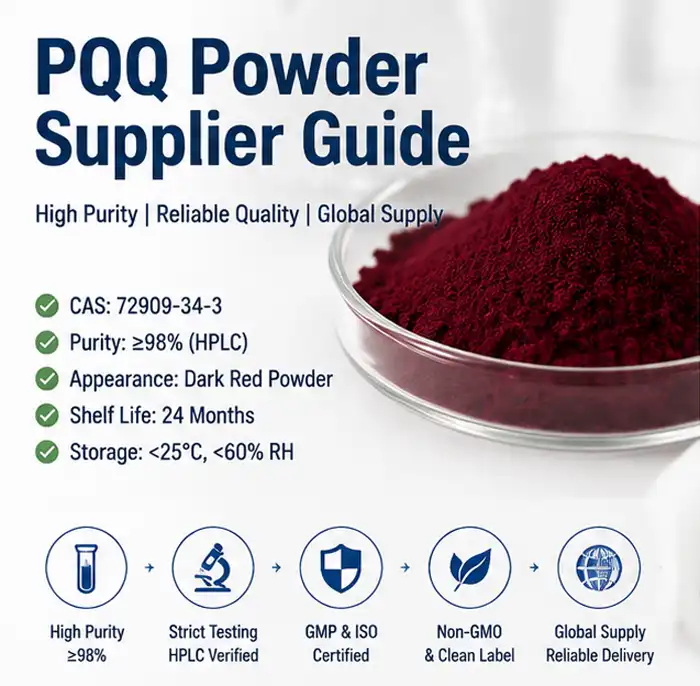
The pyrroloquinoline quinone market has grown into an important part of the global supply chain for nutraceuticals. This one-of-a-kind redox cofactor, whose CAS number is 72909-34-3 and chemical formula is C14H6N2O8, helps mitochondrial biogenesis and cellular energy production in ways that are different from how standard antioxidants work. In contrast to vitamins, which act as electron donors, this molecule can speed up thousands of redox cycles without breaking down. This makes it very useful for improving brain health and energy consumption.
The buying habits of today show that companies that make food supplements, medicines, and useful drinks are all wanting more. Professionals in procurement now prefer high-purity disodium salt forms because they dissolve better in water and stay stable in formulations longer than free acid forms. There has been a change in the market toward providers who can offer full paperwork packages that include Certificates of Analysis, safety data sheets, and allergen statements that meet both FDA and EU Novel Food standards.
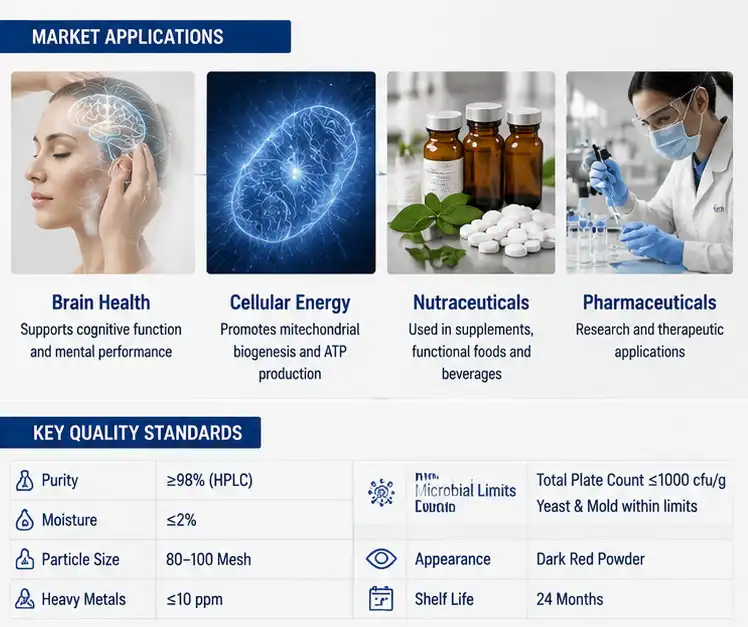
When looking at possible suppliers, it's important to understand the technical requirements. The normal industrial grade is a dark red powder that has been tested and found to be 98% pure using high-performance liquid chromatography. A particle size range of 80–100 mesh is needed for even mixing, the moisture content must be less than 2% to avoid caking, and the heavy metal levels must be less than 10 ppm to meet international safety standards. A stable shelf life of 24 months when kept correctly at temperatures below 25°C and humidity levels below 60% makes it easy for large buyers to keep track of their inventory.
Key Criteria for Selecting a Reliable PQQ Powder Supplier
A reliable PQQ powder supplier should meet the following criteria.
Quality Assurance Protocols and Testing Standards
Quality assurance is what seller rating is based on. Reputable makers use multi-stage testing methods that check each step of the production process for safety, identity, and purity. Using triple-phase HPLC testing shows that the active substance keeps its shape while it is being processed. Microbiological testing makes sure that the total plate counts stay below 1000 cfu/g and that the counts of yeast and mold stay within the limits that are allowed for use in food supplements.
Verification by a third-party lab adds an important layer of trustworthiness. When suppliers work with well-known testing centers like SGS or Eurofins, they show they are committed to fair quality control. These outside checks should look for pesticide residues, heavy metals like lead, arsenic, mercury, and cadmium, and solvent residues to make sure the clean label rules are followed. By asking for Certificates of Analysis from the last six months, you can see trends of stability and spot any possible changes in quality.
Manufacturing Certifications and Regulatory Compliance
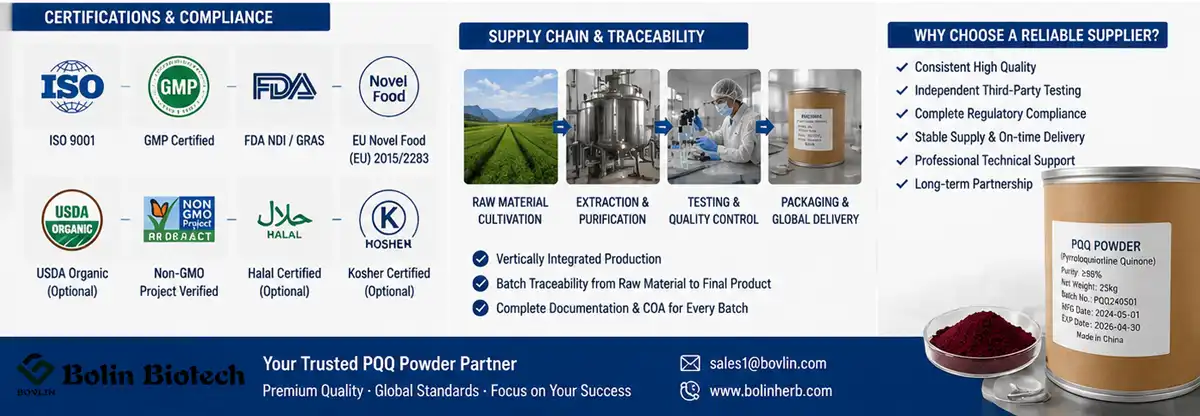
Certifications give real proof of operational excellence and following the rules. ISO 9001 certification shows that quality control systems are in place, and GMP compliance shows that production methods are up to par for pharmaceuticals. Novel food approval is now required for companies that want to sell their goods in Europe, according to EU rule 2015/2283. In the same way, companies that do business in North America should show proof that their products are GRAS or that they have made notices with the FDA about new dietary ingredients.
Organic and non-GMO certifications are appealing to companies that want to sell their products in the natural health market. USDA Organic or a similar certification shows that the raw materials come from farming methods that are recognised as organic. Verification from the Non-GMO Project or similar paperwork reassures buying teams that production does not use genetically modified organisms, which meets the needs of customers who want natural sources. Halal and Kosher approvals make it easier for people who follow certain religious diets to buy goods.
Supply Chain Transparency and Traceability
Clear ways of finding help tell the difference between great providers and average ones. Vertically integrated manufacturers, who oversee everything from farming to final processing, have clear advantages when it comes to quality control and tracking. Companies that run their own farms can keep records of the growing conditions, harvest times, and handling procedures after harvest that affect the quality of the final product. This exposure from farm to powder gets rid of the unknowns that come up in the middle, which makes quality responsibility harder.
Traceability tools that let you track a specific lot through the whole production chain are very important for managing risk. When quality issues come up, strong tracking lets you quickly find the batches that are at fault and take quick corrective action. Suppliers should easily give records of each batch's production, test results, and paperwork that shows the finished product's chain of custody back to the materials that went into making it. During regulatory inspections or customer audits, this openness is especially useful.
Comparative Analysis of PQQ Powder Offerings in the Market
PQQ powder products are compared and contrasted.
Product Differentiation and Synergistic Applications
To evaluate pyrroloquinoline quinone, you need to know where it fits in the category of mitochondrial support. While Coenzyme Q10 helps mitochondria do their job by being a part of the electron transport chain, this redox cofactor also helps make new mitochondria by turning on the PGC-1α pathway. This helps them out, which is why combination formulas often do better than single-ingredient methods in clinical studies that test cognitive and energy metabolism.
For the development of high-end formulations, the synergy with nicotinamide riboside should be given extra attention. NAD+ sources, such as nicotinamide riboside, make cells store more energy, and pyrroloquinoline quinone makes cells better able to use that energy. Formulation scientists who work on goods that promote longevity or physical success often take advantage of this link. Comparing suppliers' abilities to provide both ingredients makes the process of buying easier and may lead to volume-based benefits.
Pricing Structures and Value Assessment
Price transparency has a big effect on planning for long-term purchases. Procurement teams can make the best use of ordering schedules and inventory levels when suppliers offer tiered prices based on order volume. Understanding the cost factors that cause price changes helps tell the difference between real value and low-ball deals that can't be kept up. Cost structures that are fair take into account the production method, the quality of the raw materials, the level of testing, and the upkeep of certifications.
A more true way to figure out value is to look at the total landing cost instead of just the unit price. Different types of packaging, from 1 kg bags to 25 kg drums, change the cost per unit and the ease of handling. The general economics of procurement are affected by freight terms, minimum order amounts, and payment terms. Flexible packaging designs from suppliers make it easier to match order sizes with real formulation needs, which cuts down on waste from using only part of a container.
| Comparison Factors | PQQ Powder | Coenzyme Q10 Powder | NR Powder |
|---|---|---|---|
| Main Function | Mitochondrial biogenesis | Energy production | NAD+ support |
| Key Pathway | PGC-1α activation | Electron transport chain | NAD+ metabolism |
| Energy Role | Improves energy utilization | Supports energy generation | Supports energy storage |
| Synergistic Value | Works with CoQ10 & NR for complete mitochondrial support | Enhances mitochondrial activity with PQQ | Supports cellular energy with PQQ |
| Application Focus | Cognitive health & longevity | Energy & wellness formulas | Anti-aging & performance formulas |
Practical Steps to Vet and Engage PQQ Powder Suppliers
How to check out and practically hire PQQ powder suppliers?
Defining Technical Specifications and Requirements
Clearly stating the technical needs is the first step to engaging a seller successfully. Specifications for purchases should include requirements for purity, acceptable ranges of particle size, and standards for how the product looks. Objective evaluation standards are set by naming performance factors such as solubility rates in various pH environments, thermal stability limits for processing conditions, and compatibility with other ingredients in the formulation. These standards make it possible to compare proposals from different sellers in a way that is fair and accurate.
Assessing a supplier's abilities is based on needs like predicting volume and setting delivery times. Companies that want to start aggressively into new markets need partners who can quickly increase production while keeping quality standards high. Because supplement demand changes with the seasons, manufacturers need to be able to adapt their production capacity and provide quick customer service. Talking about production wait times, order minimums, and the amount of inventory that can be held during the first meetings helps avoid misunderstandings that can make relationships difficult.
Sample Testing and Validation Protocols
A full sample review keeps you safe from regulatory problems and formulation mistakes that cost a lot of money. By asking for samples from more than one production run instead of just one, patterns of consistency can be seen across all runs. By doing internal testing that looks like the certificates of analysis that the supplier gives you, you can get independent verification. In addition to checking the identity and purity of PQQ powder, testing should also include functional factors that are important for the uses that are being planned.
Stability testing under accelerated conditions suggests how well the product will work in the real world for the whole shelf life that was stated. By putting samples in conditions of high temperature and humidity for set amounts of time, possible degradation pathways can be seen. When planned co-ingredients are tested for compatibility, any interactions that might change the color, stability, or bioactivity are found. For food supplements, testing how well they dissolve in simulated stomach and intestine fluids shows how bioavailable they might be.
Evaluating Logistics and Technical Support
Logistics skills have a direct effect on how reliable and cost-effective the supply line is. Suppliers who know how to deal with foreign shipping rules, customs paperwork, and managing the cold chain when needed show that they are operationally mature. Knowing which carriers they work with, how long deliveries usually take, and how to file a damage claim can help them plan for possible delays. For regular buyers, domestic warehousing choices in target markets can cut wait times and freight costs by a large amount.
The level of technical help is what sets strategic partners apart from transactional providers. Suppliers who hire formulation scientists to give tips on how to use ingredients, how much to use based on written research, and how to follow regulations add a lot of value on top of providing raw materials. Product differentiation is possible with co-development tools for custom specs, changes to particle size, or unique packing solutions. Genuine partnership orientation is shown by answering technical questions and being willing to take part in troubleshooting exercises.
Risks to Avoid When Choosing a PQQ Powder Supplier
How to pick a PQQ powder supplier without taking any chances.
Quality Compromise Indicators
Several red flags point to possible quality problems that need to be looked into more deeply. Suppliers who don't want to give full test results, thorough information on how their products are made, or access to their facilities for audits may not be sure of their processes. Prices that are much lower than the market average usually mean that the quality has been lowered, testing wasn't done properly, or cheaper materials were used instead. Prices that are competitive are good for business, but prices that seem too good to be true are usually not.
Another big risk factor is licenses that are missing information or are out of date. Certificates of Analysis that don't clearly identify the lot, have testing dates that are more than one production run away, or are missing test parameters are all signs that the quality control systems aren't working well. Questions about the accuracy of certification papers that can't be independently checked through the websites of the organizations that issued them or by calling them should be raised. Teams in charge of buying things should make rules that say certificates must be checked before new sellers are approved.
Supply Chain Continuity Concerns
When you depend on a single source, you leave yourself open to production problems, quality problems, or business failures. Having ties with several qualified providers protects you in case your supply is interrupted for no reason. But qualifying backup providers takes the same amount of research and may require keeping relationships going by placing orders regularly even when they're not needed. Teams with limited resources have a hard time finding the right balance between supply security and procurement efficiency.
Protections in contracts should cover things like poor quality, late deliveries, and legal requirements. When agreements are well written, they spell out in measured terms quality standards, testing procedures, and acceptance criteria for PQQ powder. Including rules for recalling products, figuring out who is responsible, and settling disputes helps you handle problems when they happen. By having a lawyer look over supplier contracts before they are signed, bad terms that make it harder to solve problems can be avoided.
Conclusion
To find a trustworthy pyrroloquinoline quinone provider, you need to carefully look at their quality control methods, ability to follow regulations, and business skills. Checking analytical testing protocols, relevant certifications, and supply chain transparency through document reviews and facility audits when possible are all important parts of successful procurement. Sample testing verifies what the supplier says and shows patterns of consistency between batches of production. Strategic partnerships with suppliers based on clear specifications, open communication, and quick technical help give businesses long-term economic benefits. When procurement teams put enough resources into carefully evaluating suppliers, they lower quality risks and set up their companies to always have access to high-quality ingredients that help them make new products.
FAQ
What dosage levels are typically used in dietary supplement formulations?
Doses of 10 mg to 20 mg per day for adults are usually used in clinical studies that look at cognitive function and mitochondrial support. Supplement companies usually make products in this range based on evidence so that they are in line with published research. Some formulations target specific health results with higher doses of up to 40 mg per day. However, more clinical evidence supports smaller amounts for general wellness uses. Talking to legal experts makes sure that the doses meet the requirements for effectiveness while also following local guidelines.
How can I verify the authenticity of quality certificates from new suppliers?
Aside from just receiving documents, authentication involves more than one step of checking them. The contact information on certificates should match what is on file with the labs or certification groups that issued them. Independent validation is achieved by calling laboratories directly to check the issue of certificates and test results. Another way to prove who you are is to ask for digital certificates with secure verification codes that can be checked on the websites of the issuers. Hiring third-party reporting services to check out source facilities is the best way to make sure that high-value partnerships are completely safe.
What shelf life should I expect from a properly stored product?
If you keep high-quality pyrroloquinoline quinone disodium salt in sealed cases at controlled temperatures for 24 months, it will stay stable. Temperatures should stay below 25°C and relative humidity should stay below 60% in storage areas. Photodegradation can be stopped by keeping things from getting direct light. Opening containers over and over again lets moisture and oxygen in, which speeds up degradation. Repackaging large numbers into smaller working containers increases their useful life. Testing stored goods on a regular basis makes sure they continue to meet specifications for the full shelf life period.
Partner with Bolin Biotechnology for Premium Pyrroloquinoline Quinone Supply
Pharmaceutical-grade PQQ powder (pyrroloquinoline quinone) that meets the strictest international standards is available from Shaanxi Bolin Biotechnology to help you develop your formulas. Our 98% pure product goes through triple-phase HPLC verification and full safety testing at six quality checkpoints. This makes sure that the consistency from batch to batch that complex formulations need. We give your brand the purity and dependability it needs with our ISO-certified products made in our cutting-edge facility using cutting-edge closed-loop extraction technology.
You can speed up the creation of your product by working with pyrroloquinoline quinone makers who have a lot of experience and know how to use the chemical in nutraceutical, pharmaceutical, and functional food settings. Because we give away free samples, you can use your own testing methods to make sure our quality claims are true before committing to large orders. Our expert team can help you with formulation, regulatory paperwork, and unique packaging options that are made to fit your needs. Our flexible approach works for businesses at all stages of growth, whether they need trial quantities of 1 kg or a steady supply of multiple tonnes of well-known products. Get in touch with us at sales1@bovlin.com to talk about how our philosophy of quality-first, vertical integration, and customer-focused service model can help you make your supply chain more reliable.
References
1. Rucker, R., Chowanadisai, W., & Nakano, M. (2009). Potential physiological importance of pyrroloquinoline quinone. Alternative Medicine Review, 14(3), 268-277.
2. Stites, T. E., Mitchell, A. E., & Rucker, R. B. (2000). Physiological importance of quinoenzymes and the O-quinone family of cofactors. Journal of Nutrition, 130(4), 719-727.
3. Chowanadisai, W., Bauerly, K. A., Tchaparian, E., Wong, A., Cortopassi, G. A., & Rucker, R. B. (2010). Pyrroloquinoline quinone stimulates mitochondrial biogenesis through cAMP response element-binding protein phosphorylation and increased PGC-1α expression. Journal of Biological Chemistry, 285(1), 142-152.
4. Akagawa, M., Nakano, M., & Ikemoto, K. (2016). Recent progress in studies on the health benefits of pyrroloquinoline quinone. Bioscience, Biotechnology, and Biochemistry, 80(1), 13-22.
5. Harris, C. B., Chowanadisai, W., Mishchuk, D. O., Satre, M. A., Slupsky, C. M., & Rucker, R. B. (2013). Dietary pyrroloquinoline quinone (PQQ) alters indicators of inflammation and mitochondrial-related metabolism in human subjects. Journal of Nutritional Biochemistry, 24(12), 2076-2084.
6. Kumazawa, T., Sato, K., Seno, H., Ishii, A., & Suzuki, O. (1995). Levels of pyrroloquinoline quinone in various foods. Biochemical Journal, 307(2), 331-333.