_1745226507162.webp)

Madecassoside Powder in Skincare Formulations: Recommended Dosage, Solubility, and Formulation Tips
Centella asiatica was used to make madecassoside powder, which is a useful material that is pharmaceutical-grade. It's usually between 80% and 95% pure. Today, making anti-inflammatory products that work, increasing collagen production, and repairing the dermal barrier are some of the most important formulation problems in skin care. This better triterpene saponin solves some of these problems at once. There aren't any standards for plant extracts, but this precisely designed ingredient does meet strict regulatory requirements for both cosmetic and medicinal uses, so formulators can get consistent therapeutic results. It is a key ingredient for brands that want to target sensitive skin, speed up healing after surgery, and improve anti-aging because it works so well at the molecular level.
Understanding Madecassoside Powder and Its Benefits in Skincare
What Makes Madecassoside Different From Standard Centella Extracts
Asiaticoside, asiatic acid, and madecassic acid are some of the chemicals that are found in Centella asiatica extracts. Pure madecassoside is a single, well-defined pentacyclic triterpene saponin with the molecular formula C₄₈H₇₈O₂₀. In the field of formulation science, this difference is really important. When research and development teams use regulated madecassoside, they can be sure of the dose-response ratios and the clinical results they get. The chemical works by stopping NF-κB activation and p38 MAPK pathways that cause inflammation. This makes it more effective as a medicine than broad-spectrum products.
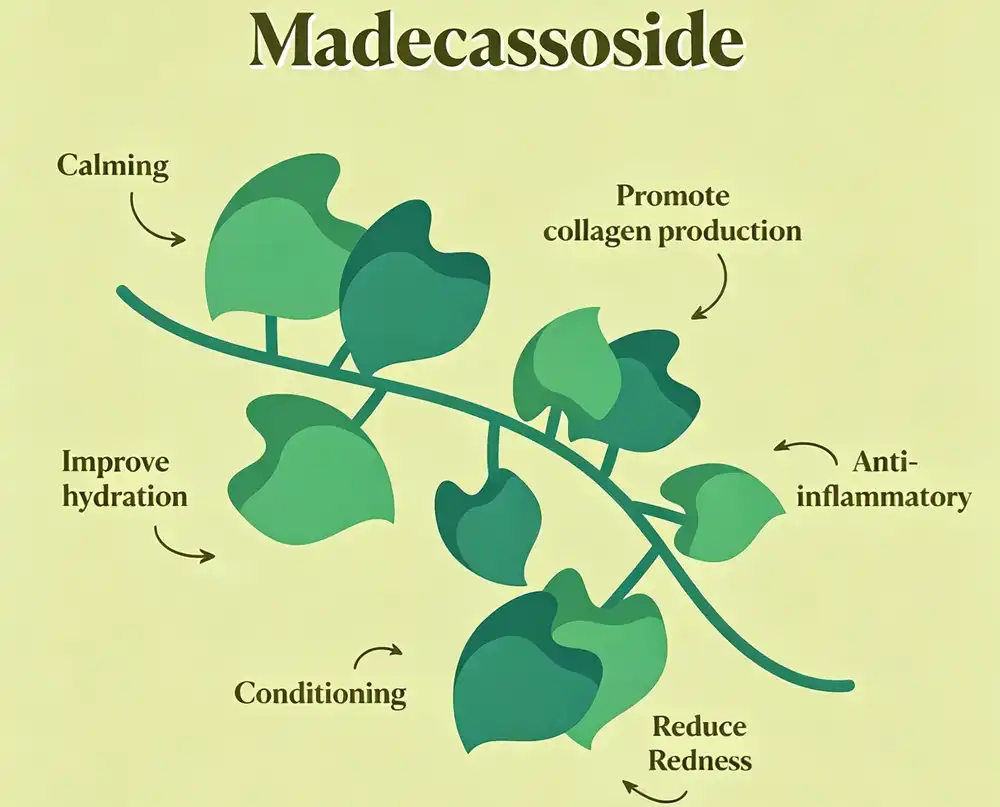
A clinical report shows that madecassoside makes fibroblasts make more Type I and Type III collagen while lowering the production of cytokines that cause inflammation, such as IL-1α, IL-6, and TNF-α. Because it does two things, it is great for fixing broken skin layers, hyperpigmentation after inflammation, and skin that has been treated with light. Animal tests have shown that it is safe to use in many ways and that small amounts used for cosmetic purposes do not cause mutations, cancer, or widespread harm.
Purity Levels and Their Impact on Formulation Performance
Pharmaceutical-grade material is generally between 85% and 95% pure when checked by HPLC against known standards. There are fewer changes in color between runs when the grades are higher. The profiles are also more stable, and there is less chance of allergy exposure from plant matrix components that are still present. Purity has a direct effect on bioavailability and efficiency. For example, a 90% grade has a more steady effect on inflammation than 50% crude extracts that contain phytochemicals that haven't been characterized.
Madecassoside powder must have its identity confirmed by mass spectrometry, its strength verified by chromatography, and be subject to mandatory screening for heavy metals, chemical residues, and bacteria. Suppliers who meet ISO 22716, GMP, and COSMOS standards are committed to ensuring batch-to-batch consistency, which guarantees formula safety and regulatory compliance across the US, EU, and Asia-Pacific regions.
Core Functional Benefits for Skincare Applications
The chemical helps with three main skin issues: lowering inflammation, fixing walls that are broken, and changing the extracellular matrix. It works just as well as outside drugs at reducing inflammation, but it doesn't have any side effects like skin loss or inflammation that comes back. People with atopic dermatitis lose less water through their skin because their bodies make more ceramide and produce more tight junction proteins.
It makes wounds heal faster by increasing the movement of blood vessels and fibroblasts. This makes it useful in products used after chemical peels, laser treatments, or microneedling. Antioxidants work with UV screens to protect against UV rays even more by turning on the Nrf2 pathway. Formulators can make products that are easier to use and work better because these traits can be used for more than one thing. They can even make products that treat difficult skin problems without using long lists of ingredients.
Recommended Dosage and Concentration Guidelines for Effective Formulations
Optimal Concentration Ranges by Product Category
Most serums have an active ingredient percentage of between 0.5% and 2.0%. This is done to make sure that the product looks good and has strong healing properties. Lightweight patterns offer enough bioactive material at these settings without losing appearance. Creams and lotions work better and last longer because of the liquid base. Of the time, it's between 0.3% and 1.5%. Sheet masks and treatments that you leave on overnight can reach 1.0% to 3.0%, using blockage and long contact time to heal deeply.
When used twice a day for four weeks, clinical studies show that a 1.0% dose greatly reduces redness and improves measures of skin hydration. Low concentrations, around 0.5%, are good for daily barrier support solutions. Higher concentrations, around 2.0%, are best for correcting discoloration or changing the shape of scars. Dose-response relationships don't change after 3.0% when ratios are too high. This means that there are diminishing returns.
Balancing Efficacy With Skin Tolerance
People who make medicines need to think about overall active loads when they mix several strong ingredients. Even though Madecassoside powder has great tolerance profiles on its own, it might still bother sensitive people when combined with high-percentage retinoids or strong AHAs—especially since the powder form can deliver a more concentrated punch than standard extracts. While madecassoside usually calms irritation down, formulation scientists recommend starting at 0.5% and gradually rising to 1.5% over time. This stepwise approach lets the skin get used to the active while real-world tolerance data is being gathered across different use cases.
Stability tests show that amounts above 2.5% might be hard to dissolve in plain water. This means we need better ways to deliver drugs, like liposome packaging or cyclodextrin complexation. When you weigh the pros and cons, the 0.8% to 1.5% level is usually the best pick. This is where healthcare success meets cost-effectiveness in business and customer affordability. Here's the sweet spot: brands can stand out with marketing that is based on facts while still being able to keep costs low.
Case Study Insights From Leading Formulations
Some of the first skin care brands in Korea to make serums with 1.0% madecassoside, niacinamide, and peptides were high-end ones. People with sensitive skin love these serums so much that they're like cult items. A lot of skin care lines in Europe use 0.5% amounts in simple products that stress cleanliness and openness. For people who have had surgery, pharmaceutical companies make mending creams with 2.0% growth factors that work better than normal silicone sheets at making scars look better.
When making choices about concentration, it's smart to make sure that they are in line with the brand message and target groups. We can use this ingredient in many ways, so it can support a lot of different formulation ideas. These range from basic clean beauty to maximalist multi-actives, as long as the amount fits what it's supposed to do and the rules set by regulators.
| Product Category | Recommended Concentration | Core Benefits | Target Application | Key Notes | |
| Serums | 0.5% - 2.0% | Strong healing + skin texture improvement; lightweight texture preserves product aesthetics | Daily repair serums, targeted treatment essences | 1.0% = clinical gold standard; 2.0% for discoloration/scar remodeling | |
| Creams & Lotions | 0.3% - 1.5% | Sustained release, longer-lasting efficacy thanks to emollient base | Daily moisturizers, barrier repair creams, body lotions | 0.8% - 1.5% is the commercial sweet spot: efficacy balanced with cost-effectiveness | |
| Sheet Masks & Overnight Treatments | 1.0% - 3.0% | Deep penetration via occlusion + extended contact time | Intensive repair masks, post-procedure overnight masks | Diminishing returns above 3.0%; no additional efficacy gain at higher ratios | |
| Low-Dose Daily Barrier Care | ~0.5% | Gentle daily barrier support, skin conditioning | Sensitive-skin lines, clean beauty formulations, maintenance products | European clean beauty brands commonly use 0.5% for simplicity and transparency positioning | |
| High-Dose Corrective / Post-Procedure | ~2.0% | Discoloration correction, scar remodeling, accelerated wound healing | Post-surgery repair creams, scar treatments, intensive corrective products | Pharmaceutical-grade 2.0% + growth factors outperform standard silicone sheets for scar improvement | |
| Formulation Tolerance Guideline | Start at 0.5% then escalate to 1.5% | Stepwise acclimation minimizes irritation risk | Multi-active formulas combining with retinoids / high-dose AHAs | Madecassoside itself is well-tolerated, but powder form delivers higher potency than standard extracts; combine carefully with strong actives | |
| Stability & Solubility Limit | <= 2.5% in plain water | Avoid solubility issues and formulation instability | Aqueous-based products without advanced delivery systems | Above 2.5% requires liposome encapsulation or cyclodextrin complexation to maintain solubility |
Solubility and Compatibility of Madecassoside Powder in Formulations
Solubility Characteristics and Solvent Selection
It takes a long time for madecassoside to dissolve in water (0.1 to 0.5 mg/mL at room temperature), so ways are needed to make it dissolve in larger amounts. Polar solvents, like propylene glycol, butylene glycol, and glycerin, make it easier to break down the material. Most of the time, these solvents are used with other solvents in makeup systems. Also, ethanol and polyethylene glycol help break things down, but flammable alcohols might make the end result look worse.
Warm mixes of water and glycol (40–50°C) dissolve things best. These mixtures should then be slowly cooled to room temperature while being stirred all the time. This heat cycle keeps molecules from getting stuck together again and spreads them out. When polysorbates or alkyl polyglucosides are used as surfactants, they create micelles that make the product look like it dissolves better. This makes it easier for the body to use leave-on items. The liposome transport method works better in getting into the skin, but it costs more and is harder to make.
Stability Considerations Across pH and Temperature
Its structure stays the same between pH 4.5 and 7.0, which is the normal range for products that are good for your face. When the pH level is above 8.0, it may cause glycosidic bonds to break, which in turn breaks down the active molecule. Temperature stability tests show that the drug works for 90 days at 40°C, which is long enough for most markets that need it to be more stable. To keep things from going bad, they need to be packed in dark or UV-protective materials because UV light breaks things down slowly.
To maximize the shelf life and overall performance of the formulation, madecassoside powder is integrated into a robust antioxidant network comprising tocopherol, ascorbic acid derivatives, or ferulic acid. In formulations where trace copper or iron ions may be present, chelating agents such as EDTA are added to suppress metal-induced oxidative reactions. Furthermore, the application of mild, broad-spectrum antimicrobial agents at appropriate levels during storage ensures microbiological stability, all while preserving the full functional activity of the madecassoside powder.
Synergistic and Incompatible Ingredient Combinations
That's right—hyaluronic acid and madecassoside work together to heal and moisturise the skin, with each ingredient making the other better at keeping water in. The matrix-stimulating properties of the active and the peptides that target collagen production work together to make the anti-aging effects greater. Niacinamide and nicotinic acid work well together to improve and lower inflammation. However, nicotinic acid can't form without careful changes to the pH level.
Be careful not to mix large amounts of strong oxidizing agents like hydrogen peroxide or benzoyl peroxide with the glycosidic structure, as this could break it down. Formulations that have a pH below 3.5 and a lot of L-ascorbic acid are not good for long-term use. Most thickeners, emulsifiers, and film-formers don't have a bad reaction with madecassoside. In other words, it can be used to make a lot of different things, from gels to thick creams.
Practical Formulation Tips for B2B Skincare Product Development
Sourcing From Certified Suppliers
Lots of work needs to be done to find sources who can give you things that are safe for pharmaceutical use. The first thing that needs to be done is to look over the proof of analysis for each production batch. Make sure that the mercury, lead, arsenic, cadmium, and other heavy metals, as well as the microbial limits, heavy metal screens, and HPLC purity data all meet the standards for makeup materials. Ask for proof that the quality control system is approved and that the manufacturing process has been checked out.
Tech sheets from well-known sources show how to handle the items most effectively, how much to use, and how they interact with other items. Once a sample is being looked at, its identity should be confirmed by comparing it to known standards using TLC or HPLC. It's easier to make quick changes to goods when you have relationships with makers that offer flexible minimum order numbers. Long-term supply deals also make sure that quality stays the same for large-scale production.
Handling, Storage, and Stability Best Practices
Keep raw materials in cases that are tightly closed and out of the way of light, water, and temperatures that are too high or too low. To keep them stable for a longer time, keep them between 2 and 8°C. For shorter periods of time, room temperature will do. Because they absorb water, they need a tight seal so they don't stick together or break when they get wet. To keep track of everything, from raw materials to finished things, use first-in, first-out inventory control and lot numbers.
During production, add the active ingredient during steps where the temperature drops below 40°C. This will cut down on heat exposure and reactive stress. Oxidation risk is smaller in large-scale processes that store a lot of things with nitrogen covers. In order to make sure that finished goods are stable, they should be aged slowly at room temperature and quickly tested at higher temperatures and higher humidity while keeping an eye on both chemical stability and microbial integrity.
Tailoring Formulations for Target Markets
For sensitive skin, it is beneficial to combine madecassoside powder with gentle moisturizers like squalane, while keeping fragrance to a minimum or eliminating it entirely. However, for clean or organic product lines, it is important to use certified organic Centella asiatica ingredients, though these are not always highly pure. In skincare products for acne-prone skin, actives such as salicylic acid or azelaic acid are often combined with the primary soothing ingredient. In this case, the acid helps protect the skin from potential irritation caused by exfoliants, as it effectively calms inflammation.
To get vegan approval, you have to show that the raw material is not touched by any tools made from animals while it is being cleaned or removed. The "clean beauty" brand message stresses clear sources, collecting ways that are good for the earth, and the lack of controversial preservatives. To make these changes that are specific to the market work, formulators, law experts, and buying teams need to work together closely to make sure that the rules are followed and that the product still works well.
Procurement Guide: Buying Madecassoside Powder for Skincare Manufacturing
Evaluating Global Supplier Landscapes
Most of the raw materials come from China and India, which grow a lot of Centella asiatica and already have systems in place to get it out of the plants. Many sellers in Europe offer pharmaceutical grades that are cleaner and come with all the legal paperwork needed for EU markets. South Korean companies focus on meeting the needs of K-beauty formulators when they make materials that are safe for cosmetics. When it comes to purity levels, price, and approval files, each regional source has its own pros and cons.
Direct factory engagement reduces supply chain complexity and cost structure, though it requires due diligence regarding manufacturing capabilities and quality systems. Trading companies have low minimum orders and make it easy to buy things, which is good for the making steps of a product. Hybrid methods that use more than one source lower the risk of running out of supplies and keep prices low by bargaining smartly.
Essential Quality Certifications and Verification
An approval from ISO 9001 shows basic quality management, and an approval from ISO 22716 goes into more information about cosmetic GMP standards. Claims of being organic or natural are backed up by approval from COSMOS or EcoCert, which is becoming more and more important for getting high rankings. When a product is registered with REACH, it shows that it can be sold in Europe. This makes sure that safety tests follow the strict EU rules.
There should be a proof of analysis in every package, and for important quality reasons, it is best to have a third-party lab check it. Set quality guidelines that are in line with what is needed for makeup ingredients for microbe counts, moisture content (no more than 5 percent), and purity (no less than 85 percent). Regular checks of sellers, which can be done by the company itself or by a qualified third party, make sure that all the rules are being followed and that the products are being made consistently.
Sample Evaluation and MOQ Negotiation Strategies
To be sure that the material fits what is sold in shops, ask for samples from production runs instead of special preparations. Test the recipes in small amounts to see how well they dissolve, how stable they are, and how they taste before you place big orders. By running the same tests on samples from different sources, you can see how speed and the trade-off between cost and quality change.
When you buy from a specialty provider, the lowest amount you can order is generally between 1 and 5 kilograms. It's normally between 25 and 100 kilograms for makers of goods on a large scale. As you talk about the terms, keep in mind how much it costs to store goods, how long it takes to make new items, and how much cash you need. People who sign long-term contracts often get better deals and faster shipping when supplies are low. This is helpful for well-known goods that are always in demand.

Conclusion
Madecassoside powder is now an important part of high-performance skin care items for people with sensitive skin, skin that needs to look younger, and skin that has been through surgery. It meets higher regulatory standards and is always clear. Its processes have been studied and have a high tolerance profile, which makes it a good choice for formulation problems. To be successful, you need to buy from trusted sources, dissolve the product correctly, and make sure that the dose you give matches how you sell the product and what it says it can do. There are a lot of ways to use the material, so it can be used in both easy and hard multi-active systems. This helps brands stand out in crowded markets by giving them the chance to come up with new, science-based ideas.
FAQ
1. Is madecassoside suitable for all skin types, including sensitive and acne-prone skin?
Clinical tests show that it works really well on many types of skin, even sensitive, rosacea-prone, and acne-prone skin. Because it reduces inflammation instead of making pain worse, it is especially helpful for shields that have been destroyed. Makeup that doesn't clog pores works well with acne solutions when put in the right amounts.
2. How does madecassoside differ from total Centella asiatica extracts?
There are a lot of triterpenes and unknown chemicals in total extracts. This means that they are not all the same strength and could subject people to allergens. Pure madecassoside gives a steady amount of a single bioactive with clear processes. This lets formulators exactly control the drug and makes sure that it always works as prescribed. This change helps with regulation support and treatment claim support the most.
3. What is the expected shelf life in finished formulations?
Well-made things will stay stable for 24 to 36 months if they are kept away from light, heat, and rust. Things last longer when they are packed well and have antioxidants. Accelerated stable testing finds early signs of wear and tear, so changes can be made to the product before it goes on sale.
Partner With Bolin Biotechnology for Premium Madecassoside Supply
Since 2012, Bolin Biotechnology has been making oil from herbs. This is done by combining old knowledge about plants with new ways to separate them so that safe active ingredients can be made. Our source for madecassoside can give you different grades of quality, from 85% to 95%. They also have all the necessary paperwork for analysis and full certifications like ISO 9001 and GMP. We are a well-known maker, so our MOQ options are open enough to work for both new and established businesses. We also give professional help, such as tips on how to make recipes better, carry out stability tests, and make sure we follow all the rules. Our quality control steps make sure that every batch is the same. This gets rid of the problem of not being able to repeat when natural products are used. You can email our team at sales1@bovlin.com to get samples, talk about special requirements, or look into OEM partnerships, which can help you get your product made faster and make sure that your supply lines are reliable and approved.
References
1. Bylka, W., Znajdek-Awiżeń, P., Studzińska-Sroka, E., & Brzezińska, M. (2013). Centella asiatica in dermatology: An overview. Phytotherapy Research, 27(8), 1117-1124.
2. Hashim, P., Sidek, H., Helan, M. H., Sabery, A., Palanisamy, U. D., & Ilham, M. (2011). Triterpene composition and bioactivities of Centella asiatica. Molecules, 16(2), 1310-1322.
3. Lee, J., Jung, E., Kim, Y., Park, J., Park, J., Hong, S., Kim, J., Hyun, C., Kim, Y. S., & Park, D. (2006). Asiaticoside induces human collagen I synthesis through TGFβ receptor I kinase-independent Smad signaling. Planta Medica, 72(4), 324-328.
4. Morganti, P., & Fabrizi, G. (2014). Cosmetic efficacy of a topical cream containing asiaticoside and madecassoside. Journal of Applied Cosmetology, 32, 75-82.
5. Orhan, I. E. (2012). Centella asiatica (L.) Urban: From traditional medicine to modern medicine with neuroprotective potential. Evidence-Based Complementary and Alternative Medicine, 2012, 1-8.
6. Somboonwong, J., Kankaisre, M., Tantisira, B., & Tantisira, M. H. (2012). Wound healing activities of different extracts of Centella asiatica in incision and burn wound models: An experimental animal study. BMC Complementary and Alternative Medicine, 12(1), 103.