_1745226507162.webp)

PQQ Powder vs. CoQ10: Which Ingredient Better Supports Mitochondrial Health?
When formulating mitochondrial support supplements, product developers face a strategic choice: PQQ powder or CoQ10? While both ingredients enhance cellular energy metabolism, pyrroloquinoline Quinone stands out for its ability to stimulate mitochondrial biogenesis—the actual creation of new cellular powerhouses—whereas CoQ10 primarily optimizes existing mitochondrial function within the electron transport chain. This fundamental difference makes PQQ particularly valuable for cognitive enhancement and neuroprotection formulations, while CoQ10 excels in cardiovascular and metabolic support products. Understanding these distinct mechanisms helps procurement professionals make ingredient selections aligned with specific product positioning and target health outcomes.
Introduction
To keep supplement and nutraceutical companies around the world on their toes, they should pay attention to how healthy mitochondria are. The global mitochondrial health supplement market is projected to grow a lot until 2030, which shows that more people are becoming aware of how cells age and lose energy. There is a lot of talk about pyrroloquinoline quinone and coenzyme Q10 when it comes to supplements. Both chemicals change the function of mitochondria, but they do so in very different ways. Because of this, the goods can be set apart in unique ways.
The decisions about which ingredients to use are getting harder and harder for people who make products and run purchases. Regulatory teams need proof from scientists and proof that they got the right certifications. The people who make medicines need bioactive chemicals that don't break down and keep working even after being saved for a while. For business-to-business (B2B) people who have to find materials, make recipes better, and make sure quality in very competitive global markets, this comparison is a great source of factual information. These two chemicals work differently, are bioavailable in different ways, and can be used in different ways. Understanding these differences can help you choose better products to buy and create new ones.
Understanding Mitochondrial Health and Its Importance
The Role of Mitochondria in Cellular Function
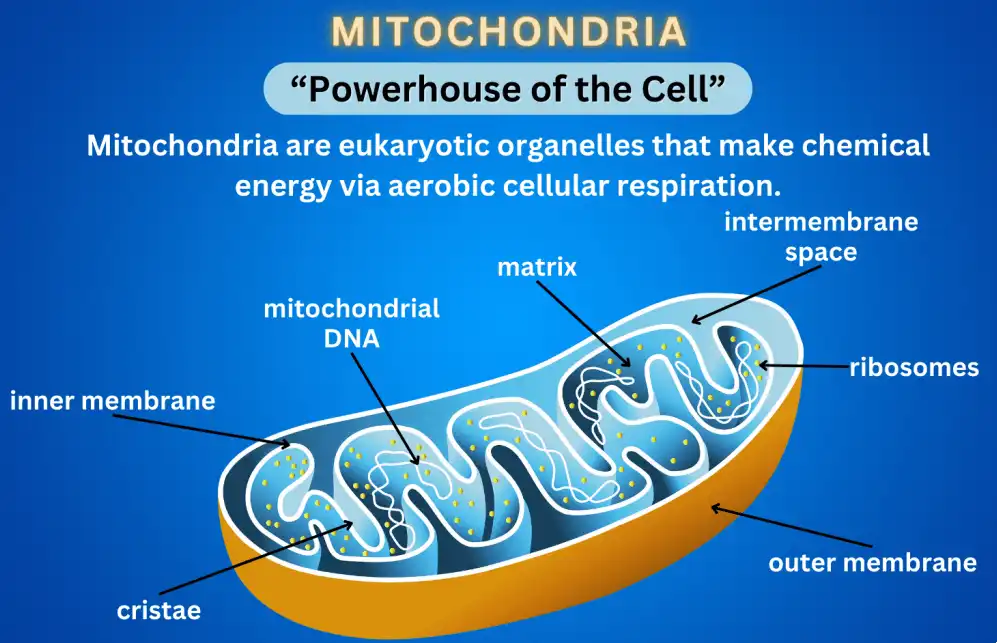
About 90% of the energy in cells is made by mitochondria, which make ATP. In other words, they are necessary for the health of your body, brain, and organs. In addition to making energy, these parts of cells also manage important processes such as calcium balance, cell signals, and cell death. Researchers have found that mitochondrial failure is a main reason why people lose their minds as they age, get brain diseases, get heart disease, and get metabolic diseases. This chain of electrons in mitochondrial membranes turns food into energy that cells can use. But this process makes reactive oxygen species, which can hurt cell structures over time.
Market Demand for Mitochondrial Support Supplements
The market for foods that help mitochondria work better has grown as more people learn about the health of cells. As people in developed markets live longer, they become interested in goods that can help them keep their energy up, remember things, and age in a healthy way. Statistics from the business world show that every year the nootropics and energy support groups have grown. This is because instead of standard boosts, people are looking for ingredients that are backed by science. When a company wants to sell to these markets, it needs to have ingredients that have been clinically proven to work, clear supply lines, and certifications that meet foreign standards. When procurement professionals choose mitochondrial support chemicals for new product development, they have to look at proof of success along with cost structures, regulatory compliance, and the ability to make more of the product.
Overview of PQQ Powder and CoQ10: Origins and Functions
What is pyrroloquinoline quinone?
For the first time, Pyrroloquinoline Quinone was discovered in enzymes from bacteria. It has also been discovered in dirt and foods made from plants. It's not like most vitamins; this one acts as a trigger inside cells and can survive thousands of redox cycles without breaking down. It is different from other antioxidants that lose their power after giving an electron just once because of how well it works as a catalyst. Controlling bacterial fermentation is how high-purity PQQ powder is made for sale. This makes pharmaceutical-grade material that can be used in healthy foods and supplements.
Cutting-edge HPLC tests show that the Pyrroloquinoline Quinone (CAS 72909-34-3) made by Shaanxi Bolin Biotechnology is 98% pure and of high quality. The basic make-up of our dark red powder is C14H6N2O8, and it works the same way in drinks, pills, and tablets. Some of the companies that make our ingredient are ISO-certified and use strict six-stage quality control methods. In terms of heavy metals, microbes, and solvent leftovers, it also meets strict international standards. The product can be kept for 24 months if it is stored correctly. This solves the problem of recipe stability that is common in the supplement business.
Understanding Coenzyme Q10
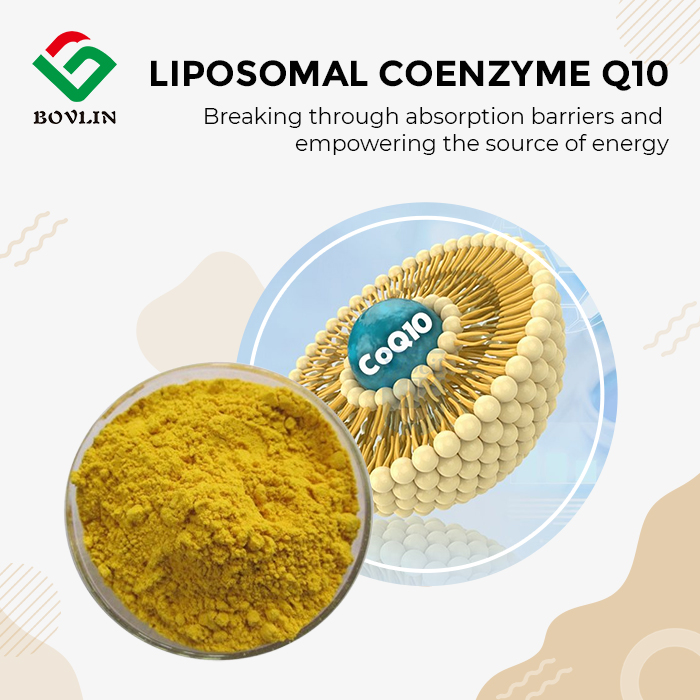
Coenzyme Q10 helps electrons move between complex I/II and complex III. It does this by being an important part of the mitochondrial electron transport chain. The body naturally makes Coenzyme Q10, but it makes less of it as we age and when we take some medicines. It keeps cell membranes safe from free radicals because it dissolves in lipids. There are two kinds of extra Coenzyme Q10: ubiquinone, which is oxidized, and ubiquinol, which is reduced. The rate at which they are taken in depends on how they were made and whether the food has fats in it.
Key Functional Differences
Both the same and different things happen when these chemicals are mixed. Pyrroloquinoline Quinone starts the PGC-1α communication pathways that make mitochondria grow. This makes cells have more mitochondria. Nerve growth factor is also made more, which helps protect neurons and keep the brain working. Coenzyme Q10 protects against lipid breakdown and makes mitochondria work better by making it easier for electrons to move around and for ATP to be made. Because of its lipid solubility, Coenzyme Q10 has problems with absorption that can be fixed with special delivery methods. This PQQ powder disodium salt form, on the other hand, is easier to mix into a wider range of mixtures.
Scientific Evidence: Comparing PQQ Powder and CoQ10 for Mitochondrial Support
Clinical Research on Pyrroloquinoline Quinone
It has been shown in published studies that taking PQQ powder supplements improves cognitive functions like working memory, focus, and information processing. Peer-reviewed studies show that older and middle-aged people who take 10 to 20 mg of the drug every day do better on tests of their brain power. As more of the protein PGC-1α has been found, it was found that the drug can improve mitochondrial formation. Animal tests have shown that oxidative stress and excitotoxicity can hurt neurons, but neuroprotectants can help. Because of this, the substance could be used in medicines that help the brain stay fit and people age in a healthy way.
Studies on humans that looked at better sleep quality and lower amounts of inflammation markers show that pyrroloquinoline Quinone has a lot of uses. It can get rid of free radicals over and over again, so it doesn't need to be replaced by other antioxidants. In terms of long-term cell protection, this is a one-of-a-kind property. Researchers have found that most people can handle taking normal amounts of supplements without experiencing any major side effects.
Clinical Research on Coenzyme Q10
For people who already have heart disease or take statins, Coenzyme Q10 has been shown to be good for the heart in a number of big studies. A review of randomized controlled studies found that heart patients who take Coenzyme Q10 supplements have better measures of quality of life, exercise capacity, and ejection fraction. Studies have shown that it helps keep blood pressure in check and improves the function of arteries. Research has shown that Coenzyme Q10 can help with more than just heart health. It can also help with migraines and make pregnancy better.
More of the ubiquinol form is absorbed than the ubiquinone form, and this is especially true for older people who are less able to change it. Clinical tests show that the daily dose should be between 100 mg and 300 mg, but higher doses have been used safely in some cases to help people get better. Researchers have looked into Coenzyme Q10 for many years and have found that it is safe and doesn't cause many side effects.
Comparative Efficacy Profiles
There aren't many studies that directly compare the two yet, but the ones that are there show that they work together instead of against each other. When you need to protect neurones and boost mitochondrial activity, Pyrroloquinoline Quinone is the best thing for the job. Because of this, it can be used in recipes that help the brain stay healthy, and people live longer. More proof has been found that Coenzyme Q10 is good for the heart and circulation. A new study is looking into what happens when you mix the two things. Early tests show that they work better together to improve mitochondrial function than either chemical alone. It's very appealing to make new multi-pathway products that aim to improve the health of all cells because they can work together.
| PQQ Powder | Coenzyme Q10 | |
|---|---|---|
| Core Function | Mitochondrial renewal & brain support | Energy production & heart support |
| Main Benefits | Memory, focus, healthy aging | Cardiovascular health, energy, antioxidant |
| Effective Dose | 10–20 mg/day | 100–300 mg/day |
| Best Applications | Nootropic & longevity formulas | Heart health & energy supplements |
| Solubility | Water-soluble | Fat-soluble |
| Market Trend | Fast-growing cognitive & longevity ingredient | Mature global supplement ingredient |
| Combination Value | Supports mitochondrial creation | Supports mitochondrial energy output |
Practical Considerations for B2B Clients: Dosage, Safety, and Quality
Recommended Dosage Parameters
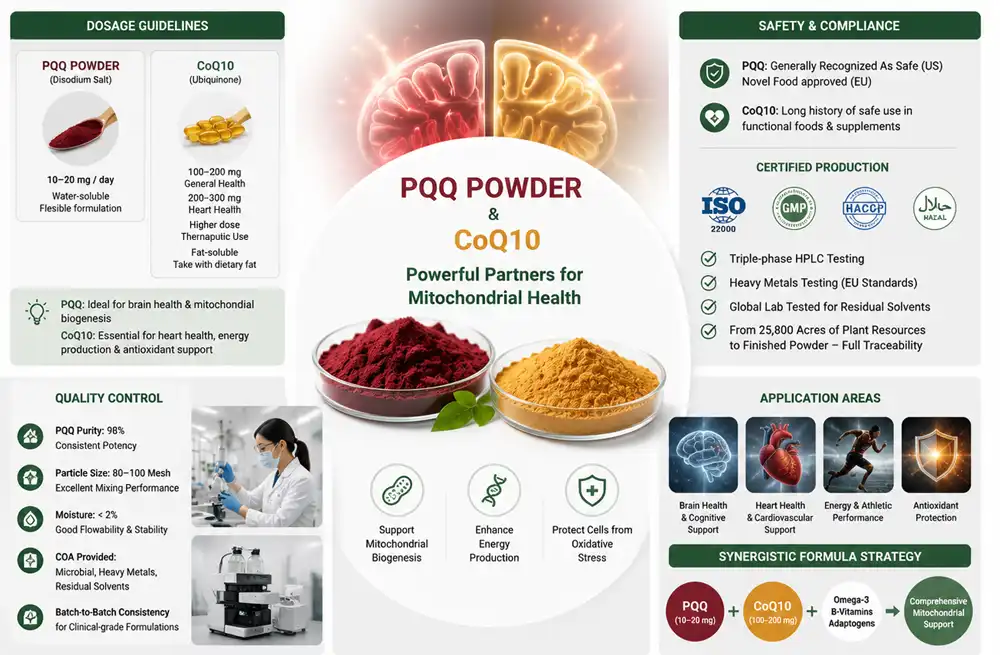
Pyrroloquinoline Quinone is generally taken in amounts of 10 to 20 mg per day to help the brain and mitochondria. Microdosing is useful for production because it lets it be added to stacks of more than one ingredient without changing the size of the pills or capsules. Depending on the goal, different amounts of Coenzyme Q10 are needed. For general health, 100–200 mg is enough; for heart health, 200–300 mg is enough, and in some healing cases, higher amounts are needed. When to use each compound depends on what it is. For instance, fat-soluble Coenzyme Q10 is better absorbed when eaten with foods that contain dietary fats, while water-soluble PQQ powder disodium salt can be given in a wider range of ways.
Safety and Regulatory Compliance
You can be sure that both ingredients are safe, and most big stores allow them. In the US, pyrroloquinoline quinone is generally thought to be safe, and in the EU, it has been accepted as a novel food. There are strict rules about how much to use and how pure it must be. We know that Coenzyme Q10 is safe because it has been used for many years in functional foods and dietary supplements. Quality certifications like ISO, GMP, and HACCP give buyers peace of mind that the production process is stable and clean.
The ways that Bolin Biotechnology makes things go above and beyond what the law requires. They check with triple-phase HPLC, test for heavy metals that meet EU standards, and look for chemical residues that are okay with labs around the world. Our plan for vertical integration makes sure that everything can be tracked, from the 25,800 acres of crops that are grown to the finished powder. This gets rid of supply chain risks that can affect quality continuity.
Quality Control and Supplier Evaluation
People who work in buying should think about a number of important things when they are looking for these items. It is very important to follow the cleanliness standards. In this case, our 98% PQQ powder standard keeps the strength the same and cuts the manufacturing factors. Different particle sizes can change how evenly the mixture is mixed. It's easier to mix things that aren't all the same size with our 80-100 mesh standard. If the wetness level is less than 2%, the product doesn't clump while it's being stored, and it stays solid during production at high temperatures.
There should be tests for microbes, heavy metals, and liquid remains on the paperwork that comes with the proof of analysis. Brands that want to be at the top of the market have to be able to meet strict quality standards set by suppliers of pharmaceutical-grade materials. When it comes to clinical-grade formulations and goods that need help with regulatory applications, consistency from batch to batch is very important.
Strategic Insights: Which Ingredient Should B2B Clients Choose?
Application-Specific Selection Criteria
Strategies for picking ingredients depend on where the product is placed in the market. Because it increases nerve growth factor and makes mitochondria work better, pyrroloquinoline Quinone is useful in formulas that focus on brain health, mental clarity, and neuroprotection. Because it can cross the blood-brain barrier and work specifically on neural mitochondria, the substance is a great choice for nootropic uses. Brands that want to reach workers, students, and older people who are afraid about memory loss can use PQQ powder's evidence profile to back up their claims and teach their customers.
When it comes to heart and digestive health, Coenzyme Q10 is still the most important part of vitamins. People who are taking care of cardiovascular risk factors like how well it works for heart failure, lowering blood pressure, and preventing Coenzyme Q10 loss caused by statins. Due to its ability to help make ATP and protect against oxidative stress caused by exercise, Coenzyme Q10 is used in energy and exercise performance goods.
Synergistic Formulation Strategies
When you mix these two chemicals together, you get health benefits for the mitochondria that work for everyone. Parallel processes—PQQ powder making new mitochondria and Coenzyme Q10 making old mitochondria work better—provide scientific support for mixtures with two ingredients. Early research suggests that both compounds may work together to make a stronger effect when they are present. When brands mix ingredients, they stand out from those that only use one. It also helps mitochondrial health in more than one way.
When making the formula, one thing that needs to be thought about is how to balance the dosage so that it works best while also keeping costs and capsule sizes in mind. Multi-ingredient products that work well often have other ingredients that work together, like omega-3 fatty acids to support membranes, B-vitamins to help the body make energy, or adaptogens to fix mitochondrial dysfunction caused by stress. Coenzyme Q10 dissolves in fats, and PQQ powder disodium salt dissolves in water, so the two can be mixed to make formulation profiles that work well with a number of delivery ways.
Supply Chain and Procurement Considerations
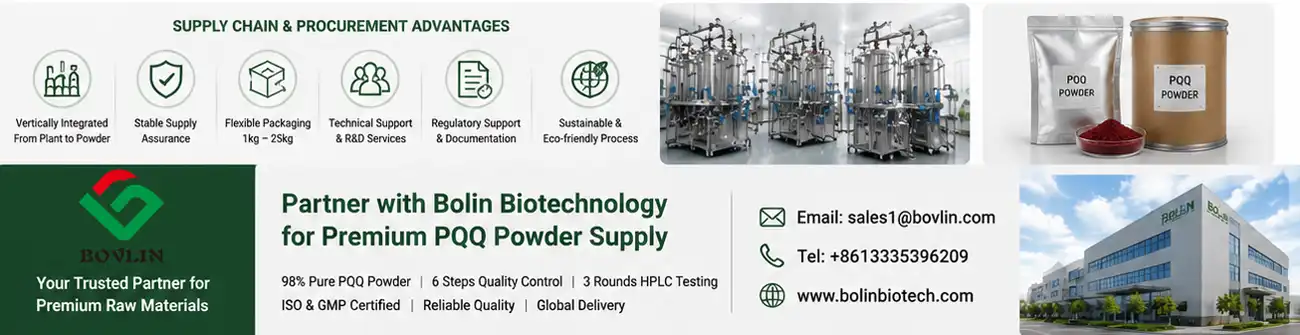
If you want to know how good a supplier is, you should check more than just the ingredients they offer. You should also look at how reliable they are, how much they can grow, and how much professional help they offer. When businesses need to make a lot of something, they need sources who can regularly give them a lot of it without lowering the quality or making delivery take longer. Minimum order amounts, wait times, and how flexible inventory is can all change how much working capital you need and when you need to make things. With options ranging from 1 kg bags to 25 kg drums, we can pack different amounts of goods without affecting the quality of the materials.
To improve a formulation, it's very helpful to have technical help, especially when coming up with new ways to deliver the product or mix the goods. Suppliers who have their own research and development departments can help with legal paperwork, stability tests, and studies that look at how well excipients work with each other. The closed-loop manufacturing methods we use are better for the climate and speed up the production process. Partner brands that stress their commitment to ecology value these two things more and more.
Conclusion
Coenzyme Q10 and Pyrroloquinoline Quinone and both help mitochondria stay healthy, but they do different things that work together. For cardiovascular and metabolic formulas, Coenzyme Q10 is still needed, but PQQ powder is better at making the brain work better and starting new mitochondria. The strategic ingredients used are chosen based on the health goals, the type of people who will be buying the product, and how well it fits in a competitive market segment. A lot of the new forms mix the two chemicals well enough to improve the health of the mitochondria in more than one way. How well a product works and how well a brand is known are both affected by quality factors like the need for purity, following the rules for licensing, and being able to trust the source. It's good for procurement professionals to work with vertically merged manufacturers that offer consistent quality, expert support, and the ability to give more or less.
FAQ
Can PQQ Powder Replace CoQ10 in Supplement Formulations?
These things don't swap places with each other; instead, they create something new. Pyrroloquinoline quinone speeds up the processes that make new mitochondria, and Coenzyme Q10 makes the electron transport chain work better in mitochondria. If you switch them, the main way they work and the clinical proof that backs up their claims will be different. Some products that are meant to help the brain may put PQQ powder at the top of their list, while most products that are meant to help the heart need Coenzyme Q10. Together, these two ingredients are found in many current products that care for mitochondrial health in a full way.
What Factors Affect Bioavailability Differences Between These Compounds?
Since Coenzyme Q10 dissolves in fats, it needs to be taken in a certain way or eaten with fats for it to work best. More so in older people, the ubiquinol form gets into cells better than the ubiquinone form. There is no need to time meals because the disodium salt form of pyrroloquinoline quinone dissolves better in water. This makes it easy to make and speeds up the process. The particle size, the choice of excipients, and the delivery technology all have a big impact on how quickly both compounds are absorbed.
Is Long-Term Supplementation with PQQ Powder Safe?
Clinical safety tests have shown that pyrroloquinoline Quinone can be taken for long periods of time at the doses that are recommended. No major side effects have been seen in controlled tests using normal vitamin amounts. Authorities have given their approval to the drug, and in the US it has GRAS status, which backs up its safety rate. The most important thing to keep in mind is still quality. When you buy pharmaceutical-grade materials from certified makers, you can be sure that they are pure. If you use lower-quality goods, you run the risk of getting them contaminated.
Partner with Bolin Biotechnology for Premium PQQ Powder Supply
Shaanxi Bolin Biotechnology sells pyrroloquinoline. Quinone that is made to strict international standards and is suitable for use in medicine. Our 98% pure PQQ powder is checked for quality six times and then put through three rounds of HPLC testing. This makes sure that each batch of powder is the same, which is important for formulas that are meant to be used in hospitals. We get rid of supply chain uncertainty while having competitive structures as a vertically integrated PQQ powder manufacturer that handles everything from growing the plants to making the powder. Because we are ISO and GMP certified, you can see that we are committed to good quality. Please email our team at sales1@bovlin.com with your recipe needs. You can also ask for analysis results or set up free samples. You can be sure that your products will do well in the growing mitochondrial health market with our help with research and development, stability tests, and regulatory paperwork.
References
1. Chowanadisai W, Bauerly KA, Tchaparian E, et al. "Pyrroloquinoline Quinone Stimulates Mitochondrial Biogenesis through cAMP Response Element-binding Protein Phosphorylation and Increased PGC-1α Expression." Journal of Biological Chemistry, 2010.
2. Stites T, Storms D, Bauerly K, et al. "Pyrroloquinoline Quinone Modulates Mitochondrial Quantity and Function in Mice." Journal of Nutrition, 2006.
3. Mortensen SA, Rosenfeldt F, Kumar A, et al. "The Effect of Coenzyme Q10 on Morbidity and Mortality in Chronic Heart Failure: Results from Q-SYMBIO: A Randomized Double-blind Trial." JACC: Heart Failure, 2014.
4. Nakano M, Ubukata K, Yamamoto T, Yamaguchi H. "Effect of Pyrroloquinoline Quinone (PQQ) on Mental Status of Middle-aged and Elderly Persons. "Food Style 21, 2009.
5. Harris CB, Chowanadisai W, Mishchuk DO, Satre MA, Slupsky CM, Rucker RB. "Dietary Pyrroloquinoline Quinone (PQQ) Alters Indicators of Inflammation and Mitochondrial-Related Metabolism in Human Subjects." Journal of Nutritional Biochemistry, 2013.
6. Garrido-Maraver J, Cordero MD, Oropesa-Avila M, et al. "Clinical Applications of Coenzyme Q10." Frontiers in Bioscience, 2014.