What Are the Main Active Compounds in Purple Yam Powder?
The main active compounds in purple yam powder are anthocyanins, dietary fiber, starch (including resistant starch), phenolic compounds, the storage protein dioscorin, and small amounts of potassium, manganese, and vitamin C. Anthocyanins give the powder its purple color and much of its antioxidant activity. Fiber and starch shape texture, digestion, and mouthfeel in finished foods. I wrote this guide for formulators who make ube lattes, ice cream, bakery items, and plant-based drinks, because the same compounds that create color and nutrition also decide how the powder behaves in your recipe. Below, I cover the science, the specs, and the practical limits.
Understanding Purple Yam Powder: Composition and Origin
What Purple Yam Powder Is Made From
A plant called Dioscorea alata, which Filipinos call "ube," has purple yam powder in its roots. The potatoes are washed, peeled, and cut up. They are then dried and ground into a fine, deep purple powder. Fresh potatoes have problems like being hard to peel and mash, having a short shelf life, and not being easy to find. Drying potatoes solves these issues. It's what I like to call "cooked ube that can be kept on the shelf." The powder has color, fiber, starch, and the vanilla-like, sweet taste that people expect from drinks and treats made with ube. In other words, one item can change the color, texture, and flavor of a meal.
How It Differs from Taro and Purple Sweet Potato
When they are gathered, three pink or purple roots are often mixed up. Ube is also written as yim or yam. The plants that make purple sweet potatoes are not the same as the plants that make anthocyanins. Colocasia esculenta is the plant that is called taro, and it doesn't have a strong color. It has light pink spots instead. There are differences between these plants in how they taste, how much sugar they have, and how they look. A lot of the time, ube powder and purple yam powder are the same thing. If the spec sheet only says "purple powder," ask what the plant is called. That one line lets shoppers know what to expect when they want real ube taste.
Origin, Drying, and Quality Control
People know that you can find Dioscorea alata in the Philippines and other parts of Southeast Asia. Different types of plants, the area, the time of year, and the way it is dried can change the color and starch profile. In 2003, Food Chemistry published a study that looked at yam flours that were dried in different ways. The researchers found that the chemicals in the flours changed depending on how they were dried, which also changed how well the chemicals worked as antioxidants. Our purple yam powder is dried with hot air and then ground up so that at least 95% of it can go through an 80-mesh screen. We test with HPLC, and the loss on drying and the residue on ignition are both 8 g/100 g or less.
Key Active Compounds in Purple Yam Powder and Their Health Benefits
Anthocyanins: The Color Compounds
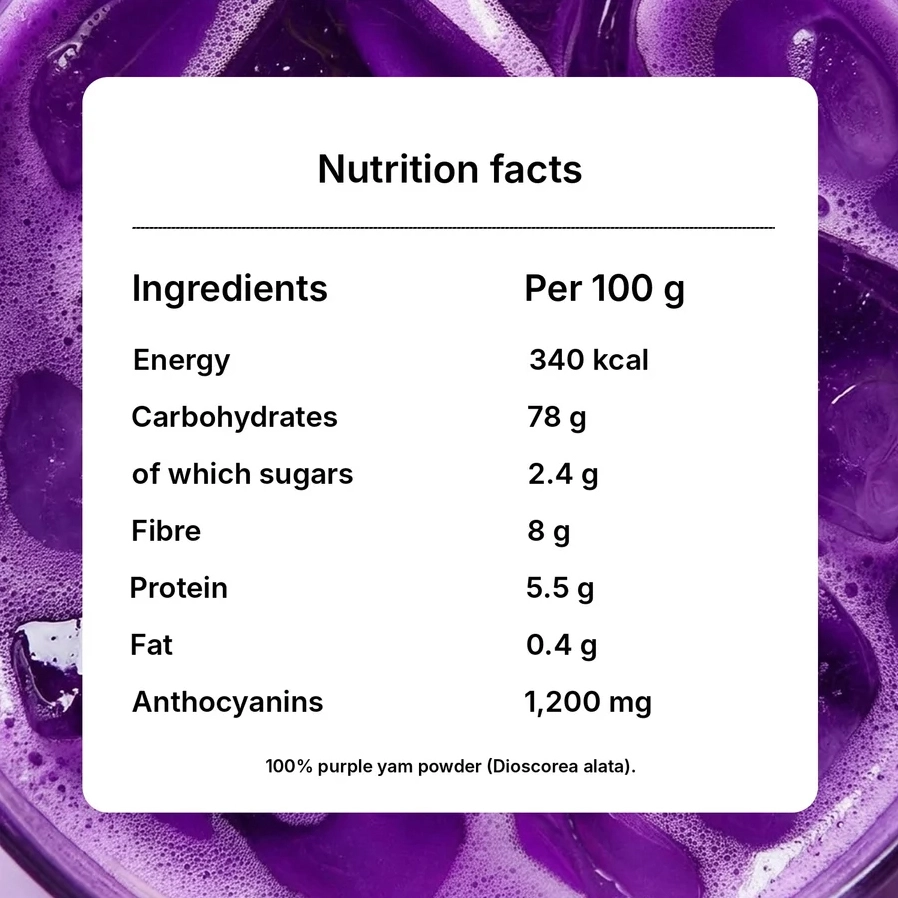
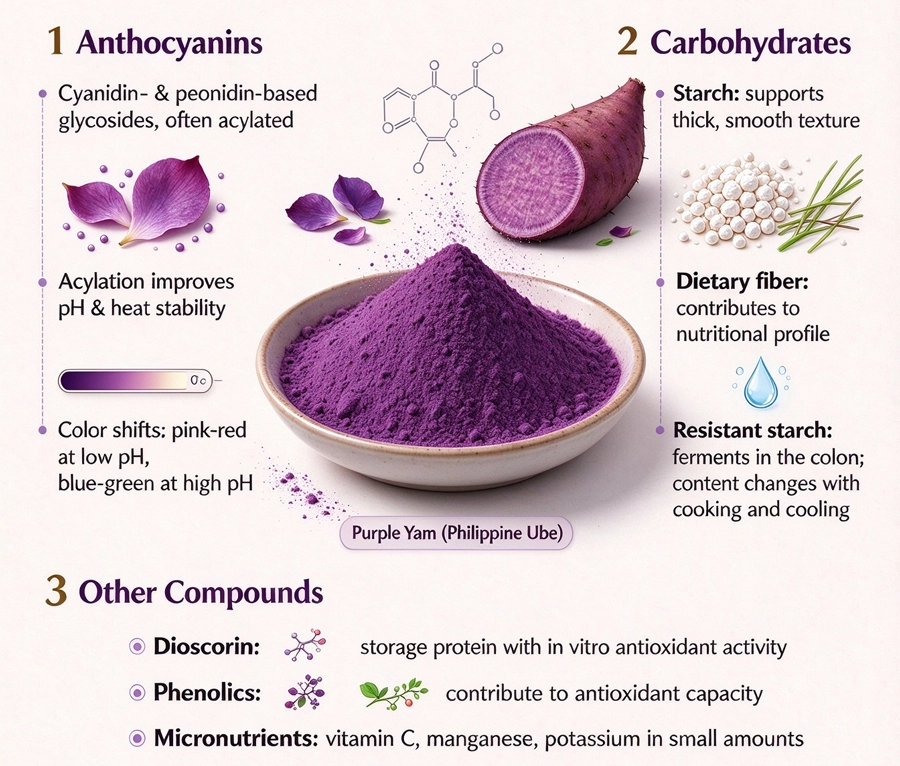
The chemicals in purple yam powder that make it work are called anthocyanins. They are colored things that break down in water. Many of them are cyanidin- and peonidin-based glycosides that are often mixed with acyl groups in purple yam. There was a study in 2015 in Bioscience, Biotechnology, and Biochemistry that looked at new acylated anthocyanins from purple yam and how well they worked as antioxidants. Three years ago, Giusti and Wrolstad looked into this and found that acylation is important in food work because acylated anthocyanins can handle changes in pH and heat better than simple ones. Still, pH changes the color. When pH is low, color is pink-red; when pH is high, color is blue-green. It has been shown in lab tests that antioxidants don't have any health effects on people, so I don't make big claims and test the color in each base.
Dietary Fiber, Starch, and Resistant Starch
Other than the color, the powder is mostly made up of carbs like starch, fiber, and natural sugars. Starch gives caramel, ice cream, and sauces their thick, smooth texture. The powder's starch and fiber also help doughs and batters keep their water. Food with fiber is good for you and adds to the nutrition facts. Resistance starch is some of the starch in yam. This type of starch doesn't break down in the small intestine. Instead, it goes to the colon, where bacteria in the gut break it down. The numbers on a standard sheet only work for that lot and method because the amounts of starch that stay strong change when you cook and cool something. Before putting a claim about glycemic index on a label, I would test the whole thing.
Dioscorin, Phenolics, and Micronutrients
In yam roots, you can also find dioscorin, a protein that stores food. A 2001 study in the Journal of Agricultural and Food Chemistry found that dioscorin from a related type of yam could fight free radicals. But what happens in a test tube doesn't always happen in real life. The powder has small amounts of vitamin C, manganese, and potassium. It also has phenolic chemicals that make it a better antioxidant. Being dry and hot break down vitamin C, so this is not a good way to make a diet claim. I'm not used to seeing this group of chemicals. People who make foods still choose purple yam powder for its color and flavor, and the nutrition story backs up the clean label.
Nutritional Comparisons and Quality Assessment for B2B Buyers
Purple Yam Powder vs. Ube Powder vs. Purple Sweet Potato
Dioscorea alata, ube powder, and purple yam powder are all the same thing when they come from the same plant. The right ones to compare are ube, purple sweet potato, and taro. Each root has a different amount of color, starch, sugar, and fiber. Purple sweet potatoes also have anthocyanins, but they taste and look different. Taro has a mild starch that isn't very colored. If you want the well-known ube taste, the purple yam powder is the safer base. I ask buyers to compare lot data instead of textbook standards because nutrition values change depending on the type of food and how it is dried. I also think you should taste-test your own recipe next to other recipes.
Quality Parameters Buyers Should Check
To give you an idea of what I want any seller to write down, let's use our own powder as an example:
- Identity and purity: The purity level of our Grade A powder is 99%. HPLC lets us check that it is what it says it is. This gives your lab a way to compare each package to the sample that was accepted early on in the process of bench tests and sensory panels. This way, you can be sure that the lot fits the sample that was accepted.
- Physical specs: As for the powder's physical properties, at least 95% of it passes through an 80-mesh screen, and less than 8 g/100 g is lost when it dries and less than that is left over when it burns. The powder mixes better in drinks with less grit when it's broken up into small pieces. The taste and color stay safe while it's being stored and shipped because the moisture level is controlled.
- Safety limits: The amount of lead, arsenic, cadmium, and mercury should not be more than 1 mg/kg, 0.05 mg/kg, and 0.03 mg/kg, respectively. The plate count stays below 10,000 cfu/g, and neither coliforms nor Salmonella are found. This is a good enough limit for food-grade use, and it gives your regulatory team something to send with every sale.
When looking to buy something, most people are wary of claims of purity that aren't backed up by proof.
|
ITEMS OF ANALYSIS |
SPECIFICATIONS |
RESULTS |
||
|
|
Purple Powder |
Conform |
||
|
Odor |
Characteristic smell |
Conform |
||
|
Impurity |
No Visible Impurity |
Visual |
||
|
Particle Size |
≥95% through 80 mesh |
Conform |
||
|
Residue on Ignition |
≤8g/100g |
0.60g/100g |
||
|
Loss on Drying |
≤8g/100g |
6.02g/100g |
||
|
Drying Method |
Hot Air Drying |
Conforms |
||
|
Ingredients List |
100% Chinese Purple Yam |
Conforms |
||
|
Heavy metals |
≤10mg/kg |
Conforms |
||
|
Lead (Pb) |
≤1.00mg/kg |
Conforms |
||
|
Arsenic (As) |
≤1.00mg/kg |
Conforms |
||
|
Cadmium (Cd) |
≤0.05mg/kg |
Conforms |
||
|
Mercury (Hg) |
≤0.03mg/kg |
Conforms |
||
|
Microbiology |
||||
|
Total Plate Count |
<10,000cfu/g |
5000cfu/g |
||
|
E.Coli |
None detected in 10g |
Absent |
||
|
Salmonella |
None detected in 10g |
Absent |
||
|
Yeast and Mould |
NMT 500 cfu/g |
50 cfu/g |
||
|
Storage |
Store in a cool, dry place away from Moisture, Light |
|||
|
Shelf Life |
2 Year when Properly Stored |
|||
 Appearance
Organic Farming and Certifications
When something is grown organically, the growing conditions change, but variety, maturity, and processing are the main things that change the amount of pigment. That's why I tell people to check the test results too, not just the report. As soon as you know that your brand needs to say that something is organic, let the dealer know so that they can check their records. There are still checks that you have to pass to get into markets and buy things. Tests at our plant are done according to ISO22000, HACCP, cGMP, Kosher, Halal, and SGS rules. This helps shops in the US and the Middle East approve our products. The ingredient list for clean-label things can just say "purple yam powder," which is clear to customers.
Practical Applications of Purple Yam Powder in Industry
Beverages and Ube Lattes
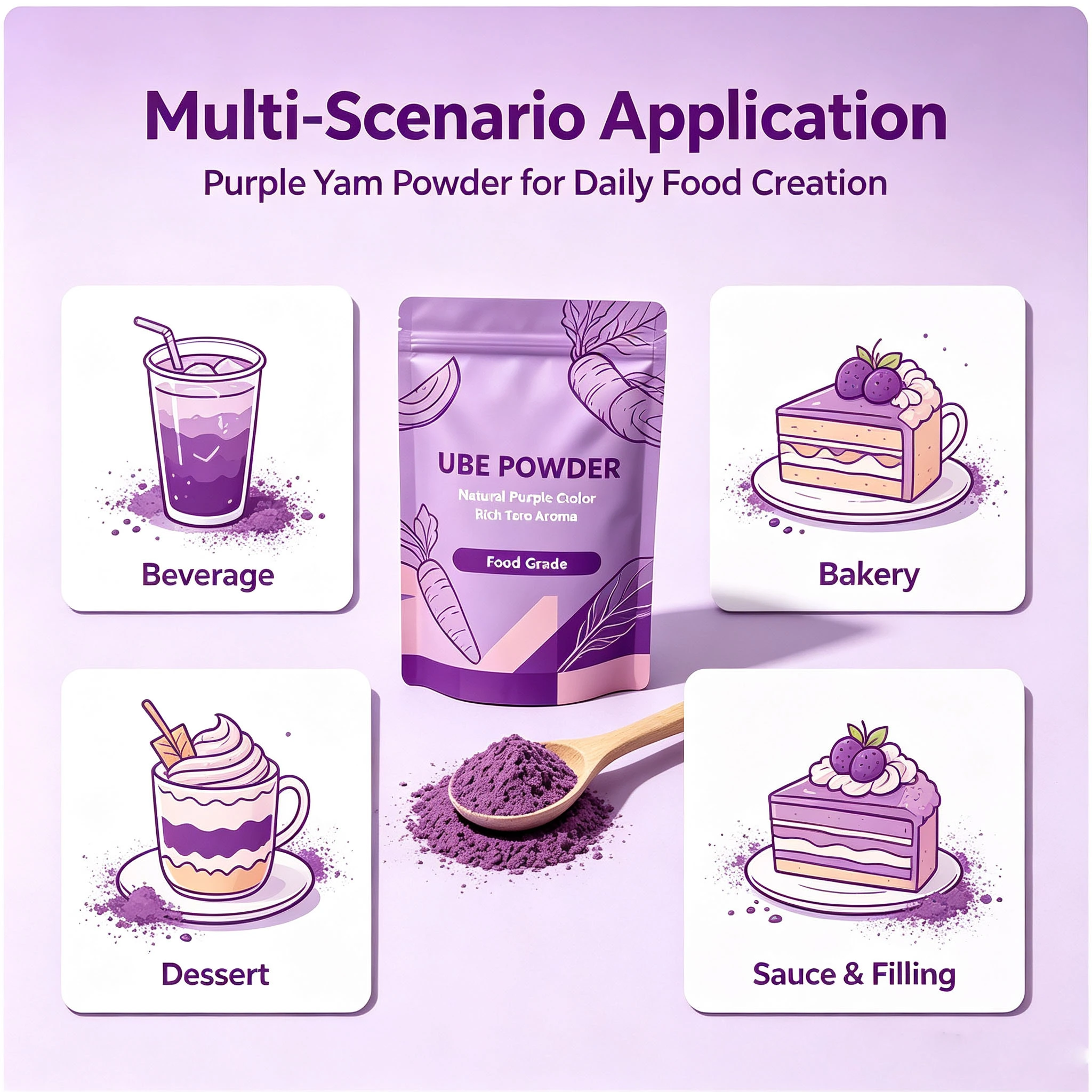
I think you should add between 0.5 and 1% purple yam powder at the end of drinks. Still, I mix the powder with a little water to make a smooth paste before adding it to the rest of the mix. This step helps plant-based bases or cold milk stay lump-free. Check the pH level right away. The anthocyanin color can fade or turn pink-red if the base is too acidic. The color might look dull or gray if the base is too simple. Mix the powder with vanilla or coconut notes to make the ube taste like you know it. Try it out to see how it tastes before making more.
Bakery, Ice Cream, and Plant-Based Foods
Most of the time, between 1% and 3% purple yam powder is used in baked goods, ice cream, and plant-based desserts. Bake them at the proper temperature of your oven, like 180°C, to keep the color of the anthocyanins. Compare the color before and after baking. Mix the powder with the dry sugar before adding it to the mix. This will keep the ice cream from getting thick. Try it and change anything that needs to be changed. Wait until it's almost cool to add the powder. For mochi, fillings, and glazes, this is very important. Talk to your team about color goals and test each batch. The exact shade of a man-made dye will never match the color of real purple.
Storage, Handling, and Shelf Life
Because anthocyanins break down in light, heat, air, and water, the way food is kept affects both its color and flavor. The powder should be kept in a cool, dry place out of direct sunlight in the bag inside the drum that is lined with foil. Close the bag back up tightly and move the stock around by lot after each use. Our goods are usually packed in a 25 kg fiber drum with an aluminum foil bag inside. We also have a big bag that can hold 1,000 kg, and you can tell us how to pack your things. It will last for 12 to 24 months if you store it right. When run by stores, smaller paper boxes work best because each opened pack is used up quickly.
Procurement Insights: Sourcing, Pricing, and Supplier Selection
What to Ask a Supplier
If I were to buy from anyone, I would ask them three things before I put in my first order for purple yam powder. This is the short list I use:
- Certificate of analysis: Ask for HPLC results that are unique to the lot, information on heavy metals, and a count of microbes. Providers who are honest about these numbers show that they are in charge of their process. So, before the ingredient goes to the production floor, your quality team can check each batch against the specs. This makes it less likely that you'll have to pay a lot of money to redo work later on.
- Certifications: Look for ISO22000, HACCP, cGMP, Kosher, and Halal papers, as well as tests from a third party like SGS. These are the things that Bolin Biotechnology can do. Stores and sellers in North America and the Middle East need to see verified food safety systems before they will accept a new ingredient for a private label product. These groups help.
- Trial flexibility: Ask about the minimum order size, how samples are handled, and the lead time while you are trying the service. Our minimum order is 1 kg, and samples are free. This way, you can try our goods before you buy a whole pallet. It takes 5 to 7 business days to ship standard things, and 2 to 3 weeks for special orders.
Pricing Factors and Order Size
Your purple yam powder price will change based on how much you buy, how it's packed, the size of the mesh, and any extra work you need done, like private label printing. When you compare quotes, make sure that the specs you choose match. Otherwise, the prices will be different. I'd rather give you a quote once I know more about your use, the dose you want to give, and the amount you buy each year. This helps me give the best advice. To keep the risk low, start with a small test order instead of a big one. We start with a sample of 1 kg and then move on to a pilot run of a few hundred kg. After that, we place repeat orders at the right time for launches and sales.
Shipping, Labeling, and Support
We send things to more than 80 countries, so I have to deal with a lot of files from other countries. For goods coming into the US, check with your customs broker to make sure they follow FDA rules. The regulatory head should look over the claim to see if the powder is really a food ingredient or just a color aid. We can make capsules, tablets, gummies, and powders with your own brand name on them. We can also make packaging just for you, and our staff can talk to you about how to plan dose, dispersion, and heat tests. Our 8,000 m² site is in the Xi'an High-tech Zone. You can get free samples and ask for a video plant tour.
Conclusion
Phytochemicals, dietary fiber, starch (including resistant starch), dioscorin, and trace amounts of potassium, manganese, and vitamin C can all be found in purple yam powder. These are the powder's main ingredients that make it work. Anthocyanins, which are mostly acylated cyanidin and peonidin glycosides, give the plant its purple color and a lot of its protective power. But their color changes because of light, heat, and pH. Ube has a texture and is healthy because of fiber and carbs. It tastes nutty and vanilla-like because of Dioscorea alata. People who are buying something should look at the HPLC data, particle size, wetness, heavy metal limits, microbe counts, test dose, and pH in their own base. Also, they need to keep the powder cool, dry, and covered. All of these lots will have the same color and taste because of these steps.
FAQ
Is purple yam powder gluten-free?
Purple yam is a root vegetable, not a grain, so the plant source does not have gluten by itself. For cross-contact to work, the way the lot is treated is important. Before putting it on the market, I think you should ask for the allergen statement and make sure it matches your label and market rules.
How can I verify anthocyanin content and overall quality?
The report you should ask for should have HPLC results, heavy metal data, and a count of bacteria. Then, test it yourself with a free sample from the real recipe. Look at the color when the pH is right, how it spreads in cold liquid, and the color after the real heat step.
How should I store purple yam powder?
Put the powder in a cool, dry place away from light and heat. Keep it in the drum's foil-lined bag. Close the bag again after each use, and replace the stock one lot at a time. The shelf life is between 12 and 24 months if these things happen.
Request Samples from a Purple Yam Powder Manufacturer
Bolin Biotechnology is a business in Xi'an that makes purple yam powder. They are certified by ISO22000, HACCP, cGMP, Kosher, Halal, and SGS. You can try their products for free, and you only need to buy 1 kg to place an order. Send sales1@bovlin.com your recipe, the amount you want to use, and how many boxes you need. Then, our team will come back to you with a plan and rules. Visit bolinbiotech.com to find out more about our pill, tablet, gummy, and powder drugs.
References
Food Chemistry, 2003 – Hsu, C.L., Chen, W., Weng, Y.M., Tseng, C.Y. Chemical composition, physical properties, and antioxidant activities of yam flours as affected by different drying methods.
Bioscience, Biotechnology, and Biochemistry, 2015 – Moriya, C., et al. New acylated anthocyanins from purple yam and their antioxidant activity.
Biochemical Engineering Journal, 2003 – Giusti, M.M., Wrolstad, R.E. Acylated anthocyanins from edible sources and their applications in food systems.
Journal of Agricultural and Food Chemistry, 2001 – Hou, W.C., et al. Antioxidant activities of dioscorin, the storage protein of yam (Dioscorea batatas Decne) tuber.
Food & Nutrition Research, 2017 – Khoo, H.E., Azlan, A., Tang, S.T., Lim, S.M. Anthocyanidins and anthocyanins: colored pigments as food, pharmaceutical ingredients, and the potential health benefits.
CABI Publishing, 2009 – Lebot, V. Tropical Root and Tuber Crops: Cassava, Sweet Potato, Yams and Aroids.