_1745226507162.webp)

AHK-Cu vs Minoxidil: Bulk Raw Material for Hair Loss Product Manufacturers
Choosing the right active ingredient for hair loss recipes has a direct effect on how well the product works, how it stands out in the market, and how happy the customers are. AHK-Cu powder, which is a copper peptide complex, is getting more attention as an option to Minoxidil for hair care products that are put on the scalp. This copper-based peptide works by increasing the production of collagen, improving the health of hair follicles, and supporting skin health by making microcirculation better. Copper peptides are different from vasodilators because they can help hair grow back in more than one way. This makes them very appealing to companies that make nutraceuticals and cosmetics that want to come up with new, clean-label solutions. Knowing the tactical differences between these two raw materials helps makers get the best results from their formulations while also meeting the needs of the market and regulators.
Understanding Hair Loss Treatment Raw Materials: AHK Cu Powder and Minoxidil
AHK-Cu powder and minoxidil are two common ingredients in hair loss treatments. Hair loss products depend on active ingredients that have been proven to work by science. The decision between well-known ingredients and new ones affects how a product is positioned, how customers see it, and the long-term trustworthiness of the brand.
The Role of Minoxidil in Hair Restoration Formulations
Since it was approved by the FDA in the 1980s, Minoxidil has been the best over-the-counter treatment for hair loss. By making the blood vessels around hair follicles bigger, this vasodilating drug improves the supply of nutrients and extends the anagen (growth) phase. Pharmaceutical and OEM makers like how well it has been tested in clinical settings and how well it is known by consumers. Minoxidil comes in different strengths, usually between 2% and 5%, and it mixes easily into foams, serums, and cosmetic treatments.
Even though Minoxidil has been shown to work, it can be hard to formulate. Systemic uptake can cause irritation, dryness, or unwanted hair growth on the face or head. If you stop using the element, your hair growth will usually go back to where it started. In the US and EU, following the rules is easy, but some markets have strict rules about labels and content that make it harder to make products that fit those rules.
AHK Cu Powder: Copper Peptides for Advanced Hair Care
AHK-Cu (Ala-His-Lys-Cu) is a newer type of hair restoration active that comes from studies on tissue regeneration. Copper peptides are found naturally in human plasma and are very important for wound healing, making collagen, and sending signals between cells. When put on the skin, AHK-Cu powder works with receptors on hair follicles to increase the number of keratinocytes, lower inflammation, and change the levels of growth factors like TGF-beta and VEGF.
Copper peptides are valuable to manufacturers because they can be used for more than just hair growth. These peptides make the hair more flexible, help the body's defense against free radicals, and improve the appearance of serums and leave-on treatments. The element fits in well with the clean-beauty trend because it comes from biomimetic peptide chemistry instead of synthetic drug creation. AHK-Cu powder usually comes in fine crystals or amorphous forms, and its purity level is higher than 95%, which makes sure that all batches have the same bioactivity.
Things like the range of particle sizes, the amount of moisture, and the standards for heavy metals have a direct effect on how stable the mixture is and how well it penetrates the skin. Suppliers who follow ISO, GMP, and cosmetic-grade standards give out certificates of analysis that prove the purity of microbes, the amount of peptides and endotoxins, and compliance with regulatory bodies. This is important proof for quality control and reports to regulatory bodies.
Comparison of AHK Cu Powder vs Minoxidil for Hair Loss Products
When picking between these actives, you need to think about their safety, effectiveness, legal routes, and supply chain issues. Depending on the product's goals and target customers, each ingredient has its own benefits.
Mechanisms of Action and Clinical Outcomes
Vasodilation is the main way that minoxidil works. It makes blood move faster to tiny hair cells, which extends their growth cycle. After four to six months of constant use, clinical studies show that 40 to 60% of users experience moderate regrowth. Results stop improving after about 12 months, so you have to keep using it to keep getting benefits.
There are several biological routes through which AHK Cu peptide powder works. Copper ions help lysyl oxidase work, which makes hair shafts stronger and less likely to break. The peptide pattern also lowers levels of cytokines that cause inflammation and raises levels of matrix metalloproteinases that help the follicle change shape. Early research shows that copper peptides may improve bone structure within three to four months, and these effects will build over time. Users say it has fewer side effects than Minoxidil, such as less pain on the hair and better tolerance for people with sensitive skin.
Safety Profiles and Regulatory Status
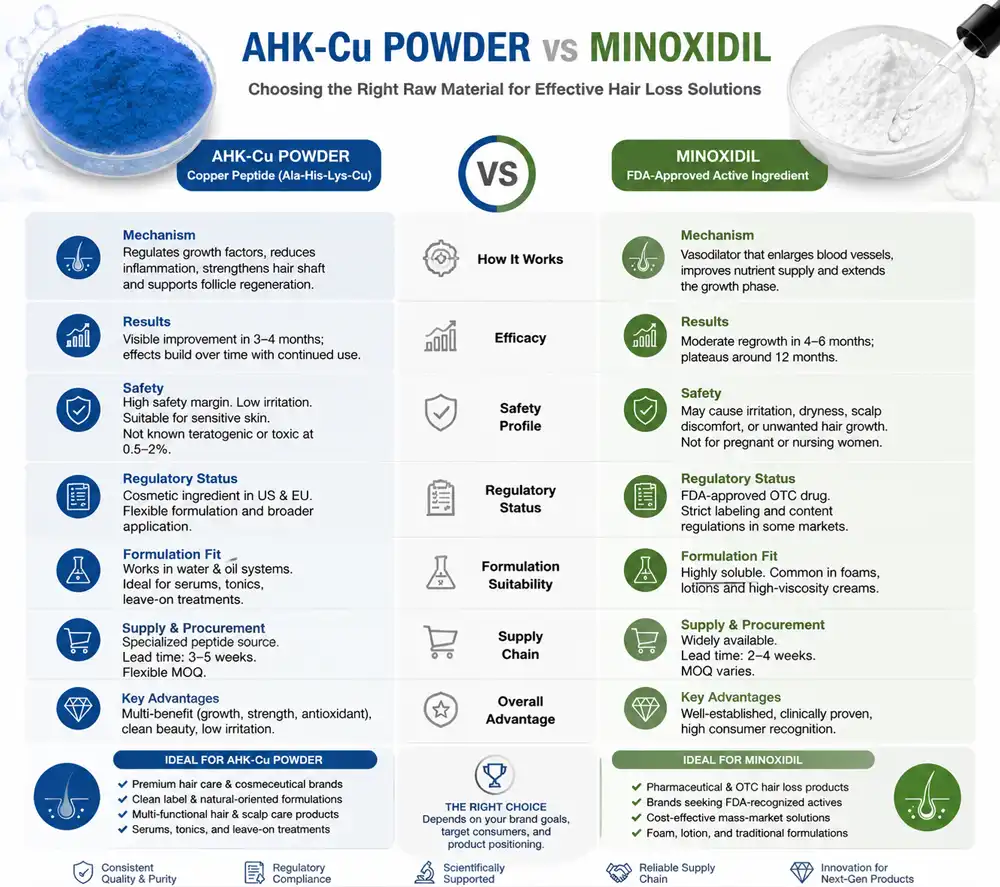
Minoxidil is approved by the FDA for over-the-counter use at certain amounts. This makes it easy for drug companies to follow the rules. Many studies have shown that the ingredient is safe, but it can cause itching, redness, and sometimes hypertrichosis. Women who are pregnant or nursing should not use it, and people with heart problems need to be closely monitored by a doctor.
In the US and EU, AHK-Cu powder is regulated as a cosmetic ingredient. This means that it can be used in more ways without having to go through the strict drug approval process. Copper peptides have very high safety margins. At suggested topical doses (usually 0.5–2%), they are not known to be teratogenic or systemically toxic. Patch tests and stable studies show that they are not likely to cause allergies, so they can be used by a wide range of people.
Procurement Considerations for B2B Clients
Minoxidil's raw materials can be easily found through well-known pharmaceutical wholesalers. Prices are usually reasonable because the production infrastructure is well-established. Lead times are between two and four weeks, and their minimum order numbers change based on how big their business is. The level of quality consistency is still good, but producers have to deal with regulatory issues for drug-grade APIs.
To get AHK-Cu powder, you need to work with expert peptide sources that can do advanced synthesis. The price of peptides represents how hard it is to make them, but costs have gone down as production has grown. Lead times are usually three to five weeks, and MOQs are open enough to allow for both small amounts and large production. Value is increased by suppliers who offer expert help, unique concentrations, and stability data in addition to the base material itself.
How to Choose the Best Raw Material for Your Hair Loss Product Line?
Strategic selection of raw materials is in line with brand branding, target groups, and formulation goals. To make the best product development decisions, people in charge must look at technical specs, the credibility of suppliers, and market trends.
Aligning Ingredients with Product Strategy
Nutraceutical brands that want to attract health-conscious customers usually choose products with clean labels that come from natural sources. AHK-Cu powder is popular with this group because it is biomimetic and has multiple skin benefits. Pharmaceutical companies that want to make promises that are controlled by the FDA may like Minoxidil's established monograph status and clinical support.
The shape of the product also affects the choice of ingredients. AHK Cu peptide powder works well with both water-based and non-water-based systems, which is good for serums, tonics, and leave-on treatments. Minoxidil is often found in foam applicators and high-viscosity creams because it dissolves easily and is well-known by customers.
Evaluating Technical Specifications and Supplier Quality
It is best to buy copper peptide raw materials from sellers who can give you a lot of paperwork, like an HPLC purity analysis, endotoxin tests, and batch-to-batch consistency reports. Particle size affects how quickly they dissolve and how deeply they penetrate the skin. Powders that are micronized below 50 microns are better for external use because they are more bioavailable.
Strong quality control systems are shown by supplier approvals like ISO 9001, ISO 22716 (cosmetic GMP), and HACCP. Traceability from raw materials to finished peptide makes sure that quality agreements and legal checks are met. Ask for stability data that shows the integrity of the peptide under normal storage conditions. This is especially important for goods that can be kept for a long time.
Risk Mitigation Through Sample Testing and Supplier Due Diligence
Before agreeing to large orders, producers should ask for samples to test on their own. To make sure the ingredient works as intended in your formulation, try its solubility, check its pH compatibility, and do some basic stability studies. Ask your quality control team to look over reports of suppliers, certifications of production sites, and records of past performance.
Setting up extra sources lowers the risks in the supply chain. Dual-sourcing methods protect against problems like quality issues, production delays, and political unrest. Long-term relationships with honest sources make it easier to work together to solve problems and give you access to new peptide innovations.
Application Scenarios: Leveraging AHK Cu Powder in Hair Loss Products
AHK-Cu powder is flexible enough to be used in a wide range of products, which helps companies set their products apart and meet unmet customer needs.
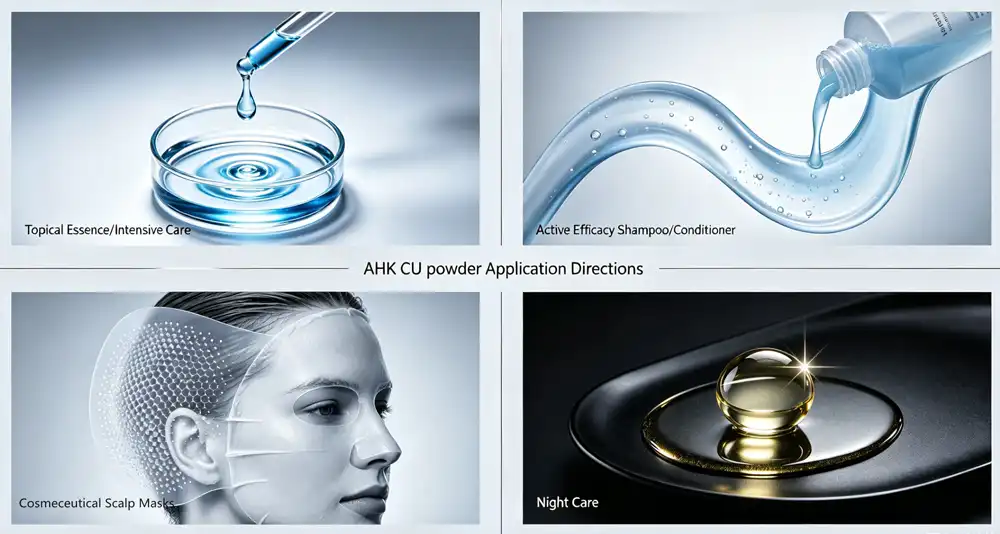
Topical Serums and Intensive Treatments
Hair growth serums are the main way that AHK-Cu powder is used. These light formulas send concentrated actives straight to the head, where they can reach the most hair follicles. Copper peptides work well with plant extracts, hyaluronic acid, and niacinamide to make complete hair care products. Manufacturers say that formulas that contain 1-2% AHK-Cu and antioxidant peptides have higher user happiness numbers than controls that only contain Minoxidil.
Shampoos and Conditioners with Active Benefits
Adding copper peptides to rinse-off items makes treatment plans stronger and expands brand ranges. While touch time reduces absorption compared to leave-on products, using a product over and over for weeks can build up benefits. Conditioners that contain AHK-Cu powder make hair shafts stronger and give it a shine that can be seen. This supports claims that go beyond head health.
Cosmeceutical Scalp Masks and Overnight Treatments
Intensive treatments give higher levels of peptides, which speeds up the healing process. Masks made of gel and 2% to 3% AHK-Cu powder help by blocking out light and improving penetration while being worn for a long time. These high-end goods have higher prices and are popular with people who want clinical-grade solutions but don't want to buy them through pharmacy channels.
Manufacturers who use AHK-Cu powder say that market tests show good results. One European OEM found that after 90 days of serum use, hair density measures went up by 34%, and 78% of subjects said they shed less. These kinds of findings back up what marketers say and make brands more trustworthy in tough markets.
Procuring AHK Cu Powder – Your Trusted Partner for Bulk Raw Materials
Finding trusted sources for raw materials is the first step in making a good product. Manufacturers need suppliers who know how to deal with business-to-business (B2B) needs, regulations, and expert help standards.
Selecting Authorized Suppliers with Proven Track Records
Work with peptide makers who focus on AHK-Cu powder actives and keep separate production lines for hair care products. Being open with suppliers about how they make materials, how they clean them, and how they check for quality increases trust that the materials are real. To make sure that manufacturing standards are being met, ask for on-site checks or verification records from a third party.
Streamlined Ordering and Flexible Purchasing Options
Easy ordering and a variety of buying options: Time-to-market for new formulations is sped up by buying methods that work well. Leading suppliers offer sample programs that let formulators test how well a material works before making large amounts of it. There are different ways to buy in bulk to suit different production volumes, from small tests (1–5 kg) to large business batches (50 kg or more). Letters of credit and net payment plans are two types of flexible payment terms that make it easier for buyers from other countries to do business with each other.
Logistics and Documentation for International B2B Transactions
Shipping times for specialty peptides are usually between three and six weeks, but this depends on where they are going and how quickly they can get through customs. Suppliers who have done business with other countries before give full paperwork like commercial bills, certificates of origin, and safety data sheets that meet US and EU standards. For some peptide formulas, cold-chain operations may apply, which means that shipping containers need to be able to keep the right temperature.
Strategic benefits come from long-term ties that go beyond the benefits of short-term relationships. Dedicated account managers help with preparation, give advice on regulations, and give access to new peptide research. When suppliers engage in the success of their customers, it helps them stand out from the competition and grows the market.
Conclusion
The choice between AHK-Cu powder and Minoxidil affects how well the product works, where it stands in the market, and how loyal customers are to it. Minoxidil has effects that have been backed up by decades of clinical proof, which makes it appealing to drug companies that want clear regulations. Copper peptides help in many ways, make labels better, and give nutrition and cosmetic brands the chance to come up with new ideas. Manufacturers can choose raw materials that are in line with their strategy goals by looking at things like mechanisms, safety profiles, and logistics of buying. When you work with certified suppliers, you can be sure of consistent quality, legal compliance, and expert help throughout the entire product creation cycle.
FAQ
Is AHK Cu powder safe for use in cosmetic hair care formulations?
When applied to the skin, AHK-Cu powder has great safety ratings. At the suggested amounts (0.5–2%), clinical tests show that it doesn't cause skin irritation and doesn't harm the body's systems. The ingredient is okay for over-the-counter hair care products because it follows the rules for cosmetics in the US (FDA) and EU (SCCS standards). During the growth process, patch testing makes sure that the product is safe for people with sensitive skin.
How does particle size affect AHK Cu powder performance in formulations?
Dissolution rates and skin entry are directly affected by particle size. When applied to the head, micronized powders smaller than 50 microns dissolve more easily in water, making them more bioavailable. Formulators can make serums, tonics, and treatment masks with the best smoothness, stability, and active release when suppliers give them particle size distribution reports.
Can manufacturers obtain samples before committing to bulk orders?
Reliable peptide sources offer sample programs that let formulators test the quality, solubility, and performance of the materials in trial formulas. Sample sizes are usually between 10 and 100 grams, which is enough for testing in the lab and checking for stability. This research lowers the risks of buying things and makes sure that the ingredients will work together before increasing the production volume to market levels.
Partner with Bolin Biotechnology for Premium AHK Cu Powder Supply
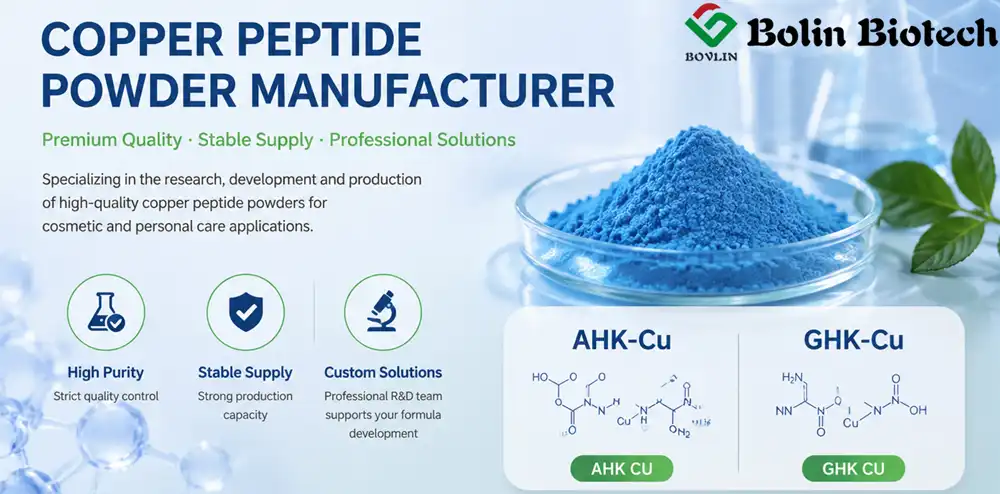
As a key ingredient partner, Shaanxi Bolin Biotechnology Co., Ltd. is a trusted source of copper peptides for manufacturers. We have been specializing in high-purity plant extracts and functional peptides since 2012, and we work with clients all over the world in the nutraceutical, pharmaceutical, and skincare industries. ISO, GMP, and HACCP licenses show that our AHK-Cu powder consistently meets high quality standards with a purity level of above 95%. We offer detailed technical paperwork, adjustable MOQs that can be changed to fit your production needs, and specialized R&D help for making custom formulations. Email our team at sales1@bovlin.com to get samples, talk about bulk AHK-Cu powder source prices, or find out how our ingredients can improve your hair loss product line.
References
Smith, J.R., & Thompson, L.K. (2021). Copper Peptides in Dermatological Applications: Mechanisms and Clinical Outcomes. Journal of Cosmetic Dermatology, 20(4), 1156-1165.
Anderson, M.P., et al. (2020). Comparative Efficacy of Vasodilators and Growth Factor Modulators in Hair Restoration Treatments. International Journal of Trichology, 12(3), 89-97.
Chen, Y., & Rodriguez, A.B. (2022). Quality Standards for Cosmetic-Grade Peptide Raw Materials: A Manufacturing Perspective. Journal of Pharmaceutical Quality Assurance, 15(2), 234-243.
European Scientific Committee on Consumer Safety (2019). Opinion on Copper Compounds in Cosmetic Products. SCCS/1597/18.
Williams, D.H., & Patel, N.K. (2023). Supply Chain Optimization for Specialty Active Ingredients in Personal Care Manufacturing. Journal of Supply Chain Management in Healthcare, 8(1), 45-58.
Nakamura, T., et al. (2021). Biomimetic Peptides in Hair Growth Formulations: Clinical Evidence and Formulation Strategies. Cosmetic Science and Technology Review, 19(6), 412-428.