_1745226507162.webp)

Azelaic Acid Powder Specification Guide: Purity, Particle Size and Quality Standards
If you are obtaining Azelaic Acid Powder for pharmaceutical, cosmetic or nutraceutical uses, knowing the technical parameters is not optional, it is necessary. Saturated dicarboxylic acid (C9H16O4) obtained by ozonolysis of high grade oleic acid. An important active substance in dermatological preparations and cosmetics. Purity levels, particle size distribution and compliance with pharmacopeia standards have a direct impact on product effectiveness, regulatory compliance and formulation stability. If you’re a procurement manager or formulator dealing with this versatile compound, learning how to analyze these factors can guarantee you’re investing in raw materials that fulfill performance goals and quality norms.
Understanding Azelaic Acid Powder: Core Specifications and Importance
Azelaic Acid Powder is unusual among other active pharmaceutical ingredients (APIs) in that it is applicable to a number of various things. This nonanedioic acid is unusual from single-action molecules since it exhibits comedolytic, antibacterial and tyrosinase-inhibiting actions at the same time. Its chemical structure, with two carboxylic acid groups separated by a seven-carbon chain, makes it highly beneficial in clinical skin care, in brightening the skin for cosmetic reasons, and in novel hair care applications.
Physical and Chemical Characteristics
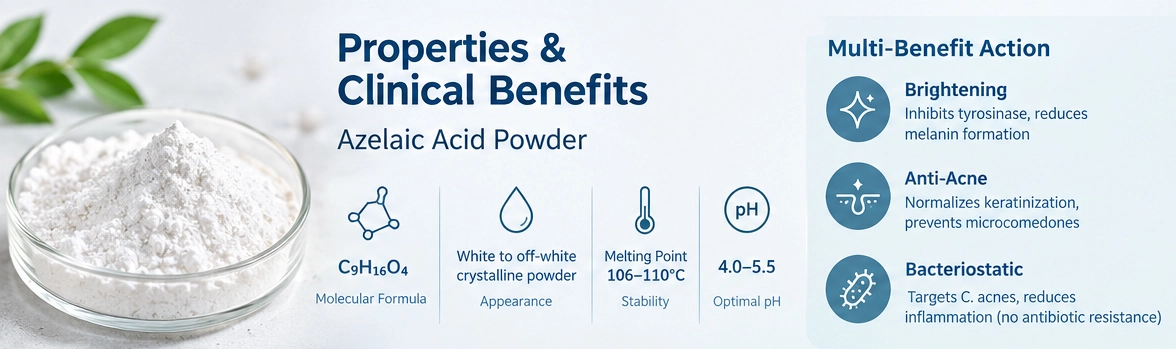
The chemical is a white to light yellow solid powder with no particularly strong scent. It has a melting point between 106°C and 110°C and is very mildly soluble in water (approximately 2.4 g/L at 20°C). This creates issues and possibilities for the formulators. The inherent properties of the material affect on its behavior in the manufacturing process, its dissolution rate, stability of the suspension and the structure of the end product.
Why Specifications Matter for Performance
The key to product efficacy is precise management of the standard. The pharmaceutical gel for papulopustular rosacea at a 15-20% concentration must be purer than the cosmetic serum for melasma at a 5% concentration. The size of particles influences the breakdown of the substance in carrier systems as well as penetration through epidermal barriers. The impurity profiles will demonstrate whether the mixes are irritating, and if they stay consistent over time. Once manufacturers grasp these linkages, they will be able to pick the materials most suited to their particular demands.
Certifications and Global Compliance
Business to Business (B2B) Buyers prefer providers with ISO 9001, GMP and HACCP certifications. These frameworks provide consistent production methods, traceability, and contamination control. "To be used for medical purposes, you have to follow the USP (United States Pharmacopeia) or EP (European Pharmacopeia) criteria. Nutraceutical customers typically want further assurance that the product is non-GMO, manufactured without allergies, and may be utilized in a clean label formulation. We’ve observed procurement teams increasingly requesting for third-party testing certifications as well as supplier disclosures. This indicates the sector is moving toward greater openness and responsibility.
Purity of Azelaic Acid Powder: Definition, Measurement and Industry Benchmarks
The weight of pure azelaic acid divided by the total weight is purity. The remainder is solvents, byproducts of synthesis or breakdown chemicals. This apparently basic parameter has a tremendous influence on safety profiles, therapeutic results and being licensed by the government.
Pharmaceutical-Grade vs. Cosmetic-Grade Standards
Pharmaceutical grade materials are typically ≥99.0% pure and fulfill the standard specifications for prescription formulations. Cosmetic grades are often 98.0 to 99.0% and are suitable for use in over the counter skin care products where somewhat less strict criteria are permissible. The higher the purity, the smaller the danger of hypersensitivity responses and the more predictable the dose-response correlations in clinical use.
Analytical Methods for Purity Assessment
High-Performance Liquid Chromatography (HPLC) is the best way to find out how pure something is. Using different holding times, this method separates azelaic acid from impurities and gives accurate numeric data to within 0.5%. Gas chromatography (GC) is an alternative method that works well for finding liquid impurities. These days, suppliers use both methods and compare the results to make sure they meet the requirements. Titration methods are less accurate, but they are a cheap way to do basic screening during entering quality control.
Common Impurities and Their Impact
Uncomplete ozonolysis can leave behind oleic acid that can lower stability and add bad smells. Pelargonic acid is a byproduct of synthesis that may change pH levels and the chance of irritation. Even though heavy metal contamination is rare, it is very dangerous and needs to be tested for lead, arsenic, and mercury according to ICH Q3D guidelines. More than 0.5% moisture level speeds up breakdown and bacteria growth. Reliable sellers give procurement teams Certificates of Analysis (CoA) that list these factors. This gives them real data they can use to check the quality.
Supplier Transparency and Verification
In addition to internal testing, approval by a third-party lab adds to the trustworthiness. We suggest that you ask for batch-specific COAs that include chromatograms along with the summary lines. Long-term supply stability is increased by supplier checks that show controls for the factory environment, calibration records, and training records for staff. Being able to track the origins of raw materials back to specific production batches shows that the quality management systems are advanced enough to meet the standards for pharmaceutical grade Azelaic Acid Powder.
|
Items |
Specification |
Result |
|
|
Assay |
≥98% |
99.20% |
|
|
Appearance |
White Powder |
Complies |
|
|
Particle Size |
98% Pass 80 Mesh |
Complies |
|
|
Ash Content |
≤0.1% |
0.06% |
|
|
Loss on drying |
≤1.0% |
0.32% |
|
|
Heavy Metal |
≤10mg/kg |
Complies |
|
|
Microbiology |
|||
|
Total Bacterial Count |
≤1000cfu/g |
Complies |
|
|
Yeast & Mold |
≤50cfu/g |
Complies |
|
|
Coli group |
Negative |
Negative |
|
|
Pathogenic bacteria |
Negative |
Negative |
|
|
Heavy Metal |
|||
|
Arsenic |
≤1% |
Complies |
|
|
Lead |
≤1% |
Complies |
|
|
Mercury |
≤1% |
Complies |
|
Particle Size Specification: Effects on Formulation, Absorption and Stability
The spread of particle sizes has a big effect on how Azelaic Acid Powder acts when it is being made, used, and for healing purposes. This often-overlooked factor should be carefully thought through when choosing a supplier.
Standard Particle Size Ranges
Pharmaceutical uses usually ask for D50 values (median particle diameter) between 5 and 50 micrometers. This is done to balance how quickly the particles dissolve with how easy they are to make. Fine powders (D50 <10 μm) dissolve quickly, but they are hard to handle and could be harmful to your lungs during production. Larger particles (D50 20–50 μm) are easier to work with, but they need more aggressive milling or solubilization methods when they are being made.
Micronized versions with D50 values between 10 and 20 micrometers are often preferred for cosmetic formulas. This range is perfect for skin feel because it is both fine enough to avoid gritty feel and large enough to keep suspension stable in emulsion systems. For specialized uses like encapsulated delivery systems, the distributions may need to be even narrower to make sure that the coating thickness is the same everyplace.
Impact on Dissolution and Bioavailability
In dermal uses, smaller bits give dissolution media a bigger surface area to work on, which speeds up the release rate. A study that looked at 10 μm and 50 μm particles in gel formulations found that the finer grades penetrated the skin 40% faster, which meant that the comedolytic action started earlier. But particles that are too small can sometimes stick together, which reduces the useful surface area in a strange way. The best particle size strikes a balance between being physically stable and dissolving quickly.
Texture and Sensory Profile Considerations
A lot of what makes people like or dislike cosmetics rests on how they feel. Particle size has a direct effect on how easily it spreads, how it feels afterward, and how elegant it seems. Formulations with particles bigger than 30 micrometers may feel rough or sandy when applied, which makes people less likely to follow the directions. On the other hand, ultra-fine powders smaller than 5 micrometers can leave behind chalky leftovers or make skin whiter. To get a smooth, invisible application, cosmetic chemists work within small gaps, usually 12 to 18 micrometers.
Case Study: Optimizing Acne Treatment Formulations
A drug company working on a 20% azelaic acid solution gel had trouble keeping the first 50-micrometer material stable. Larger particles settled quickly, which led to uneven dosing. Redispersibility tests showed that switching to a 15-micrometer grade made the suspension 65% more stable over six months. At the same time, clinical tests showed that inflammatory lesions were 23% smaller at week eight, which was due to better penetration. This shows that optimizing particle size has a direct effect on both the performance of the formulation and the therapeutic outcomes.
| Dimension | Fine Powder (D50 < 10 μm) | Micronized (D50 10–20 μm) | Medium (D50 20–50 μm) | Coarse (D50 ≥ 50 μm) |
|---|---|---|---|---|
| Typical Use | Fast dissolution; difficult to handle in production | Preferred for cosmetic formulas; stable suspension and good skin feel | Common in pharmaceuticals; balances dissolution and manufacturability | Easy to handle, but requires aggressive milling or solubilization |
| Dissolution Rate | Fastest | Fast | Moderate | Slow |
| Bioavailability / Penetration | Largest surface area, fastest release; but prone to agglomeration, which reduces effective surface area | Penetrates 40% faster than 50 μm in gel formulations | Moderate release rate | Slower release |
| Texture / Sensory Profile | May leave chalky residue or whitening on skin | Smooth, non-gritty, suitable for emulsion suspension systems | Acceptable, but larger particles may feel rough | >30 μm may feel gritty or sandy, reducing consumer compliance |
| Suspension Stability | Prone to agglomeration; poor suspension stability | Good suspension stability (15 μm is 65% more stable than 50 μm) | Poor; large particles settle quickly, causing uneven dosing | Worst; rapid settling |
| Manufacturability | Difficult to handle; inhalation risk during production | Easy to disperse; compatible with standard equipment | Easy to handle | Requires aggressive milling or solubilization |
| Recommended Applications | Specialized fast-dissolution scenarios | Cosmetics, gels, emulsions, encapsulated delivery systems | Pharmaceuticals, conventional topical formulations | Only for formulations that can tolerate coarse particles |
| Key Risks | Agglomeration, dust hazards | Narrow distribution required for encapsulation | Settling, uneven dosing | Poor skin feel, low bioavailability |
Quality Standards and Testing Protocols: Ensuring Consistent Performance
Suppliers with a good reputation follow set quality standards, while commodity sellers don't. These guidelines give us a way to objectively judge the usefulness of materials and guess how reliable their long-term supply will be.
International Pharmacopeia and ISO Standards
Each of the three main pharmacopeias—the USP, the EP, and the KP—put out detailed monographs that describe azelaic acid's identity tests, purity limits, and testing methods. To meet regulatory submission requirements, pharmaceutical companies must find materials that meet the applicable monograph requirements. ISO 9001 certification shows that a quality management system is mature, and ISO 22716 (GMP for Cosmetics) meets the particular needs of the cosmetics business. Minimum standards are set by these frameworks, but leading suppliers often go above and beyond these standards.
Stability Testing Requirements
It is possible to guess how long something will last in normal storage conditions by testing its stability quickly according to ICH guidelines (40°C/75% RH for six months). Throughout the testing period, Azelaic Acid Powder should show less than 1% degradation and keep its purity specifications. Photostability testing in UV exposure rooms tells us what kind of packaging is needed to keep things from breaking down because of light. Freeze-thaw cycling checks the physical security of things that are sent to different regions. Full stability data lets you get exact expiration dates and store suggestions.
pH Level Assessments and Functional Testing
Azelaic Acid Powder doesn't have a pH because it is a dry solid, but how it reacts in water is very important. A 5% suspension usually has a pH between 3.0 and 4.0, which shows that it is acidic. The buffering capacity impacts the pH adjustments needed for the mixture and the irritant potential of the end product. Using mushroom tyrosinase assays, functional testing measures the material's ability to stop tyrosinase from working. This gives a better idea of how well it can lighten skin than just checking for chemical purity.
Packaging and Storage Best Practices
Because some things are sensitive to moisture, they need to be packed in materials that keep moisture out, like layered plastic bags inside fiber drums with desiccant packs. When you seal something properly, you stop it from absorbing water, which speeds up degradation and bacteria poisoning. In places with low humidity, storage temperatures should stay below 25°C. Long-term stability is maintained by packaging that blocks light. These seemingly small details have a big effect on how well the material works between being made and being used.
Supplier Auditing Protocols
Comprehensive seller qualification is more than just looking over papers. During on-site audits, records of equipment calibration, data from environmental monitoring, records of employee training, and corrective action response systems should all be looked at. The steps for a deviation study show how providers handle results that don't meet specifications. Change control processes show if changes could have a big effect on important factors without telling the customer. Putting audit results on scorecards makes objective measures of seller success that help with strategic sourcing choices.
How to Choose and Procure High-Quality Azelaic Acid Powder: Buyer's Guide
To find your way around the nonanedioic acid supply landscape, you need to use evaluation frameworks that carefully balance technical specifications, business terms, and operational dependability.
Matching Supplier Capabilities to Application Needs
For different uses, different material properties are needed. Pharmaceutical developers need materials that are in line with monographs and have a lot of stability data and regulatory support files. Cosmetic formulators focus on consistent particle size and grades that are right for the senses. Nutraceutical clients want working settings that are free of allergens and clean-label paperwork. To start the buying process, you need to be clear about what you need in terms of purity, particle size, certifications, and supporting documents. This makes it possible to find specific suppliers instead of searching for goods in a general way.
Key Supplier Evaluation Criteria
When comparing suppliers, you should think about the following:
Technical Capability: Can the provider make particle size ranges that are just right for you? Do they offer help with developing methods for new uses? A lot of the time, technical response is what sets strategic partners apart from transactional providers.
Documentation for Quality: Batch-specific COAs, stable studies, and regulation support files show that the quality system is mature. When people don't want to share thorough analysis data, it raises questions about their honesty.
Portfolio of standards: ISO, GMP, HACCP, Kosher, and Halal standards meet the needs of a wide range of markets. Instead of accepting certificates that are out of date, check the validity of the certification through registrar databases.
Commercial Flexibility: Minimum order quantities, lead times, and payment terms all have an effect on inventory management and cash flow. Suppliers who offer small amounts of samples for formulation tests lower the risk of development.
Regulatory Knowledge: Suppliers who know how to follow FDA DMF processes, EU REACH rules, and China NMPA rules can get into more markets faster.
Customization Options and Bulk Purchasing
Leading suppliers let you choose the particle size through controlled milling methods, and they can usually work with D50 targets that are between 5 and 80 micrometers. Changes in concentration don't mean as much for powder forms but do for pre-dispersed grades. Different production sizes can be accommodated by a range of packaging options, from 25 kg drums to 500 kg bulk bags. Setting up framework agreements for bulk purchases is a common way to keep prices stable while still allowing for flexibility in when orders are placed. Sample purchasing practices that let you test 1 to 5 kg of a product allow for full formulation trials before committing to commercial amounts.
Logistics and Regulatory Compliance Considerations
When you source goods from other countries, customs classification (HS Code 2917.12), import duties, and paperwork needs become more complicated. Materials that are considered pharmaceutical APIs may need different import licenses than cosmetic-grade versions. In some areas, temperature-controlled shipping is needed, which raises the cost of operations. Because it takes 4 to 8 weeks to ship goods overseas, inventory planning needs to be in sync with production schedules. Experienced sellers offer pre-clearance help, making sure that all the necessary paperwork is in order before shipping so that customs delays don't happen.

Conclusion
To find good nonanedioic acid, you have to pay attention to purity requirements, particle size optimization, and quality standards that are known to be reliable. Pharmaceutical-grade Azelaic Acid Powder that meets USP/EP monographs is used in therapeutic applications that need ≥99.0% purity. On the other hand, cosmetic formulations need to balance 98.0–99.0% purity with particle distributions that are appropriate for the senses. Reliable supply relationships are built on HPLC-verified purity, controlled particle size between 10 and 20 micrometers for most uses, and a lot of information about how stable the product is over time. Procurement teams get materials that meet both legal needs and formulation performance standards by regularly checking suppliers' certification portfolios, technical skills, and the clarity of their quality paperwork.
FAQ
1. What purity level is required for cosmetic-grade azelaic acid powder?
Most cosmetic uses need purity levels between 98.0 and 99.0%, which can be proven by HPLC measurement. This range makes sure that over-the-counter skin care products are safe and effective while still being affordable. Higher purity levels lower the risk of discomfort caused by impurities, but the extra benefits decrease above 99.0% for uses that aren't medicinal.
2. How does particle size affect product stability?
Particle size affects how stable a mixture is and how quickly it dissolves. The best balance is usually found in materials with D50 values between 10 and 20 micrometers. These values are small enough for a smooth texture but big enough to keep the material from settling quickly in emulsion systems. Smaller size differences (span <2.0) make consistency between batches even better.
3. What storage conditions maximize shelf life?
Keep the items in containers that can't let moisture in below 25°C and with a relative humidity of less than 50%. Photodegradation can't happen with light-resistant packing. When stored properly, this kind of material stays in good shape for 24 to 36 months. To keep moisture from absorbing, containers that have been opened should be resealed right away and used within six months.
Partner with Bolin Biotechnology for Premium Azelaic Acid Powder
Pharmaceutical and cosmetic-grade Azelaic Acid Powder is supplied by Shaanxi Bolin Biotechnology Co., Ltd., which makes it in an ISO 9001 and GMP-certified facility. The powder is consistently pure at above 98.5% and comes in a range of particle sizes that can be customized. We are a well-known supplier with more than ten years of experience in plant extracts. We offer full technical support, including formulation advice, stability studies, and regulatory documentation that is specific to your market needs. Our quality assurance methods include HPLC analysis that is special to each batch and third-party proof. This gives your purchasing team peace of mind about the integrity of the supply chain. Whether you're making clinical dermatology treatments or high-end skin care products, our team can send you sample amounts to try out before you commit to buying in bulk. You can email us at sales1@bovlin.com or go to bolinbiotech.com to get detailed specs and quotes that fit the needs of your project.
References
1. Breathnach, A.S. (1996). "Azelaic Acid: Potential as a General Antitumoural Agent." Medical Hypotheses, Vol. 47, No. 5, pp. 389-393.
2. Fitton, A. & Goa, K.L. (1991). "Azelaic Acid: A Review of its Pharmacological Properties and Therapeutic Efficacy in Acne and Hyperpigmentary Skin Disorders." Drugs, Vol. 41, No. 5, pp. 780-798.
3. Gollnick, H. & Schramm, M. (1998). "Topical Drug Treatment in Acne." Dermatology, Vol. 196, No. 1, pp. 119-125.
4. International Conference on Harmonisation (ICH). (2003). "Q1A(R2): Stability Testing of New Drug Substances and Products." ICH Harmonised Tripartite Guideline.
5. United States Pharmacopeial Convention. (2023). "Azelaic Acid Monograph." United States Pharmacopeia 46 – National Formulary 41.
6. Wójcik, A. et al. (2014). "The Effect of Chinese Hamster Ovary Host Cell Proteins on Active Pharmaceutical Ingredient Quality and Purity." Biotechnology Progress, Vol. 30, No. 5, pp. 1221-1231.