_1745226507162.webp)

What Is Pure Rutin Powder Used For?
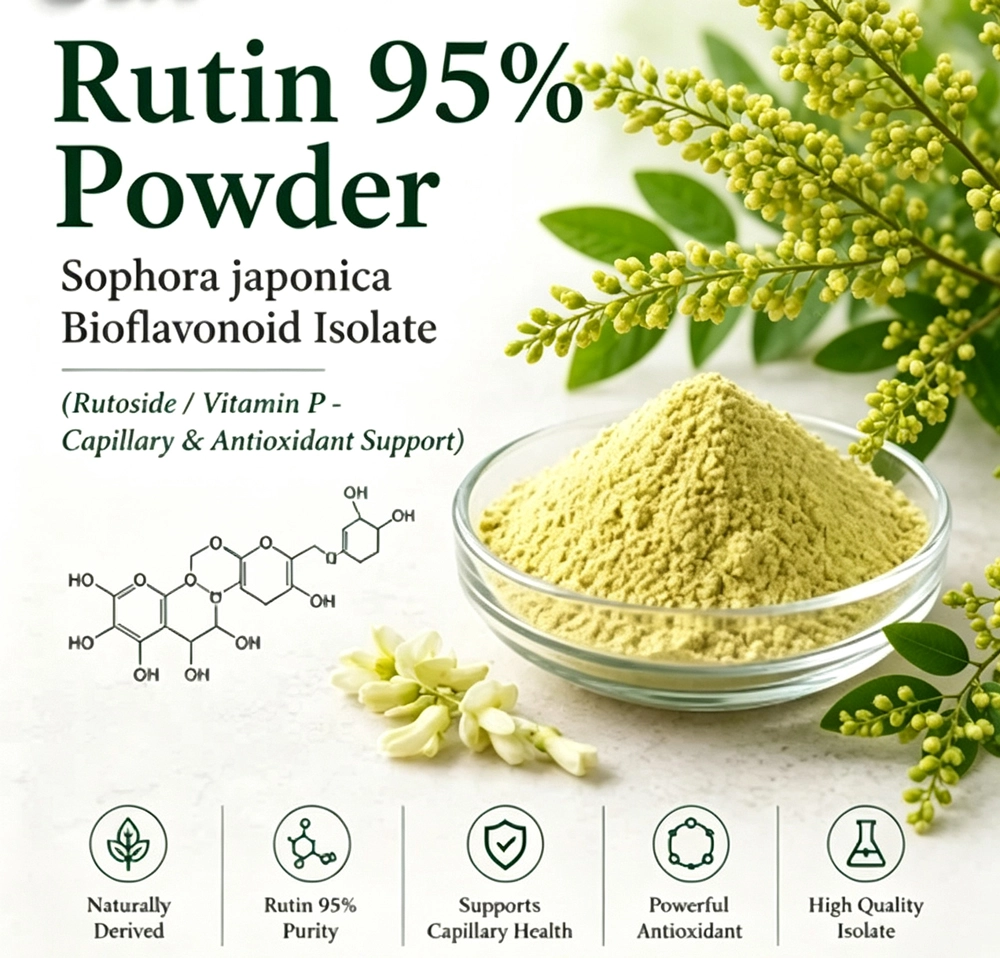
Pure rutin powder (CAS 153-18-4, often called Rutin NF11) is a concentrated bioflavonoid glycoside derived from the dried flower buds of Sophora japonica. Yellow-green fine powder, purity ≥95% (HPLC). B2B formulators in the nutraceutical, pharmaceutical, and cosmetic sectors utilize it for cardiovascular support, capillary protection, antioxidant activity, and anti-ageing skincare. The defined specification of 80 mesh particle size, heavy metals < 10 ppm, and loss on drying ≤5% makes it a dependable raw material for supplement capsules, functional foods, and topical applications.
Understanding Pure Rutin Powder: Definition and Natural Sources
What Is Rutin, Chemically Speaking?
The chemical formula of Rutin is C27H30O16, and its molecular weight is 610.52 g/mol. The bioflavonoids in this compound are flavonols. Rutinose disaccharide with a quercetin aglycon. The structure of Rutin enables it to attach to metal ions and neutralize free radicals. These are two of numerous applications of rutin in the health and personal care sectors.
Where Does It Come From?
The major commercial source is the flower buds of Sophora japonica (Japanese Pagoda Tree). They contain some of the highest natural concentrations of rutin ever known, up to 20% dry weight. The plant is also available from citrus peel and buckwheat (Fagopyrum esculentum). Bolin Biotechnology derives its Rutin NF11 directly from the Sophora japonica plant. It is subsequently crystallized and solvent-extracted to produce ≥95% purity with extremely few plant contaminants.
How Does Purity Level Matter in B2B Applications?
Not all flours are the same. The phenolic content in a standardized extract with 60–80% purity is higher, and co-extracted phenolics might modify the color, smell, and labeling requirements of the batch. Ingredients are more constant if purity is ≥95% (verified by HPLC), which supports fixed-label claims. It also provides for more accurate bioactivity dosing and smoother regulatory filings. This is particularly true for US dietary supplement products that comply with FDA 21 CFR Part 111.
Core Uses and Health Benefits of Pure Rutin Powder
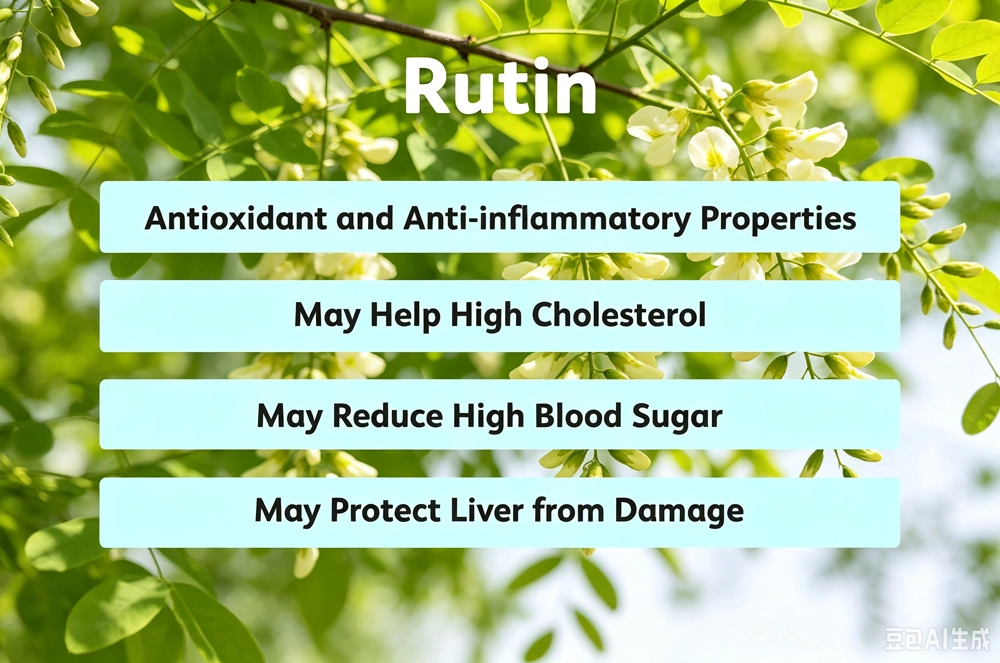
Rutin has been the subject of scholarly investigation for many years. A 2020 review in the journal Biomolecules verified the role of pure rutin powder in lowering permeability and fragility of capillaries. This is the basis for its use in venotonic medications in Europe and Asia. This element has been used in the following principal areas:
- Cardiovascular and vein health supplements. Rutin strengthens the walls of the capillaries by suppressing the enzymes collagenase and hyaluronidase, which break down vascular connective tissue. It is the predecessor to troxerutin, a licensed pharmacological treatment for chronic venous insufficiency in Germany and France.
- Dietary supplement formulations: Rutin is often combined with ascorbic acid (Vitamin C). Studies have shown that rutin prevents copper-catalyzed oxidation of Vitamin C in the gut, therefore increasing the useful half-life of the vitamin. This makes it a partner ingredient of choice for immune-support mixtures.
- Anti-aging and brightening skin care: Topical rutin is a superoxide radical scavenger and may also reduce the production of Advanced Glycation End-products (AGEs), associated with skin stiffness and discolouration. It is used by cosmetic formulators in serums, eye creams and UV protection products.
- Fortification of functional foods and beverages: Rutin’s yellow colorant and antioxidant activity make it excellent for fortification of health teas, fruit drinks and nutraceutical snacks with claims of oxidative stress and vascular wellbeing.
Fortification of functional foods and beverages: The antioxidant activity and yellow color of rutin are suitable for fortification of health teas, fruit drinks, and nutraceutical snacks for oxidative stress and vascular health claims.
Comparing Pure Rutin Powder with Related Compounds and Supplements
Rutin vs. Quercetin
Rutin is just quercetin with a sugar attached to it. Quercetin is the "core" of rutin. This sugar unit decreases the solubility of quercetin as an aglycone when taken alone, but enhances the stability of rutin in dry powder form and slows down absorption in the intestines, resulting in a more constant release profile. In vascular applications where prolonged retention in the plasma is required, free quercetin is not necessarily better than rutin.
Rutin vs. Hesperidin
Hesperidin, a flavanone glycoside in orange fruits, has some of the same benefits for heart health. The distinction is in how they act. Hesperidin works on venous flow, whereas rutin works by strengthening capillary walls and has antioxidant effects. They are typically blended together in European venotonic medication formulations instead of being used separately.
| Rutin | Quercetin | Hesperidin | |
|---|---|---|---|
| Chemical Nature | Quercetin + sugar unit | Quercetin aglycone (core structure) | Flavanone glycoside from orange fruits |
| Solubility | Better dry-powder stability | Lower solubility when taken alone | — |
| Absorption | Slower, sustained release | Faster absorption | — |
| Primary Action | Strengthens capillary walls; antioxidant | Vascular support | Supports venous flow |
| Best For | Prolonged plasma retention | — | Venous tone |
| Typical Use | Vascular support, antioxidant formulas | — | Often blended with rutin in European venotonic medications |
High-Purity vs. Standard-Grade Extracts
Standard plant extracts with 60-80% pure rutin powder may be sufficient to add to food to make it healthier, but pharmaceutical and high-end nutraceutical applications need them to be ≥95% pure. At this grade, you minimize the risk of adverse effects from co-extracted medications, confirm the label is valid, and fulfill pharmacopeial criteria such as USP, EP, or NF11. Bolin Biotechnology’s Rutin NF11 is produced according to the NF11 standard and is tested by a third party, SGS, on every batch.
| Standard Grade | High-Purity Grade | |
| Purity | 60–80% rutin | ≥95% rutin |
| Suitable For | Food fortification | Pharmaceuticals, high-end nutraceuticals |
| Key Benefit | Cost-effective | Minimizes co-extracted impurities; confirms label accuracy |
| Compliance | — | Meets USP, EP, NF11 |
| Testing | — | Every batch third-party tested (SGS) |
Procurement Guide: How to Buy Pure Rutin Powder for Business
Looking at a pricing list is not enough to get a botanical ingredient at industrial scale. Procurement teams with a lot of understanding ask themselves the following questions before placing their first order:
- Purity Documentation: Request comprehensive COA containing HPLC chromatogram, heavy metals panel (≤10ppm per our spec), loss on drying (≤5%) and microbiological data. A reputable manufacturer will provide you with this documentation without any questions.
- Sample and MOQ Policy: Many vendors need minimum 25kg purchases, which adds risk for formulators in early development. Bolin Biotechnology’s MOQ is a modest 1kg, enabling R&D teams to evaluate the ingredient before committing to bulk quantities, a major plus for new product lines.
- Consistency of batches: Ask for COAs from 3 consecutive manufacturing batches. Sure signs of variance among batches include process instability that will lead to downstream difficulties in produced products, such as HPLC peak area or moisture content.
- Third-party certification: ISO 9001 and ISO 22000 accreditation represents systematic quality management, not simply one-off testing. Third-party testing of the finished product by SGS offers an independent verification that cannot be obtained through internal QC alone.
Bolin Biotechnology is a company founded in 2012, situated in Shaanxi, China. It adopts two management tools: ISO 9001 and ISO 22000. We deliver to North America, Europe, and Australia. They have things in stock that can be sent immediately. They provide English-language technical support throughout the ordering process.
Conclusion
Pure rutin powder is one of the natural bioflavonoids that has been studied the most and is now available to formulators. It has a wide range of uses, from protecting capillary walls in vein health supplements to keeping antioxidants stable in skin care emulsions. Decades of research have supported these claims. For business-to-business buyers, it's not whether to use rutin or not; it's finding a seller who can meet the strict requirements for purity, documentation, and supply reliability that come with real product development. Bolin Biotechnology's Rutin NF11 is perfect for buying teams that want to be sure before they commit. It has ≥95% HPLC purity, quality that has been checked by SGS, and a 1 kg minimum order that makes sampling easy.
FAQ
1. What is the recommended dosage of rutin in dietary supplements?
For arterial health, clinical studies usually use 500 mg to 4,000 mg per day in split doses. In the US, doses of 500 mg per serving are common for supplement labels. Always make sure that the amount you use is in line with what your product is supposed to do and the rules that apply.
2. Is rutin powder safe for long-term use in formulations?
At >95% purity, rutin has a safety profile that has been well studied. Most people agree that normal supplement amounts are safe. Heavy metal compliance (< 10 ppm) and the lack of plant co-contaminants at this purity grade lower the chance that final goods will have bad effects.
3. How do you handle the low water solubility of rutin in liquid products?
Native rutin doesn't dissolve well in cold water (about 0.125 g/L). For water-based drinks, formulators use co-solvents like ethanol, change the pH to alkaline conditions, or use enzymes to change the sugar to α-glucosyl rutin.
4. Does rutin from Sophora japonica contain allergens?
When the plant proteins are extracted and crystallized, high-purity rutin isolate (≥95%) is separated from them. Most people don't have any problems with it, and it works with vegan and gluten-free product approvals.
5. What packaging does Bolin Biotechnology use for rutin powder?
The product is shipped in foil bags or fiber drums and is kept in light-resistant, double-lined boxes to keep it from breaking down due to UV light. Storing things correctly keeps them fresh and extends their shelf life.
Source Your Rutin NF11 Directly From Bolin Biotechnology
Since 2012, Bolin Biotechnology has sold plant-based ingredients all over the world. We have ISO 9001 and ISO 22000 certifications for our processes that make pure rutin powder, and every batch is tested by a third party, SGS. With a minimum order quantity of 1 kg and full COA documentation included, we make it easy for procurement and R&D teams to check quality before going big. Email sales1@bovlin.com with your technical needs or to ask for a sample.
References
1. Ganeshpurkar, A., & Saluja, A. K. (2017). The pharmacological potential of rutin. Saudi Pharmaceutical Journal, 25(2), 149–164.
2. Kreft, S., Knapp, M., & Kreft, I. (1999). Extraction of rutin from buckwheat (Fagopyrum esculentum Moench) seeds and determination by capillary electrophoresis. Journal of Agricultural and Food Chemistry, 47(11), 4649–4652.
3. Selloum, L., Reichl, S., Müller, M., Sebihi, L., & Arnhold, J. (2001). Effects of rutin on the antioxidant activity of ascorbic acid. Cell Biochemistry and Function, 19(1), 43–49.
4. Patel, K., Singh, G. K., & Patel, D. K. (2018). A review on pharmacological and analytical aspects of diosmetin: A concise report. Chinese Journal of Integrative Medicine, 24(12), 950–960.
5. Grand View Research. (2023). Flavonoids market size, share & trends analysis report by product, by application, by region, and segment forecasts, 2023–2030. Grand View Research.
6. Chua, L. S. (2013). A review on plant-based rutin extraction methods and its pharmacological activities. Journal of Ethnopharmacology, 150(3), 805–817.