_1745226507162.webp)

Blue Butterfly Pea Powder - Natural Food Coloring
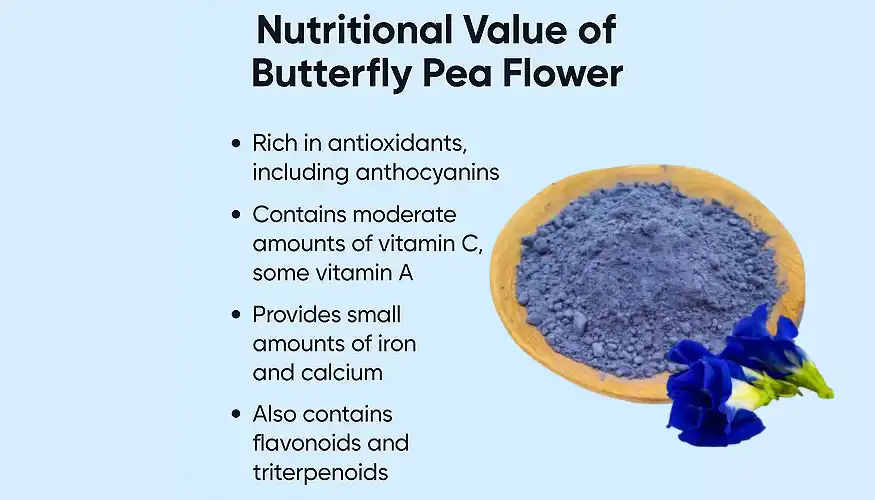
Blue butterfly pea flower powder, which comes from the Clitoria ternatea flower, is a new kind of natural food coloring that gives foods an intense, bright blue color that changes the way they look without using any artificial ingredients. This plant ingredient is not only beautiful to look at, but it also has health benefits thanks to its high anthocyanin content. This makes it an increasingly important part for companies that want to use clean labels. As people want more natural and clear ingredients, purchasing teams in the food, drink, cosmetics, and nutraceutical industries see this powder as a key ingredient that helps them follow the rules and makes their goods stand out in a crowded market.
What is Blue Butterfly Pea Powder and Its Core Benefits?
Botanical Origin and Production Process
The butterfly pea flower powder comes from Clitoria ternatea, a Southeast Asian perennial plant that is grown for its bright blue petals. We use controlled dehydration methods, like freeze-drying or low-temperature air-drying, on these petals to protect the delicate anthocyanin chemicals that give them their color. As needed for the application, the dried petals are micro-milled to make particles with sizes ranging from 80 to 200 mesh. This standardized production makes sure that the color intensity and dispersion qualities are the same across batches. This solves the problems that come up when using fresh flowers in industrial formulations because they are not always the same.
Antioxidant Profile and Bioactive Components
Blue butterfly pea powder contains a distinctive anthocyanin profile dominated by ternatins, a group of polyacylated anthocyanins that exhibit superior stability compared to standard anthocyanins found in berries or grapes. Total anthocyanin content in lab tests is usually between 0.5% and 2.5%, based on how the plants were grown and how they were processed. It has been shown that these compounds are antioxidants; at normal test concentrations, their ability to scavenge DPPH radicals often exceeds 70%. Besides anthocyanins, the powder also has flavonoids and polyphenolic chemicals that may help reduce inflammation. This makes it a good choice for functional ingredient uses other than just coloring.
pH-Sensitive Color Transformation Properties
One thing that makes this natural colorant stand out is how dramatically it reacts to changes in pH. The powder stays its deep blue color at pH levels between 7.0 and 9.0, which are neutral to slightly alkaline. When the formulation's pH falls below 6.0, chemical changes happen to the anthocyanin structure that make the visible spectrum shift toward purple, then pink, and finally red when the pH is very low, around 3.0. Because of this trait, people who make drinks and foods can make them visually interactive, with color changes that indicate changes in flavor or functional benefits. This gives them a marketing edge that synthetic dyes can't match.
How to Use Blue Butterfly Pea Powder in Food and Non-Food Products?
Application in Beverages and Functional Drinks
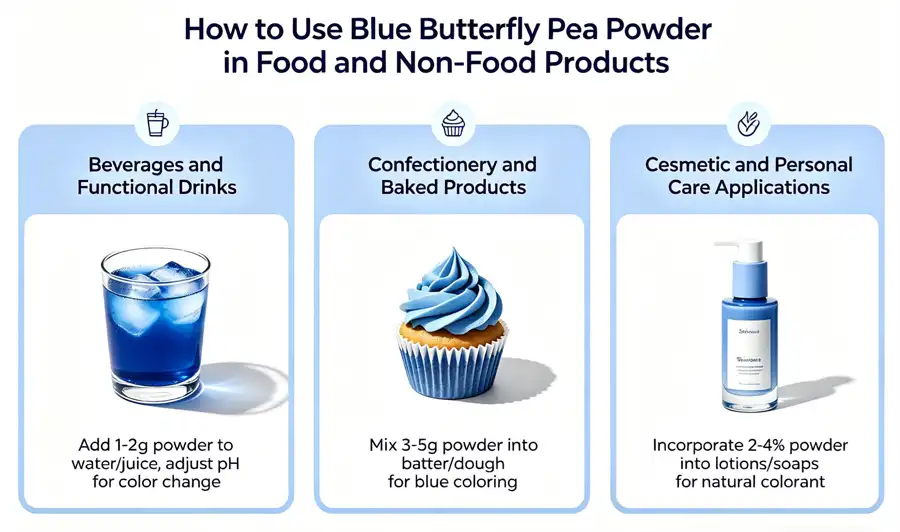
Butterfly pea powder is used by beverage companies to make ready-to-drink teas, cocktail mixes, and sports nutrition drinks, among other things. Rates of use usually range from 0.05% to 0.3% by weight, based on the color intensity you want and the type of drink you're making. For even spread, we suggest mixing the powder with a small amount of room-temperature water first, before adding it to the main batch. This will keep it from clumping together. When stored properly, the powder can last for more than a year and dissolves easily in water. It also stays stable in clear liquids forever. Developers of drinks love that it doesn't contain caffeine, which lets it be marketed as a drink for relaxing or the evening without the stimulant effects of regular matcha.
Integration into Confectionery and Baked Products
When using chemicals in confectionery, you have to think about special issues because of the heat and changing pH levels. Formulators who use butterfly pea flower powder in baked goods should know that the color will fade some during high-temperature processing. After normal baking at 180–200°C, the color will stay about 60–75% of the time. Some ways to protect yourself are to bake things for shorter amounts of time, lower the temperature when you can, or use the colorant on frostings and glazes instead of dough. This ingredient works especially well in gummies because the low-heat gelatin setting process keeps the color true and the powder's pH sensitivity lets you use citric acid gradients to create creative stacked color effects.
Before adding butterfly pea powder to all of their production lines, companies should make sure that their own recipes are stable first. Different ingredients, like proteins, minerals, and preservatives, can change how well the pigment works, based on how it interacts with them. As iron and copper can cause color changes or precipitation that we don't want, we usually see the best results when the recipes have very few metal ions in them. Conditions of storage are very important for managing large ingredients. When stored in sealed cases that are kept below 25°C and have a relative humidity of less than 60%, the pigment stays potent for 18 to 24 months. On the other hand, if you don't store it properly, the anthocyanin content can drop by 30 to 40 percent in just six months.
Cosmetic and Personal Care Applications
Butterfly pea extract powder is used in the cosmetics business because it can be used to color things and has health benefits. Concentrations of 0.5% to 3% are added to serums, creams, and masks by people who make skin care products. The anthocyanin content helps protect against environmental stresses by acting as an antioxidant. The powder mixes well in oil-in-water emulsions as long as the particles are homogenized properly. However, smaller particles may look better in high-end recipes if they are milled more. Color cosmetics brands love the natural blue pigment for eyeshadows and color-correcting products, since the "clean beauty" movement calls for natural dyes instead of manufactured ones. Stability testing shows that it works well with popular cosmetic preservatives and emulsifiers. Changing the pH to 5.5–6.5 keeps the color true while still being gentle on the skin.
Quality and Market Comparison of Butterfly Pea Powder Products
Organic Versus Conventional Production Standards
Organic and standard butterfly pea powder are different in more ways than just the labels on the packages. There are big differences in how the peas are grown and how good the powder is. Organic varieties follow the rules set by the USDA NOP or the EU, so they don't need manmade fertilizers or pesticides during the growing process. Due to stress factors and limited nutrient supply, this method of production usually results in lower anthocyanin concentrations per batch—often 15–20% less than normal levels. However, organic certification opens up high-end market segments where customers and brands value caring for the environment and not leaving behind chemical residues. Certified organic powder usually costs 30% to 60% more than regular powder because it costs more to make and there aren't as many supplies available.
Higher yields and more consistent anthocyanin profiles are possible with conventional farming because it allows for better fertilization schedules and integrated pest control. Reliable conventional providers still have strict quality control measures in place. For example, testing for pesticide residues makes sure that they meet FDA tolerance levels and EU maximum residue limits. We see that clients in the pharmaceutical and nutraceutical industries often value analytical consistency more than organic certification. On the other hand, food and drink brands that want to appeal to health-conscious customers are increasingly demanding organic status, even if it means spending more money.
Form Factor Considerations: Powder, Extract, and Fresh Material
Teams in charge of buying things have to decide whether standard dried powder, concentrated extract, or fresh flowers will work best for their manufacturing needs. Standard blue butterfly pea powder is the most flexible because it has particle sizes that are good for mixing directly into dry mixtures and keeps anthocyanin levels around 1% to 2%. Extra steps are taken with concentrated extracts to get rid of insoluble fiber and concentrate active chemicals. Spray-drying with carrier matrices is used to get anthocyanin levels of 10–25%. These extracts give better color strength per unit weight, but they need to be handled in a certain way because they absorb water and can cause problems with caking.
Fresh flowers are appealing to small-batch artisanal makers who want to be as real as possible, but they are very hard to handle for industrial operations. Shipping costs are too high when the moisture content is over 80%, and fast decay means that the food needs to be processed within 24 to 48 hours of being picked. We usually only suggest using fresh materials for activities that are close to cultivation areas that already have cold-chain infrastructure in place.
Critical Quality Benchmarks and Supplier Verification
Setting quality standards starts with figuring out what the color value needs to be by using standard measurements. Professional sellers give spectrophotometric data that shows absorbance peaks between 580 and 600 nm, with certain absorbance values corresponding to the amount of anthocyanin present. Food-grade guidelines say that the total plate count must be less than 10,000 CFU/g, yeast and mold must be less than 1,000 CFU/g, and pathogens like Salmonella and E. coli must not be present. coli. There should be less than 2 parts per million of lead, 1 part per million of arsenic, and 0.5 part per million of cadmium in heavy metals tested to meet FDA and EU rules.
A study of particle size distribution shows that manufacturers are consistent, with good suppliers keeping specifications within ±20 microns of goal values. Karl Fischer titration should show moisture content levels below 8% to stop microbes from growing and to keep the product from sticking while it's being stored. Asking for Certificates of Analysis for more than one batch helps procurement teams check how consistent a seller is and spot possible red flags, such as lots that differ too much from each other or test parameters that are missing.
Procurement Guide: How to Select and Source Blue Butterfly Pea Powder for B2B Use?
Certification Requirements and Regulatory Compliance
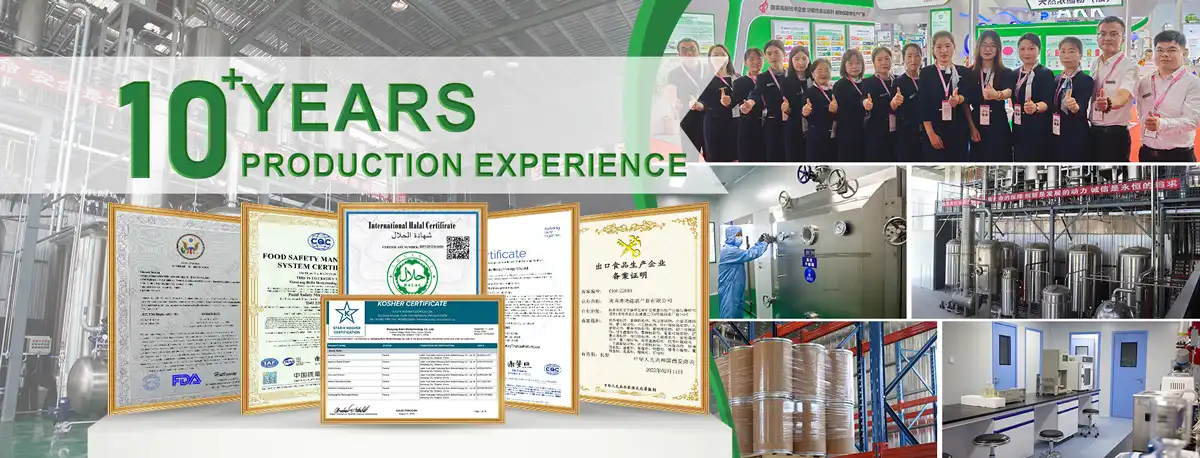
For B2B sourcing to work, you need to make sure that the certifications of your suppliers are in line with your target markets and product groups. For food-grade uses, suppliers must have current GMP certifications, and facilities must be audited by reputable third-party groups. The ISO 22000 or FSSC 22000 certifications show that a company has a complete food safety management system that includes checking the suppliers, controlling the production process, and following strict tracking rules. Manufacturers of nutraceuticals should check for NSF or NPA GMP certification that is special to making dietary supplements. This certification meets extra requirements like making sure the supplements are who they say they are and that they work.
To make organic claims, you need the right certifications. For example, you need USDA Organic certificates to sell your products in the US, EU organic certificates to sell your products in Europe, or similar certifications for other areas. We suggest checking the validity of certificates directly with the organizations that issued them, since fake papers do sometimes show up in foreign trade. Kosher and Halal certifications help goods that are aimed at certain religious groups reach more customers, but they cost more and need to be renewed every year. When looking for cosmetics, make sure that the suppliers you talk to can show proof that they follow the rules, like the EU Cosmetics Regulation 1223/2009 or any regional standards that apply.
Price Benchmarking and MOQ Considerations
Depending on the quality grade, certification status, and order volume, the price of blue butterfly pea powder on the market today changes significantly. For quantities over 500 kg, regular food-grade powder costs between $15 and $35 per kilogram, while approved organic powder costs between $30 and $65 per kilogram for the same quantities. When you buy directly from a manufacturer, the smallest amount you can order is usually between 100 and 200 kg, but some sellers will take smaller trial orders at a higher price. Trading companies and wholesalers have more flexible MOQs that start at 25 to 50 kg, but they add margin layers that make each unit cost 20 to 40 percent more.
Purchasing teams should ask for thorough quotes that clearly state the Incoterms (FOB, CIF, or DDP), as these have a big effect on the total landed costs. We think that international shipping and customs duties add about 15 to 25 percent to FOB prices for US buyers, based on the type of goods and the country where they come from. Payment terms depend on the seller and the size of the order. For new customers, a pro forma invoice is usually needed, while customers who have been working with the supplier for a while may be able to negotiate 30 to 60 day terms. When you agree to a volume that covers more than one shipment, you can often get tiered price discounts of 5–15%. This makes annual contracts financially advantageous for situations where demand stays stable.
Sourcing Channels and Supplier Relationship Management
Directly working with factories in Thailand, Vietnam, India, and China, which are the main production regions, gives you the best access to prices and quality control, but it costs money to qualify suppliers and build relationships. Before we sign official agreements with suppliers, we do virtual or in-person facility audits to check out production capabilities, quality systems, and capacity limits. Setting up dual-source strategies lowers the risks in the supply chain, but handling multiple suppliers requires more time and money to make sure that specifications are met and quality is maintained.
Alternative sourcing through well-known ingredient sellers is easier and lowers risk for smaller buyers or those who are testing the demand in the market. Distributors with a good reputation keep their stock locally, offer technical help, and take care of regulatory paperwork, but their markup structure makes prices go up. B2B marketplaces and platforms are another way to find suppliers. They are especially helpful for researching the market and finding new suppliers, but you should do a lot of study before making any big commitments. No matter what method of sourcing you use, evaluating samples is a very important step. Suppliers should send 100–500 g samples in the right packaging for internal testing and formulation trials before you buy in bulk.
Conclusion
As customer tastes and rules change, blue butterfly pea flower powder stands out as an appealing natural colorant option that offers both visual impact and functional benefits. The anthocyanin-rich makeup of this ingredient gives it bright color and antioxidant qualities that help products stand out in nutraceutical, food, drink, and beauty uses. If procurement workers learn the quality standards, supplier verification procedures, and application considerations in this guide, their companies will be ready to take advantage of clean-label trends while managing supply chain risks well.
Shaanxi Bolin Biotechnology Co., Ltd. has been making plant extracts for more than ten years and uses both traditional botanical knowledge and modern quality systems to make sure that their ingredients are always uniform and certified. Our blue butterfly pea powder is fully traceable and meets strict international standards. We also offer technical support to help you speed up the time it takes to build your product.
FAQ
What is the typical shelf life of blue butterfly pea powder under proper storage?
Quality butterfly pea powder maintains 90% or greater anthocyanin content for 18-24 months when stored in sealed containers protected from light, heat, and humidity. Storage temperatures below 25°C with relative humidity under 60% preserve pigment stability, while exposure to direct sunlight or elevated temperatures accelerates degradation. We recommend dating inventory using first-in-first-out rotation and conducting periodic quality checks on aging stock before incorporation into production batches.
Does heating or baking significantly affect the blue color intensity?
Thermal processing impacts anthocyanin stability, with degradation rates accelerating above 160°C. Conventional baking at 180-200°C for 20-30 minutes typically results in 25-40% color loss compared to unheated applications. Strategies to minimize degradation include reducing processing temperatures, shortening heat exposure duration, or applying the colorant to components that avoid direct heat such as frostings or post-bake glazes. Beverage pasteurization at 72-85°C for short periods causes minimal color change when pH remains controlled.
Can blue butterfly pea powder replace synthetic blue dyes in large-scale manufacturing?
The powder serves as a viable alternative to synthetic dyes like Brilliant Blue FCF in many applications, though formulation adjustments may be necessary to achieve equivalent color intensity. Natural anthocyanins require higher usage rates—typically 2-5 times more by weight—compared to synthetic counterparts, impacting ingredient costs and potentially affecting flavor profiles at elevated concentrations. Manufacturers successfully implementing this substitution often reformulate around the natural colorant's unique properties, leveraging pH-sensitivity for marketing differentiation rather than attempting direct one-to-one replacement.
Partner with a Trusted Blue Butterfly Pea Flower Powder Supplier
Shaanxi Bolin Biotechnology Co., Ltd. specializes in premium blue butterfly pea flower powder backed by ISO, GMP, and organic certifications that satisfy the most demanding regulatory requirements. Our production facility processes carefully selected Clitoria ternatea flowers through controlled dehydration and micro-milling protocols, ensuring particle consistency and preserved anthocyanin content across every batch. We maintain flexible minimum order quantities starting at 100 kg with scalable capacity supporting your growth trajectory. Technical teams provide formulation guidance specific to your application challenges, whether developing pH-responsive beverages or stable cosmetic emulsions. Contact sales1@bovlin.com to request complimentary samples, detailed specifications, and customized quotations addressing your procurement requirements.
References
Kongkachuichai, R., et al. "Nutritional and Phytochemical Analysis of Clitoria ternatea L. Flower and Its Stability Under Various Processing Conditions." Journal of Food Science and Technology, 2015.
Chusak, C., et al. "Anthocyanin Content and Antioxidant Capacity of Butterfly Pea Flower Extract During Simulated Digestion." Food Chemistry, 2018.
Escher, G. B., et al. "Clitoria ternatea as a Potential Natural Blue Colorant for Food Applications: A Review of Chemistry and Stability." Comprehensive Reviews in Food Science and Food Safety, 2020.
Neda, G. D., et al. "pH-Dependent Color Stability and Bioactive Properties of Butterfly Pea Flower Extracts in Functional Beverage Applications." International Journal of Food Properties, 2019.
Mukherjee, P. K., et al. "Quality Control and Standardization of Traditional Medicine: Safety Assessment and Phytochemical Analysis of Clitoria ternatea." Pharmaceutical Biology, 2016.
Pasukamonset, P., et al. "Industrial Applications and Stability Studies of Natural Anthocyanins from Butterfly Pea in Food Systems." Food Research International, 2017.