Can Liposomal Vitamin D3 Powder Disperse in Water and Be Used in Gummies, Capsules, and Beverages?
Liposomal vitamin D3 powder can disperse in water and fit into gummies, capsules, and beverages, as long as the formula respects the limits of the liposome. The vitamin sits inside a phospholipid bilayer, so the powder forms a fine, slightly hazy dispersion instead of a clear solution. Heat, strong acid, alcohol, and high shear can damage liposomes, so each format needs its own testing. I wrote this guide for brand owners and formulators who want clear technical answers before they order samples. Below, I cover dispersion, each dosage form, format comparisons, sourcing checks, and safe use.
Understanding Liposomal Vitamin D3 Powder and Its Water Dispersibility
What Liposomal Vitamin D3 Powder Is
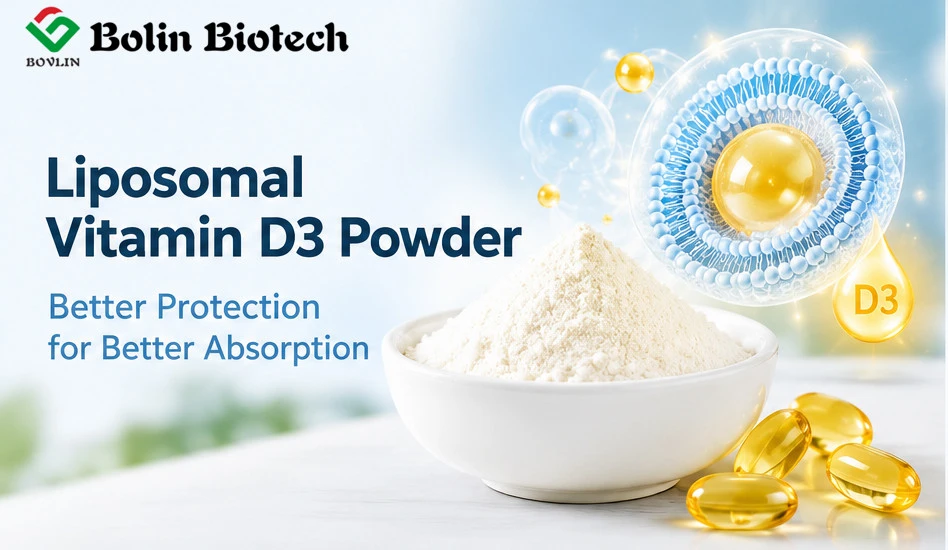
A liposome is a small, round ball made up of layers of phospholipids. Cell walls are made up of the same building blocks. It works that way with our Vesilipo™ liposomal vitamin D3 powder. Next, the powder is dried out, and the vitamin D3 that dissolves in fat is added to it. Cholesterol and non-GMO soy or sunflower lecithin are used to make the liposomes. Vitamin D3 is very pure; it's at least 98% pure. There are already liquid forms of vitamin C, K2, NMN, curcumin, and other things made on the Vesilipo platform. D3 doesn't change anything about the way things are already done. You can get COA, TDS, and tracking papers from Bolin Biotechnology. You can find out how much D3 was used and how well it was sealed on the batch COA.
How the Powder Disperses in Water
Vitamin D3 does not mix with water by itself. They are water-friendly because they have a phospholipid shell around them. When you mix the powder with water, it turns into a thin liquid. People who buy from me know that the particles will make the liquid a little cloudy. The mesh size, the carrier size, the particle size, and the water temperature can all be changed to change how fast the particles spread. Because strong pressure can break up vesicles, it is better to stir slowly than to blend quickly. Because it's different for each grade, you should test a piece in a real base that has the right pH. You can tell us what you want us to change about the mesh, particle size, and container.
Why Encapsulation Matters for Absorption
No matter what form vitamin D is in, the body can use it better or worse. A lot of study in the journals Molecular Nutrition and Food study has looked into this question and found that the carrier is very important. Small scientists who study food say that liposomes can also be used to keep delicate ingredients from breaking down. Empty boxes are not a promise; they are a way to keep something. To be true, the claims about bioavailability must be backed up by facts. Also, the way they talk about structure-function must follow FDA rules. You should ask any service about particle size, stability, and how well they surround before you say anything about absorption.
Application Potential: Using Liposomal Vitamin D3 Powder in Gummies, Capsules, and Beverages
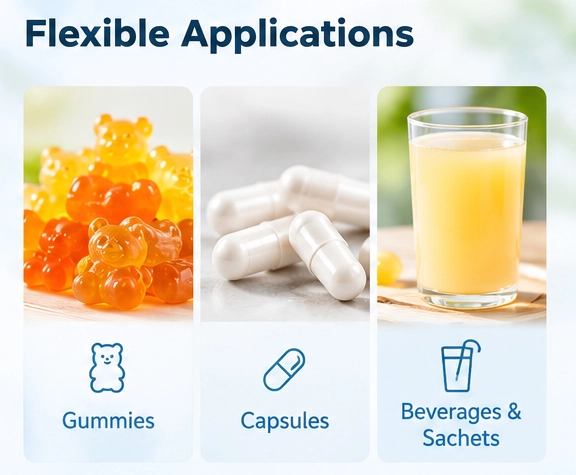
Gummies
It's hard to work with this shape. Heat is used to cook pectin and gelatin bases, but liposomes should not be touched with heat. After the pot has cooled as much as the process will allow, the powder should be added last. After that, mix it for a short time. After putting them in, check three things: how well the encapsulation stays in place, how much D3 is in the end pieces, and how they taste. Also, the vesicles can become less stable depending on the sugar, pH, and fruit acids used, so start by making small pieces. If you don't like pills, try gummies. Bolin Biotechnology also makes sweets, so we can test both test recipes and foods that are already made.
Capsules
As H3_005 says, capsules and powders work well together. It is possible to put liposomal vitamin D3 powder inside hard pills. This powder is frequently combined with magnesium or vitamin K2. To see if fill weights stay the same, you should look at a sample's flow, mass density, and static charge. To protect the vesicles, don't cut and use a dry blend instead. Also, don't let the humidity get too high, as water can make the cake stick together. Some pills are made from plants, so they are safe for vegetarians. An empty pill doesn't have any oil in it. It helps me a lot to make sure that the material of several full pills is the same before I start making them.
Beverages and Sachets
Better yet, put water in bottles and mix it with other drinks. Mix the powder with cool or room-temperature water, juice, or a plain drink base. Make sure the powder is well mixed so it doesn't settle or make rings that stick together. Before putting each drink base on the market, I think you should test them in the lab. Liposomal substances can be broken down by strong acids, alcohol, and hot drinks. Flow and static can make it harder to fill packets correctly, so check the D3 on each stick. People can take a bag instead of softgels or drinks. We can make the mesh and packing fit your filler line.
Comparative Analysis of Liposomal Vitamin D3 Powder Forms
Powder, Liquid, and Softgel Formats
It's important to remember that each style does something different. Lots of liquid liposomal things need to be kept cool or with stabilizers because they have water in them. Also, they weigh more when they are shipped. Softgels keep D3 in oil, but they make it harder to mix them with other powders and change recipes for the worse. Liposomal vitamin D3 powder gets rid of most of the water, which makes it easier to ship and lets the same raw material be used to make sachets, hard capsules, gummies, and drink mixes. Powders need to be kept dry and mixed slowly to protect the vesicles, which makes them harder to work with. I think you should first pick the format based on where you sell and how your customers usually buy things. After that, use stable facts to make sure you made the right choice.
Liposomal and Regular Vitamin D3
There are different kinds of D3: oil, beads, and dry powder. Many things on the market use it since it is cheap, simple to find, and has been looked into a great deal. This is because making liposomal D3 takes longer and costs more. It needs to be a big part of your line. This is often because it tells a different story, can spread water, and is small and easy to carry. It's not a good idea to say that your product takes more before you prove it. It is better to try than to guess because research on vehicle chemicals has shown that they can change how much vitamin D is taken in. You can turn a marketing line into a claim by looking at both sides for a short time.
Genuine Liposomes Versus Look-Alikes
Some things that say they are liposomal are actually just emulsions or small pills. To tell them apart, you need to see how the particle sizes are spread out and how well they are encased. If you can, you should also look at pictures of them under a microscope. Check to see if the mixture has cholesterol and where the phospholipids came from. Our Vesilipo™ platform already works with more than 12 liposomal ingredients, such as vitamin C, K2, NMN, curcumin, and berberine. The D3 grade is the same. You can ask for a video factory check if you want to see how it's done. You'll also get a COA, TDS, and traceability paper. This lets your team check each claim before a good editor does.
Key Considerations for Procurement Managers and OEM Clients
Specifications and Documents to Request
I think you should ask each seller for the following things before you place an order.
• Particle size and encapsulation efficiency: Ask for both the test method and the results at the same time. It's not possible to tell if something is "liposomal" without these numbers. Authorities often look for this space. On our COA, it says how much D3 is in it and how well it is sealed up. We can also talk about the project's particle size goals.
• Stability data: You can ask for information on oxidation, caking, and D3 loss, as well as the shelf life, in any format you want. Try out a few packets or gummies before you buy a lot of them. Ask for a real-time or faster study plan. A lot of brands say they work for 18 months. Write down how you put the things away.
• Powder handling data: the flow, bulk density, static, and mesh all affect how well sachet and pill filling stays in place. Write these numbers on a piece of paper. Next, check to see if the amount in each serving is the same by looking at how the content stays the same in a few full units. Some lots can be sent to your refill partner so that they can do these checks first.
These three data sets let your formulator evaluate the quality of liposomal vitamin D3 powder using measurable data rather than marketing language.
Certifications and Regulatory Readiness
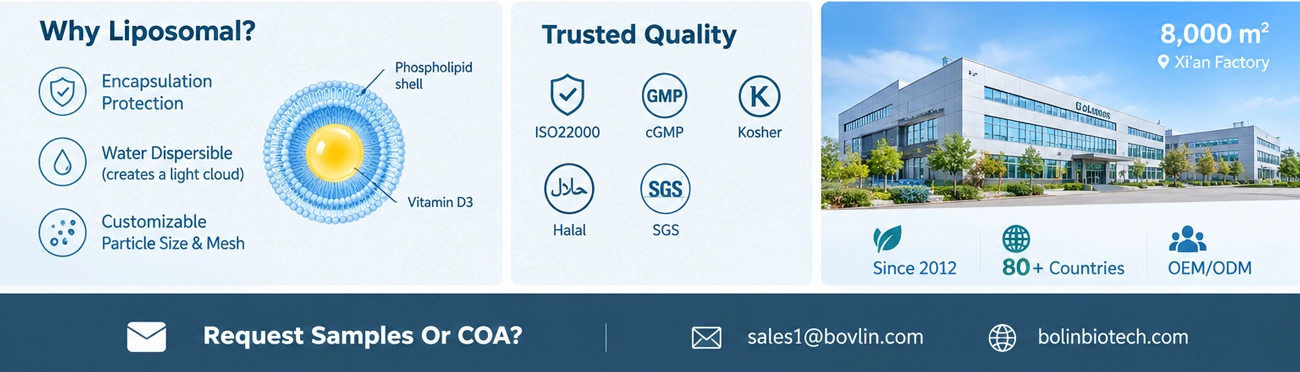
Since it started in 2012, that business, Shaanxi Bolin Biotechnology Co., Ltd., has been studying plants, turning them into useful drugs, and selling them. More than 80 countries get goods from our 8,000-square-meter plant in the Xi'an High-Tech Zone. We have certificates from SGS, Kosher, HACCP, cGMP, ISO22000, and HACCP. These are important for stores in the Middle East and among Jews. For the US market, keep in mind that claims about form and function must be allowed by the FDA and come with the usual warning. Also, claims of "high absorption" need to be shown to be true. The person who looks over the label for you should compare it to the real information we give them.
MOQ, Lead Time, and Customization
When you try something new, smaller test buys make it safer. We can send you more than 1 kg of free samples so that your team can try them out before you buy a lot. To ship standard items, it takes five to seven business days. To ship items that were made just for you, it takes two to three weeks. This D3 can have its appearance, particle size, mesh, packing, and label changed. You can even make your own label and put it on the D3. You can get D3 with magnesium, K2, or a mix of the two. We can take doses in the form of powder, pill, tablet, or candy. Tests for stability should be on your list, since getting real data on shelf life takes weeks, not days.
Safety, Dosage, and Usage Guidelines for Liposomal Vitamin D3 Powder
Dosage Reference Points
It helps the body take in calcium and phosphorus, which is good for bones. It makes the body stronger and helps the muscles. Adults over 70 should take 800 IU (20 mcg), and people ages 1 to 70 should take 600 IU (15 mcg). People aged 9 and up can only take 4,000 IU (100 mcg) per day. Brands can use these serving sizes. Structure-function rules set by the FDA are used to back up the claims on the labels. The people who use it the most are kids and teens, older adults, and people who spend most of the day inside. This is not medical advice; it's just general information.
Safety Profile and Interactions
The NIH says it is safe to take the amounts of vitamin D that are suggested. Too much, on the other hand, can raise the calcium level in your blood, which can make you sick, weak, or give your kidneys trouble. There are ways to make sure that people who take certain drugs, like some steroids and thiazide diuretics, can keep their vitamin D levels healthy. When mixed with D3, each item can only do certain things. Know what those limits are and make sure the mix works well. I don't believe that liposomal delivery would help you get more of the medicine. The label tells you how much to take each day. Don't take more than that. Make sure that the final formula is also looked over by a trained professional.
Storage and Handling
Read and follow the steps on the COA and TDS to store the powder. Keep it somewhere cool and dry that doesn't get any light. Blobs and clumps can get damaged by water, so quickly close the containers again and put opened bulk drums in dry packaging. Mix the powder slowly into water that is cool or at room temperature until it's all combined. You should drink the drink right away after mixing it. Goods that are already made should be wrapped in barrier packaging like paper sachets or sealed boxes with desiccant. Check the expiration date to make sure that the way you pack it will work. To find out how long something will last, I use any number as a guide until I see proof that it stays stable.
Conclusion
Liposomal vitamin D3 powder can be mixed with water and used in drinks, gummies, and pills, but each has its own limits. Water dispersion doesn't make a clear solution; it makes a fine mix that is a little cloudy. For sweets, adding must happen late at night and when the temperature is low. The inside of packages needs to stay the same and flow well. Also, drinks need to be checked for heat, acid, and mixing. There are more shapes and sizes that powder can be made into than drinks, softgels, or normal D3. However, it costs more to make and claims about absorption need data that is specific to the product. Buyers should look at the label and ask about certificates, particle size, stability, how well the product is packaged, and information on how it is handled. The NIH says amounts should stay within certain ranges and drugs should be kept somewhere dark, cool, and dry.
FAQ
Does liposomal vitamin D3 powder dissolve completely in water?
It spreads out instead of breaking up. The liposomes are very small pieces that float on water. They make the water look a little cloudy. Slowly mix the powder with your own base to make sure it's in the right pH range.
Is the powder more effective than capsules or gummies?
"Powder" does not refer to a different type of food. You can get it in pills, gummies, and tablets. Before you write the label copy, make sure that any claims about absorption are backed up by bioavailability data on the finished product.
What should I request when sourcing in bulk?
Ask for the COA, TDS, records of traceability, data on stability, and scores for powder flow. You can try a small amount first because we give away free samples and the smallest amount you can buy is 1 kg.
Request Samples of Liposomal Vitamin D3 Powder from Bolin Biotechnology
Bolin Biotechnology is a liposomal vitamin D3 powder supplier with Vesilipo™ technology, an 8,000 m² plant in Xi'an, and exports to over 80 countries. We hold ISO22000, HACCP, cGMP, Kosher, Halal, and SGS certifications, offer free samples, and accept orders from 1 kg with private label support. Send your formula and target format to sales1@bovlin.com, or visit bolinbiotech.com for details.
References
National Institutes of Health, Office of Dietary Supplements, "Vitamin D: Fact Sheet for Health Professionals," 2024.
National Academies Press (Institute of Medicine), "Dietary Reference Intakes for Calcium and Vitamin D," 2011.
Nanoscale Research Letters, "Liposome: classification, preparation, and applications," 2013.
Journal of Liposome Research, "Nanoliposomes and their applications in food nanotechnology," 2008.
Molecular Nutrition & Food Research, "Evaluation of vehicle substances on vitamin D bioavailability: a systematic review," 2010.
New England Journal of Medicine, "Vitamin D Deficiency," 2007.