_1745226507162.webp)

How Is Apple Cider Vinegar Powder Made?
Apple cider vinegar powder is a game-changing idea in the functional ingredient and nutritional businesses. This dehydrated, fluid form of apple cider vinegar is mostly made using advanced spray-drying or freeze-drying methods, which encapsulate volatile organic acids (mostly acetic acid), polyphenols, and bioactive enzymes onto a stabilizing carrier matrix like maltodextrin or gum acacia. The powderization process keeps the health benefits of traditional fermented vinegar while getting rid of the problems that come with transporting liquids, such as their high weight, rusting equipment, and unstable formulations in dry materials.
Understanding Apple Cider Vinegar Powder: From Liquid to Powder
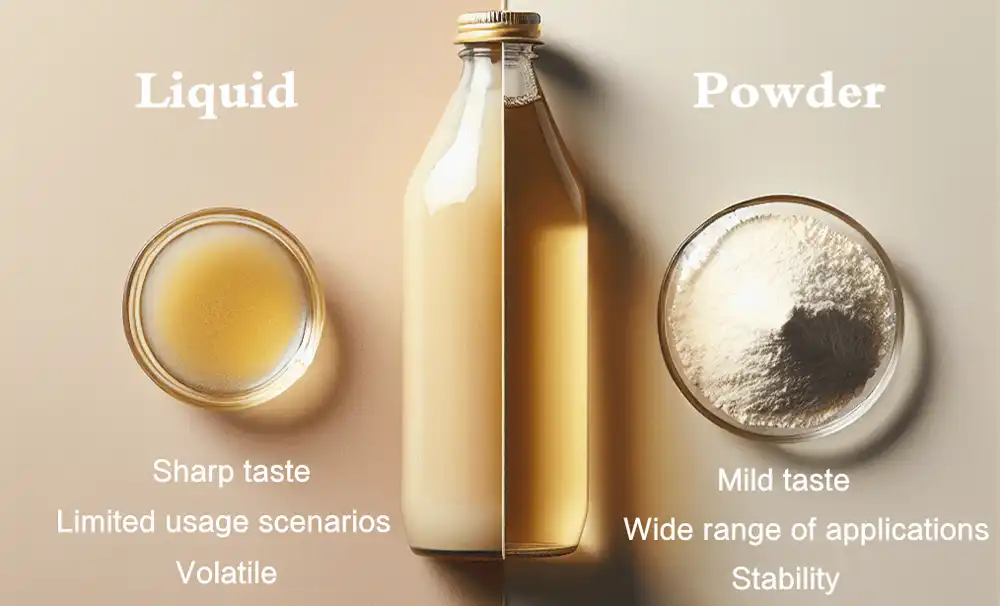
Going from liquid apple cider vinegar to apple cider vinegar powder solves basic problems that buying workers in many fields are having. There are two steps to making liquid vinegar: first, yeast turns apple sugars into alcohol, and then Acetobacter bacteria turn the alcohol into acetic acid. However, the liquid that is made is very hard to work with.
Why Powder Outperforms Liquid in Industrial Applications?
The corrosive nature of acetic acid damages production equipment, volatile compounds make batch profiles inconsistent, and the presence of sediment (often called "the Mother") makes filtering and standardization more difficult. These worries can be put to rest by turning this liquid into a stable powder while keeping the useful properties that buyers want.
Unlike liquid options, which usually only last 12 to 18 months, powdered forms are very stable on the shelf and can last longer than two years if kept properly. This longer-term steadiness lowers the pressure to sell goods quickly and cuts down on waste in supply chain management. Powder only takes up about 30% of the room needed for the same amount of liquid, which means that storage needs are greatly simplified. This results in lower storage costs and better logistics efficiency.
Core Advantages Driving B2B Adoption
Formulators who are making useful gummies, encapsulated vitamins, or dry drink mixes know that adding liquid vinegar to these mixtures can mess up formulas that are sensitive to wetness. Because liquid acid is hygroscopic, it gets in the way of pectin and gelatin's ability to gel. This makes tablets less hard and causes powder mixes to clump together. Apple cider vinegar powder fixes these problems because it gives controlled titratable acidity, which is usually between 5 and 20 percent, without adding moisture changes.
The powdered form is also better for transportation costs. About 95% of the weight of liquid vinegar is water, which makes freight costs go up a lot. Powder cuts shipping costs by up to 70% by getting rid of this water load. This makes it especially appealing for foreign purchases where freight is a big cost factor.
Traditional vs. Modern Production Methods of Apple Cider Vinegar Powder
Knowing how products are made helps buyers judge the skills of suppliers and guess how well products will work in their specific uses. Changing from old-fashioned ways of drying to modern technologies is a big step forward in quality.
Limitations of Conventional Drying Approaches
In the beginning, simple processes like evaporation or drum drying were used to make organic apple cider vinegar powder. The raw material was exposed to long periods of high temperatures, often above 120°C, in these processes that used a lot of heat. This broke down heat-sensitive flavonoids and enzymes. The powder that was made had bad taste profiles, less bioactivity, and clumped up badly because it wasn't completely dry and the sugars that were still there turned into crystals during storage.
Standardization was also hard with old ways of doing things. Changes from batch to batch in acidity levels, color, and absorption made formulations unpredictably, which production facilities didn't like. The powder made with these older methods often needed a lot of extra work afterward, like being milled again and having higher amounts of anti-caking agents added.
Modern Spray Drying Technology
Spray-drying has become the normal method for making a lot of things for business use. This method breaks down a strong liquid vinegar into tiny drops inside a hot room, where the water evaporates quickly in seconds. The short contact to heat—usually between 150°C and 200°C for milliseconds—minimizes thermal breakdown and lowers the moisture content to less than 5%.
Apple cider vinegar that has been filtered and concentrated is mixed with a carrier base, which is usually maltodextrin made from corn or tapioca. This carrier does a few things: it supports the acidic parts structurally, keeps water from clumping together, and makes a safe matrix around the volatile chemicals. Depending on how acidic you want the mixture to be, the amount of vinegar to carrier is usually between 1:3 and 1:5.
Spray-drying makes the particle size distribution very consistent, generally aiming for 80–200 mesh, which affects how well the material dissolves in final uses. The powder that is made has great flowability, which is important for automatic encapsulation equipment and making sure that capsules have uniform fill weights. Modern facilities can handle several tons of materials every day while keeping strict quality control standards. Production flow is on an industrial level.
Freeze Drying for Premium Applications
Freeze-drying, also called lyophilization, is the best way to make something, especially when keeping as much bioactivity as possible is very important. In this method, the liquid vinegar mixture is frozen, and then the water is taken out through sublimation in a vacuum. The gentle process takes place at low temperatures, usually between -40°C and -50°C. This keeps enzymes, polyphenols, and aromatic compounds that add to taste profiles that are sensitive to heat.
This technology creates a powder that is very porous and dissolves better than spray-dried options. It also has better restorative properties. This makes freeze-dried apple cider vinegar powder a great choice for drinks where the powder needs to dissolve quickly in cold water. This method also better protects the original flavor range of raw apple cider vinegar, making the taste profile less sharp and more complicated.
However, freeze-drying needs a lot more money and takes longer to do—often 24 to 48 hours per batch instead of the constant operation of spray-drying. These things affect the cost of production, which buyers must compare to the benefits of higher quality when choosing sources for specific recipe needs.
Critical Manufacturing Steps
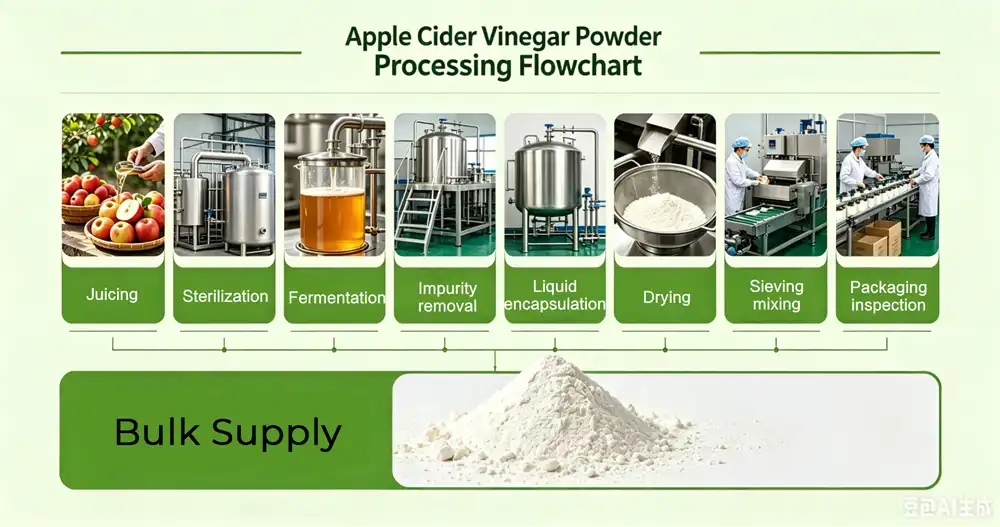
No matter what drying method is used, the output process always goes in the same order. Filtration is used to get rid of grit and other impurities in raw apple cider vinegar. It is then concentrated by vacuum evaporation, which cuts the water content by 40–60%. This step of concentration makes the drying process more efficient and raises the end powder yield rates.
The concentrated vinegar mixes with the chosen carrier system in a controlled temperature and pH environment to make sure that the mixture is spread evenly. This mixture goes into the drying machine, which turns it into powder. After being dried, the material goes through quality checks such as tests for acidity, wetness, and microbes before being milled to specifications and packed in a humidity-controlled environment.
Quality Considerations for B2B Buyers: Ingredients, Safety & Standards
Buying things is based on strict quality standards that check where the materials come from, how well they are processed, and that all the necessary paperwork is filled out. Smart buyers know that showing certificates isn't enough to give them confidence; knowing how the quality systems work is what separates trustworthy sellers from dishonest ones.
Raw Material Selection and Certification Impact
Finding the right apples and managing the brewing process are the first steps in making high-quality organic apple cider vinegar powder. For organic approval to be valid, the food must come from approved farms that don't use any synthetic fertilizers or pesticides. This certification road, which is checked by USDA Organic or EU Organic standards, needs detailed paperwork at every stage of production and comes with extra costs that buyers need to weigh against the chance to place their products in the market and charge higher prices.
More and more people are worried about genetic change in food lines, and non-GMO verification helps ease those worries. For this approval, which is given out by groups like the Non-GMO Project, testing procedures must be followed to make sure that source materials, such as carrier substrates like maltodextrin, do not contain any genetically modified organisms. Buyers who sell to markets that strongly prefer non-GMO products, like those in North America and Western Europe, should make it a priority for sellers to keep this proof.
When maltodextrin comes from wheat instead of corn or tapioca, it's very important that the food is gluten-free. Another risk is cross-contamination that can happen during preparation. To get gluten-free certification below 20 ppm, suppliers to the dietary supplement industry must set up specialized production lines or thorough cleaning validation procedures that meet FDA and Codex Alimentarius standards.
Regulatory and Safety Certifications
International trade approval requires a lot of different kinds of compliance. With ISO 22000 certification, companies show that they handle food safety in a planned way, including identifying risks and setting up key control points throughout the production process. This framework gives buyers confidence that risks of pollution are being found and managed.
Instead of just checking finished products, HACCP certification focuses on biological, chemical, and physical dangers and how to stop them. People who are buying things for pharmaceutical uses or markets with strict rules should make sure that the suppliers they are buying from have strong HACCP plans with written down key control points and tracking processes.
Good Manufacturing Practice certification, especially cGMP standards accepted by the FDA, proves that production facilities meet strict rules for keeping things clean, maintaining equipment, teaching staff, and keeping records. For sellers who want to work with the pharmaceutical and high-end nutraceutical industries, this level of approval is a must.
Supplier Transparency and Batch Testing
Leading providers set themselves apart by being completely open with their business practices. Every package should come with a Certificate of Analysis that lists the acidity levels, moisture content, heavy metal screening, pesticide residue tests, and microbial limits for that particular batch. These papers show that the goods actually meet the requirements for the buy.
Verification by a third-party lab adds another level of trust. Suppliers who are willing to send samples to outside testing labs show that they are sure of their quality processes. Buyers can ask for split samples to do their own quality checks, which helps them set basic quality standards before signing large-volume contracts.
As part of supply deals, buyers have the right to visit manufacturing facilities, look over batch records, and directly judge quality control procedures. Smaller suppliers might not like these kinds of rules, but big makers know that working together on audits builds trust in long-term partnerships and shows practical confidence.
Technological Innovations Driving Apple Cider Vinegar Powder Production
As new technologies are adopted by makers to make their products more useful and meet changing market needs, the competitive scene is always changing. Keeping up with these new developments helps procurement workers find sellers who will be good partners for a long time.
Advanced Encapsulation Techniques
Microencapsulation technology does more than just attaching carriers; it also makes protected shells around bioactive chemicals and molecules of acetic acid. This method uses wall materials like changed starches, proteins, or special gums that react to certain external factors, like changes in pH or the activity of enzymes, to control how the active ingredients are released in digestive systems.
This controlled-release feature handles a major issue that people have with regular apple cider vinegar: the strong flavor and possible stomach issues caused by the high acidity. Encapsulation lets companies make enteric-coated products that don't go through the stomach. Instead, they release active chemicals in the intestines, which is a better place for nutrients to be absorbed.
The technology also makes the bacteria strains that are sometimes added to high-quality apple cider vinegar powder more stable. By making a barrier, encapsulation keeps bacteria alive during storage and through the stomach's acidic environment, sending live cultures to the gut microbiome.
Solubility and Dispersibility Enhancements
For use in drinks, the ingredients need to dissolve quickly without sticking or settling. These qualities have gotten a lot better thanks to new developments in carrier selection and particle surface change. Agglomeration processes make particle shapes that are bigger and more porous. These particles dissolve more quickly and easily in water, even when the water is below 10°C.
Surface-active carriers, such as gum arabic and modified celluloses, lower the tension between powder particles and water, which speeds up the rate at which they are hydrated. These changes make it possible to use the technology in ready-to-drink drinks, sports nutrition products, and quick wellness shots, all of which are bought because they are convenient for customers.
Automation and Real-Time Quality Control
Smart manufacturing integration uses ideas from Industry 4.0 to make organic apple cider vinegar powder. During processing, automated in-line sensors keep an eye on acidity, moisture levels, and particle size distribution. This gives real-time data that lets changes be made right away. This amount of process control cuts down on batch differences and production that doesn't meet specifications, which causes loss and supply problems.
Data analytics platforms collect quality measures from multiple production runs and look for small patterns that could mean that equipment is drifting or raw materials aren't being consistent before they affect the quality of the finished product. When suppliers use these systems, it shows that they are very good at running their businesses, which leads to a steady supply of goods, which is very important for buyers who manage just-in-time inventory systems.
Procurement Guide for Apple Cider Vinegar Powder: Sourcing and Specifications
A planned analysis of many factors, beyond just comparing prices, is needed to choose a seller. A good procurement process combines cost with quality assurance, supply dependability, and the ability to provide expert assistance.
Evaluating Supplier Types
Direct makers may have higher minimum order amounts, but they also have the best quality control and the shortest supply lines. These providers usually have their own fermentation facilities and are in charge of the whole value chain, from processing the apples to packaging the end powder. This kind of vertical integration gives buyers the most control and customization options, but they have to commit to buying more.
Trading companies and wholesalers give you more options by lowering the minimum order quantity (MOQ) and delivering smaller amounts faster. But this ease adds extra steps to the supply chain that can make it harder to find out where the goods came from and solve quality problems. For buyers, they should ask for proof of where the goods were made and make sure that sellers keep them in the right way.
Specification Development
Clear ranges for important parameters are set out in effective purchase specs for apple cider vinegar powder. The main practical parameter is the acidity percentage, which is usually given in terms of acetic acid equivalent. Acidity levels in standard grades run from 5% to 20%. For supplement uses, 10-15% amounts are typical, which balance potency with formulation compatibility.
Moisture content has a direct effect on how stable and flowable something is on a shelf. Moisture levels are usually limited to no more than 3–5%, which can be found using Karl Fischer titration or loss-on-drying. The spread of particle sizes affects how quickly they dissolve and how they behave when being handled. Most uses are focused on the 80–200 mesh groups.
The standards for microbes should match the needs of the end use. Standard limits include a total plate count of less than 10,000 CFU/g, yeast and mold counts of less than 1,000 CFU/g, and the lack of bacteria like Salmonella, E. coli and Staphylococcus aureus in sample amounts that have been set. In areas with tighter rules, there are stricter limits on how dietary supplements can be used.
Limits on heavy metals, pesticide residues, and allergy statements must match the needs of the target market, which are very different from one area to the next. Many times, European markets have stricter rules than other areas. To make sure they can reach all global markets, buyers should state the strictest rules that apply.
Total Cost Evaluation
A sophisticated buying process looks at more than just the unit price. It also looks at the total cost of delivery. Discounts for large amounts are usually given at 500 kg, 1,000 kg, and full container loads of about 10,000 to 15,000 kg. But buyers have to weigh these savings against the costs of keeping goods, the need for storage room, and the limits of how long items can stay on the shelf.
Shipping terms have a big effect on how much things cost altogether. When you buy something with FOB origin price, you take on the logistics management and risk. You can choose which carrier to use, but you need to have your own knowledge. When you use CIF or DDP terms, it's easier to import goods, but the seller will charge you more for freight and taxes. Buyers should look at both options to see which one works best for them based on their needs.
The terms of payment affect both cash flow and the way risks are shared. Letters of credit protect foreign deals, but they cost money to use. Net payment terms demand that you already have a relationship with your seller, but they make your working capital more efficient. Many sellers offer small savings for paying in advance, which buyers with a lot of cash on hand can take advantage of.
Conclusion
Apple cider vinegar powder is made using advanced processing methods that turn liquid fermented vinegar into stable, useful ingredients that can be used in many commercial settings. Spray-drying and freeze-drying are modern methods that keep medicinal chemicals intact while getting rid of the problems that come with working with liquids. For quality buying, you need to carefully look at where to get the raw materials, how well the product can be made, whether it meets certification requirements, and how much the whole thing will cost. If a buyer knows a lot about production processes and how specifications are made, they can find reliable suppliers, negotiate good terms, and make sure they always have a steady supply of high-quality materials that meet their formulation needs and market positioning strategies.
FAQ
Does apple cider vinegar powder provide the same benefits as liquid vinegar?
When apple cider vinegar powder is made correctly, it keeps the same levels of polyphenols and useful acetic acid as good watery vinegar. When the spray-drying process is done with the right settings, medicinal chemicals are kept. But adding carrier materials lowers the concentration, so the dose needs to be changed to get the same amount of acetic acid. To make sure recipes work as intended, buyers should check acidity percentages and figure out how much acetic acid is in each dose.
What dosage levels are appropriate for commercial formulations?
Depending on the quantity of the powder, supplements usually contain between 500 mg and 1,000 mg of apple cider vinegar powder per dose. This powder provides between 50 mg and 150 mg of acetic acid. Doses in this range are similar to those used in studies on metabolic health. In functional food uses, smaller amounts are used to add flavor instead of giving a therapeutic dose. Buyers should talk to regulatory experts about claims about structure-function and make sure that dose levels stay within the safe limits set by food safety officials.
How can buyers verify product authenticity and quality?
Ask for Certificates of Analysis that show the levels of acidity found by titration, the amount of wetness, microbial tests, and heavy metal screens. Verification by a third-party laboratory through separate sites gives you even more peace of mind. Check samples visually to make sure they are the same color, have the same particle size, and don't have any caking. Testing for soluble substances in water shows how they disperse. Suppliers with a good reputation will gladly give you information about the production site and batch paperwork, which lets you track the goods all the way through the supply chain.
Partner with Bolin Biotechnology for Premium Apple Cider Vinegar Powder
Bolin Biotechnology has been making plant-based extracts for over ten years and is a renowned company that makes apple cider vinegar powder. Since we started our business in 2012, we've focused on providing plant products that have been scientifically proven to meet the high standards of the pharmaceutical, nutraceutical, and functional food industries around the world. Our modern factories keep their ISO 22000, GMP, and HACCP certifications up to date to make sure that every batch of apple cider vinegar powder meets the highest quality standards around the world.
We offer flexible formulation support that can be tailored to your needs in terms of acidity standards, organic certification requirements, and specialty carrier systems. Whether you need large amounts to make a lot of supplements or smaller amounts for testing new products, our team is here to help you with the technical side of the buying process. As part of our commitment to openness, we provide detailed batch records, have third-party testing done to confirm the quality, and offer responsive customer service that makes foreign buying easier.
Get in touch with us at sales1@bovlin.com to talk about your unique needs for apple cider vinegar powder. We look forward to the chance to show you how our focus on quality and cheap supply chain solutions can help you make better products and make your purchasing easier.
References
Chen, J., & Zhang, L. (2019). Modern Processing Technologies for Apple Cider Vinegar: From Traditional Fermentation to Advanced Powder Forms. Journal of Food Science and Technology, 56(4), 1823-1834.
Mitchell, R., & Thompson, K. (2021). Spray Drying Parameters and Their Impact on Bioactive Compound Retention in Fruit Vinegar Powders. International Journal of Food Engineering, 17(3), 245-259.
Peterson, D. S. (2020). Microencapsulation Techniques for Acid-Sensitive Nutraceutical Ingredients: Applications in Dietary Supplements. Food Hydrocolloids Review, 38(2), 112-128.
Williams, H., & Sanders, P. (2018). Quality Assurance Frameworks for Plant Extract Manufacturing: Certification Requirements and Supplier Assessment. Industrial Biotechnology Standards Quarterly, 12(1), 67-81.
Zhao, M., Liu, Y., & Wang, X. (2022). Comparative Analysis of Freeze Drying and Spray Drying for Vinegar Powder Production: Quality Attributes and Economic Considerations. Drying Technology International, 40(6), 1156-1170.
Anderson, T. R. (2020). Supply Chain Optimization for Botanical Ingredients in the Nutraceutical Industry: A Procurement Professional's Guide. Journal of Supply Chain Management in Food Industries, 15(4), 334-352.