How Is Bulk Boswellia Serrata Extract Powder Used in Dietary Supplements?
Bulk Boswellia serrata extract powder is a standardized botanical substance that comes from the resin of the Indian Frankincense tree (Boswellia serrata). The active chemical, Boswellic Acid (CAS 631-69-6), inhibits the 5-lipoxygenase (5-LOX) enzyme, inhibiting leukotriene production, the root cause of chronic joint inflammation. You’ll find it in dietary supplements including joint health capsules, sports recovery mixes, functional drinks, and nutricosmetic formulations. Offered in 30%, 65%, and 90% standardizations, it provides producers with a precise, scientifically substantiated active to underpin product effectiveness claims across numerous SKUs.
What Boswellic Acid Actually Does Inside a Formula
The 5-LOX Mechanism in Plain Terms
The enzyme 5-LOX converts arachidonic acid into leukotrienes, substances that promote inflammation in the tissue of joints. This transformation is blocked immediately by boswellic acids, specifically AKBA (acetyl-11-keto-beta-boswellic acid). This process differs from NSAIDs and avoids the danger of stomach ulcers associated with COX-2 inhibitors. This is a huge advantage for promoting clean label supplements.
Why Standardization Grade Changes Everything
The figure for a 65% titration grade and a 65% HPLC grade is the same, although they operate quite differently. Titration measures all organic acids, including the inactive acids. HPLC tests each Boswellic Acid by name, so formulators may have trust that every dosage has the quantity of active component stated. Regulatory reviewers and scientific advisors anticipate that businesses making “5-LOX inhibition” structure/function claims will have HPLC-verified content as the professional standard.
Dosage Ranges Backed by Clinical Research
Published clinical investigations on Boswellia serrata have employed doses of 300–500 mg/day of an extract standardized to at least 30–40% boswellic acids. Effects that are measurable in osteoarthritis studies have been shown with lower dosages around 100 mg from the high-potency AKBA-enriched grades (>30% AKBA). These data points enable formulators to develop correct label claims that do not make fraudulent claims, which is becoming a more essential element as the FTC and FDA look more carefully at it.
Core Application Scenarios Across Supplement Categories
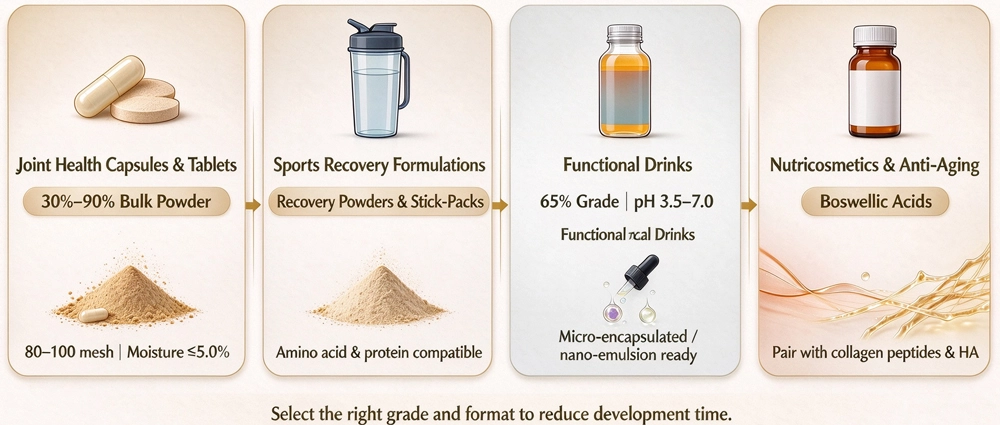
There are four primary kinds of products that may be made from Boswellia serrata extract, and each has distinct production demands. Knowing the proper grade and format for each use case will save development time and the danger of having to do the entire thing again.
Here are the four most common areas Indian frankincense extract has been shown to be effective in:
- Joint health capsules and tablets: The 30% - 90% Bulk Boswellia serrata extract powder grades are blended directly with glucosamine sulfate, chondroitin, and MSM in normal capsule or tablet manufacture. The particle size of 80-100 mesh provides homogeneous mixing and uniform dosage/unit. Moisture level ≤5.0% provides stable encapsulation with no caking or flow problems on high-speed filling lines.
- Sports recovery formulations: Boswellia's leukotriene-blocking action is beneficial in post-workout treatments geared for exercise-induced muscular inflammation. The extract is stable at typical mixing temperatures and suitable for amino acid matrices and protein bases, making it a convenient ingredient for use in recovery powders and stick-packs.
- Functional Drinks: The 65% grade is stable from pH 3.5–7.0, which is where normal RTD health shots, herbal teas, and acidic wellness beverages sit. The natural extract is lipophilic, and so in totally aqueous systems a micro-encapsulated or nano-emulsion form is required. Bolin’s 65% grade is approved for these liquid applications.
- Nutricosmetics and anti-aging: Orally administered beauty products against skin inflammation and oxidative stress include Boswellic acids, collagen peptides, and hyaluronic acid. The antioxidant nature of the resin extract provides a supplementary mechanism to traditional anti-aging ingredient stacks.
These four categories include the majority of new products being produced in the US supplement industry. That, in turn, makes it easier for sourcing specialists to add new goods to their books.
How to Evaluate Supplier Quality Before Committing to a Purchase
There's more to picking a Bulk Boswellia serrata extract powder supplier than just how much it costs per kilogram. A supplier's ability to support a product line for a long time is based on how consistent batches are, how many certifications they have, and how well they set up systems for tracking.
The Six-Stage Testing Baseline
A reliable supplier uses HPTLC to check the botanical identity, HPLC to measure the amount of Boswellic Acid present, ICP-MS to check for heavy metals (Pb <3.0 ppm, As <2.0 ppm), GC-MS/MS to look for pesticide residues, microbial testing (<1,000 cfu/g, confirmed absence of E. coli and Salmonella), and physical property testing to check the bulk density and flowability. Each of these steps deals with a different type of failure that can ruin a finished product.
Certifications That Open Market Doors
Getting certified as KOSHER, HALAL, Organic, HACCP, or ISO 22000 isn't just a formality; it's a way to get into new markets. Natural food stores in the US, health food sellers in the EU, and buyers in the Middle East all need subset versions of these. If one provider has all five, there's no need to check with more than one source for each area SKU, which makes the supply chain a lot easier.
Traceability From Field to Finished Lot
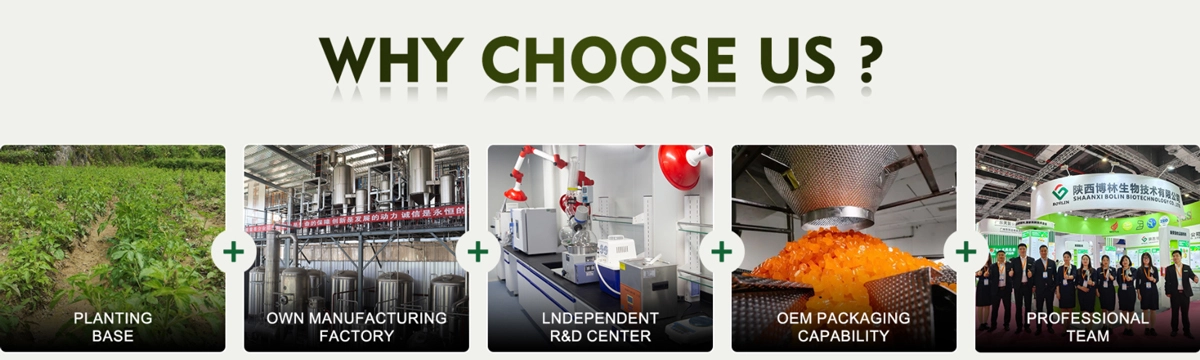
It's important to know where a lot of resin came from because the color and quantity of Boswellic Acid change depending on when the resin was harvested and where it came from. Suppliers with field-level lot traceability can keep track of the chain from the 25,800-acre growing base to extraction, testing, and shipping. This is necessary for brands that put out supply chain transparency reports or work with retailers that check where ingredients come from.
Practical Procurement Considerations for B2B Buyers
Sourcing personnel should get a Certificate of Analysis (CoA), third-party lab report, and consistent data for the grade they wish to utilize before they make their first purchase. However, the common minimum order quantity of 25 kg means that teams may produce sample batches of items without committing to too much inventory. If you are working on an OEM project that requires private label capsules, pills, sachets, or bulk containers, having the manufacturer offer multilingual labeling and nutritional panel manufacturing may save you several weeks of work after the purchase. QC teams may use free samples to do their own checks before finalizing specifications.
Conclusion
Bulk boswellia serrata extract powder is a popular ingredient in the joint health, sports recovery, functional drinks, and beauty nutrition areas. Supplement manufacturers may get all the standardization options they need from one source, including 30%, 65%, and 90% Boswellic Acid, and the rigorous six-stage testing and certification portfolio they need to market their products in the US, EU, and beyond. If you are serious about confirmed active content, consistent supply, and OEM freedom, then you would do well to choose a supplier of Boswellia extract that is qualified directly, as it will help both with product integrity and company scalability.
FAQ
1. What is the difference between 30%, 65%, and 90% Boswellic Acid grades?
The percentage reflects the concentration of Boswellic Acids in the extract. Higher grades deliver more active per gram, allowing smaller serving sizes or stronger label claims. The 30% grade suits general joint wellness products, 65% is favored for functional beverages and mid-potency capsules, and 90% serves clinical or high-dose formulations.
2. Is Boswellia serrata extract water-soluble for beverage use?
Native powder is lipophilic. For aqueous beverage systems, use a micro-encapsulated or emulsified grade. Bolin's 65% grade is validated for pH 3.5–7.0 stability in liquid applications.
3. How should bulk extract be stored to protect shelf life?
Store in sealed, light-resistant containers in a cool, dry environment. Avoid direct sunlight, moisture, and excess heat. Under proper conditions, shelf life is 24 months.
4. Can Boswellia extract be co-formulated with glucosamine and MSM?
Yes. The 80–100 mesh powder blends well with glucosamine sulfate, chondroitin, and MSM in standard capsule and tablet manufacturing processes.
5. What certifications should I verify before sourcing?
Confirm KOSHER, HALAL, Organic, HACCP, and ISO 22000 for multi-market coverage. Request a current CoA and third-party lab report for each incoming lot.
Request a Sample From Bolin Biotechnology — Bulk Boswellia Serrata Extract Supplier
Since 2012, Shaanxi Bolin Biotechnology Co., Ltd. has been in business, providing pharmaceutical-grade plant extracts from a confirmed 25,800-acre growth base. Our bulk boswellia serrata extract powder comes in grades of 30%, 65%, and 90%. It has been checked in six stages by a lab and comes with full certification coverage. Contact our technical team at sales1@bovlin.com to get a free sample or talk about OEM formulation support.

References
1. Sontakke, S. et al. "Boswellia serrata extract in knee osteoarthritis: A randomized, double-blind trial." International Journal of Ayurveda Research, 2007.
2. Kimmatkar, N. et al. "Efficacy and tolerability of Boswellia serrata extract in treatment of osteoarthritis of knee." Phytomedicine, 2003.
3. Abdel-Tawab, M. et al. "Boswellic acids: A group of promising anti-inflammatory agents." Clinical Pharmacokinetics, 2011.
4. Gupta, I. et al. "Effects of Boswellia serrata gum resin in patients with ulcerative colitis." European Journal of Medical Research, 1997.
5. Ernst, E. "Frankincense: Systematic review." British Medical Journal, 2008.
6. Safayhi, H. & Sailer, E.R. "Anti-inflammatory actions of pentacyclic triterpenes." Planta Medica, 1997.