How to Choose High-Quality Rutin Powder
Selecting the proper provider of rutin powder is one of those choices that will discreetly impact your product's effectiveness, your consumers' confidence, and your brand's long-term reputation. If you’re making a cardiovascular supplement, vein-health capsule, or antioxidant skincare serum, the quality of your rutin ingredient can be more important than most purchasers realize at first. Pure rutin powder — isolated from Sophora japonica flower buds and standardized to not less than 95% purity by HPLC — is not a commodity that "close enough" will do. This book will show you precisely what to look for, what to ask, and how to avoid the sourcing blunders that waste time and money.
Why Rutin Powder Quality Defines Your End Product
What Rutin Actually Is
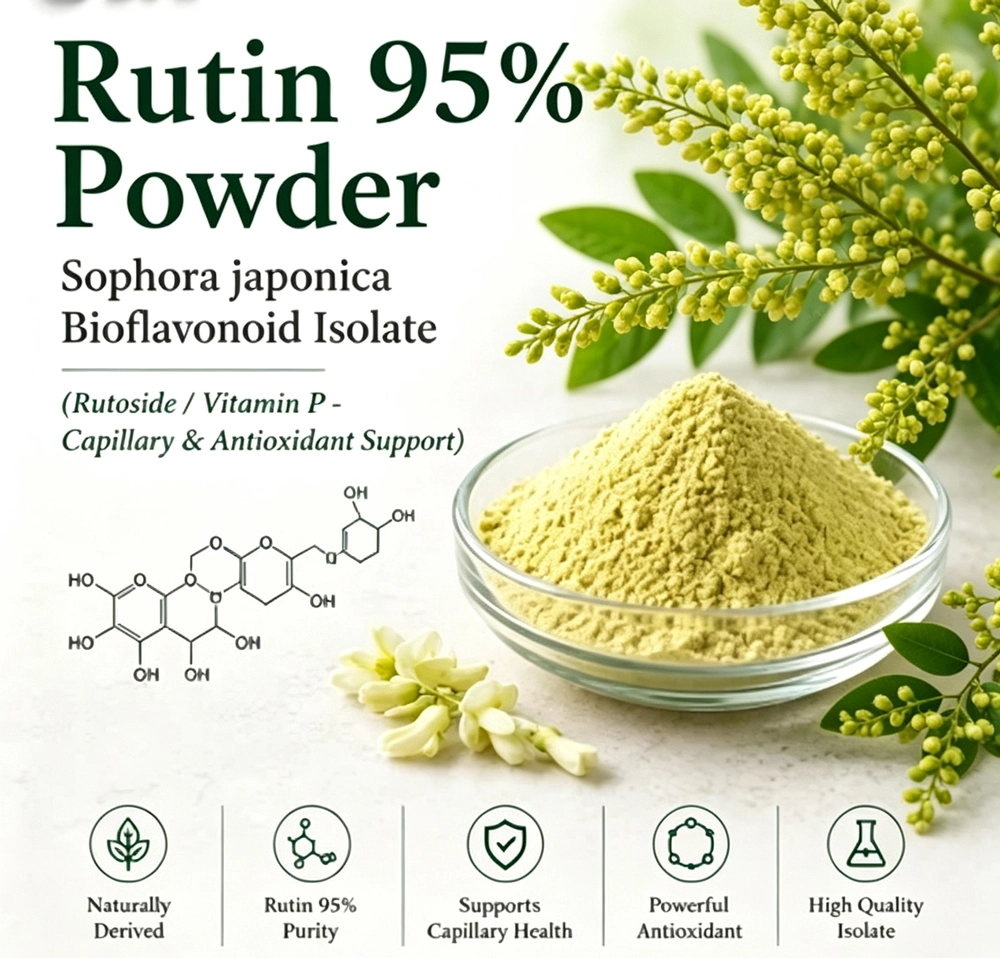
Rutin (CAS 153-18-4) is a flavonoid glycoside and is a member of the class of flavonols. Quercetin-3-O-rutinoside is another name for it. It is mostly produced from the dried flower buds of the Japanese Pagoda Tree (Sophora japonica). Its chemical formula is C27H00O16 and its molecular weight is 610.52 grams. It may be used for stabilizing the capillaries, fighting inflammation, and protecting against free radicals. These actions rely on the standardized concentration.
How Purity Affects Efficacy
Depending on how it was prepared, “rutin extract” may be anywhere from 40% to 98% active material. That is the problem with lower purity levels. Botanical impurities decrease effective dosage, create batch variances, and introduce variables that will be difficult for your quality control team to monitor. High-purity rutin (generally ≥95% by HPLC) provides formulators with the steady starting point needed to make valid label claims and achieve the same outcomes in all manufacturing runs.
The Business Risk of Substandard Rutin
There is a lot of evidence that changed or mislabeled chemicals may create legal concerns. Under U.S. FDA Dietary Supplement cGMP regulations (21 CFR Part 111), manufacturers are required to verify the name and purity of ingredients. Buying from a supplier without the correct documents may land you with a defective product, recalls, compliance audits, and a reputation that might take years to repair.

Core Criteria for Evaluating a Rutin Powder Supplier
Purity Verification and Testing Standards
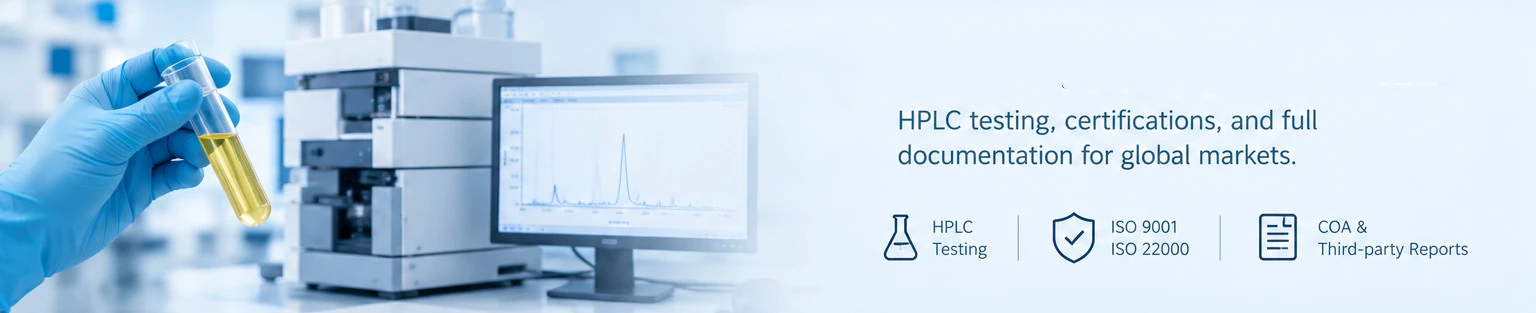
The most essential factor is purity, which is proven by HPLC. Request a COA to state heavy metals < 10 ppm, rutin concentration >95%, and loss on drying <5%. A good vendor will additionally include lab reports from a 3rd party such as SGS or something similar. If a vendor is unwilling to provide these documents or just provides data from internal testing, it should be a red warning for you to dig deeper before proceeding.
Certifications That Matter for Global Markets
If a buyer wants to sell their products into the U.S., EU, or Australia, they need to look at ISO 9001 (quality management), ISO 22000 (food safety management), and follow pharmacopeial standards such as USP or NF11. Bolin Biotechnology adopts ISO 9001 and ISO 22000 processes and has third-party certification from SGS. Here is an example showing the corporation is in compliance with the regulations of regulated markets. These certificates prove product testing as well as process control.
Particle Size, Solubility, and Physical Specs
Rutin is sparingly soluble in cold water (approximately 0.125 g/L), but soluble in ethanol and alkaline solutions. So when you make supplements into tablets or capsules, the size of the particles directly affects how uniform the mix is. Requiring 95% passing 80 mesh, such as Bolin’s Rutin NF11, helps pure rutin powder flow well in high-traffic areas. Cosmetic formulators should be aware that for aqueous-phase usage, they generally need to emulsify or alter the pH.
Rutin vs. Related Flavonoids: Making the Right Ingredient Choice
Rutin, Quercetin, and Hesperidin Compared
Rutin and quercetin are both flavonols, but rutin has a rutinose sugar group that changes how it is absorbed and how it reacts when it is mixed with other substances. In some delivery formats, quercetin is more bioavailable than rutin. However, rutin is better at staying stable in water and is preferred for vein health and capillary support. Hesperidin is a flavonoid that comes from citrus fruits. It targets similar circulatory pathways, but it comes from a different source and has different allergy concerns for some markets.
When to Choose Rutin Over Other Flavonoids
When your formula is meant to treat chronic venous insufficiency, capillary fragility, or antioxidant skin protection, rutin is the best ingredient to use. It also works as a stabilizer for Vitamin C in supplement mixes, stopping the breakdown of ascorbic acid that is caused by copper and making the supplements last longer. Because rutin has been regulated and studied for a long time, it is a safer ingredient for OEM brands making cardiovascular or vein-health products than alternatives that haven't been studied as much.
Matching Ingredient Grade to Application
Pharmaceutical-grade rutin that meets USP or NF11 standards can be used in supplement formulas that have to stick to strict label claims. Cosmetic-grade rutin, which is found in anti-aging creams and serums that make the skin look younger, may be able to meet a few more physical requirements, but it still needs to be tested for heavy metals and microbes. For functional food and drink uses, the ingredient supplier usually needs to have food safety certification (ISO 22000 or something similar).
| Comparison Dimension | Rutin | Quercetin | Hesperidin |
|---|---|---|---|
| Chemical Classification | Flavonol with a rutinose sugar group | Flavonol (aglycone, no sugar moiety) | Flavonoid derived from citrus fruits |
| Structural Feature | Quercetin + rutinose (disaccharide) | Aglycone | Hesperidin with sugar moiety |
| Absorption | Slower absorption, but better aqueous stability | Higher bioavailability in certain delivery formats | Targets similar circulatory pathways, different absorption mechanism |
| Water Solubility / Stability | Good stability in water, suitable for water-based formulas | Less effective in water-based forms | Stability depends on formulation environment |
| Core Functional Focus | Vein health, capillary support, antioxidant skin protection | Rapid-absorption antioxidant formulas | Circulatory support, collagen formation |
| Source | Sophora japonica (Japanese pagoda tree) and other plants | Various plant sources | Citrus peel |
| Allergy / Market Considerations | Long regulatory history, well-studied, high acceptance among OEM brands | — | Some markets require citrus allergen labeling |
| Regulatory & Market Maturity | Long regulatory history and extensive research; suitable for cardiovascular/vein-health products | Well-studied but formulation-dependent | Different source; allergen labeling requirements vary by market |
Practical Steps to Source and Verify Rutin Suppliers
Start with a 1 kg Sample Order
A low minimum order quantity isn't just helpful; it's also a way to make sure the quality of the product. Bolin Biotechnology has a minimum order quantity of 1 kg, which lets purchasing teams do their own HPLC testing, make small test batches, and compare COA data to their own results before committing to large orders. Any provider that won't let you do a sample review on this scale should be looked at closely.
Before you place a business order, you should ask any rutin pure rutin powder provider for these key documents:
- Certificate of Analysis (COA): Confirms purity (≥95% HPLC), particle size, loss on drying, and heavy metals per batch.
- Third-party test reports: SGS or equivalent independent lab verification of heavy metals, pesticide residues, and microbiological safety.
- Quality system certifications: ISO 9001 and ISO 22000 certificates with valid dates and issuing body details.
- Regulatory support documents: Safety Data Sheet (SDS) and any applicable pharmacopeial grade designation (USP, NF11, EP).
These papers together give your QC and regulatory teams the information they need to file product dossiers and respond to market audits.
Evaluate Batch-to-Batch Consistency
It doesn't matter how good a single batch is if the next package tests at 91% pure instead of 95%. To find out what the differences are, ask providers for COA records for at least three different production runs. Consistent HPLC results across runs show that the process is being controlled and that the raw materials are coming from a known source. Both of these things keep your recipe stable over time.
Assess Communication and Lead Time Realistically
Breaks in the supply chain are a real risk in procurement. Before confirming a supplier, find out how to communicate a reorder and how much stock is currently available. Trading middlemen who get their supplies from several third parties are less likely to be able to meet deadlines than suppliers who have their own production facilities and keep track of their stock.
Integrating Rutin Powder Correctly into Your Formulations
Dosage Guidelines by Application
Clinical investigations of rutin administration have given dosages of 500 milligrams to 4,000 milligrams by mouth daily to help blood vessels. The label dosage for dietary supplements normally suggests 250 mg to 500 mg per serving. In cosmetics, rutin is commonly included in dermal preparations at a range of 0.1% to 0.5% w/w. You will want to compare these data to what your regulatory expert has given you for the market you are filing in.
Storage and Handling to Preserve Potency
Light affects Rutin. Powder will darken and lose its active contents if exposed to UV light for an extended period of time. To protect the rutin powder from light and moisture, pack it in double-lined plastic bags, hermetically sealed in fiber drums. Bolin Biotechnology ships Rutin NF11 in foil bags and fiber drums to ensure product integrity during shipping and storage.
Compatibility Considerations for Formulators
In water-based mixes, rutin is significantly easier to dissolve by raising the pH to alkaline levels (pH 7.5-9). Rutin blends nicely with typical fillers in tablets and capsules but only if the mixing procedures have been studied and confirmed to function. If they are not, the mixture may separate when the density varies. Cosmetic chemists need to utilize an appropriate emulsifier system to retain the physical stability of cream bases containing rutin when the temperature changes.
Conclusion
In the end, choosing a pure rutin powder ingredient is a matter of managing risk. The better your supplier’s paperwork, the better you can defend your goods in the market. The quality of your end product is the quality of your raw ingredients. Procurement teams may design a sourcing process with third-party testing, batch uniformity, validated purity, and traceable sourcing to safeguard the product and the company. They may also accomplish this by asking for a sample before they commit to a major purchase.
FAQ
1. What is the standard purity specification for pharmaceutical-grade rutin powder?
For pharmaceutical and nutritional uses, the quality must be at least 95%, which can be checked using HPLC. This is in line with pharmacopeial standards like NF11 and USP. This is met by Bolin's Rutin NF11 (CAS 153-18-4), which has heavy metals below 10ppm and loss on drying below 5%. This supports regulatory reports in the US, EU, and Australian markets.
2. How do I distinguish a genuine manufacturer from a trading intermediary?
Ask the supplier for their ISO certificate and information on the organization that issued it. Also, ask for a facility audit or third-party inspection report and check to see if their COA lists an internal batch production code. Companies like Bolin Biotechnology, which was founded in 2012 and has both ISO 9001 and ISO 22000 certifications with third-party verification from SGS, can provide this paperwork consistently for all orders.
3. Is rutin powder suitable for cosmetic formulations?
Yes, rutin can be used in cosmetic products to fight free radicals and has been shown to have anti-aging and skin-brightening effects by blocking UV light and preventing glycation. When buying things to use in cosmetics, formulators should ask for more than just the usual COA. They should also ask for microbiological test results and heavy metal reports.
4. What is the MOQ for sampling rutin powder from Bolin Biotechnology?
The smallest amount that can be ordered is 1 kg, which allows for trial batches and independent lab checks before committing to a large order.
Source Your Rutin Powder from Bolin Biotechnology
Bolin Biotechnology has been providing standardized plant extracts to business-to-business clients around the world since 2012. They follow the ISO 9001 and ISO 22000 quality systems and have a third party, SGS, check their work. Our pure rutin powder source can handle orders from 1 kg as a sample up to bulk business supply. We offer batch COA, full regulatory paperwork, and direct technical help in English. To get a sample, COA, or formulation consultation, email our team at sales1@bovlin.com.

References
1. Havsteen, B. H. (2002). The biochemistry and medical significance of the flavonoids. Pharmacology & Therapeutics, 96(2–3), 67–202.
2. Ganeshpurkar, A., & Saluja, A. K. (2017). The pharmacological potential of rutin. Saudi Pharmaceutical Journal, 25(2), 149–164.
3. U.S. Pharmacopeial Convention. (2023). United States Pharmacopeia and National Formulary (USP–NF). USP.
4. European Medicines Agency. (2016). Assessment report on Sophora japonica L., flos. EMA/HMPC/513895/2014.
5. U.S. Food and Drug Administration. (2007). Current Good Manufacturing Practice in Manufacturing, Packaging, Labeling, or Holding Operations for Dietary Supplements; Final Rule (21 CFR Part 111). FDA.
6. Chua, L. S. (2013). A review on plant-based rutin extraction methods and its pharmacological activities. Journal of Ethnopharmacology, 150(3), 805–817.