How to Choose a Bulk Brown Rice Protein Powder Supplier
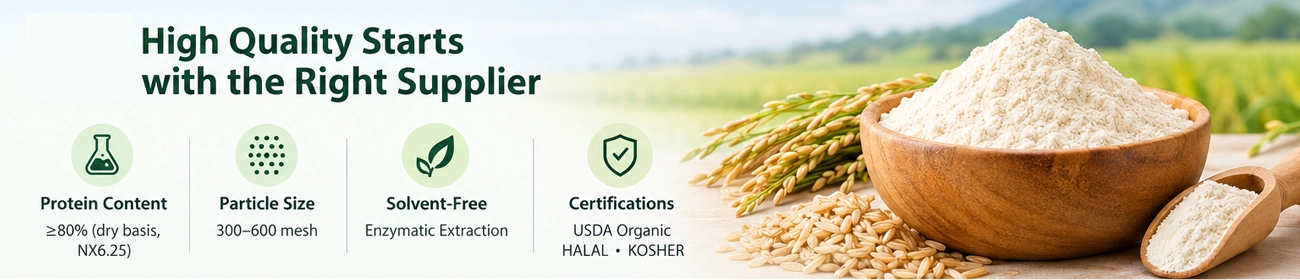
Choosing the right bulk brown rice protein powder supplier directly affects your product quality, production continuity, and brand reputation. A qualified supplier should offer verified protein content at 80% or higher (dry basis, NX6.25), solvent-free enzymatic extraction, fine particle size (300–600 mesh), and recognized certifications such as USDA Organic, HALAL, and KOSHER. Beyond the spec sheet, reliability matters — consistent batch quality, in-stock inventory, and responsive technical support separate a true manufacturing partner from a basic commodity vendor.
Understanding Your Procurement Needs and the Market Landscape
Why Plant-Based Protein Demand Is Rising
The market for plant-based proteins grew steadily and hit $14.5 billion in 2023 (Grand View Research, 2023. Sports nutrition, meal replacement, and functional food brands are actively changing their recipes to use allergen-free protein sources. Many people like brown rice protein because it doesn't contain dairy, soy, or gluten, which are three of the most common allergens.
Who Is Buying Brown Rice Protein in Bulk
There are three main types of B2B buyers who buy rice protein concentrate in large amounts: sports nutrition brands that want to add more plant-based protein to their diets, contract manufacturers that make private-label powders and bars, and ingredient distributors that keep stock for clients further down the line. Different types of people have different needs. Brands care about taste and formulation, producers need consistent batches, and distributors want solid lead times.
Common Procurement Challenges
Purchasing managers often complain about three problems that keep coming up: protein content errors on COA documents, color and taste differences between shipments, and trouble getting multi-market compliance paperwork. Before committing to a provider, these risks can be cut down a lot by checking HPLC amino acid profiles and asking for SGS third-party test results.
Establishing Core Supplier Evaluation Criteria
Certifications That Actually Matter
When looking for plant-based bulk brown rice protein powder and products for sale in North America or Europe, you have to make sure they have certain certifications. USDA Organic says that no pesticides are allowed to be used. Certifications like HALAL and KOSHER let you reach a lot of different types of customers. ISO 22000 talks about how to handle food safety at the production level. If a seller has all five of these certifications—ISO9001, ISO22000, HALAL, USDA Organic, and KOSHER—they have already been through several levels of independent auditing, which makes it much easier for you to check them.
Supply Chain Reliability and Lead Times
A scientifically good product doesn't mean much if it's hard to get. Ask wholesalers how much stock they have now, how long it takes to make things, and how long the wait time is usually for repeat orders. Distributors and producers give more weight to sellers who have ready-to-ship goods and can meet the needs of their customers quickly on a monthly or yearly basis. Ask for references from current clients in your area to make sure they have a history of meeting expectations.
Pricing Transparency and Volume Tiers
As fast as possible, margin can be lost due to hidden costs like foreign freight, paperwork, or minimum order fines. Before signing a contract with a seller, you should ask for a tiered price plan that takes into account realistic order amounts, ranging from 10 kg sample orders to full pallet and container orders. In general, it's easier to work with a supplier in the long term if they are willing to set clear price ranges based on volume.
Comparing Brown Rice Protein Supplier Types and Formulation Options
Organic vs. Non-Organic Brown Rice Protein
Organic brown rice protein costs a lot more than regular brown rice protein, but the USDA Organic certification often makes up for the extra cost for brands that sell to health-conscious stores. Non-organic choices may meet quality standards, but they can't make as many claims on the package. If your finished product has an organic label, so must the company that gives you the raw materials.
Protein Blending and Formulation Compatibility
The natural amino acid profile of brown rice protein is high in methionine and cysteine and low in lysine. It works well with pea protein, hemp protein, or pumpkin seed protein to make a blend that is similar to animal-based proteins in terms of PDCAAS (van Vliet et al., 2015). Check with a supplier's R&D team to see if they can support custom blending ratios instead of just selling a standard SKU.
Particle Size and Sensory Performance
Particle size is one of the most useful ways to tell one supplier from another. Early versions of brown rice proteins often felt rough in the mouth, which made them hard to use in RTD drinks or smooth protein bars. This is directly addressed by a 300–600 mesh specification, which makes powder that dissolves cleanly in both hot and cold situations. Before you place a business order, ask for a real sample and do your own dispersibility test at the water temperature you want to use.
Best Practices for Bulk Ordering and Supplier Relationship Management
Starting With Samples Before Scaling
Usually, to get brown rice protein ingredients, someone asks for a sample, then there is a bench-top formulation trial, then there is a small pilot batch, and finally there are full commercial orders. It takes four to eight weeks for a first-time seller to go through this process. If you skip any step, especially the sense review, you may have to pay more to redo the whole process later on.
Here are the steps that are taken at each stage to protect the security of procurement:
- Request HPLC-verified amino acid profiles and heavy metal screening results alongside the standard COA. These documents confirm the protein figure is accurate and that the product meets EU or US heavy metal limits.
- Run a dispersibility and heat stability test in your actual formula matrix, not just in plain water. Rice bulk brown rice protein powder behaves differently in acidic RTD beverages versus neutral meal replacement powders.
- Confirm thermal stability specifications if your process involves pasteurization or baking. Protein functional properties should be maintained up to at least 90°C without significant denaturation.
All of these checks protect your formulation investment and stop expensive batch failures that happen on a large scale.
Building Long-Term Supplier Partnerships
Once a supplier passes the initial qualification process, the relationship should move toward structured agreements that include batch consistency standards, QC documentation requirements, and ways to handle lots that don't meet standards. Audits of suppliers once a year or twice a year, whether they are done remotely or in person, make them more accountable. Over the course of a multi-year partnership, suppliers who let customers see their facility and production data always do better.
Practical Tips and Why Bolin Biotechnology Stands Out
What Strong Suppliers Do Differently
The most reliable rice protein suppliers get their own traceable raw materials, do multiple rounds of quality control in-house, and hire outside labs to check their work. The company Shaanxi Bolin Biotechnology was established in 2012 and processes brown rice from more than 25,800 acres of controlled growing areas in Xi'an, Shaanxi, China. There are six quality control steps that every production batch goes through. These include checking the raw materials, screening for heavy metals and pesticides (to EU standards), testing for microbial safety, checking the proteins using HPLC, checking the suppliers upstream, and third-party proof by SGS.
OEM and Custom Formulation Capability
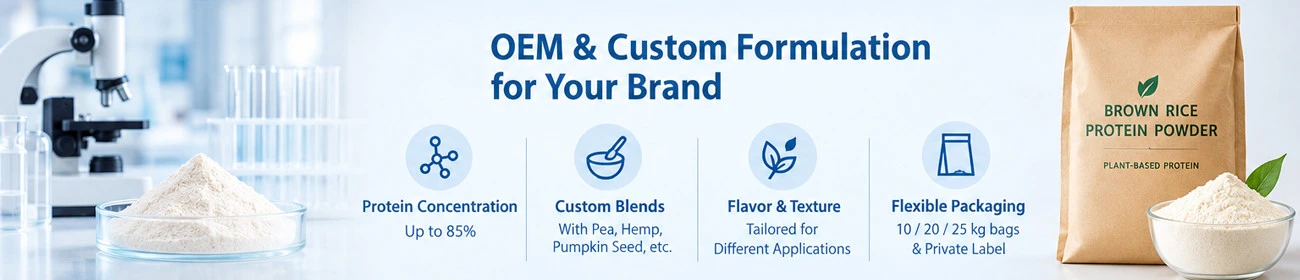
In addition to normal bulk supply, brands that are making unique goods need a supplier that helps them come up with new formulas. Bolin's research and development team can change the protein concentration by up to 85%, add flavor and sweetness, blend protein with pea, hemp, and pumpkin seed proteins, and change the texture for different types of applications. End-to-end brand launch is easier to handle when you can choose from 10, 20, and 25 kg bags with private label and full customs documentation for North America, Europe, and Asia-Pacific.
A Quick Supplier Evaluation Checklist
Make sure of the following things before choosing a brown rice protein supplier:
- Protein content verified by HPLC at ≥80% dry basis
- Particle size at 300–600 mesh with dispersibility data
- Valid USDA Organic, HALAL, KOSHER, ISO9001, and ISO22000 certificates
- SGS or equivalent third-party test reports available per batch
- In-stock inventory with documented lead times
- OEM and custom blending capability with R&D support
- Export documentation support for your target market
These factors are the same whether you are looking for a clean-label meal replacement line in Europe or a sports nutrition brand in the US.
Conclusion
Choosing a source for bulk brown rice protein powder is a purchasing choice that will have long-lasting effects on the recipe and supply chain. The right partner will have tested protein levels, clean extraction methods, compliance with multiple certifications, and the technical know-how to help you build your product. Give more weight to suppliers who openly share their quality control paperwork, keep reliable stock, and do custom formulation work. You can protect your brand and your production schedule by taking the time to sample, test, and audit before going big.
FAQ
1. What protein content should I expect from a quality rice protein powder?
As shown by HPLC, a trusted supplier should always supply at least 80% protein on a dry basis.
2. Is brown rice protein suitable for clean-label formulations?
Yes, as long as the supplier uses enzyme extraction instead of methods based on hexane. Solvent-free processing means that the finished item doesn't have any chemical leftovers, which directly supports claims of clean labels.
3. What certifications are most important for US and EU markets?
The USDA Organic Standard and ISO 22000 are good starting points. Getting HALAL and KOSHER certifications lets you reach more customers. An extra layer of quality assurance is added by SGS third-party verification.
4. Can rice protein be blended with other plant proteins?
Together, rice protein, pea protein, hemp protein, and pumpkin seed protein make a more complete amino acid profile. If your provider does its own research and development, they can help you figure out the best blend ratio for your product shape.
5. What is the typical minimum order quantity for bulk rice protein?
Not all suppliers do this. Reliable makers offer small samples (10 kg or less) for testing purposes. Larger bags (20–25 kg) are used for business orders, which build up to full container loads.
Partner With Bolin Biotechnology for Your Rice Protein Supply
Since 2012, Bolin Biotechnology has given plant-based protein ingredients to brands in more than 30 countries. Our brown rice protein powder in bulk is certified by the USDA as organic, halal, kosher, ISO9001, and ISO 22000, and every batch is checked by SGS. We are a reliable company that makes bulk brown rice protein powder. We have ready-to-ship products, can help with custom formulations, and provide full export documentation. You can ask for a sample right now by emailing sales1@bovlin.com.
References
1. Grand View Research. (2023). Plant-Based Protein Market Size, Share & Trends Analysis Report. Grand View Research.
2. van Vliet, S., Burd, N. A., & van Loon, L. J. C. (2015). The skeletal muscle anabolic response to plant- versus animal-based protein consumption. Journal of Nutrition, 145(9), 1981–1991.
3. Gorissen, S. H. M., et al. (2018). Protein content and amino acid composition of commercially available plant-based protein isolates. Amino Acids, 50(12), 1685–1695.
4. Food and Agriculture Organization of the United Nations. (2013). Dietary Protein Quality Evaluation in Human Nutrition: Report of an FAO Expert Consultation. FAO Food and Nutrition Paper 92.
5. Mariotti, F., & Gardner, C. D. (2019). Dietary protein and amino acids in vegetarian diets — a review. Nutrients, 11(11), 2661.
6. International Food Ingredients Council (IFIC). (2022). Consumer Survey on Plant-Based Protein Trends. IFIC Foundation.