How to Choose High-Purity Palmitoylethanolamide Powder for Supplements
A batch-specific certificate of analysis (COA) that displays HPLC purity, particle size, residual solvents, heavy metals, and microbiological findings is the first step in selecting high-purity palmitoylethanolamide powder for supplements. Next, make sure the supplier has accredited food safety certificates and operates under cGMP. After that, ask for a sample and see how it fills, mixes, and flows on your own tablet or capsule line. Lastly, discuss your claim wording and the published study with regulatory counsel. A good option for a long-term supply arrangement is a provider who responds to these four questions with documentation rather than assurances. PEA is a well-known component in solutions for pet joints, pain relief, and neurological health, and more US companies are including it in their products. Its performance is determined by batch uniformity and purity because it is sold by several sources. For distributors, brand owners, and formulators looking for an easy-to-use, document-based method of comparing choices, I produced this guide.
Understanding Palmitoylethanolamide Powder and Its Benefits
What Palmitoylethanolamide Powder Is?
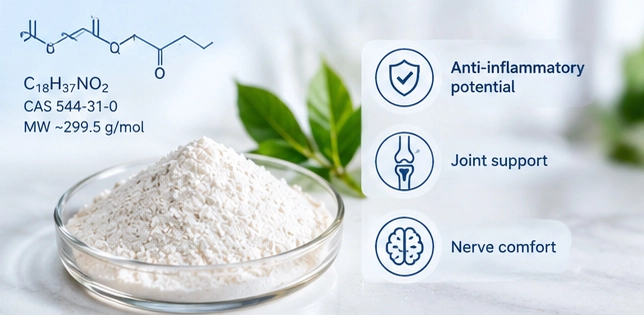
PEA is a fatty acid amide since it is an N-acylethanolamine. Its CAS number is 544-31-0, and its formula is C18H37NO2. At the molecular level, it weighs around 299.5 g/mol. Every time tissue is injured or stressed, the body produces PEA. Powdered palmitoylethanolamide is an off-white, solid material. It blends nicely with oils and spirits but poorly with water. This liking of fat makes particle size and transfer form crucial. Later in this book, I'll go into further detail regarding it. A connection between PEA and the nuclear receptor PPAR-alpha has been discovered. According to the 2005 study published in the journal Molecular Pharmacology, PEA mostly reduces inflammation in mice through PPAR-alpha. Additionally, it appears that PEA helps regulate mast cells, which are responsible for sending signals that cause inflammation. It is understandable why formulators create products designed to support joints, reduce ordinary discomfort, and relax nerves. Most of the knowledge we have about people comes from their trials. Although there were several problems with the data, a 2017 study in Pain Physician stated that it did assist with pain. Before you make a decision on your name, I believe you should read these papers.
How PEA Works in the Body
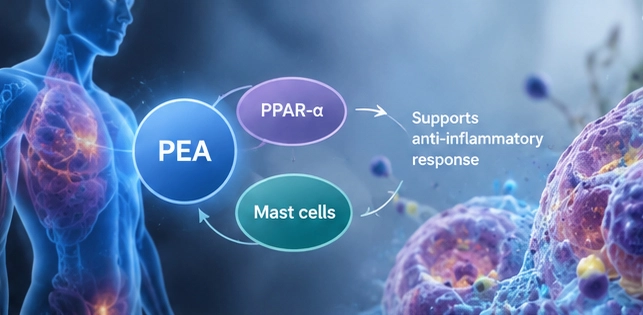
Studies connect PEA to PPAR-alpha, a nuclear receptor. According to a 2005 study published in Molecular Pharmacology, PPAR-alpha mediates PEA's anti-inflammatory actions in mice. Additionally, mast cells, which emit inflammatory signals, seem to be modulated by PEA. These processes provide formulators with a strong justification for drugs targeted at joint support, nerve comfort, and daily pain, and they are central to how palmitoylethanolamide powder is positioned. Clinical trials are the primary source of human data. In addition to reporting a pain-reducing benefit, a 2017 meta-analysis published in Pain Physician identified limitations in the body of data. Before deciding on your label orientation, I advise you to study these studies.
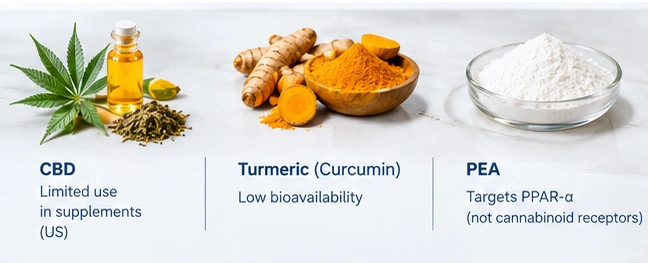
PEA Compared With CBD and Turmeric
How PEA compares to two well-known brands is of relevance to many companies. The FDA claims that because CBD is derived from plants, it cannot be used as an ingredient in food supplements. This indicates that there aren't many options for selling CBD in the US. Curcumin is one kind of polyphenol present in turmeric extracts. This polyphenol doesn't function well when consumed if that isn't considered in the calculation. Research indicates that PPAR-alpha receptors, rather than the more prevalent cannabinoid receptors, are responsible for the body's production of PEA. Telling a clear tale lets you stand out on the shelves. I believe you should examine the evidence for each of these ingredients independently, even if some manufacturers combine them in their formulations.
Dosage and Safety Notes
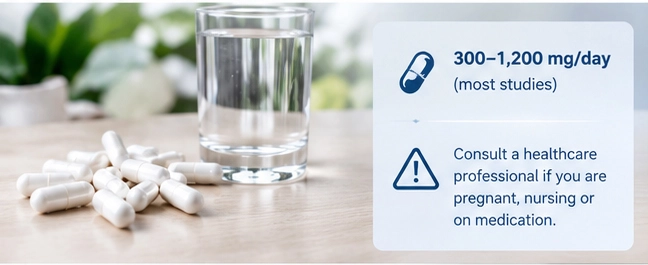
Publicly available tests typically utilize two daily doses of 300–1,200 mg of PEA. According to a 2016 study published in the British Journal of Clinical Pharmacology, PEA was prevalent in the publications examined. Your document should still come before your label. If you are taking medication, have children, or are pregnant, consult a nurse or physician. Based on the kind and weight of your pet, a veterinarian can assist you in determining how much food it requires. In the United States, such statements must be followed by an FDA warning. Additionally, you should never claim that a product cures, prevents, or treats a disease.
Core Criteria for Selecting High-Purity Palmitoylethanolamide Powder
Purity and HPLC Results
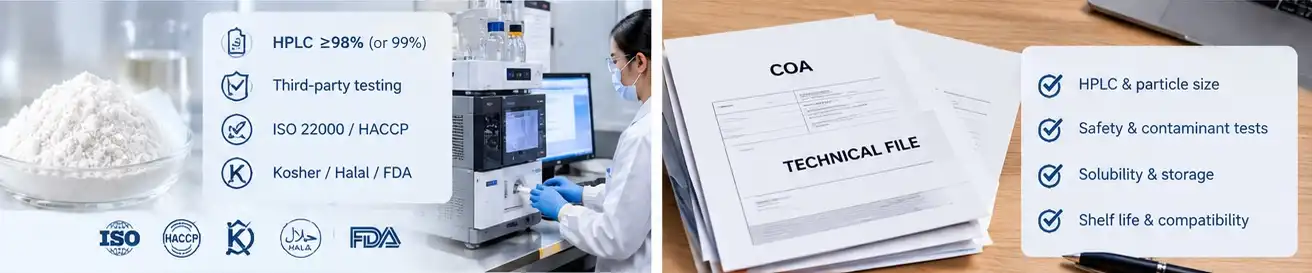
Most sellers say that the HPLC quality of their PEA raw material is at least 98%, and some say it's even 99%. It's not just a number. Ask for the chromatogram, the HPLC method, details on the column and measurement, and a list of any impurities that may be there, such as starting materials that haven't been broken down yet. Before you do the test, make sure you know what it is based on, such as dried material. See at least three groups. If the assay changes by one or two points between lots, your capsule fill weight might also change. It takes longer to get things done at a provider that lets everyone see all of your records.
Certifications and COA Credibility
Certificates show how a plant works, while the COA shows how well one batch did. You should look for third-party testing like SGS results and food safety systems like ISO 22000 or HACCP. These licenses are important if you sell to those groups. FDA 21 CFR Part 111 says that you have to set standards and make sure that food products are what they say they are if you want to sell it in the US. This means that your seller qualification should be in line with that rule. It should have a name, the batch number, test dates, and methods put on it. Find out if the same batch can be proven by a different test.
Process Transparency and Contaminant Testing
Adding ethanolamine to palmitic acid, which comes from plant oils, is the main way that PEA is made for sale. More important than "natural or synthetic" is "how well does the supplier control the process?" You should know what solvents are used to clean the crystals and how they are dried. You can ask for results on heavy metals compared to USP <232> limits, counts of microbes, and results on extra fluids compared to ICH Q3C or USP <467> limits. Ask for statements about the source and any allergens that might be present. Not just for the first batch, ask for these for all of them. This shows that the seller knows what goes into each lot.
Comparing Palmitoylethanolamide Powder with Other Forms and Ingredients
Standard, Micronized, and Ultra-Micronized Grades
The particles' size affects how PEA works. In a 2014 study of rats published in the Journal of Neuroinflammation, micronized and ultra-micronized PEA worked better by mouth than non-micronized PEA. A model of inflammatory pain was used in the study. It is common for micronized grades to have a d90 value below 10 µm and ultra-micronized grades to have a d90 value below 6 µm, which is a key quality distinction for palmitoylethanolamide powder. For each lot, find out about laser scattering. Finer powder has more surface area, but it can also make more dust and less flow, so make sure you can squeeze tablets and fill capsules before you decide.
Choosing the Finished Form
Powder gives you the freedom to choose what to do. What works best for your customer is the style and dose. This could be a pill, tablet, or gummy. Tablets, which don't have a taste, make up most lines of supplements for adults. Because PEA likes fat, forms that are based on oils work well for them. However, they need more work on security and a partner who knows about lipid systems. Pet brands should test a product's taste before putting it on the market. Bolin Biotechnology has powder, pill, tablet, and chewy types, so you can get all of them from one place as your lines grow.
Combinations, Delivery Systems, and Market Feedback
When some brands make nerve pain creams, they mix PEA and luteolin together. Lutein is a flavonoid found in plants. To get around the fact that PEA doesn't mix well with water, some people are testing liposomal or dispersible systems. The British Journal of Pharmacology published a study in 2017 that talks about new PEA products and gives the first information on them. Before you copy something, read the studies that back it up. There is different proof for each pair. Check out how a seller has done in the past. Check to see if finished goods made with the material have been tested by someone else and found to be safe. You can also ask for customer references and read reviews written by people other than the company.
Strategic Procurement: How to Source High-Quality Palmitoylethanolamide Powder
Vetting Manufacturers and Production Capability
respectively). In 2012, Shaanxi Bolin Biotechnology Co., Ltd. was set up in the Xi'an High-tech Zone. It has an 8,000-square-meter building and sends goods to more than 80 countries. Certifications from ISO 22000, HACCP, cGMP, Kosher, Halal, and SGS have been given to it. Before you choose a provider, make sure they have a quality manual, sample batch records, and a video check. They let your team watch videos of the factory checks before they place an order. This way, they can see the workplace, testing area, and packing line.
MOQ, Samples, and Lead Times
Small test lots keep your cash safe while you try out a new method. BOLIN BIOTECH has a 1 kg MOQ as a general rule. If you want to use PEA for some high-value items, the MOQ can be as low as 1–10 g. Please check with the sales team today. Things that aren't made to order take about 5–7 working days to ship, while custom orders take almost 3 weeks. You could get some for free. A lot of the time, 25 kg drums and 1 kg paper bags are used. Most of the time, to get approved, you have to look over the technical file, test samples, work on formulation and stability, make a pilot batch, and then plan for a yearly supply.
Pricing Factors, Logistics, and Customs
The price is based on how pure it is, how many particles there are, how big the order is, how they are packed, and what tests are done. Ask for quotes at different price points and don't just look at the highest numbers; compare specs that are the same. If you base your price on weak papers, it might cost you more in the long run if batches fail, which is especially true for palmitoylethanolamide powder. You should both agree on the Incoterm, the HS code, and the set of documents that will be sent to the US. An invoice, a packing list, a certificate of authenticity, and a safety data sheet should all be in the set of documents. The FDA needs to be told about foreign food ahead of time. This includes dietary supplement ingredients, so check who files it. Before the first sale, you should also agree on how to pay and when the sea freight will come.
Final Checklist for Choosing the Right Palmitoylethanolamide Powder Supplier
Documents to Request Before You Order
Before you place an order, collect the paperwork below. These are the three sets of documents I ask for first from any new source.
- HPLC purity, the test method, batch number, test date, and lab name should all be included on the batch COA with method information. To compare lots side by side and identify drift before it reaches your filling line, add particle size data from laser diffraction and drying loss.
- Contaminant and safety panel: This includes a safety data sheet, allergy and origin declarations, microbiological findings, and residual solvents and heavy metals. The panel provides your regulatory consultant with the necessary information to examine the ingredient for sale in the United States.
- English-language technical file: Solubility, storage conditions, shelf-life information, flow remarks, and compatibility with common excipients should all be included. Each item will be questioned by your formulator; a provider that responds promptly may save weeks of stability planning.
With these documents on file, you can compare suppliers fairly and speed up your internal approval.
Testing Samples and Pilot Batches
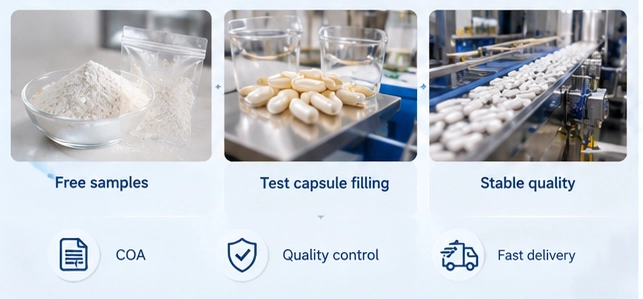
And be sure to examine a sample before you give the merchant the go-ahead. Validate the name and validate it either with a lab outside the organization or with your own technique. Find out the mass density, dust and motion. After that, conduct a quick test using a pill or capsule to see whether it stays steady as you planned. Design your PEA for storage in a cool, dry place. When the test run is completed, compare the test results with the COA. Bolin Biotechnology gives free samples for these tests. Save some of each batch for comparison later.
Building a Long-Term Partnership
Pick a partner you can stick with because changing raw materials increases the cost of keeping things safe.” How soon can the group answer a question about their work? Will you be notified if the process is changed? Identify who is responsible for maintenance of samples as per the quality agreement, what has to be done and how changes will be handled. When a lot comes, check it against the specs and offer comments to the vendor. Bolin Biotechnology can help with unique packages and private names. This will be useful for businesses looking to create their own bags, capsules or finished products.
Conclusion
Before picking out a high-purity palmitoylethanolamide powder, understand what PEA is, how it works via PPAR-alpha, and why particle size matters, since PEA doesn't dissolve well in water. You should provide HPLC data, batch-level COAs and thorough contaminant testing to confirm the purity of the product. cGMP and food safety certifications. Research underpins both micronized and ultra-micronized grades. What the optimal completed shape is for your market will depend on your requirements. Procurement is preferable when you compare the same specs, make sure of logistics early on, and visit the manufacturer. It is safer to utilize a paper plan, sample tests and a practice batch to make sure that the formula does not change over time.
FAQ
Is PEA safe for use in supplements?
Published studies describe PEA as well tolerated at common doses of 300 to 1,200 mg daily. Safety still depends on your formula, dose, and audience. Have your regulatory adviser review the dossier, include the required label statements, and advise consumers with medical conditions to speak with a healthcare professional.
How can I verify purity before a bulk order?
Compare the supplier's COA with an independent lab test of the same batch. Ask for the HPLC chromatogram, then run identity and assay tests and check residual solvents and heavy metals. Test several lots, and approve volume only after the results match the COA.
Is natural or synthetic PEA better?
Commercial PEA is typically made by synthesis, so the useful question is process control. Ask about starting materials, solvents, and purification, and request origin statements. A well-documented synthetic route with clean test results serves a brand better than a vague natural claim.
Request Palmitoylethanolamide Powder Samples from Bolin Biotechnology
For example, Bolin Biotechnology can talk to you about what kind of palmitoylethanolamide powder you need and how you'd like it packed. Palmitoylethanolamide powder that we sell is cGMP, ISO 22000, HACCP, Kosher, Halal, and SGS-approved, and we have a lot of experience. We offer free samples, video factory checks, and a minimum order size of 1 kg. Email sales1@bovlin.com to get a COA, a sample, or a quote.
References
1. Molecular Pharmacology, 2005. Lo Verme et al., "The nuclear receptor peroxisome proliferator-activated receptor-alpha mediates the anti-inflammatory actions of palmitoylethanolamide."
2. Journal of Neuroinflammation, 2014. Impellizzeri et al., "Micronized/ultramicronized palmitoylethanolamide displays superior oral efficacy compared to nonmicronized palmitoylethanolamide in a rat model of inflammatory pain."
3. British Journal of Clinical Pharmacology, 2016. Gabrielsson, Mattsson, and Fowler, "Palmitoylethanolamide for the treatment of pain: pharmacokinetics, safety and efficacy."
4. Pain Physician, 2017. Artukoglu et al., "Efficacy of palmitoylethanolamide for pain: a meta-analysis."
5. British Journal of Pharmacology, 2017. Petrosino and Di Marzo, "The pharmacology of palmitoylethanolamide and first data on the therapeutic efficacy of some of its new formulations."
6. U.S. Food and Drug Administration, Code of Federal Regulations Title 21 Part 111, 2007. "Current Good Manufacturing Practice in Manufacturing, Packaging, Labeling, or Holding Operations for Dietary Supplements."


_1780035065210.webp)