How to Use Purple Yam Powder in Food and Beverage Manufacturing
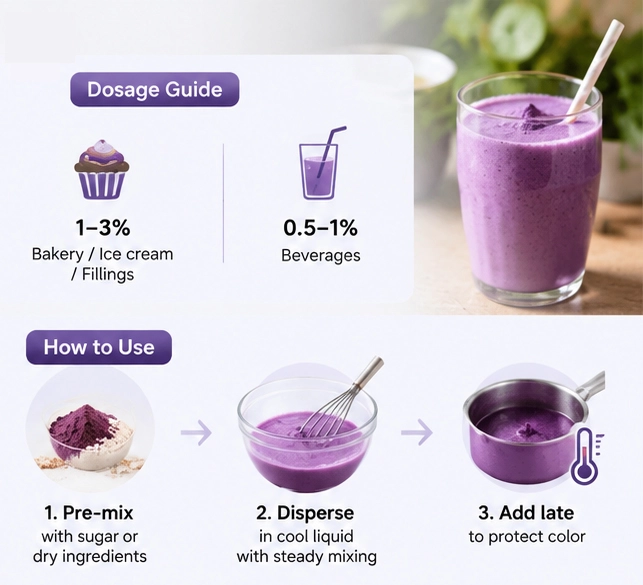
To use purple yam powder in food and beverage manufacturing, match the dose to the product. I use 1–3% of the formula for bakery items, ice cream, and fillings, and 0.5–1% for beverages. Pre-mix the powder with sugar or other dry ingredients. Then disperse it in cool liquid with steady mixing. Add it late in the process, because anthocyanin color weakens under long heat and shifts in acid. Run small trials for heat, pH, and taste before scaling up. Below, I cover composition, process steps, comparisons, sourcing, and storage.
Understanding Purple Yam Powder: Composition and Benefits
What Purple Yam Powder Is and How It Differs from Ube Powder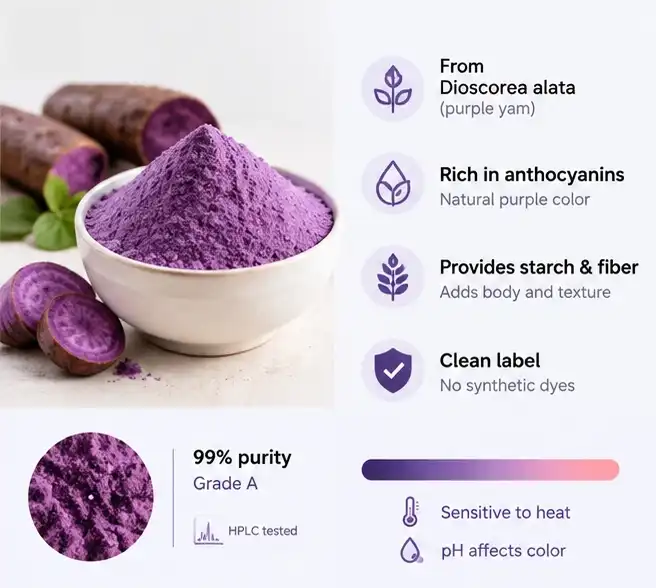
Purple yam powder is made by drying and grinding the root of the purple yam powder plant (Dioscorea alata). These words are often used to buy something: "purple yam powder" or "purple yam powder." Brand names can hide a difference, though. Different plants are used to make some of the things that are sold as purple yam powder. These are made with purple sweet potato. You need to write to each seller and ask them where the trees came from.
Purple yam powders are where Bolin Biotechnology gets its purple yam powder. We use hot air to dry it out, and then we sell it as 99% pure Grade A purple powder. The HPLC test showed that it breaks down in water. The spec tells the people who make your drinks where to begin.
Nutrition and Natural Pigments in Purple Yam
Anthocyanins are what give blueberries and red cabbage their purple color. Its color changes because of pH, heat, light, and the way the molecules are shaped. There was this in the Journal of Food Science. They also found that acylated anthocyanins, which are found in purple sweet potatoes and other foods like them, tend to keep their color longer than simple ones.
You can get both starch and fiber from this root. These give drinks body and make made things soft.
Clean-Label and Flavor Benefits
A lot of food has been colored purple with red and blue paints that people have made. The U.S. Food and Drug Administration took it off the market in January 2025. Food recipes can be changed until January 15, 2027. Many brands are using natural purple colors because of the date.
The label on a purple yam powder package might just say "purple yam powder," which is easy to read. When people think of purple yam powder, they also think of a note that tastes like sugar, spice, and vanilla. This means that the amount changes both the color and the taste. I always judge them all at the same time when they are on trial.
How to Incorporate Purple Yam Powder into Food & Beverage Manufacturing Processes
Dosage Guidelines by Application
The first thing every formulator asks is, "What is the dose?" We should use a little more than a third of the formula's total weight in our fillings, baked goods, frozen desserts, and snacks. I like 0.5 to 1% for drinks.
Put yourself in the middle of each group to begin. You should start with about 0.75% for a latte base. Start with about 2% for cake batter or ice cream mix. Start by making little changes. First, look at the color. Next, taste it. Finally, feel it in your mouth. You can change the color by adding more of it, but it also tastes more like potatoes and has more carbs. This method works every time as long as you keep track of each test by lot number.
Blending, Hydration, and Heat Treatment
Putting powder and liquid together makes it stick together. This doesn't happen because I don't add any water when I mix the purple yam powder with sugar, flour, or milk powder. Then I slowly stir that mix into a cool or room-temperature drink. It was left alone for a while so the tastes could mix.
The main thing that can damage colors is heat. If you heat anthocyanins for a long time, they lose their color. When the recipe says to, add the powder. Make sure your real oven setting works in a kitchen where 180°C is normal. If you drink something sour, the color will move toward pink. Check the pH level.
Application Examples: Bakery, Ice Cream, Latte, and Plant-Based Drinks
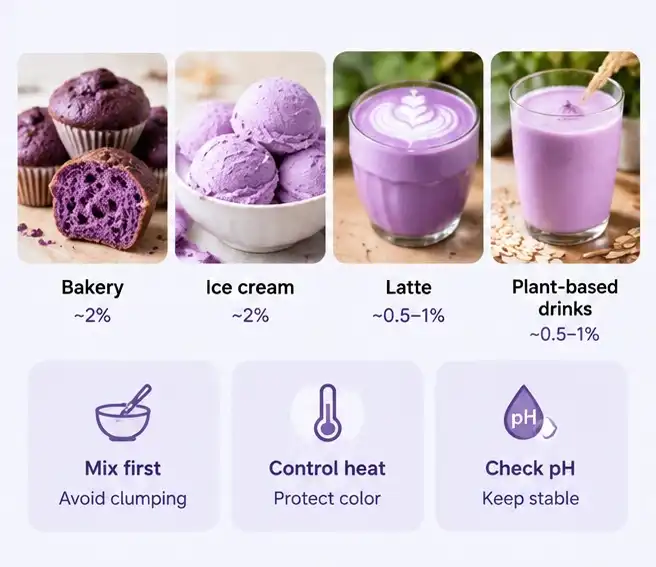
Usually, these are the best places to start:
- Bakery and mochi: Add the wet ingredients to the dry ones and mix them together. Then bake or steam the mochi as usual.
- Ice cream: It doesn't matter how hot you use; you can add it to the base before or after making the ice cream.
- Purple yam powder latte: Mix purple yam powder with milk or a plant-based drink, then add sugar and whisk it in.
Each of these plans is just a test run because it has its own limits. It might take a little longer to mix plant-based drinks with oat or wheat bases. You should always compare your sample to a saved standard before you use it.
Fixing Clumping, Sediment, and Flavor Masking
It keeps coming up three times. When you put it together, the powder went right into the liquid, so mix it first. Either the pressure is too low or the soak time is too short. Mix for longer. About 95% of the powder needs to be able to pass through an 80-mesh screen. This lets the powder get out there.
To cover up the purple yam powder note, there needs to be strong vanilla, coconut, or lemon. First, add a little less of the extra taste. After that, add a little more purple yam powder. Check the pH, wetness, and heat time between runs to see if the color changes. If it does, then change the amount.
Comparing Purple Yam Powder with Other Natural Powders for Industrial Use
Purple Yam Powder, Ube Powder, and Taro Powder
It's the same thing that's known as purple yam powder and purple yam powder, which has already been said. With taro powder, it's not the same. The plant that gives it its name is called Colocasia esculenta. It's a light brown color and tastes mild and sweet. The taro gives it body and a good taste, but it's not very purple.
Some brands make the color look like lavender by mixing taro with purple dyes. When people hear the word "purple yam powder," they'll think of something purple that tastes sweet and nutty. That's why I picked purple yam powder instead of taro.
Purple Yam Powder Versus Sweet Potato and Yam Flour
There are also anthocyanins in purple sweet potatoes. In 2008, Steed and Truong released their research in the Journal of Food Science. They looked into how purple-fleshed sweet potato purees changed color. It tastes a lot like sweet potato, so it might not be what purple yam powder says it is.
Is plain yam flour made from yams with white meat? It adds body and sugar, but not much purple color. Look at more than just the weight price when you shop around. Plan how much you need to get the shade you want. Your recipe might cost less if you use a powder that doesn't need as many color or volume fixes.
| Dimension | Purple Yam Powder | Taro Powder | Purple Sweet Potato Powder | Plain Yam Flour |
|---|---|---|---|---|
| Botanical Source | Dioscorea alata (Implied, true ube) | Colocasia esculenta | Purple-fleshed sweet potato (Ipomoea batatas) | White-fleshed yams |
| Color | Purple | Light brown (Not very purple naturally; some brands mix it with dyes to look lavender) | Purple (Contains anthocyanins) | White / No purple color |
| Flavor Profile | Sweet and nutty | Mild and sweet | Tastes strongly like sweet potato | Adds sugar/body, lacks ube flavor |
| Functional Role in Formula | Provides authentic purple color and ube flavor | Adds body and good taste, but lacks natural purple color | Provides color (anthocyanins) and sweet potato flavor | Adds body and sugar, but provides no purple color |
| Key Characteristics | The authentic standard for purple color and nutty flavor | Often artificially colored to mimic purple yam; buyers expect purple yam to be naturally purple and nutty | Might not meet the definition of "purple yam powder" due to its distinct sweet potato taste; color stability studied by Steed & Truong | Used for texture and sweetness, not for color |
Organic Versus Non-Organic Purple Yam Powder
When something is living, you can't name it the same way. If you want to sell something as organic in the U.S., you must first get a legal written organic certificate from a seller and make sure it covers the item you buy. Do not believe what someone says.
Even if the powder isn't organic, it can still be used in food. Still, you should always look for building licenses, heavy metals, and microbes. There can't be more than 1 mg/kg of lead or arsenic in our goods. Also, the mercury and cadmium levels must be less than 0.05 mg/kg and 0.03 mg/kg, respectively. Set a goal for your seller early on so that they can keep going.
Procurement Guide: Buying Purple Yam Powder for Bulk Manufacturing
How to Evaluate a Supplier
If the seller only says "99% pure," they haven't told you enough. Get an analysis report that lists the test method, the amount of moisture, the particle size, the heavy metals and microbes that were discovered. If you dry our purple yam powder, you lose less than 8 grams. If you light it, you lose the same amount. It also says that there are no Salmonella or coliforms and that the plate count is less than 10,000 cfu/g.
Also, look at the building. Bolin Biotechnology has been around since 2012 and has a plant that is 8,000 square meters and is in the Xi'an High-Tech Zone. People buy what we sell all over the world. They have given us their seal of approval, along with Kosher, HACCP, cGMP, ISO 22000, and HACCP. We check out movie studios too.
Packaging, Samples, MOQ, and Lead Time
A 25 kg fiber drum lined with metal foil or a 1,000 kg big bag is what most people use to pack. You can change both of them. You can make tiny store bags and boxes when you use a private-label service.
They can test before committing to a trial run because they only have to buy 1 kg. It's possible to get it for free. It takes 5–7 business days to ship most items, but 2–3 weeks for custom orders. Test samples will be used first, then a pilot batch, and finally sea freight. As you plan, go back to the day you began.
Common Procurement Pitfalls to Avoid
Brands spend a lot of time in just a few spots. They don't look at the colors next to each other between deals. They only test in water, never in the real dish, which could be hot or sour. They don't look at the lot number or the date it was written when they accept a certificate.
Putting in a big first order before the formula is locked is another way to get caught. I don't need a big test run to make sure the color, taste, and flow are right in my own gear. After that, take little steps. Before you print the boxes if you only sell in the U.S., talk to your law team about what should be on the labels.
Shelf Life, Storage, and Safety Protocols for Purple Yam Powder in Manufacturing
Shelf Life and Storage Conditions
If the package is still sealed, our purple yam powder will last for 12 to 24 months. Powder and dust both take in water from the air. Powders lose their color faster when they get wet. Anthocyanins break down over time in the presence of light and heat.
Do not lie down on the bags or drums. Put them somewhere cool, dry, and dark instead. If the foil cover is open, squeeze out all the air and then close it up tight. You should use early lots. Write the date the bag was opened on a small piece from each lot that you want to keep. It will help you later when you want to compare the colors.
Quality Control and Food Safety Checks
Do a few easy checks when you get it. First, look for tears in the box and then compare the certificate to the lot number. In the same way, compare the color of each new lot to the standard you already agreed on. If your line has signs of water damage, you should check it.
The law in the United States says purple yam powder is one of the nine main food allergens, even though it's not one of them. Still, make sure you get an allergy report that lists the plant because cross-contact can happen in many places. If you keep track of each test and production lot, you can figure out where any complaint came from.
U.S. and EU Regulatory Points
The US Code of Federal Regulations has it in Title 21, Part 73. There are different ways to use purple yam powder, and it may be used as a food ingredient or a color agent. Before launch, your regulatory lead should look that over.
This group checks color chemicals for safety in food in Europe (EFSA). Color is an important part of some foods, not just something that is added on top. Make sure you know how to fit each group of people you want to reach. You should get test results, specifications, and certificates from your service that match your things.
Conclusion
When purple yam powder is added to drinks or food, it turns them naturally purple and makes them taste like purple yam powder. It's important to know how much to use, how to mix them, and how the tests go because heat and pH can change the color of its anthocyanins. It's between 0.5 and 1% for drinks and 1% to 3% for most other things. If you use purple yam powder flour instead of taro, sweet potato, or plain yam flour, it works better. When you buy something, you should look at more than just claims of cleanliness. You should also use test results, licenses, particle size, and sample checks. Color will stay fresh for 12 to 24 months if you keep it somewhere cool, dry, and tightly closed. This is because lots of checks are made and governmental review starts early. Brands and signs stay the same in the EU and the US.
FAQ
What dose of purple yam powder should I start with?
I say use 1% to 3% for baked goods, frozen desserts, and sauces. Use 0.5 to 1% for drinks. After you try, make changes.
Will the color fade during baking or in acidic drinks?
This color can fade in hot weather, and acid can turn it pink. Make sure you know the pH and the real process. Don't add the powder until the very end.
Can I order a small amount for testing?
Yes. We offer a free trial service, and the smallest amount we can handle is 1 kg.
Which certificates do you hold?
Bolin Biotechnology is ISO 22000, HACCP, cGMP, Kosher, Halal, and SGS approved.
Request Purple Yam Powder Samples from Bolin Biotechnology
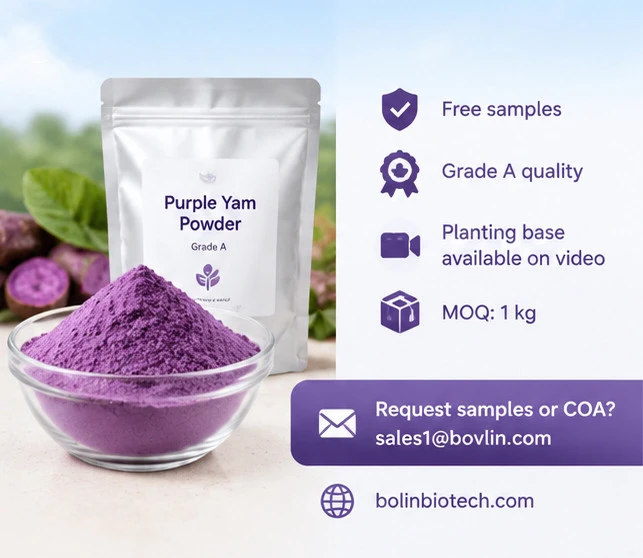
Want to buy purple yam powder from a company that lets you label it and test it on small groups of people? Bolin Biotechnology gives away free samples, sells Grade A purple yam powder, and checks plants on video. Every order has to weigh at least 1 kg. Send an email to sales1@bovlin.com explaining how you will use the product, how much you want to take, and what kind of packaging you need. To find out more, you can also go to bolinbiotech.com. We'll help you find a sample that fits your needs.
References
Journal of Food Science, 2004. "Anthocyanin Pigments: Bioactivity and Coloring Properties."
Biochemical Engineering Journal, 2003. "Acylated Anthocyanins from Edible Sources and Their Applications in Food Systems."
Journal of Food Science, 2008. "Anthocyanin Content, Antioxidant Activity, and Selected Physical Properties of Flowable Purple-Fleshed Sweetpotato Purees."
U.S. Food and Drug Administration, 2025. "FDA to Revoke Authorization for the Use of Red No. 3 in Food and Ingested Drugs."
Code of Federal Regulations, 2024. Title 21, Part 73: Listing of Color Additives Exempt from Certification.
CABI Publishing, 2009. "Tropical Root and Tuber Crops: Cassava, Sweet Potato, Yams and Aroids."