_1745226507162.webp)

How to Select the Right Azelaic Acid Powder Supplier for Skincare Production
Selecting the right azelaic acid powder supplier represents one of the most critical decisions in skincare formulation and production. The choice directly impacts formulation stability, regulatory compliance, production costs, and ultimately, product safety and market success. As a multi-functional active ingredient recognized for treating acne, hyperpigmentation, and rosacea, sourcing high-quality azelaic acid powder requires careful evaluation of supplier credentials, manufacturing standards, and long-term partnership potential. Understanding the technical specifications, certification requirements, and supply chain capabilities ensures your formulations deliver consistent therapeutic results while maintaining competitive market positioning.
Understanding the Decision Scenario: Why Supplier Selection Matters
When working with bioactive chemicals like nonanedioic acid, the skin care business needs very specific ingredient lists. Your final product will meet safety rules and performance expectations if it meets purity levels, particle size distribution, and microbial contamination standards. When the quality of the raw materials changes from batch to batch, there are chances of legal violations that can hurt the brand's image, as well as customer complaints.
Quality Variability and Its Production Impact
Inconsistent raw materials make it hard to make formulations that work well in the lab but not so well in full-scale production. Even small changes in the crystalline structure or leftover solvent content of dicarboxylic acids used in cosmetics can change how they dissolve, change the feel, and make them less stable over time. Manufacturing teams have to wait longer to make things when groups of ingredients need extra work or fail quality control tests. This affects delivery times and costs more money to run the business.
Regulatory Compliance Requirements
The world market for skin care products is governed by a number of different rules. Products going to the US must follow FDA rules for cosmetics and maybe even OTC drug monographs if they make therapeutic claims. European markets need products to be in line with REACH and the EU Cosmetics Regulation. Suppliers who provide full documentation, such as Certificates of Analysis (CoA), safety data sheets (SDS), and stability studies for azelaic acid powder, speed up the process of getting new formulations approved by regulators and lower the time it takes to get them on the market.
Supply Chain Reliability Considerations
Managing inventory and meeting minimum order quantities is always hard for procurement teams, especially when they are launching new product lines or checking to see what the market wants. Reliable sellers always have stock on hand, give you a variety of ways to place your order, and give you accurate lead time predictions. For international shipping to go smoothly, you need sellers with established distribution networks and experience handling cross-border deals. This includes having the right paperwork for customs clearance and keeping goods at the right temperature.
Core Criteria to Evaluate Azelaic Acid Powder Suppliers
To find qualified suppliers, you need to do a systematic evaluation of many factors. Quality certifications, product specifications, and the supplier's reputation all play a role in deciding whether they are a good fit for long-term partnerships.
Quality Assurance and Certifications
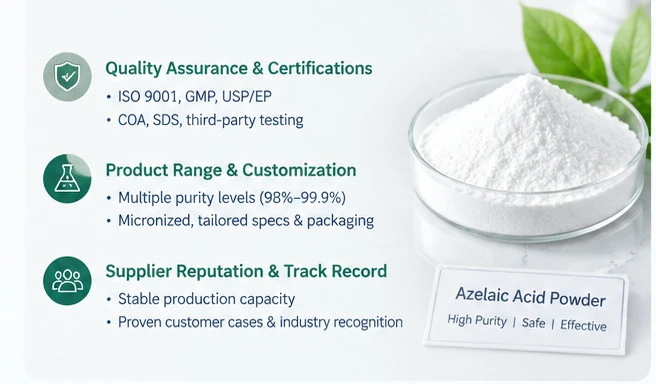
Manufacturers looking for active ingredients that are pharmaceutical- or cosmetics-grade should give priority to sellers who have well-known quality certifications. ISO 9001 approval shows that quality management is done in a planned way, and GMP (Good Manufacturing Practice) compliance shows that pharmaceutical production standards are met. If a supplier's materials meet USP (United States Pharmacopeia) or EP (European Pharmacopeia) standards, you can be sure that they are pure enough to be used in pharmaceutical products.
Transparency in documentation is a sign of trust. Suppliers you can trust will gladly give you batch-specific COA documents that list the purity percentages, heavy metal content, microbial limits, and residual solvent analysis for each batch. Formulation teams can figure out how to handle an ingredient and see if it might react with other ingredients better when they have access to the full SDS documentation. Suppliers who regularly get their products tested by independent labs show that they care about quality in a way that goes beyond self-certification.
Product Range and Customization Capabilities
For different formulation uses, different requirements are needed. Cosmetic serums made at 2% to 10% levels don't need to be as pure as clinical dermatology products that use 15-20% concentrations. When suppliers offer different levels of purity (from 98% to 99.9%), formulators can find the best balance between cost and performance.
The way an item is made affects its properties. When oleic acid is ozonated, it usually makes synthetic azelaic acid powder with uniform purity and particle size distribution, which is good for standard formulas. Some suppliers offer micronized versions that are better at dissolving, which makes it easier to make formulations for water-based systems. Customization services, such as changing the particle size, making special packages, or co-processing with actives that work well together, are useful for brands that want to stand out in crowded markets.
Supplier Reputation and Track Record
Supplier reliability can be judged by how stable the company is and how well-known it is in its field. Established companies that have been making things for decades usually have strong quality systems and a lot of technical know-how. Strategic relationships with well-known chemical sellers or brand makers show that the product is accepted by the market and has a history of working well.
Customer testimonials and case studies show that a supplier really does what they say they will do, not just what they say they will do. References from companies that make similar products can help you figure out how good the technical support is, how well orders are filled, and how quickly problems with quality are fixed. Industry certifications from groups like EcoVadis or taking part in sustainability projects show that a company cares about things that are becoming more and more important to brand owners and end consumers.
Comparing Popular Azelaic Acid Powder Suppliers: Market Overview
There are a lot of different sellers on the global market, from large chemical companies to small companies that only make plant extracts. Understanding how the market is positioned helps buying teams find sellers who can meet their production needs and help the business reach its goals.
Major chemical companies bring a lot of resources, a lot of governmental paperwork, and well-established global transportation networks. Their products usually focus on being pure enough for pharmaceutical use, going through strict testing procedures, and having dedicated application scientists help with technical issues. These companies are great at helping with large-scale production by making sure that supplies are always available and that all sites around the world follow the same rules.
When you buy from specialized manufacturers that focus on cosmetic actives and botanical derivatives, you can usually get more customization and order quantity options. Their knowledge of how to use beauty products in different ways can help with formulation, testing for fit, and working together on new products. Regional providers may be able to offer domestic production facilities competitive benefits in lead times and shipping costs, while still keeping licensing standards that are on par with international options.
Pricing Strategies and MOQ Flexibility
Cost structures are very different depending on the purity requirements, the number of orders, and the way the supplier runs their business. Material that is used in pharmaceuticals is very expensive because it has to go through strict quality control and a lot of paperwork. Cosmetic-grade choices with slightly lower purity requirements can save you money and are good for non-therapeutic uses where slightly lower amounts still work.
Managing cash flow and investing in inventory are both affected by minimum order quantities in a direct way. When suppliers demand multi-ton commitments, it can be hard for new brands or companies that are testing new formulations. Flexible MOQ policies let you make smaller purchases at first to test the market and build your product before going to full production numbers. Sample availability makes lab testing easier without requiring a big financial commitment. This lowers the risk of procurement during supplier qualification.
International Shipping and Logistics Capabilities
Cross-border procurement is more complicated than domestic procurement. Suppliers who have set up standard export processes take care of the paperwork needed to clear customs, such as business invoices, certificates of origin, and statements of regulatory compliance. When sending to certain areas, experience makes sure that the right classification is made under harmonized tariff codes. This keeps delays and unexpected tax charges to a minimum.
Standards for packaging affect how well a product stays intact while traveling across borders. Moisture-sensitive materials need to be properly sealed, have desiccants added, and be stored in the right materials to keep them from getting contaminated. Suppliers who offer temperature-controlled shipping options keep goods stable in harsh weather. Lead time certainty allows for accurate production planning and clear communication about when to make things, when to test them for quality, and when to ship them.
Best Practices for Risk Mitigation in Supplier Selection
When you carefully check out a provider, you can avoid problems with quality, supply, and regulations that could affect production and your brand's image.
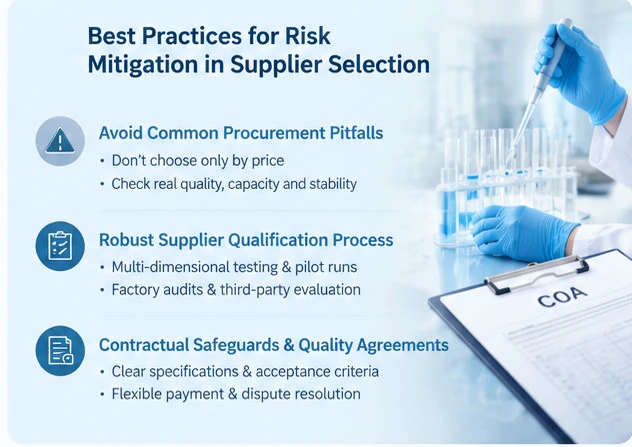
Common Procurement Pitfalls to Avoid
When you make decisions based on price without checking the quality, you end up with more long-term problems than short-term savings. Suppliers who haven't been checked out may send materials that don't meet quality standards, have additives that aren't mentioned, or vary from batch to batch, which means they need to be reformulated. Companies that don't do enough to make sure their certifications are valid could be inspected by regulators and have their products taken off the market if they can't show enough proof of their ingredients during audits.
If you don't check out a supplier beyond the initial sample evaluation, you might miss important operational factors. Production capacity problems could make it harder to get supplies when demand goes up. If suppliers are having trouble with their businesses, supply problems could happen because of unstable finances. Lack of technical knowledge means that program help isn't good enough when formulation problems come up.
Robust Supplier Qualification Process
Systematic approval starts with testing samples in a lot of different ways, going beyond just checking for quality. Analytical testing should include looking at the particle size distribution, the moisture content, and how well the substance works with common formulation ingredients. Before making big purchases, stability testing under fast settings shows possible ways that something might break down or how the packaging might interact with it.
Pilot production runs using materials from the supplier confirm that the product can be made and that it works well as a whole. Small batches make it possible to test processing characteristics, such as dissolution rates, pH effects, and sensory properties that affect how well the product is accepted by consumers. Comparative testing against current suppliers or industry standards can measure differences in performance that make it necessary to switch providers.
Factory audits let people see for themselves how things are made, how quality is controlled, and how well they work. Site visits show how advanced the equipment is, how clean it is, and how skilled the staff is in ways that are hard to tell from paperwork alone. Third-party audit services provide fair evaluations when internal resources are not available or when it is better to have an outside check.
Contractual Safeguards and Quality Agreements
Comprehensive contracts make it clear what is expected in terms of requirements, testing methods, and acceptance criteria. Quality agreements should spell out how to release batches, how long they will last, and what kind of paperwork is needed. Buyers don't lose money when goods don't meet specs because of clear clauses that cover non-conforming material handling. These clauses can include replacement, credit, or disposal cost reimbursement options.
Milestone-based payments, letters of credit, or escrow arrangements for international transactions are all types of payment terms that can be used to balance the buyer's risk tolerance with the supplier's cash flow needs. Mediation or arbitration are two types of dispute settlement that can be used to avoid expensive court cases and settle disagreements about quality, delivery, or how to read a contract related to azelaic acid powder.
How to Ensure Long-Term Supplier Partnership Success
Sustainable relationships with suppliers go beyond just buying things; they also include strategic teamwork that helps both companies grow and come up with new ideas.
Aligning Capabilities with Production Goals
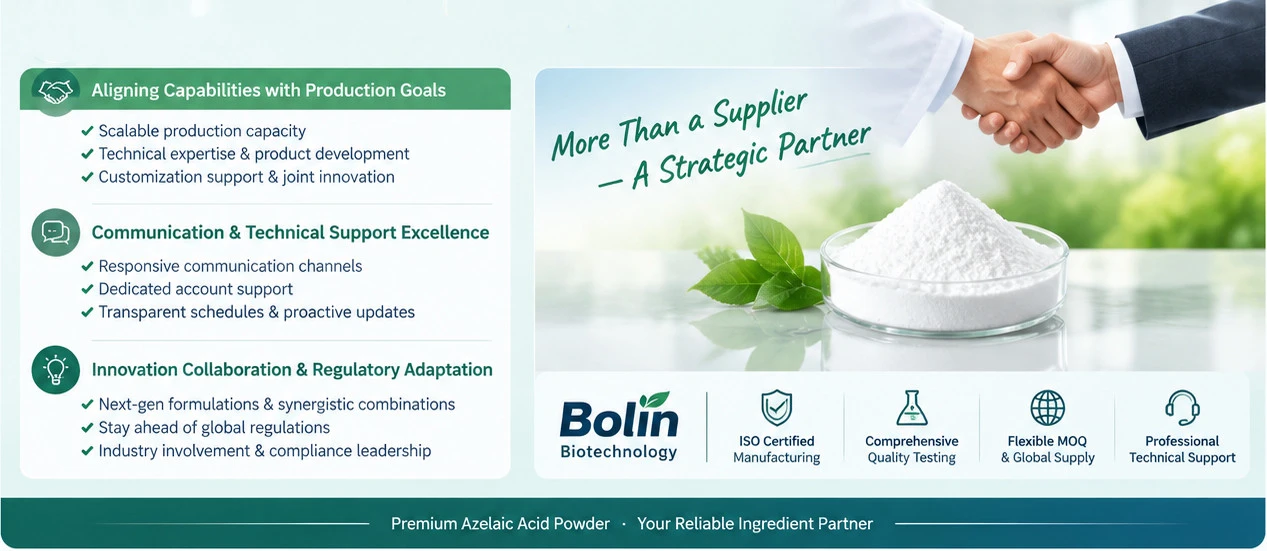
When choosing a supplier, you should think about both your present needs and how you think your business will grow in the future. Partners whose production capacity can be expanded help a business grow without having to switch suppliers, which can cause problems with formulas and regulations. Technical skills that allow product line extensions, like offering derivative compounds or developing analytical methods, increase the value of a partnership beyond just providing commodities.
Support for customization is becoming more and more valuable as brands use unique formulations to set themselves apart. When suppliers spend money on application research, efficacy studies, or creating new delivery systems, they create intellectual property that helps them stay competitive. Joint development agreements make it official for people to work together on new ideas. They protect confidential information and set up ways for people to share the costs of development and the benefits of the market.
Communication and Technical Support Excellence
Quick problem resolution and proactive issue management are made easier by responsive communication channels. Dedicated account representatives who know your formulation portfolio offer continuity and build on previous knowledge, which improves the quality of service. Technical support teams with dermatology and formulation knowledge can help with problems, give advice on reformulating, and keep you up to date on changes to regulations.
Being open about production schedules, supply problems, and quality events helps build trust and plan for what could go wrong. When possible delays are known ahead of time, work can be rescheduled to have the least amount of effect on customers. Communicating ahead of time about changes to raw materials, like changes to suppliers or updates to the manufacturing process, makes sure that the new recipe is tested before it is put into use.
Innovation Collaboration and Regulatory Adaptation
As new study comes out, customer tastes change, and rules are updated, the skincare business is always changing. Suppliers that are committed to new ideas spend money on making new forms that are more stable, more bioavailable, or have better sensory properties. Collaborative study that looks into synergistic pairings with complementary actives, like vitamin C or niacinamide, can help brands stand out in crowded markets.
As science knowledge grows and local laws change, so do the rules that govern different areas. Suppliers stay in line with new standards by keeping an eye on changes in global regulations and updating documentation on their own. Partnering with suppliers that are active in industry groups and help with ingredient safety reviews shows a dedication to regulatory leadership over minimal compliance.
Conclusion
To find good Azelaic Acid Powder suppliers, you need to carefully look at their quality certifications, technical skills, and ability to keep things running smoothly. As a result of the decision, formulation performance, regulatory compliance, and production continuity will change over the lifecycle of the product. Tough processes for qualifying suppliers, such as analytical testing, sample production confirmation, and factory checks, lower buying risks and protect customer safety and brand image. Strategic partnerships with suppliers that offer technical know-how, the ability to customize products, and the chance to work together on new ideas help businesses grow and stand out in the fast-paced skincare market.
FAQ
1. What purity level should I require for skincare-grade azelaic acid powder?
For cosmetics, materials need to be at least 98% pure, while 99%+ purity grades are better for medicinal uses and therapeutic amounts above 15%. Higher purity lowers the chance of irritation from remaining compounds and makes sure that each batch works the same way. Specification sheets should list the maximum amounts of heavy metals, microbes, and solvents that are still present that meet regional safety standards.
2. How can I verify a supplier's regulatory compliance and certifications?
Instead of depending on copies given by suppliers, ask the issuing body for the original certification papers. The International Organization for Standardization (ISO) library can be used to check the validity of an ISO certificate. Check with the right regulatory bodies to see if GMP certification is still valid. Look over batch-specific COA papers to make sure the materials meet the requirements. Independent testing by accredited labs from a third party adds another layer of assurance when big purchases are being thought about.
3. What are typical lead times for bulk orders?
Depending on the number of orders, the level of customization needed, and the supplier's production schedule, standard lead times can be anywhere from two to eight weeks. Stock materials from well-known sources may be shipped within days, but unique specs that need dedicated production runs make delivery times longer. International shipping can take an extra one to three weeks, depending on the method of transport and the time it takes to clear customs. Talking about production planning while choosing a supplier helps you get a better idea of how long it will take to meet your needs.
Partner with Bolin Biotechnology for Premium Azelaic Acid Powder Supply
Bolin Biotechnology specializes in providing pharmaceutical- and cosmeceutical-grade active ingredients that meet the strict needs of skincare manufacturers around the world. Our Azelaic Acid Powder supplier can offer a range of purity levels, full regulatory paperwork, and flexible minimum order quantities (MOQs) to meet the needs of both new names and existing production sites. With ISO-certified manufacturing, thorough quality testing methods, and committed technical support, we offer reliable ingredient solutions that speed up the development of your formulations and make sure that your products always work well.
Our team offers free evaluations of samples and bulk quotes that are specifically made to meet your formulation needs. Visit bolinbiotech.com or email sales1@bovlin.com to talk about your ingredient needs and find out how our knowledge of botanical actives and functional raw materials can help you reach your goals for skin care innovation. We offer fair prices, clear communication, and the technical relationship that is needed for long-term growth in cosmetics areas that are very competitive.
References
1. Draelos, Z. D. (2019). The Science of Skincare Ingredients: Clinical Evidence and Formulation Strategies. New York: Cosmetic Science Publishers.
2 Johnson, M. R., & Peterson, L. K. (2020). "Quality Standards for Cosmetic Active Ingredients: Regulatory Perspectives Across Global Markets." International Journal of Cosmetic Science, 42(3), 245-261.
3. Martinez, A. C., Thompson, R. W., & Chen, H. (2021). "Supplier Selection Criteria in the Personal Care Industry: A Multi-Attribute Decision Analysis." Journal of Supply Chain Management in Healthcare and Beauty, 15(2), 112-128.
4. Patel, S., & Williams, K. D. (2018). Pharmaceutical and Cosmetic Raw Material Procurement: Best Practices for Quality Assurance. London: Global Pharmaceutical Press.
5. Roberts, E. J., Kumar, S., & Anderson, F. T. (2022). "Risk Mitigation Strategies in International Ingredient Sourcing for Skincare Manufacturing." Supply Chain Excellence Quarterly, 28(4), 87-103.
6. Zhang, Y., Morrison, J. L., & Garcia, M. (2023). "Dicarboxylic Acids in Dermatological Applications: Manufacturing Standards and Quality Specifications." Cosmetic Chemistry Review, 51(1), 34-52.