_1745226507162.webp)

How to Choose High-Quality Red Clover Extract?
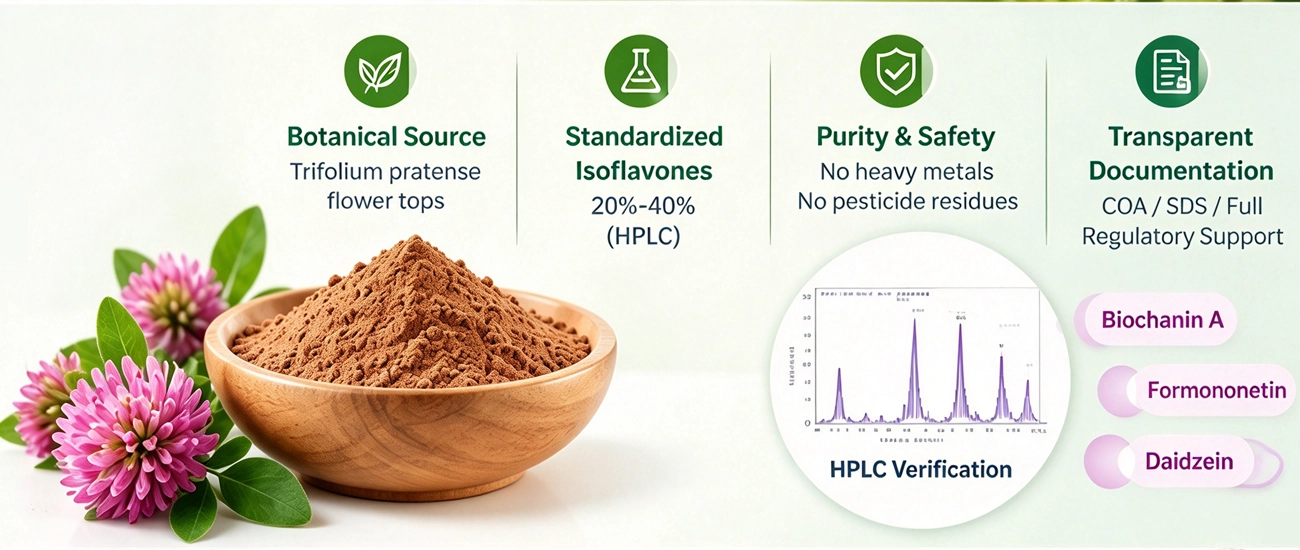
Choosing the right red clover extract powder for your formulation starts with knowing exactly what to look for. A premium-grade extract comes from the flower tops of Trifolium pratense, standardized to 20%–40% isoflavones (biochanin A, formononetin, daidzein) via HPLC, and verified to be free of heavy metals and pesticide residues. For B2B buyers in women's health, nutraceuticals, or functional beverages, the difference between a compliant ingredient and a regulatory liability often comes down to documentation quality, batch consistency, and supplier transparency.
Understanding the Core Quality Criteria for Red Clover Extract Powder
You need to have a clear idea of what "quality" means for this botanical item before you place a large order. Standardization, safety tests, and extraction consistency are the three things that matter the most.
Isoflavone Standardization and HPLC Verification
The main biological marker in red clover is the amount of isoflavone it has. Trustworthy sellers will say the exact amount—usually between 20% and 40%—and name the compounds: biochanin A, formononetin, daidzein, and genistein. High-Performance Liquid Chromatography (HPLC) is the standard analytical method for this check. You can't be sure of the strength of your finished product's claims of effectiveness without a batch-specific HPLC report.
Heavy Metal and Pesticide Testing
The EU and North American markets can't live with contamination. In both areas, strict rules apply: heavy metals should test at less than 10 parts per million (ppm), and pesticide residues should show as not detected (ND). SGS testing by a third party gives an extra layer of independence that goes beyond a supplier's own quality control. If a provider won't share these results, that's a red flag.
Extraction Method and Raw Material Origin
The original isoflavone profile is kept when supercritical CO2 or hydro-ethanolic extraction is used, as solvent leftovers are not introduced. The source material is also important. For example, flowers picked from fields that were grown organically have a lower contamination baseline. The right conditions for storage and processing are shown by a moisture content of about 3.21% and an ash content of about 3.1%.
|
Item |
Specification |
Result |
Method |
|
Total isoflavones |
≥40.0% |
40.12% |
HPLC |
|
Daidzein |
32.20% |
||
|
Genistein |
0.16% |
||
|
Formononetin |
7.08% |
||
|
Biochanin A |
0.68% |
||
|
Physicochemical Control |
|||
|
Appearance |
Fine powder |
Complies |
Sense |
|
Color |
Brownish Yellow |
Complies |
Sense |
|
Odor&Taste |
Characteristic |
Complies |
Sense |
|
Loss on Drying |
≤5.0% |
2.84% |
GB5009.3 |
|
Ash |
≤5.0% |
1.27% |
GB5009.4 |
|
Particle Size |
95% pass 80 mesh |
Complies |
CP2025 |
|
Heavy Metals |
|||
|
Pb |
≤1.0ppm |
Complies |
GB5009.12 |
|
As |
≤1.0ppm |
Complies |
GB5009.11 |
|
Hg |
≤0.1ppm |
Complies |
GB5009.17 |
|
Cd |
≤1.0ppm |
Complies |
GB5009.15 |
|
Microbiological Control |
|||
|
Total Plate Count |
≤10000cfu/g |
80cfu/g |
GB4789.2 |
|
Mold & Yeast |
≤100 cfu/g |
<10cfu/g |
GB4789.15 |
|
E. Coli |
≤10 cfu/g |
<10cfu/g |
GB4789.38 |
|
Conclusion:Conform with Specification |
|||
Evaluating Supplier Credentials and Manufacturing Capabilities
It takes more than reading a product page to find a good supplier of ingredients. Before you commit to a buying agreement, you need to look at the big picture of your operations.
Certifications That Matter in Global Markets
ISO 22000 and cGMP standards show that a company has a written food safety management system that can be checked by others. If a buyer wants to sell their goods in the EU, they must follow the EU Pharmacopeia. The FDA's GRAS status helps products get into the North American market. If you want to reach a wider audience, HALAL and KOSHER licenses can help you reach more people. Get copies of all the certificates and make sure you know when they are still valid.
Supply Chain Traceability and Production Capacity
A provider that is fully integrated (controls cultivation, extraction, and testing) makes it easier to track products than a trading company that buys from many farms and puts them together. The structure lowers the chance of batch-to-batch variation, which is one of the main issues product managers have when they need to get botanical extracts. Make sure that the seller can meet your volume needs and keep the specs the same for each order.
OEM and Private Label Support
Suppliers need to be able to be flexible if they want to work with brands that are making their own recipes. Look for companies that let you change the amount of isoflavone (10% to 50%), mix botanicals that work well together (like black cohosh or chasteberry), and package their products in a variety of ways, from 1 kg bags to 25 kg drums. When you work with a private label company, you can expect Certificates of Analysis (COA) and Safety Data Sheets (SDS) to be co-branded and available in more than one language.
Comparing Red Clover Extract Powder Varieties and Market Alternatives
There are different kinds of red clover extract powder that are used for different things. Knowing what your choices are will help you make the right choice from the start.
Extract Powder vs. Whole Herb and Tea Formats
Whole herb tea products just can't compare to standardized extract powder when it comes to getting a concentrated and regular amount of isoflavones. For making capsules and tablets, a fine powder with particles that are between 80 and 120 mesh and whose size can be controlled allows for even mixing and fast encapsulation with a weight difference of no more than 3 percent.
Red Clover Isoflavones vs. Soy Isoflavones
Tea-based formats work well for retail sales but not for mass production of nutraceuticals.
Conventional vs. Organic-Grade Sourcing
Both types of plants contain phytoestrogens, but they have different chemical makeups. Red clover also has biochanin A and formononetin, which are precursors that the body turns into active estrogen-like chemicals. Daidzein and genistein make up most of the isoflavones in soy. This wider range is one reason why red clover ingredients are often chosen for menopause-support products. It has been used to treat vasomotor symptoms in published clinical studies, such as work mentioned in journals like Maturitas.
Procurement Best Practices: How to Source Red Clover Extract Powder Wisely
A structured buying method keeps your business safe from poor quality and supply problems.
These are the main steps that every serious buyer should take before making a deal with a supplier:
- Request samples with full documentation: Before any bulk commitment, ask for a 100–200 g sample alongside the full COA, HPLC report, heavy metal panel, and pesticide screen. This lets your QC team verify the supplier's claims independently.
- Conduct a regulatory pre-check: Match the extract's specifications against your target market's requirements—EU Novel Food, FDA dietary supplement regulations, or APAC-specific standards—before your formulation team invests time in development.
- Negotiate MOQ and batch scheduling: The standard MOQ of 25 kg is a reasonable entry point for pilot production. For ongoing supply, negotiate scheduled delivery windows to avoid stock-outs without over-purchasing.
These steps lower the chance of a late-stage compliance failure that could cause your product launch to be months late.
Once you've done all of your research, the last step is to make the terms official. Ask for a framework agreement that spells out the accepted ranges of batch variation, the time it takes to get paperwork, and the steps that need to be taken to retest results that aren't up to standard. This makes everyone involved in the deal responsible.
Leveraging Research and Functional Benefits to Support Product Marketing
Clinical data is valuable to businesses. If buyers know about the written research on red clover extract powder isoflavones, they can use that information to better market the product.
Clinical Evidence for Menopause Support
Several peer-reviewed studies, including a 2007 meta-analysis published in Maturitas, found that postmenopausal women who took red clover isoflavone supplements had far fewer hot flashes. This body of research gives product managers a solid base for making claims based on evidence that stands up to regulatory scrutiny better than general botanical wellness language.
Bone Health and Cardiovascular Associations
Studies that have been published in Osteoporosis International and related journals have looked at how phytoestrogen intake affects bone mineral density in women who have gone through menopause. Even though the results are different depending on the population and dosage, these links give formulators more claim guidance than just managing vasomotor symptoms.
Safety Profile and Dosage Guidance
There is a lot of evidence that red clover isoflavones are safe when used in the recommended dose amounts (40–160 mg per day in clinical tests). Including this information in your product documentation and materials that people will see builds trust and meets the requirements for disclosure set by the EU and FDA.

Conclusion
It takes more than reviewing product sheets to find a good plant ingredient. The best red clover extract powder comes from a company that offers tested isoflavone standardization, clear contamination testing, full compliance documentation, and the operational flexibility to meet your needs for formulation and packaging. Whether you are building a private label brand or expanding a women's health line, these factors will show you how well your supply chain can handle pressure from both business and government. It's important to carefully consider providers because it keeps your product, business, and customers safe.
FAQ
1. Is red clover extract powder safe for long-term use in dietary supplements?
When writing up product paperwork, you should always look at the most recent safety papers.
2. How do I verify isoflavone potency between batches?
For each package, ask for an HPLC analysis that is specific to the batch. This will come as usual from a reliable source. You can also send a sample of each batch you receive to a third-party laboratory that has been approved by your company to make sure it is correct before sending the material to production.
3. What certifications should I require when purchasing in bulk?
You should at least look for ISO 22000, cGMP, and up-to-date test results from a third party that cover chemicals and heavy metals. For distribution in the EU, EU Pharmacopeia compliance documentation is needed. HALAL or KOSHER approval may be needed for certain areas.
4. Can the isoflavone concentration be adjusted for my specific formula?
Yes. Reliable manufacturers can change the concentration of isoflavones from 10% to 50%, and they can mix the extract with other plants that work well with it, depending on your formula goals.
Partner with Bolin Biotechnology for Your Red Clover Extract Supply
Bolin Biotechnology was established in 2012 and has spent more than ten years creating plant extract solutions that meet the high standards of performance and compliance that markets expect. Our company is a verified provider of red clover extract powder. We offer ISO 22000- and cGMP-certified products with HPLC-verified isoflavone content, SGS-confirmed heavy metal and pesticide testing, and full regulatory paperwork support for markets in the EU and North America. Our MOQ is 25 kg, and we can package it in a variety of ways, from 1 kg bags to 25 kg drums. To get a sample and COA, email us at sales1@bovlin.com.
References
1. Huntley, A. L., & Ernst, E. (2004). A systematic review of herbal medicinal products for the treatment of menopausal symptoms. Menopause, 11(4), 405–415.
2. Atkinson, C., Compston, J. E., Day, N. E., Dowsett, M., & Bingham, S. A. (2004). The effects of phytoestrogen isoflavones on bone density in women: a double-blind, randomized, placebo-controlled trial. American Journal of Clinical Nutrition, 79(2), 326–333.
3. Coon, J. T., Pittler, M. H., & Ernst, E. (2007). Trifolium pratense isoflavones in the treatment of menopausal hot flushes: A systematic review and meta-analysis. Maturitas, 55(1), 1–9.
4. Ghazanfarpour, M., Sadeghi, R., Latifnejad Roudsari, R., & Khadivzadeh, T. (2016). Red clover for treatment of hot flashes and menopausal symptoms: A systematic review and meta-analysis. Journal of Obstetrics and Gynaecology, 36(3), 301–311.
5. European Medicines Agency. (2016). Assessment report on Trifolium pratense L., flos. EMA/HMPC Committee on Herbal Medicinal Products.
6. Occhiuto, F., Zangla, G., Samperi, S., Palumbo, D. R., Pino, A., De Pasquale, R., & Circosta, C. (2007). The phytoestrogenic isoflavones from Trifolium pratense L. protect human and animal neural cells against glutamate excitotoxicity. Phytomedicine, 14(9), 628–636.