_1745226507162.webp)

Kojic Acid Powder for Skin Tone: Scientific Mechanism and Formulation Considerations
Kojic acid powder has become a common component of skin-brightening treatments because of its capacity to lessen discoloration by blocking tyrosinase. Aspergillus oryzae ferments food to produce this solid, which provides formulators with a scientifically validated substitute for contentious compounds like hydroquinone. Understanding this compound's biochemical properties and formulation aspects is crucial for businesses looking to sell to the nutraceutical, pharmaceutical, cosmetic, and OEM industries as demand for safer, organically derived active ingredients rises globally.
Understanding Kojic Acid Powder: Scientific Mechanism and Safety
The Biochemical Foundation of Tyrosinase Inhibition
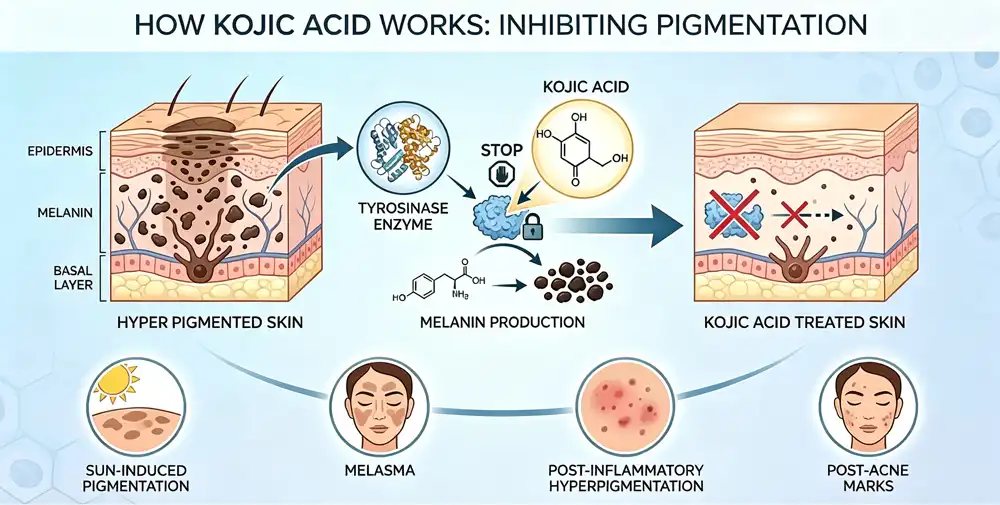
At the molecular level, 5-hydroxy-2-(hydroxymethyl)-4-pyrone functions via copper binding in the tyrosinase enzyme's active site. The chelation process prevents L-tyrosine from transforming into L-DOPA and subsequently dopaquinone, which are the precursors of melanin. Clinical research has shown that concentrations between 1% and 4% may effectively reduce melanin synthesis without endangering the integrity of skin cells. Compared to acids that eliminate dead skin or vitamin C derivatives that degrade preexisting melanin, this fungal substance functions somewhat differently. It is thus a useful option for preventing further discoloration.
Regulatory Landscape and Safety Parameters
The purity levels of Kojic Acid Powder must be more than 99.0%, as required by quality control requirements, according to the HPLC study. Heavy metal contamination levels must remain below stringent limits in order to comply with both international beauty regulations and USP/NF pharmacopoeia requirements. For instance, lead levels must remain below 5 ppm while arsenic levels must remain below 2 ppm. Safety tests show that when Kojic acid concentrations are above 2% and stabilizing agents are not utilized, the likelihood of skin irritation increases. Japan, the US, and the EU all permit its usage in cosmetics, but only to a limited extent. Kojic acid concentration limits are 1% for leave-on cosmetics and 4% for rinse-off products. These variables are used by formulation teams to ensure that their products are safe for customers and function properly.
Documented Clinical Efficacy and Tolerance Studies
Research published in dermatological publications showed that melasma severity ratings significantly improved after twelve weeks of therapy with 1% concentrations. Approximately 5 to 7 percent of users report moderate redness or touch sensitivity, particularly in the early phases, according to patient tolerance studies. Although the safety profile is superior to that of other whitening agents, formulators must be mindful of the potential for photosensitivity. People who use products containing this active ingredient should be instructed on how to shield themselves from UV radiation throughout the day.
Formulation Considerations for Kojic Acid Powder in Skin Care Products
Optimizing Concentration for Product Categories
Serum preparations often employ levels between 1% and 2% since the substance dissolves in water at a rate of roughly 44 g/L at 25°C. 0.5 to 1.5% is often used to ensure that the emulsion approach works with cream-based automobiles. Finding the ideal dosage to provide apparent results while reducing the possibility of aggravating sensitive skin types is the challenging part. Pharmaceutical-grade treatments for post-inflammatory hyperpigmentation or melasma may exceed regulatory restrictions. However, in order to ensure that most individuals can tolerate them, cosmetic products used on a regular basis keep under the lower limitations.
Stability Challenges and Preservation Strategies
Particularly in damp areas with plenty of light and high temperatures, oxidation may readily destroy Kojic acid powder. Because it functions best in a pH range of 3.0 to 5.0, the formation materials must be acidic, which may lead to issues with certain active combinations. Additionally, the copper-binding mechanism required for the medication to function may be disrupted by EDTA and other chelating agents. However, antioxidants like sodium metabisulfite and alpha-tocopherol have two functions: they strengthen the skin's antioxidant defenses and prevent the breakdown of the active substance. Lastly, solid, airless pumps must be included in the package to reduce oxidative exposure during product usage.
Synergistic Ingredient Combinations
The brightening effects may be increased while potentially lowering inflammation by cleverly combining comparable active ingredients. Formulators see improved barrier function that prevents potential sensitivity when they include niacinamide with 2-5% quantities. Another glycosylated hydroquinone derivative that functions by obstructing tyrosinase via different mechanisms is arbutin. As a result, the benefits are amplified without correspondingly increasing pain. Different forms of vitamin C, particularly magnesium ascorbyl phosphate, can reduce melanin levels and shield cells from free radicals. To ensure that the components will continue to function together during the product's shelf life, it is crucial to carefully balance the pH of these mixes and verify their stability.
It's important to pay extra attention to packaging rules when buying in bulk. The storage temperature and relative humidity should remain below 25°C and 60%, respectively, to maintain the stability of the crystals. To prevent the contents from becoming wet or rusty during international shipping, we recommend opaque, moisture-barrier containers with nitrogen flushing for large parcels. These procedures safeguard the product's purity from the manufacturing facilities to the final consumers.
Comparative Analysis: Kojic Acid Powder vs Alternative Skin Brightening Agents
Mechanism Differentiation Across Brightening Actives
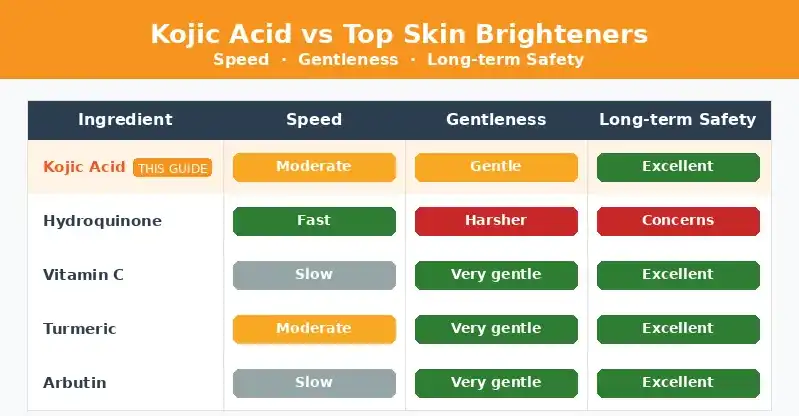
Developing innovative goods may be aided by understanding how various depigmenting tools operate. Arbutin competes with the tyrosinase substrate, although its effects are milder and need larger concentrations (3–5%). Rather of directly preventing melanosome development, niacinamide prevents melanosomes from moving from melanocytes to keratinocytes. Although hydroquinone is quite effective, its usage is restricted in certain locations since prolonged exposure to it may be hazardous. When taken orally, which is a whole different method of delivery, glutathione acts throughout the body. Fungi-based chelating agents are in the center; they are safer than synthetic ones but stronger than botanical options.
Efficacy Benchmarking and Clinical Outcomes
Following eight weeks of twice-daily administration, both treatments decreased melanin levels by around 60–70%, according to head-to-head clinical trials comparing 2% formulations and 4% hydroquinone. The tyrosinase inhibitor acts faster but is more painful than 5% niacinamide or kojic acid powder. For vitamin C products to function as effectively as they do on their own, a synergistic composition is required. Product marketing benefits from these comparisons. For instance, mass-market beauty companies prioritize tolerance and employ modest dosages, while formulators seeking rapid results with medical oversight could go for larger concentrations.
Regulatory Acceptance and Market Access
The selection of ingredients is significantly impacted by the state of international law. Although there are restrictions on the amount that may be used, the fungal metabolite is still permitted in the majority of major beauty markets. However, in many regions, hydroquinone may only be obtained with a prescription. Plant-based substitutes, such as mulberry and licorice extract, have a clean label appeal but aren't usually standardized. Plans for market entrance are directly impacted by these regulatory concerns. This is particularly true for businesses that want to market their goods in both the United States and the European Union, where ingredient approval procedures vary greatly.
Procurement Guide for Kojic Acid Powder: Sourcing and Supplier Considerations
Quality Verification and Certification Requirements
Teams in charge of purchasing goods for companies need to give greater weight to vendors that can provide comprehensive analytical reports that display testing for purity, microorganisms, and heavy metals. Compared to food-grade regulations, cosmetic-grade standards call for stricter contamination controls. USP/NF compliance and complete batch monitoring documentation are required for pharmaceutical applications. Minimum order amounts vary greatly between direct producers and traders. Although they provide better pricing models at bigger quantities, dedicated manufacturing sites typically need at least 25 kg. ISO 9001 accreditation is essential for quality management systems. GMP compliance is essential for pharmaceutical applications, while HACCP certification is essential for food-grade goods.
Supplier Relationship Management and Technical Support
Strategic partnerships with production suppliers aid in formulation development in addition to transactional purchasing, which reduces the time it takes to launch a product. Before committing to full-scale manufacturing, suppliers with application laboratories allow you to test compatibility with certain delivery methods. For example, application laboratories can rapidly assess the stability of active chemicals like Kojic Acid Powder in a variety of emulsion systems to prevent future expensive failures. Technical documentation bundles that contain solubility data across pH ranges, temperature stability profiles, and recommended use procedures reduce the amount of research and development that purchasing organizations must conduct. For formulators to avoid discoloration problems with Kojic Acid Powder, access to such comprehensive scientific data is essential, especially regarding its pH-dependent stability and chelation behavior. Custom test development for particular concentration requirements, such as figuring out the ideal dose of Kojic Acid Powder for brightening serums while guaranteeing skin tolerability and regulatory compliance, may help private-label businesses that want to differentiate their goods.
Logistics Optimization and Supply Chain Risk Mitigation
For international transportation, temperature control is crucial, particularly for routes that pass through warm climates where container temperatures may increase over what is required for stability. Ocean freight typically has lead periods of 30 to 45 days from Asian industrial hubs to North American distribution locations. This implies that shifting demand must be considered in inventory planning. Although dual-sourcing techniques reduce the possibility of supply interruptions, they need extensive testing to ensure that the quality of the products from each source is constant. Customs categorization under HS code 2932.19 expedites the import procedure when documentation accurately displays product specifications and intended use groups.
Best Practices for Incorporating Kojic Acid Powder into Skincare Routines
Formulation Protocols for Finished Product Development
The first stage in creating a new product is to dissolve it in water at temperatures below 60°C to prevent heat deterioration. Formulators should allow the solid powder to completely hydrate before including it into emulsion systems, since it dissolves readily in ethanol and water mixtures. The active's heat sensitivity must be considered while determining the phase inversion temperatures. Using the appropriate buffering techniques, the pH is adjusted to a range of 3.5 to 4.5 after emulsification. Compatibility testing is necessary for preservation devices because some preservatives perform less effectively in acidic environments. Stability programs should include strength testing at predetermined intervals and accelerated aging at 40°C/75% RH for 12 weeks.
Consumer Application Guidance and Education
Patch testing should be performed before applying the whole face, particularly for those with sensitive skin, according to finished product labels. The majority of individuals begin by using the Kojic Acid Powder-containing product once daily in the evening, and as their bodies adjust, they raise it to twice daily. Because of the possibility of photosensitivity, which may be exacerbated by active substances like kojic acid, broad-spectrum SPF 30 sun protection is necessary for daytime usage. Layering is crucial. To ensure that the kojic acid penetrates deeply enough into the skin, use it after washing and toning but before using strong moisturizers for optimal effects. Giving individuals realistic deadlines helps them establish realistic objectives, and the brightening benefits of kojic acid normally become apparent after four to eight weeks of consistent usage.
Integration with Complementary Skincare Elements
Complete photoprotection strategies are created by combining the whitening agent with antioxidant serums in the morning. Gentle exfoliants, such as 5% lactic acid, may be used in the evening to enhance active penetration, but not concurrently to prevent excessive pain. Moisturizers with a hyaluronic acid basis prevent dry skin and maintain the integrity of the skin barrier. The likelihood of long-term pain is reduced by avoiding concurrent use of retinoids in the early phases of introduction. Both formulation chemists who are creating use notes and customer service representatives who are responding to inquiries from clients about product integration benefit from these protocol recommendations.
Tyrosinase inhibitors generated from fungi must be properly incorporated into skin-brightening formulas, which calls for a thorough grasp of a variety of topics, including supply chain management, molecular processes, formulation chemistry, and regulatory compliance. Good purchasing connections and scientifically grounded formulation techniques enable manufacturers to produce competitive products that satisfy the demands of the worldwide market. Naturally derived active ingredients with distinct safety profiles are becoming more and more popular. This crystalline substance is growing in value as a component for pharmaceutical, nutraceutical, and cosmetic formulators attempting to treat hyperpigmentation problems.
conclusion
To sum up, kojic acid powder is a well-studied and potent tyrosinase inhibitor that is often used in contemporary skin-brightening formulas. It is a useful substitute for more contentious medications because of its capacity to lower melanin production at the enzymatic level and its scientifically proven effectiveness in treating hyperpigmentation diseases like melasma. However, proper formulation—especially with respect to concentration, pH control, antioxidant stabilization, and suitable packaging to preserve stability and reduce irritation risk—is crucial to its effective use. Even though it is usually well tolerated within set limits, careful user education on sun protection and gradual introduction are still necessary to guarantee safety and the best outcomes. Kojic acid continues to be a crucial component spanning performance, regulatory acceptability, and market adaptability across cosmetic and pharmaceutical applications as demand for organically sourced and scientifically proven active ingredients rises.
FAQ
1. What concentration of skin-brightening active is most effective for hyperpigmentation?
There is clinical data that suggests amounts between 1% and 2% are the best for leave-on cosmetics because they are the most effective and well-tolerated. Higher amounts, up to 4%, can be used in pharmaceutical products for clinical hyperpigmentation conditions as long as they are supervised by a doctor. The exact quantity should take into account the pH of the mixture, the active ingredients that work well together, and the skin sensitivity profiles of the target consumers. Before finalizing concentration standards, formulation teams should test tolerance across groups of users that are typical of the users.
2. How does stability compare between powder and liquid forms?
Because it is less likely to react with oxygen, the solid powder form is more stable than the pre-dissolved liquid types. Powders that are kept properly stay effective for 24 to 36 months, while liquids usually start to lose their effectiveness after 6 to 12 months. Because the powder absorbs water, it needs to be stored in a way that keeps the moisture level low. However, this gives formulators more freedom to change the pH and concentration of the end product while it is being made.
3. Can this ingredient be combined with retinoids in the same formulation?
The tyrosinase inhibitor needs acidic conditions (pH 3.5–4.5), while retinoids become unstable below pH 5.5. This makes concurrent synthesis difficult from a scientific point of view. Instead of using just one recipe together, many doctors suggest switching up when you use your skin care products, using the brightening active in the morning and the retinoids at night. This method maximizes the stability of each ingredient while minimizing the risk of cumulative soreness. However, stable co-formulation has been achieved by some advanced delivery systems that use capsule technology.
Partner with a Trusted Kojic Acid Powder Supplier for Your Formulation Needs
Bolin Biotechnology specializes in providing pharmaceutical- and cosmetic-grade boosting actives that meet the high standards needed by B2B clients around the world. Since we started our business in 2012, we have been dedicated to quality assurance at all times. We offer goods that have been tested and proven to be more than 99% pure, and we have a full list of certifications that show we follow ISO, GMP, and HACCP rules. For formulation advice, help with stable testing, and unique concentration creation that fits the needs of your product, our expert team is here for you. Our adjustable MOQ structures and reliable supply chain infrastructure support your production plans whether you make nutraceutical supplements, come up with new drug formulations, or come up with new lines of cosmetics. Email our team at sales1@bovlin.com to talk about the details of your project and find out how our plant-based solutions can help your products stand out in crowded markets.
References
1. Burnett, C. L., Bergfeld, W. F., Belsito, D. V., Hill, R. A., Klaassen, C. D., Liebler, D. C., Marks, J. G., Shank, R. C., Slaga, T. J., Snyder, P. W., & Andersen, F. A. (2010). Final Report of the Safety Assessment of Kojic Acid as Used in Cosmetics. International Journal of Toxicology, 29(6_suppl), 244S-273S.
2. Saeedi, M., Eslamifar, M., & Khezri, K. (2019). Kojic Acid Applications in Cosmetic and Pharmaceutical Preparations. Biomedicine & Pharmacotherapy, 110, 582-593.
3. Draelos, Z. D. (2007). Skin Lightening Preparations and the Hydroquinone Controversy. Dermatologic Therapy, 20(5), 308-313.
4. Chang, T. S. (2009). An Updated Review of Tyrosinase Inhibitors. International Journal of Molecular Sciences, 10(6), 2440-2475.
5. Zhu, W., & Gao, J. (2008). The Use of Botanical Extracts as Topical Skin-Lightening Agents for the Improvement of Skin Pigmentation Disorders. Journal of Investigative Dermatology Symposium Proceedings, 13(1), 20-24.
6. Nihei, K., & Kubo, I. (2003). Identification of Oxidation Product of Arbutin in Mushroom Tyrosinase Assay System. Bioorganic & Medicinal Chemistry Letters, 13(14), 2409-2412.