_1745226507162.webp)

Kojic Acid Powder vs Vitamin C: Which Skin Brightening Ingredient Is Better for Formulations?
When used in skin-brightening products, kojic acid powder and vitamin C may both help lighten skin, but they do so in somewhat different ways. Kojic acid powder is a dependable option for treating acne since it effectively inhibits the tyrosinase enzyme's activity via copper binding. Although vitamin C increases the formation of collagen and protects against more antioxidants, it requires more complex stabilization techniques. The best choice depends on your formulation objectives, target efficacy claims, stability requirements, and cost considerations in relation to your product category and market positioning.
Introduction
The worldwide cosmetics industry continues to concentrate on brightening agents as the need for even skin tones increases across all age groups. Although there are other depigmenting agents available, experienced formulators still find that kojic acid powder and vitamin C are the most economical and scientifically sound options. Knowing the tiny distinctions between these two potent compounds directly affects a product's functionality, compliance with laws, shelf life, and, eventually, market performance.
Finding the ideal balance between safety and efficacy, cost-effectiveness and novel ideas, and speed-to-market and long-term supply chain stability is becoming more important for formulation chemists, B2B procurement specialists, and product development teams. By examining the biochemical processes, formulation characteristics, purchasing considerations, and strategic selection criteria that distinguish kojic acid powder from vitamin C derivatives, this research examines these crucial decision points. Giving manufacturers, OEM partners, and brand developers actual data that transforms selecting ingredients from a guessing game into a tactical advantage is our aim.

Understanding the Core Mechanisms of Kojic Acid Powder and Vitamin C
How Kojic Acid Powder Functions at the Cellular Level
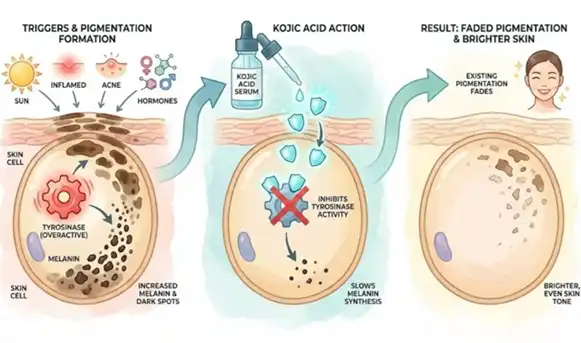
Tyrosinase is a fairly specific biological mechanism that is blocked by kojic acid powder. With a molecular weight of 142.11 g/mol and a chemical name of 5-hydroxy-2-(hydroxymethyl)-4-pyrone, this crystal molecule retains copper ions in the tyrosinase enzyme's active site. Without functioning copper cofactors, tyrosinase cannot convert tyrosine to DOPA and subsequently melanin. According to clinical research, doses of 1% to 3% may effectively lower hyperpigmentation indicators by 30 to 50% over a 12-week period. When it comes to storage, powder is the most stable form. When maintained correctly, away from light and moisture, assay purity by HPLC remains at ≥99.0%.
Vitamin C's Multifaceted Approach to Skin Brightening
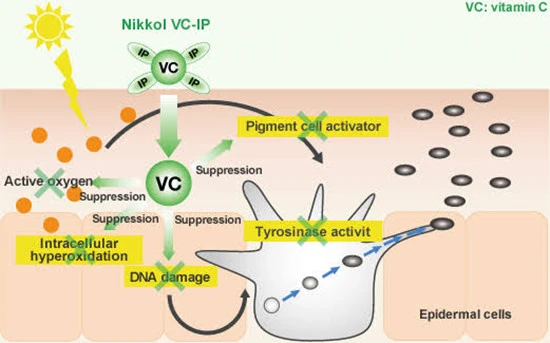
Vitamin C affects color via many mechanisms rather than simply inhibiting the activity of enzymes. L-ascorbic acid or its stable derivatives, which are forms of vitamin C, combat free radicals that lead to inflammatory hyperpigmentation. Additionally, it increases cell turnover and prevents melanin from migrating from melanocytes to keratinocytes. It typically makes the skin smoother and more radiant since it may increase the synthesis of collagen. Maintaining stability in the formulation is the challenge. L-ascorbic acid must be packaged without air and transported via acidic systems since it degrades rapidly above pH 4.5 and when exposed to light. Other kinds, such as ascorbyl glucoside or magnesium ascorbyl phosphate, are more stable but less effective in entering cells.
Comparative Safety and Regulatory Compliance
Both active substances have excellent safety ratings when combined in quantities that fall within established limits. Although levels of kojic acid powder below 2% are unlikely to induce sensitivity, certain Asian markets have restricted its usage due to concerns about long-term exposure. The FDA in the US says it is acceptable for cosmetic usage without imposing quantitative restrictions. Many toxicological studies have shown that vitamin C is usually regarded as safe by authorities worldwide. Iron contamination must be tightly managed to prevent the distinctive yellow-brown discoloration, and heavy metal levels must be less than 10 parts per million (ppm). In order to anticipate the combination, vitamin C raw materials must specify what sort of product they are, how pure they are, and how they are stabilized.
Scientific Comparison: Kojic Acid Powder vs Vitamin C in Formulation Performance
Stability Profiles and Shelf-Life Considerations
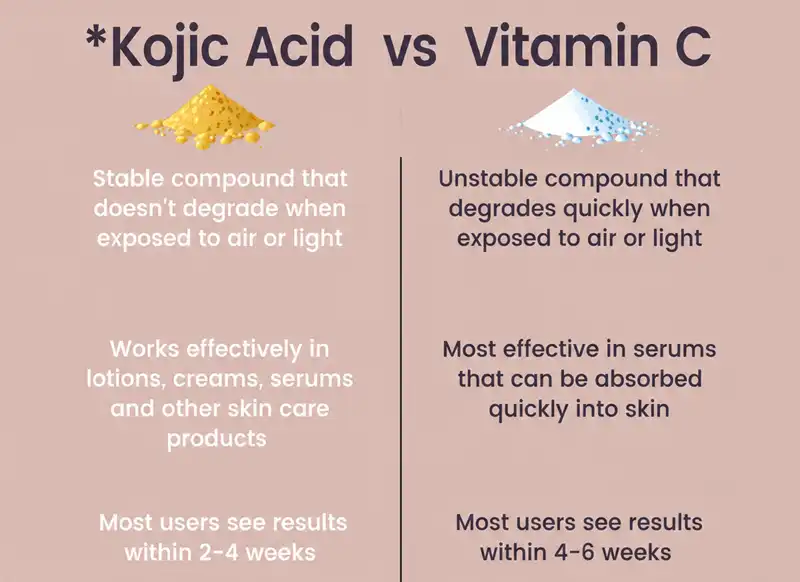
When these active substances are prepared and maintained properly, their behavior in formulations varies greatly. Kojic acid powder is highly stable in its crystalline state and breaks down very little when stored at a regulated temperature and humidity. It may be added to a variety of formulations without altering during typical manufacturing procedures since its freezing point is between 152 and 156°C. The element functions best in slightly acidic environments, about pH 5.5, although it is stable at pH values between 4.0 and 9.0. Formulators are able to create a greater variety of products, including cleansers and leave-on treatments, thanks to this increased pH tolerance.
Efficacy Data and Clinical Performance Metrics
In order to make evidence-based judgments on formulations, controlled clinical trials provide us with quantifiable performance requirements. 2% kojic acid powder improves hyperpigmentation scores by 20–40% over the course of 8–12 weeks, according to studies that track the melanin index decline. The chemical is particularly effective in removing age spots and post-inflammatory hyperpigmentation. Results are often apparent after four to six weeks of consistent usage. Because melanogenesis is a continuous biological process, it is advisable to use it often for optimal results. However, its unique mechanism guarantees consistent outcomes across a variety of skin types.
The efficiency of vitamin C varies greatly depending on the kind of derivative used and how it is administered, according to study findings. Similar to kojic acid powder, L-ascorbic acid exhibits potent lightening effects at 10 to 20 percent concentrations. Additionally, it promotes collagen, which offers further anti-aging advantages. Larger quantities of stabilized derivatives are often required to achieve the same results. In a manner not possible with enzyme-inhibiting agents alone, a mechanism known as antioxidants provides protection against subsequent coloring. Because of this, vitamin C products seem less like spot treatments and more like upscale anti-aging remedies.
Formulation Versatility Across Product Categories
Expert formulators choose active ingredients according to how well they fit the forms and delivery systems they want to use. Examples of typical applications for each item that demonstrate its optimal performance are as follows:
Kojic acid powder is effective in emulsion systems, cold-process soap bases, and water-free formulations. It dissolves readily in ethanol and water (approximately 44 g/L at 25°C), making it simple to include into toners, essences, creams, and gels without the need for additional techniques. Concerns regarding pre-dissolved chemicals degrading during storage and transportation are eliminated by the powder form. Its stability in opaque packaging throughout typical pH ranges for cosmetics appeals to manufacturers. This reduces packaging costs and facilitates formulation.
More clever manufacturing techniques that are adapted to the special qualities of vitamin C derivatives are required. Light serums with basic constituents, an acidic pH, and techniques that prevent air from entering the container are ideal for L-ascorbic acid. Because they may pass through lipid barriers more readily, lipophilic compounds—like ascorbyl tetraisopalmitate—perform well in oil-based serums and rich creams. However, their effectiveness must be shown in other ways. A greater variety of formulations may use stabilized versions that dissolve in water, but they must be thoroughly studied to ensure they don't react negatively with other active substances, preservatives, and texturizers.
Procurement Considerations for Kojic Acid Powder and Vitamin C
Quality Grade Classifications and Sourcing Standards
Procurement standards must divide materials into three categories: cosmetic-grade, food-grade, and pharmaceutical-grade, depending on the required degree of purity and the intended use. Cosmetic-grade kojic acid powder typically maintains a minimum of 99% purity, with only trace levels of solvents, heavy metals, and microbiological contaminants that are suitable for skin application. The majority of the material is produced by fermentation using the fungus Aspergillus oryzae. Experts in fermentation technology reside in Asian markets, where the majority of it is produced. HPLC purity tests, drying loss limits (often ≤0.5%), and heavy metal limitations (such as arsenic below 2 ppm and lead below 5 ppm) should all be included in quality certifications.
Supplier Evaluation and Supply Chain Robustness
You must consider more than simply unit pricing in order to develop trustworthy relationships with suppliers. Additionally, you should consider things like supply continuity assurance, technical support capabilities, regulatory compliance documents, and quality consistency. Prominent suppliers have GMP-certified manufacturing facilities, ISO 9001-approved quality management systems, and complete chain-of-custody documentation required for regulatory documents and brand transparency initiatives. The minimum order numbers vary significantly. While specialty distributors may be able to handle lesser quantities at higher costs, bulk powder providers typically need at least 25–100 kg to give affordable pricing.
Lead times, transportation stability requirements, the accuracy of customs documentation, and indicators of a supplier's financial health are all important considerations in the supply chain. Kojic acid powder can withstand typical shipping temperatures; however, it must be protected from light and moisture during transportation. Stricter cold chain management is required for vitamin C components, depending on how stable the derivative is. Reliance on a single source is less risky when supplier relationships are spread across several regions. No matter how reputable the source is, incoming goods must be rigorously inspected to maintain consistency in quality.
How to Choose Between Kojic Acid Powder and Vitamin C for Your Formulation
Strategic Decision Criteria for Product Development Teams
It's important to consider additional factors when selecting ingredients than merely their compatibility. Whether a product offers focused spot treatment characteristics or general anti-aging advantages that align with the brand's strategy and consumer expectations depends on how it is positioned. Because it is cheap, simple to combine, and effective at brightening regions, kojic acid powder is used in the majority of mass-market items. Vitamin C's premium positioning may be able to justify its higher material prices and complex production requirements with stronger marketing narratives regarding collagen activation and antioxidant protection.
Real-World Application Scenarios and Case Studies
Because it is inexpensive when used in the proper proportions and is stable in alkaline soap conditions, kojic acid powder is often used by private label soap manufacturers. Thanks to rigorous pH control and the incorporation of antioxidants, a significant OEM partner was able to effectively launch a range of kojic acid powder-based soaps with a 2% active content. During the 24-month testing period, the items performed as planned and were stable. The robust supply chain and straightforward manufacturing process allowed for rapid expansion to meet unexpected demand surges without sacrificing quality.
In order to keep their anti-aging serums stable while maintaining their efficacy claims, professional skin care companies are using an increasing number of distinct types of vitamin C. A well-known brand that was established by a doctor combined 2% ascorbyl glucoside with 10% L-ascorbic acid in a two-chamber package. Scientific evidence of both immediate antioxidant protection and long-lasting brightening benefits over a 12-week period resulted from this. The medicine had to be more expensive because of its complex composition, and the clinical evidence supported a therapeutic positioning that made it stand out in a crowded market.
Emerging Trends in Skin Brightening Technology
The industry is shifting away from single-active formulations and toward combination techniques that use cooperative mechanisms. When kojic acid powder and mild AHAs or niacinamide are combined, the results are felt more quickly because of the synergistic effects of inhibiting enzymes, accelerating cell turnover, and preventing melanin transfer, among others. Antioxidants like ferulic acid or vitamin E are increasingly included in vitamin C supplements to increase their stability and strengthen their capacity to combat free radicals. These intricate formulae satisfy evolving consumer demands for multipurpose products and provide formulators with strategies to differentiate themselves in crowded marketplaces.
The profitability of ingredients in global markets is still impacted by regulatory change. More consumers are purchasing plant-based products and biofermentation-derived active ingredients because they want to be ethical and utilize clean beauty products. Both kojic acid powder and properly obtained, thoroughly documented natural vitamin C derivatives satisfy these preferences. Strategic ingredient selection that guarantees a product's long-term survival rather than merely short-term optimization is made possible by anticipating changes in rules and consumer attitudes.
| Ingredient | Product Characteristics | Advantages | Functions | Purposes |
| Kojic Acid Powder |
Cost-effective; Easy to formulate; Stable in alkaline soap conditions |
Low material cost; Simple manufacturing process; Robust supply chain; Scalable mass production |
Skin brightening; Spot lightening/hyperpigmentation treatment |
Dominates mass-market products; major OEM partner successfully launched 2% active soaps stable over 24-month testing; rapid scale-up to meet unexpected demand surges without quality loss |
| Vitamin C Powder |
Premium positioning; Higher material cost; Complex production requirements; Requires specialized two-chamber packaging for stability |
Stronger marketing narrative Clinical evidence supports premium therapeutic positioning that stands out in crowded markets |
Antioxidant protection; Skin brightening; Collagen synthesis stimulation; General anti-aging benefits |
Used in professional anti-aging serums; Physician-founded brand combined 2% ascorbyl glucoside + 10% L-ascorbic acid in two-chamber packaging; Clinically proven immediate antioxidant + long-lasting brightening over 12 weeks, justifying premium pricing and therapeutic differentiation |
Conclusion
Selecting between kojic acid powder and vitamin C requires a thorough examination of formulation requirements, market positioning, production capabilities, and procurement variables rather than only comparing their effectiveness. Tyrosinase is precisely blocked by the kojic acid powder, which is inexpensive and simple to use. Because of this, it is ideal for whitening a wide range of products. Vitamin C has several applications, including enhancing the creation of collagen and shielding cells from free radicals, but it must be properly prepared and promoted at a high level. Successful businesses often create packaging with active ingredients across a range of product tiers and categories. In addition to maximizing the advantages of each ingredient, this enables them to reach as many consumers as possible. Strategic partnerships with reliable suppliers provide consistent quality, regulatory compliance, and supply stability—all of which are critical for preserving a brand's reputation and being competitive in the market.
FAQ
1. Is kojic acid powder safe for long-term use in skincare formulations?
Due to a lot of toxicological research and years of industrial use, kojic acid powder is known to be safe at amounts below 2% for use in cosmetics that are put on the skin. Regulatory bodies, such as the FDA, agree that it is safe for use in cosmetics, and there are no specific limits on quantity in the US market. To stop discoloration caused by oxidation, the right formulation has antioxidants and chelating agents. Some sensitive people may experience slight itching, which is why products need to be properly labelled and consumers need to be given advice. For compliance across all target markets, good providers provide detailed safety data sheets and regulatory support documents.
2. Can kojic acid and vitamin C be combined in a single formulation?
Combining these actives can be hard to formulate, but it is still technically possible with the right approaches. Concerns mostly revolve around pH compatibility—kojic acid powder works best at a pH of 5.5, while L-ascorbic acid needs a pH below 3.5 to stay stable. It is possible to co-formulate at middle pH levels by using stabilized vitamin C derivatives like sodium ascorbyl phosphate or mixing with buffered kojic acid powder systems. When there are enough antioxidants and chelating agents, bad reactions don't happen. Many successful formulations layer these actives in different product steps instead of mixing them all together in one step. This lets each ingredient work best in its own setting.
3. Where can procurement teams source reliable bulk suppliers for these ingredients?
Ingredient wholesalers with a history of working with the nutraceutical and cosmetics businesses keep reliable supply networks for both actives. Verification of factory standards, such as GMP compliance, quality management systems, and the completeness of legal paperwork, is needed to qualify suppliers. Direct relationships with manufacturers often offer lower prices for big orders, while specialized distributors offer lower minimums with technical help that adds value. To make sure that the relationship will work after the initial purchases, full supplier checks should look at things like production capacity, quality control methods, regulatory knowledge, and financial stability.
Partner with Bolin Biotechnology for Premium Kojic Acid Powder Supply
Shaanxi Bolin Biotechnology can help you create new medicines and make them available to more people by providing pharmaceutical-grade kojic acid powder along with detailed quality paperwork and technical support. As a manufacturer that has been ISO-certified since 2012, we follow strict quality control procedures that make sure your product stays stable throughout its shelf life and has an assay purity of 99.0% or higher via HPLC. Our expert team helps with formulation, provides regulatory support paperwork, and creates unique solutions to meet the needs of your cosmetic, nutraceutical, or pharmaceutical product. We have flexible minimum order quantities and helpful customer service, so you can come to us whether you need bulk supplies for well-known brands or small amounts for new ideas. Email our team at sales1@bovlin.com to talk about your needs for a kojic acid powder source, ask for certificates of analysis, or set up a review of a sample. We know a lot about plant ingredients and can do modern analytical work to give your production operations the reliable supply partnerships they need.
References
1. Lim, J.T. "Kojic Acid in Cosmetic Applications: Safety and Efficacy Review." Journal of Cosmetic Dermatology, Vol. 18, No. 4, 2019, pp. 1205-1213.
2. Pullar, J.M., Carr, A.C., and Vissers, M.C.M. "The Roles of Vitamin C in Skin Health." Nutrients, Vol. 9, No. 8, 2017, pp. 866-882.
3. Burnett, C.L., et al. "Safety Assessment of Kojic Acid as Used in Cosmetics." International Journal of Toxicology, Vol. 29, Supplement 4, 2010, pp. 244S-273S.
4. Telang, P.S. "Vitamin C in Dermatology." Indian Dermatology Online Journal, Vol. 4, No. 2, 2013, pp. 143-146.
5. Pillaiyar, T., et al. "Skin Whitening Agents: Medicinal Chemistry Perspective of Tyrosinase Inhibitors." Journal of Enzyme Inhibition and Medicinal Chemistry, Vol. 32, No. 1, 2017, pp. 403-425.
6. Draelos, Z.D. "Skin Lightening Preparations and the Hydroquinone Controversy." Dermatologic Therapy, Vol. 20, No. 5, 2007, pp. 308-313.