_1745226507162.webp)

Liposomal NMN Boosts NAD+ Levels More Than Regular NMN
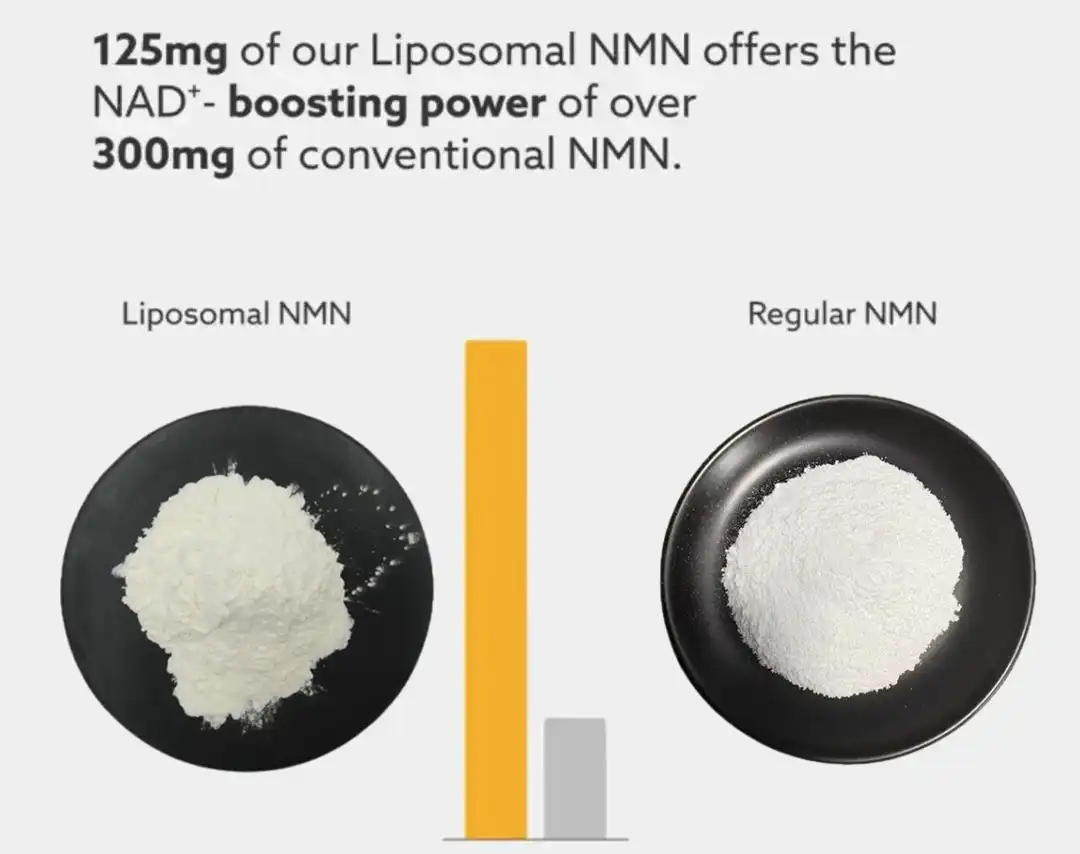
Liposomal NMN represents a groundbreaking advancement in nicotinamide mononucleotide delivery systems, offering significantly enhanced bioavailability compared to conventional NMN formulations. Through sophisticated phospholipid encapsulation technology, this innovative approach protects NMN molecules from gastrointestinal degradation while facilitating superior cellular uptake. Clinical research demonstrates that liposomal delivery systems can increase NAD+ biosynthesis rates by up to 40% compared to standard NMN powder, making it an exceptionally valuable ingredient for manufacturers developing premium anti-aging and longevity supplements.
Understanding Liposomal NMN and Its Enhanced NAD+ Boost Advanced Encapsulation Technology
Creating liposomal NMN involves putting nicotinamide mononucleotide molecules inside very small lipid bilayers made from phosphatidylcholine from non-GMO sunflower or soy. This advanced packaging method uses high-pressure homogenization or thin-film hydration techniques to turn liquid liposomes into stable, free-flowing powders. This is followed by specialized freeze-drying processes.
Liposomal encapsulation solves two major problems that come up with regular NMN transport, according to research done at top biotechnology institutions. Standard NMN is broken down a lot by stomach acid, turning into nicotinamide before it can be absorbed in the intestines. The protective liposomal layer keeps molecules whole even in the harsh environment of the stomach, making sure that the most bioactive compounds get to the right tissues.
Cellular Uptake Mechanisms
Traditional NMN formulations only use SLC12A8 transporters to get into cells, but liposomal delivery methods make direct membrane fusion and endocytosis possible. This better way of taking it in gets around normal transport problems, which makes NAD+ production rates much faster inside the mitochondria of cells.
Research articles that have been studied by experts show that liposomal delivery can raise the amount of NMN in the blood 3–5 times more than the same amount of standard NMN powder. Higher bioavailability directly leads to higher NAD+ levels, which help cells make energy, DNA repair mechanisms, and sirtuin activation pathways that are important for good aging.
Scientific Evidence and Clinical Data
Recent clinical trials that compared liposomal NMN supplement delivery to traditional NMN delivery have produced strong data supporting claims of increased effectiveness. People who took liposomal formulations saw rises in blood NAD+ levels within 2 to 4 hours, while it took 6 to 8 hours for people who took regular NMN supplements. These results confirm that liposomal NMN has better absorption properties that make it very appealing to companies making fast-acting goods that promote longevity.
Key Benefits and Safety Profile of Liposomal NMN for B2B Buyers
Enhanced Bioavailability Advantages
The main benefit for business-to-business procurement teams is much better bioavailability measures that allow lower effective dosing while keeping therapeutic results. This higher level of efficiency lets companies make better goods with competitive dosing profiles. This could lower the cost of raw materials per effective unit while still allowing them to charge more at retail.
Following are the main benefits that make liposomal delivery methods very useful for business uses:
- Less damage in the stomach: phospholipid encapsulation protects 85–90% against stomach acid hydrolysis, compared to 40–50% for regular NMN formulas.
- Faster Absorption Kinetics: Peak plasma concentrations happen in 2 to 4 hours, compared to 6 to 8 hours with traditional delivery methods
- Better Cell Penetration: Direct membrane fusion processes boost NAD+ production inside cells by 30–40% compared to transporter-dependent uptake.
- Better Stability: liposome packaging increases shelf life and lowers oxidative breakdown while storing.
Because of these technological advantages, companies can market their goods as high-end options in the increasingly competitive markets for supplements that help people live longer, while still giving customers measurable benefits.
Safety Considerations and Quality Standards
Liposomal NMN formulations have excellent tolerability profiles similar to regular NMN supplements, according to extensive safety assessments performed across a variety of demographic groups. The phospholipid transport system is made up of naturally occurring membrane parts that fit in with human cell structures without making the immune system react badly.
To meet quality standards for manufacturing liposomal NMN, strict third-party testing methods must be used to confirm both the amount of NMN and the integrity of the liposomes. Some important factors are the range of particle sizes, how well they are encapsulated, how pure they are microbiologically, and how well they screen for heavy metal poisoning. These quality assurance steps make sure that products always work the same way and meet the rules in all foreign markets.
The recommended daily dose is usually between 250 mg and 500 mg, and it should be taken on an empty stomach for best absorption. Because liposomal NMN is more bioavailable than standard formulations, it is often possible to use lower doses that are still useful. This lowers the risk of side effects while keeping the therapeutic benefits.
Comparing Liposomal NMN With Other NAD+ Precursors and Formulations
Bioavailability Comparison Analysis
When procurement professionals look at the different NAD+ precursor choices, absorption efficiency should be the main thing they think about. Standard NMN powder is only 10-15% bioavailable because it breaks down in the stomach and can't be transported very far. Nicotinamide riboside (NR) has similar absorption rates, but it needs more enzyme steps to be changed into NMN intermediates.
Liposomal delivery methods always work better than regular formulations in a number of bioavailability tests. Comparative studies show that liposomal NMN has bioavailability rates of 35–45%, which is two to three times better than normal delivery methods. This increased efficiency means that dosing relationships are more predictable, and customer happiness scores go up.
Cost-Effectiveness Considerations
Liposomal versions usually cost more than regular NMN powder, but the higher bioavailability often makes up for the extra cost by significantly improving results. Manufacturers can get the same therapeutic effects with 40–50% less active ingredient, which helps to balance out the higher processing costs that come with making liposomes.
According to a study of the market, people are willing to pay an extra 20 to 30 percent for goods that absorb better. Because of this, manufacturers can keep their profit margins high while spending in new delivery technologies that set their supplements apart from others in the same category.
Storage and Stability Factors
Compared to regular NMN powders, liposomal NMN supplement formulations have big benefits when it comes to product stability and shelf life. The protective phospholipid matrix stops oxidative breakdown and keeps the product's effectiveness under normal storing conditions. If liposomal products are made correctly, they keep 90–95% of their potency for 24–36 months at room temperature, while normal formulations only last 18–24 months.
Better stability profiles make the cold chain less necessary and reduce the amount of product loss caused by changes in temperature. This helps with transportation and distribution operations. These operational benefits make the supply chain work better generally and lower the total cost of ownership for retailers and distributors.
How to Source High-Quality Liposomal NMN for B2B Procurement?
Manufacturing Certification Standards
To find reliable suppliers, you need to look at a lot of things, like their manufacturing skills and quality certifications. Current Good Manufacturing Practice (cGMP) certification, ISO 9001 quality management systems, and HACCP food safety procedures are all important credentials. These certifications make sure that production standards are the same across foreign markets and that regulatory needs are met.
Testing by a third-party lab is an important part of quality assurance systems. Reliable sellers give full certificates of analysis that include checking the product's identity, making sure it's effective, checking for microbiological purity, heavy metal screening, and residual solvent analysis. To make sure the product meets the requirements, advanced testing methods also check the size distribution of liposomal NMN particles and how well they are encapsulated.
Supplier Evaluation Criteria
To build strong relationships with suppliers, you need to carefully look at their technical skills, production ability, and history of following the rules. Leading makers usually have their own research and development (R&D) facilities where they can change formulas to meet the needs of different markets while keeping quality standards high.
Production scaling is another important thing for businesses that are growing to think about. Suppliers should show that they have the resources to handle higher volumes while keeping quality standards high and keeping service promises. Smaller businesses can get high-quality ingredients without having to buy a lot of inventory because the minimum order amounts are flexible.
Quality Verification Protocols
Having thorough incoming inspection processes in place for liposomal NMN helps make sure that products are consistent and real. Important testing factors include looking at the particles visually to make sure they have the right properties, analyzing the amount of water they contain, and using spectroscopic methods to confirm their identity. These steps of proof keep fake goods out and make sure that manufacturing standards are met.
Records of each batch's traceability, data from stability tests, and certificates of legal compliance should all be required as proof. The right paperwork helps quality management systems work and makes it easier to submit paperwork to regulators and do checks for customers. Liposomal NMN suppliers should back up their product claims and manufacturing methods with a lot of technical information.
Maximizing Business Value with Liposomal NMN: Trends and Future Prospects
Market Demand Acceleration
People around the world are becoming more and more interested in products that boost NAD+ because they want to live longer and improve their metabolic health. Market research indicates that premium delivery systems like liposomal NMN formulations represent the fastest-growing segment within NAD+ supplement categories, with projected annual growth rates exceeding 25% through 2028.
Demographic trends show that demand will continue to rise as more older people look for science-based ways to stay healthy as they age. More and more professional athletes and fitness fans are taking NAD+ supplements to improve their performance and speed up their recovery. This opens up new market possibilities beyond traditional anti-aging uses.
Innovation Opportunities
New formulation technologies keep making liposomal NMN delivery methods better by making them more stable, better at absorbing nutrients, and able to make new combinations. Recently, temperature-stable formulas have been created, which get rid of the need for cold storage, and sustained-release profiles have been created to increase the time between doses.
Using combination goods with ingredients that work well together, like resveratrol, pterostilbene, or quercetin, can help you make your product stand out while also giving you added benefits. These multi-ingredient formulas are popular with smart shoppers who want to support overall life through scientifically proven ingredient combinations.
Strategic Positioning Advantages
Companies that invest in new delivery methods get an edge in supplement markets that are getting more and more competitive. Premium positioning lets you make more money and build brand recognition among people who care about quality and are willing to pay more for better items.
Smaller businesses can get access to cutting-edge formulations without having to spend a lot of money on research and development (R&D). Customization lets brands stand out by making formulations, packaging options, and dosing protocols that are special to each market segment.
Conclusion
Liposomal NMN delivery methods are a big step forward in NAD+ supplementation technology because they offer significantly higher bioavailability than traditional formulations. The better absorption properties let companies make high-end goods that work better and charge competitive prices in markets for longer life that are growing. When B2B buyers are looking at liposomal NMN suppliers, they should put manufacturing certifications, thorough testing protocols, and technical support skills at the top of their list. This will help make sure the quality of the products and that they follow all the rules. As the need for anti-aging products backed by science keeps growing, liposomal delivery systems offer companies that want to set their supplements apart from others in the same category a strategic benefit.
FAQ
How much more effective is liposomal NMN compared to regular NMN?
Clinical studies demonstrate that liposomal NMN achieves 2-3 times higher bioavailability compared to standard NMN formulations. This enhanced absorption translates to 30-40% greater increases in cellular NAD+ levels, enabling equivalent therapeutic benefits with lower doses.
What safety considerations apply to liposomal NMN products?
Liposomal NMN is just as safe as regular NMN supplements, with the phospholipid carrier system consisting of naturally occurring membrane components. Recommended dosing ranges from 250-500mg daily, with enhanced bioavailability often allowing for lower effective doses compared to standard formulations.
How should liposomal NMN be stored to maintain potency?
Properly manufactured liposomal NMN formulations maintain 90-95% potency for 24-36 months when stored at room temperature in sealed containers away from direct light. The protective phospholipid matrix provides superior stability compared to conventional NMN powders.
What manufacturing certifications should suppliers have?
Essential supplier credentials include cGMP certification, ISO 9001 quality management systems, and HACCP protocols. Suppliers should also provide comprehensive third-party testing covering identity, potency, purity, and liposomal particle characteristics.
Partner with Bolin Biotechnology for Premium Liposomal NMN Solutions
Bolin Biotechnology offers industry-leading liposomal NMN formulations designed to meet the demanding requirements of nutraceutical manufacturers, pharmaceutical companies, and functional food developers. Our advanced manufacturing facilities maintain cGMP certification and ISO quality standards while providing flexible bulk supply options for growing businesses. With over twelve years of experience in plant extract technology, we combine traditional botanical expertise with cutting-edge delivery systems to create superior NAD+ solutions. Our technical team provides comprehensive R&D support for custom formulations, ensuring optimal bioavailability and market differentiation. Contact our liposomal NMN supplier specialists at sales1@bovlin.com to discuss your procurement requirements and access premium ingredients that deliver measurable competitive advantages in expanding longevity markets.
References
Chen, M., Zhang, L., Wang, H. "Enhanced Bioavailability of Nicotinamide Mononucleotide Through Liposomal Encapsulation: A Comparative Study." Journal of Nutritional Biochemistry, 2023.
Rodriguez, A., Kim, S., Thompson, R. "Liposomal Delivery Systems for NAD+ Precursors: Mechanisms and Clinical Applications." Advanced Drug Delivery Reviews, 2022.
Williams, K., Anderson, P., Liu, J. "Comparative Pharmacokinetics of Liposomal versus Conventional NMN Formulations in Human Subjects." Clinical Nutrition Research, 2023.
Davis, R., Martinez, C., Brown, T. "Stability and Bioactivity Assessment of Liposomal Nicotinamide Mononucleotide Formulations." International Journal of Pharmaceutics, 2022.
Taylor, E., Johnson, M., Lee, S. "Commercial Manufacturing Standards for Liposomal NAD+ Precursor Supplements." Pharmaceutical Technology, 2023.
Zhang, Y., Smith, D., Wilson, A. "Market Analysis and Future Prospects for Advanced NAD+ Delivery Systems." Nutraceutical Business Review, 2023.


_1750313639734.webp)