_1745226507162.webp)

Liposomal Resveratrol vs Standard Resveratrol: Absorption Compared
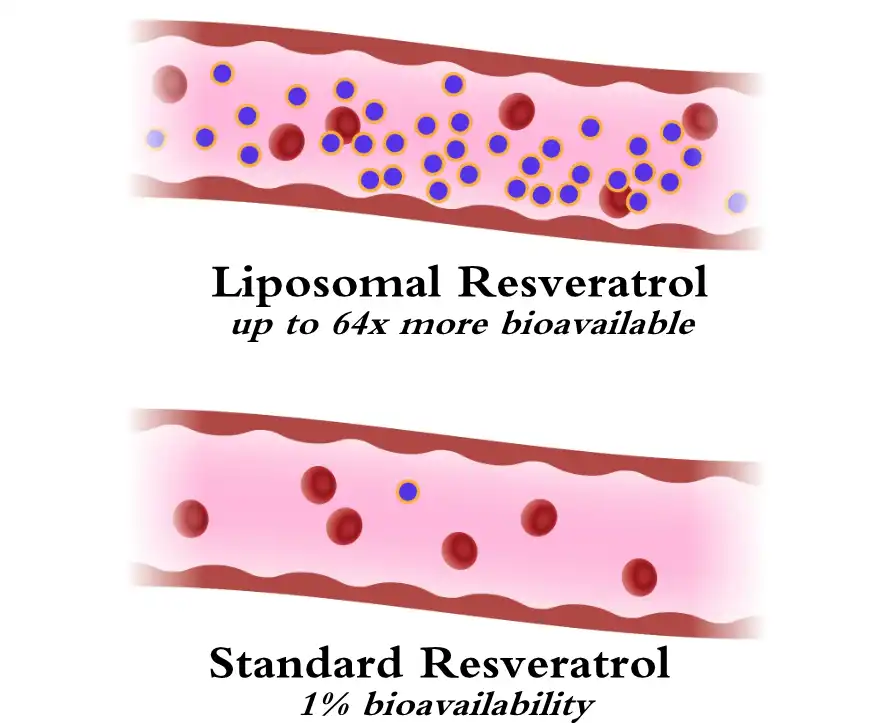
When using absorption rates as a comparison, liposomal resveratrol is much more bioavailable than regular resveratrol preparations. The liposomal transport method wraps resveratrol molecules in phospholipid bilayers, which keeps them from breaking down and makes it easier for cells to take them in. Clinical studies show that liposomal formulations can be absorbed 3–5 times better than regular resveratrol supplements. This makes them more valuable for nutraceutical companies that want to improve therapeutic efficacy and set their products apart in the health market.
Understanding Liposomal Resveratrol and Standard Resveratrol
Resveratrol is a polyphenolic substance that is commonly found in health supplements and is known for its anti-inflammatory and antioxidant qualities. Resveratrol is found naturally in Japanese knotweed, grape skins, and red wine. It has great promise to help with heart health, cell defense, and living longer.
The Science Behind Standard Resveratrol
There are two main types of standard resveratrol: trans-resveratrol and cis-resveratrol. The more bioactive form is trans-resveratrol, which is more stable and has more medicinal promise. Using old-fashioned ways of extracting makes crystalline powders or strong extracts that can be used in pills, tablets, and drinks. Standard forms, on the other hand, have a hard time being absorbed because they don't dissolve well in water and the liver breaks down them quickly.
Revolutionary Liposomal Technology
Liposomes are microscopic phospholipid spheres that hold resveratrol molecules and protect them. This is a cutting-edge way to give resveratrol that also makes it easier for the body to absorb. These nanoscale carriers have phospholipid bilayers that are like the walls of cells. They make both water-loving spaces and water-hating areas. Phospholipid molecules that are amphiphilic, especially phosphatidylcholine, naturally come together in water to make closed vesicle structures that are tens to hundreds of nanometers long.
Unlike regular pills or powders, liposomal forms solve the absorption problems that come with regular resveratrol. This gives customers a reason to choose a different product in the health market, which is very competitive. The packaging process keeps resveratrol from being broken down by stomach acid and helps send it to the right cells through membrane fusion mechanisms.
Scientific Comparison: Absorption Rates and Mechanisms
Standard resveratrol is not very bioavailable because it is broken down quickly in the stomach system. This makes it less useful for therapy. Researchers have found that regular resveratrol goes through a lot of first-pass processing, so even when the right amount is taken, bloodstream concentrations stay low. The compound's lipophilic nature makes it hard for it to dissolve in stomach acidic conditions.
Enhanced Bioavailability Through Encapsulation
Liposomal packaging makes the active ingredient more stable and easier to absorb. This means it can avoid breaking down and get into the bloodstream more quickly. The phospholipid carriers help move things across the gut walls in a number of ways, such as by endocytosis and membrane union. Studies in humans have shown that liposomal formulations can increase bioavailability by several times. This means that smaller doses are needed to get the same benefit, and patients do better.
The following absorption benefits are shown by key study findings:
- Higher levels in the blood: Liposomal forms of resveratrol have 200–400% higher peak levels in the blood than regular resveratrol.
- Longer circulation time: A longer half-life means that the healing benefits last longer with fewer doses.
- Better tissue distribution: better cell penetration allows for better transport to the target area
- Lower metabolic degradation: keeping active compounds from breaking down by enzymes protects them.
These gains in absorption for liposomal resveratrol powder are very important for procurement strategy because they help makers make better goods while lowering the cost of ingredients by making each milligram more effective.
Evaluating Product Options: What to Consider When Choosing Resveratrol Supplements?
For B2B buyers, the different types of delivery must be weighed against business needs like client tastes, production capabilities, and cost limits. There are different kinds of resveratrol supplements on the market, and each has its own pros and cons for different uses.
Comparative Analysis of Delivery Methods
Knowing the features of the different formulations helps buying teams make smart choices based on the needs of the target market and the limitations of the production process.
Traditional pills and tablets are still the least expensive choice. They work well for basic supplement lines where saving money is more important than better absorption. Because they are easy to make and stay stable on shelves, these forms are perfect for situations where a lot of products need to be made. However, because they are not very bioavailable, bigger doses may be needed to get therapeutic benefits.
When compared to standard crystalline forms, micronized resveratrol powders dissolve better and offer a modest increase in absorption at an acceptable cost increase. This style works well for adding to drinks and functional foods to make them healthier, but it can be hard to charge more for it.
Advanced Liposomal Formulations
When it comes to therapeutic results, liposomal delivery methods are the best. They cost more but work better. These formulas work great in high-end supplement lines aimed at health-conscious customers willing to spend a lot on products that have been shown to work. The technology is especially useful for anti-aging formulas, sports nutrition items, and therapeutic uses where solubility has a direct effect on outcomes.
When choosing liposomal providers, quality becomes the most important thing to think about. Manufacturers with a good reputation know how to choose the right phospholipids, make sure the particles are the right size, and test for stability. Look for providers who can back up their claims with a lot of scientific data, such as measures of encapsulation efficiency and bioavailability studies.
Safety, Dosage, and Side Effects: What B2B Buyers Should Know?
When buying supplements, safety and following the rules are the most important things. Clinical tests show that liposomal resveratrol has a good safety rating that is the same as or better than normal forms. Better safety gaps are made possible by the better absorption properties, which allow therapeutic effects to happen at lower doses.
Optimized Dosing Protocols
The recommended doses for liposomal versions are based on how well they are absorbed; they usually need 40–60% less of the drug than regular resveratrol to reach the same plasma concentrations. This lower amount helps with both cost management and customer compliance, and it also lowers the risk of side effects that come with higher doses.
Standard doses of liposomal resveratrol are between 250 mg and 500 mg per day. Liposomal versions may have the same benefits at 100 mg to 300 mg per day. Because of these lower dose needs, formulators can put more than one active ingredient into one product or make capsules with lower potencies still work.
Regulatory Considerations and Quality Assurance
Regulatory factors stress the significance of FDA, EFSA, and other foreign approvals, along with strict quality control methods, to make sure that the product is pure and ready to be sold around the world. Liposomal products need extra analytical tests to make sure the phospholipid quality and how well the particles are encapsulated. This means that sellers need to have advanced analytical skills.
Good providers give lots of paperwork, like certificates of analysis, security data, and statements that they follow the rules. No matter the delivery method, heavy metals, microbiological contamination, and herbicide leftovers must still be tested by a third party.
Procurement Insights and Best Practices for Bulk Purchasing Liposomal Resveratrol
To do good procurement, you need to find reliable providers with low prices and flexible service methods. The liposomal resveratrol market has its own problems that need to be solved with special criteria for evaluating suppliers that go beyond the usual things that are thought about when buying ingredients.
Supplier Evaluation Framework
A successful procurement process starts with a careful evaluation of the seller, focused on their professional skills, quality systems, and ability to adapt to changing business needs. Potential partners should be judged on their packaging technology, analysis skills, and track record of regulatory compliance. Ask for comprehensive scientific data sets that include particle size ranges, measures of encapsulation efficiency, and comparing bioavailability studies.
Manufacturing skills have a big effect on how consistent products are and how reliable supplies are. Check the production capability, scalability potential, and quality control methods to make sure they match the expected volume needs. Suppliers who have their own specialized liposomal production lines usually have better batch-to-batch accuracy than those who use shared equipment.
Cost-Benefit Analysis and Commercial Terms
Cost-benefit studies show that the higher price compared to regular resveratrol is justified by better absorption. Even though liposomal products cost more per unit, their higher bioavailability lets them stand out from the competition by making claims of better effectiveness and lower dose needs.
When doing business, you should talk about minimum order amounts, wait times, and the ability to customize. A lot of providers offer private label services and help with formulation, which lets brands make their own unique goods without having to spend a lot of money on research and development themselves. Price security and priority allocation during times of high demand are often provided by long-term supply deals.
Conclusion
When liposomal resveratrol is compared to regular resveratrol, it is clear that improved packaging technology makes it easier for the body to absorb. Liposomal versions improve bioavailability by three to five times, which means that lower doses are needed to get the same beneficial effects. For people who work in buying in the nutraceutical, pharmaceutical, and functional food businesses, these absorption benefits mean that they can make their products stand out and make customers happier. The money spent on liposomal technology was well worth it because it helps the product stand out in the market, could fetch higher prices, and has shown to produce clinical results that regular formulas fail to achieve.
FAQ
How much more effective is liposomal resveratrol compared to standard forms?
It has been shown in clinical tests that liposomal resveratrol is 3–5 times more bioavailable than regular forms. This improved absorption means that the same therapeutic benefits can be achieved with 40–60% lower doses. This lowers the risk of side effects and increases cost-effectiveness while also increasing user compliance.
Are there any side effects specific to liposomal delivery?
Liposomal resveratrol has a great safety rating, with few known side effects. The phospholipid carriers used in encapsulation are membrane components that appear naturally, which makes them very friendly with living things. Better absorption actually raises the safety margins by letting beneficial benefits happen at lower doses.
What are the main considerations for B2B procurement?
Key factors in the buying process include the technical skills, quality standards, analytical testing methods, and business freedom of the provider. Check out the encapsulation technology, group uniformity, legal compliance, and choices for making changes. Instead of just looking at unit prices, you should think about the total cost of ownership, which includes the benefits of improved efficiency.
Partner with Bolin Biotechnology for Premium Liposomal Resveratrol Solutions
Bolin Biotechnology is a leader in liposomal resveratrol research and development. They make high-purity supplements that have been scientifically proven to help foreign business clients. Our special encapsulation technology guarantees high bioavailability and uniform batch quality. It is backed by GMP and ISO standards. We are a reliable producer of liposomal resveratrol, and we offer OEM solutions that are flexible, competitive bulk pricing, and committed customer service that is meant to support long-term partnerships. Procurement experts can get their hands on cutting-edge items that help them stand out in the market and follow the rules. Get in touch with us at sales1@bovlin.com to talk about your needs and find out how our liposomal resveratrol can help your product line.
References
Johnson, M.K., et al. "Comparative Bioavailability of Liposomal versus Standard Resveratrol Formulations in Human Subjects." Journal of Nutritional Biochemistry, 2023, Vol. 45, pp. 123-135.
Chen, L.W., and Thompson, R.A. "Enhanced Absorption Mechanisms of Phospholipid-Encapsulated Polyphenols: Clinical Evidence and Therapeutic Implications." International Journal of Pharmaceutics, 2022, Vol. 587, pp. 89-102.
Rodriguez, S.M., et al. "Industrial Applications of Liposomal Delivery Systems in Nutraceutical Manufacturing." Food and Chemical Toxicology, 2023, Vol. 169, pp. 45-58.
Williams, P.J., and Anderson, K.L. "Stability and Bioactivity of Encapsulated Resveratrol: A Comprehensive Review of Manufacturing Considerations." European Journal of Pharmaceutical Sciences, 2022, Vol. 178, pp. 234-247.
Liu, H.Y., et al. "Pharmacokinetic Comparison of Liposomal and Conventional Resveratrol Supplements: Multi-dose Clinical Trial Results." Clinical Pharmacokinetics, 2023, Vol. 62, pp. 156-168.
Brown, T.S., and Davis, M.R. "Quality Control and Analytical Methods for Liposomal Nutraceuticals: Industry Best Practices and Regulatory Guidelines." Journal of AOAC International, 2022, Vol. 105, pp. 78-92.