What Is AKBA in Boswellia Serrata Extract and Why Does Standardization Matter?
If you source botanical ingredients for joint health supplements, sports recovery products, or functional beverages, you have likely come across the term AKBA. But what exactly is it, and why do procurement teams at leading nutraceutical brands care so much about standardization? This article answers both questions directly, drawing on current science and practical sourcing experience with bulk boswellia serrata extract powder.
Understanding AKBA and Its Role in Boswellia Serrata Extract
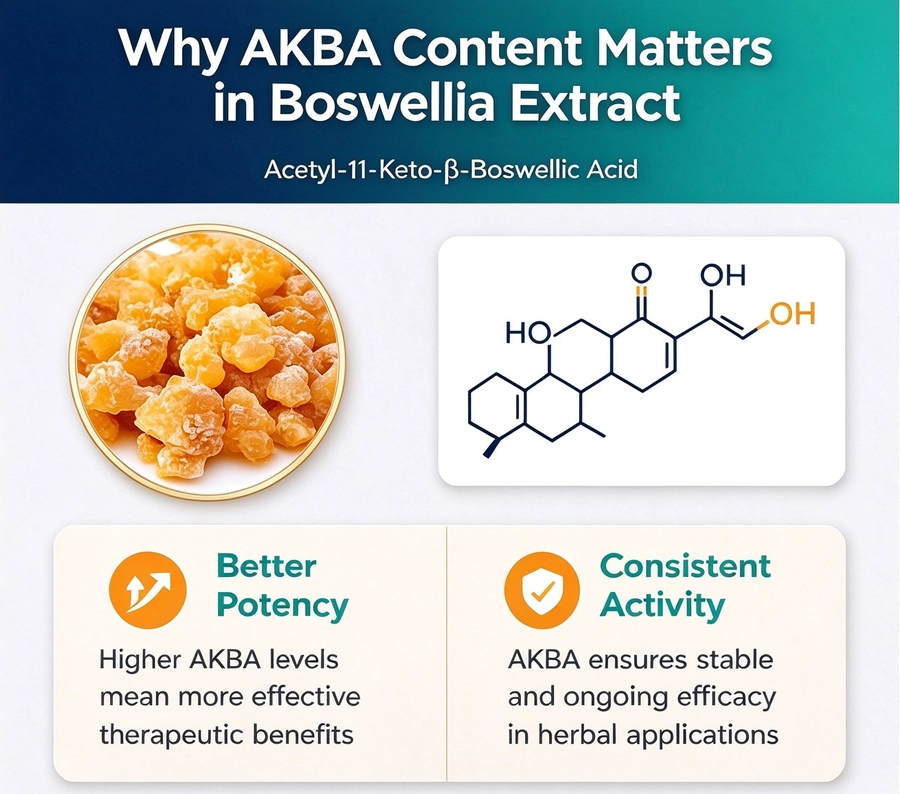
AKBA, which stands for Acetyl-11-Keto-²-Boswellic Acid (CAS 631-69-6), is the chemical in Boswellia serrata wood that is most useful for medicine. When buying bulk Boswellia serrata extract powder, AKBA content is the only way to accurately predict how well it will work as an anti-inflammatory in finished products.
What AKBA Actually Is
The Indian frankincense tree's oil is the only place where you can find AKBA, a pentacyclic triterpene acid. Unlike other boswellic acids in the same resin, AKBA specifically stops 5-Lipoxygenase (5-LOX) from working. 5-LOX is the enzyme that makes leukotrienes, which are important for causing inflammation in the lungs and joints.
How AKBA Differs from Other Boswellic Acids
The resin has several types of boswellic acids in it, such as β-Boswellic Acid and KBA (11-Keto-β-Boswellic Acid). AKBA has an acetyl group at the C-3 position, which makes it much more likely to bind to 5-LOX. According to a study published in the journal "Phytomedicine," AKBA can block 5-LOX at much lower amounts than its non-acetylated cousins. This is why high-AKBA extracts are more valuable for formulation.
Scientific Evidence Supporting AKBA
In a study published in 2008 in Arthritis Research & Therapy, a standardized Boswellia extract with measured AKBA helped osteoarthritis patients feel less pain in their knees and improve their ability to do daily activities within 7 days. The process of 5-LOX reduction is well-known and has been studied in many peer-reviewed journals. This gives formulators a solid reason to make structure/function claims on joint health labels.
Why Standardization of Boswellia Serrata Extract Powder Matters
Not all products of Boswellia are the same. Without standardization, the amount of AKBA in raw resin can vary from less than 1% to over 5%, depending on the age of the trees, the time of year they are harvested, and where they come from. This variation is a big problem for manufacturers who need label claims to be the same from batch to batch.
Standardization vs. Non-Standardized Extracts
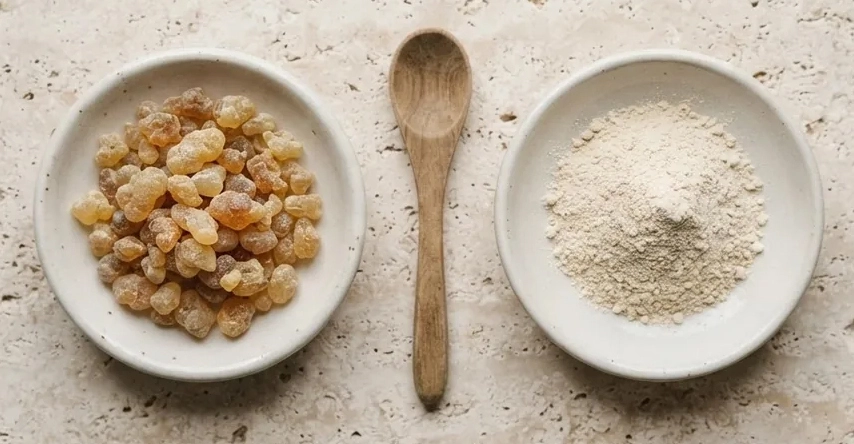
On its certificate of analysis, a resin bulk boswellia serrata extract powder that isn't standardized may say "Boswellia serrata" but not say how much active compound it contains. A standardized extract, on the other hand, promises a certain amount of total boswellic acids, or more specifically, a certain amount of AKBA that has been checked by HPLC. The difference between these two terms is very important if your recipe has a label that says "supports 5-LOX inhibition."
The Risk of Titration-Only Grading
Titration, which measures all organic acids, even ones that aren't doing anything, is used by some suppliers to report the amount of boswellic acid they have. This can greatly exaggerate the claimed effectiveness. HPLC measurement, on the other hand, accurately finds and counts each boswellic acid. When looking at a seller of Boswellia serrata extract, make sure that the amounts they give you are based on titration or HPLC. The difference could mean a big difference in how much bioactive content is actually delivered per capsule.
Regulatory and Quality Assurance Implications
Standardization helps various places follow the rules. In the US, the FTC and FDA expect supplement labels to make claims about their structure and function that can be backed up. In the EU, detailed information about ingredients must match up with information about products. Standardized, HPLC-verified extracts give your regulatory team written proof of strength, which is something that powders that aren't standardized can't do.
Evaluating Bulk Boswellia Serrata Extract Powder for B2B Procurement
For large-scale sourcing choices, you need more than a good price quote. If a boswellia ingredient will work reliably in thousands of production units, it depends on quality parameters, testing methods, and the infrastructure of the supplier.
Key Quality Parameters to Verify
Before placing a bulk order, ask for documentation that covers the following parameters. Each one has a direct effect on the safety and effectiveness of your finished product:
- AKBA and total boswellic acid content verified by HPLC, not titration alone
- Heavy metals: Pb <3.0 ppm, As <2.0 ppm — meeting EU EC regulation criteria
- Microbial count: <1,000 cfu/g, with confirmed absence of E. coli and Salmonella
- Moisture content: ≤5.0% to prevent degradation during storage and transit
- Particle size: 80–100 mesh for uniform blending in capsule and tablet production lines
These parameters show production standards for pharmaceuticals. If a supplier gives you a full proof of analysis that has been checked by a third-party lab, your QC team will be able to see where the item came from before they approve it.
Consistency from batch to batch is what strict regulation actually leads to. If your supplier keeps records of testing across multiple production lots, not just one reference batch, that shows they have process control, which lowers your risk of having to change the formula over a long-term supply relationship.
|
Item |
Specification |
Result |
Method |
|
3-Acety 11-Keto-Beta-Boswellic Acid on dry basis |
≥20.0% |
24.03% |
HPLC |
|
Boswellic acid |
≥45.0 % |
66.04% |
Titration |
|
Physicochemical Control |
|||
|
Appearance |
Powder |
Complies |
Sense |
|
Color |
Off white color |
Complies |
Sense |
|
Odor&Taste |
Characteristic |
Complies |
Sense |
|
Loss on Drying |
≤7.0% |
1.2% |
USP <731> |
|
PH (1% w/v) |
3.00-7.00 |
6. 1% |
USP <791> |
|
Tapped Bulk Density |
≤0.40 gm/ml |
0.4256 gm/ml |
USP <616> |
|
Particle Size |
95% pass 80 mesh |
Complies |
80 mesh screen |
|
Heavy Metals |
|||
|
Pb |
≤3.0ppm |
Complies |
ICP-OES |
|
As |
≤2.0ppm |
Complies |
ICP-OES |
|
Cd |
≤1.0ppm |
Complies |
ICP-OES |
|
Hg |
≤0. 1ppm |
Complies |
ICP-OES |
|
Microbiological Control |
|||
|
Total Plate Count |
≤1000CFU/g |
260CFU/g |
USP <2021> |
|
Mold & Yeast |
≤100CFU /g |
10CFU/g |
USP <2021> |
|
E. Coli |
Negative |
Complies |
USP <2022> |
|
Salmonella |
Negative |
Complies |
USP <2022> |
|
staphylococcus aureus |
Negative |
Complies |
USP <2022> |
|
Conclusion:Conform with Specification |
|||
Certifications That Expand Market Access
Ingredient certifications are a must for brands that want to sell in the US, EU, and Middle Eastern markets. Make sure that the company you're buying from has KOSHER, HALAL, Organic, HACCP, and ISO22000 standards. Each certificate offers a different route of distribution and pleases a different group of your customers.
How to Select the Right Boswellia Serrata Extract Powder Supplier
The process of choosing a supplier goes beyond just listing the product specs. Long-term supply security, OEM capability, and technical support are what determine how long a sourcing relationship will last for the whole life of your product.
Supply Chain Transparency and Traceability
A reliable company that makes bulk boswellia serrata extract powder should be able to track each batch from where it was harvested to where it was extracted, tested, and finally packed. Because they control the quality of the resin from the time it is harvested, suppliers who work from their own approved growing base offer much more consistent lots than those who buy raw resin on the open market.
OEM and Private Label Flexibility
Check with the provider to see if they can make pills, tablets, sachets, or bulk packages under your private name if your brand needs finished dosage forms. Full OEM services, which include making nutritional panels and making sure that labels are legal in multiple languages, cut down on your time to market and help you work with fewer vendors.
MOQ, Lead Time, and Sample Availability
In this group, the minimum order quantity is usually 25 kg, which lets you do test production runs before committing to yearly framework volumes. If you want to buy plant ingredients, you should be able to get free samples before you make a decision. Write down the wait times and ask especially about inventory buffer stock for times when demand is high.
Practical Applications of AKBA-Standardized Boswellia Extracts
Boswellia extract that has been standardized by AKBA works well in a number of different B2B application categories, each with its own formulation needs.
The main use is in joint health products, where the extract works well with glucosamine, chondroitin, and MSM to make complicated support systems. Boswellia is added to protein powders or post-workout powders in sports rehab goods to help with inflammation caused by exercise. The 65% grade is stable for functional drinks across a pH range of 3.5 to 7.0, which means it can be used for ready-to-drink health shots without any clarity problems. Anti-aging nutricosmetics are a growing market. In ingestible beauty forms, boswellia's antioxidant profile works well with collagen proteins and hyaluronic acid.
Conclusion
AKBA is the substance that makes the difference between bulk boswellia serrata extract powder and useful boswellia extract. Standardization, which is checked by HPLC, is what makes that action uniform, able to support a label, and safe for business use. For procurement workers in charge of joint health or sports nutrition product lines, the choice of where to get their products comes down to proven effectiveness, certified quality systems, and a supplier with the tools to produce regularly on a large scale. These things are not less important. They check to see if your formula always does what you say it will do, batch after batch.
FAQ
1. What AKBA percentage should I specify for a joint health supplement?
Clinical studies typically use extracts standardized to at least 30–40% total boswellic acids. For high-potency AKBA-specific extracts (above 30% AKBA by HPLC), effective dosages may start as low as 100 mg per serving.
2. Does standardization affect shelf life?
Yes. A properly standardized and dried powder (moisture ≤5%) stored in sealed, nitrogen-flushed, light-resistant containers maintains potency for up to 24 months. Non-standardized powders with higher moisture content degrade faster.
3. What is the minimum order quantity for trial purposes?
Most qualified suppliers accept initial orders from 25 kg, with free samples available before commitment to validate quality specifications.
4. Can boswellia extract be used in beverage applications?
The native powder is lipophilic and requires a water-soluble grade or micro-encapsulated form for clear beverage applications. The 65% grade is stable across pH 3.5–7.0 in functional beverage systems.
5. How do I verify that a Certificate of Analysis is accurate?
Request both internal HPLC data and third-party laboratory confirmation for each production lot. Cross-reference heavy metal and microbial results against the supplier's declared specifications before approving the ingredient.
Source Certified AKBA Extract with Bolin Biotechnology
Bolin Biotechnology makes pharmaceutical-grade Boswellia serrata extract powder that meets 30%, 65%, and 90% standards. It is certified as KOSHER, HALAL, Organic, HACCP, and ISO22000. Our verified planting base of 25,800 acres and six-stage testing protocol give your QC team the proof they need. You can email our team at sales1@bovlin.com to get free samples and full technical specs from a reliable bulk boswellia serrata extract powder provider.
References
1. Kimmatkar, N., et al. "Efficacy and tolerability of Boswellia serrata extract in treatment of osteoarthritis of knee." Phytomedicine, 2003.
2. Safayhi, H., et al. "Boswellic acids: novel, specific, nonredox inhibitors of 5-lipoxygenase." Journal of Pharmacology and Experimental Therapeutics, 1992.
3. Sengupta, K., et al. "A double blind, randomized, placebo-controlled study of the efficacy and safety of 5-Loxin for treatment of osteoarthritis of the knee." Arthritis Research & Therapy, 2008.
4. Siddiqui, M.Z. "Boswellia serrata, a potential anti-inflammatory agent: an overview." Indian Journal of Pharmaceutical Sciences, 2011.
5. Abdel-Tawab, M., et al. "Boswellia serrata: an overall assessment of in vitro, preclinical, pharmacokinetic and clinical data." Clinical Pharmacokinetics, 2011.
6. Ammon, H.P.T. "Boswellic acids and their role in chronic inflammatory diseases." Advances in Experimental Medicine and Biology, 2016.