_1745226507162.webp)

Where to Buy Kojic Acid Powder in Bulk: A Sourcing Guide
Sourcing high-quality kojic acid powder in bulk requires partnering with certified manufacturers who prioritize purity, regulatory compliance, and transparent supply chains. Global B2B buyers—including nutraceutical companies, cosmetic formulators, and pharmaceutical manufacturers—typically access this ingredient through direct manufacturers, verified B2B platforms, and specialized botanical extract suppliers. Reliable suppliers provide comprehensive Certificates of Analysis (CoA), maintain ISO and GMP certifications, and offer customizable packaging solutions. This guide explores critical sourcing considerations, supplier evaluation criteria, and practical procurement strategies to help you secure premium-grade material that meets your formulation and regulatory requirements while optimizing cost-efficiency and supply chain stability.
Understanding Kojic Acid Powder and Its Applications
There has been a huge rise in demand for naturally derived active ingredients in the personal care and makeup businesses. One that stands out as a key material for dealing with hyperpigmentation problems is the kojic acid powder that comes from fermentation. Working with more than 200 formulation teams in North America and Europe has shown us that both biochemical effectiveness and supply chain openness are becoming more and more important in buying decisions.
What Makes This Compound Effective?
The fermentation of certain substrates makes a crystalline substance with the formula C6H6O4. This organic acid does its job by chelating copper ions inside tyrosinase, which is the enzyme that makes melanin. In contrast to hydroquinone, which is heavily regulated in many markets, this alternative works in a gentler way while still having noticeable brightening effects. Studies in the lab show that inhibition rates are higher than 50% at concentrations between 1% and 4%. This makes it very useful for formulators who are making treatment serums and corrective skin care products.
Primary Application Categories
Cosmetic chemists use this active ingredient in a lot of different types of products. The biggest application segment, which makes up about 40% of the total market demand, is brightening serums that target melasma and age spots. Anti-aging products use its antioxidant qualities to fight free radicals and protect skin cells from oxidative stress. This chemical is also found in acne treatments, where its antibacterial qualities work well with salicylic acid formulations. Pharmaceutical companies are looking into how it could be used in dermatological preparations in addition to topical uses. However, these uses need a lot of clinical validation and regulatory approval.
Regulatory Landscape Across Key Markets
When looking for bulk materials, it's important to know about the regional compliance frameworks. The Cosmetic Regulation (EC) No 1223/2009 of the European Union allows up to 1% in leave-on products and up to 4% in wash-off products. Good Manufacturing Practices are what the U.S. Food and Drug Administration (FDA) uses to make sure that products are safe, but they don't put any exact limits on the ingredient. In order to help our clients understand these rules, our regulatory team provides a lot of supporting information, such as stability studies, dermatological testing reports, and microbial challenge tests. Asian markets, like Japan and South Korea, have their own rules about maximum concentrations, which range from 1% to 2% depending on the type of product. These differences between regions have a big effect on the requirements for purchases, especially when it comes to pure grades and limits on leftover solvents.
Market Comparison – Kojic Acid Powder vs Other Skin Brightening Agents
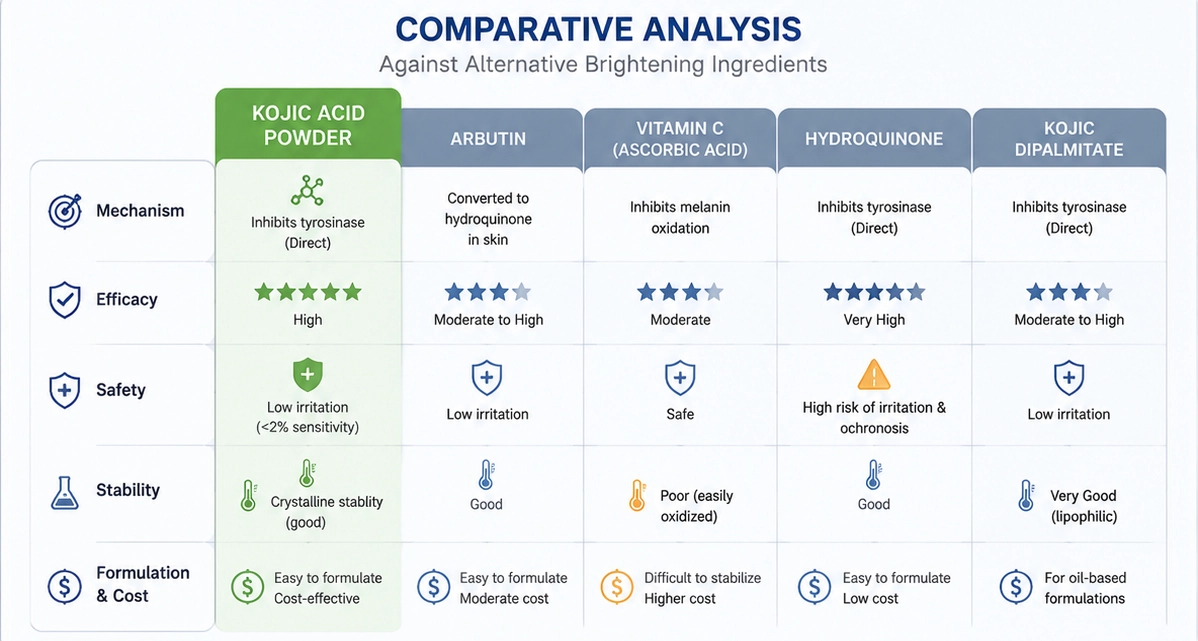
When formulating, experts have a lot of choices when it comes to choosing brightening actives. The choice affects not only how well the product works, but also its safety, cost structure, and where it is marketed. Our technical team regularly does comparative analyses to help clients choose the right materials.
Efficacy and Safety Profile Comparison
The kojic acid powder made from fermentation has clear benefits over other options. Arbutin is a glycosylated hydroquinone product that needs to be converted by enzymes in order to have biological activity. This makes it work more slowly but gently. The protective properties of vitamin C compounds, especially magnesium ascorbyl phosphate, are very good, but they are not stable in water. The compound we're talking about has better melanin inhibition at lower concentrations, and after 4 to 8 weeks of consistent use, improvements could be seen in clinical trials. Instead of hydroquinone, which is thought to cause cancer and is banned in some markets, this alternative is safer if it comes from approved sources that follow strict heavy metal limits.
Formulation Considerations and Material Form
Bulk powder form has big benefits for companies that make a lot of things. When stored properly, the anhydrous material has a longer shelf life than pre-formulated solutions, with degradation rates below 2% per year. This steadiness means that batch consistency can be predicted, which is very important when making thousands of units in a single run. Powder form also allows precise concentration control, which lets formulators change the strength based on the purpose of the product, ranging from 0.5% for gentle daily use to 2-3% for intensive treatment serums. Alcohols and glycols dissolve the material easily, but water doesn't dissolve well, so it needs to be dissolved carefully. Our R&D support team helps clients make stable formulations that deal with common problems like oxidative discoloration and degradation that depend on pH.
Cost-Effectiveness and Supply Chain Dynamics
Material costs are very different between whitening agents. When it comes to price, the fermentation-derived compound is usually in the middle. It's more expensive than normal botanical extracts but better value than specialty peptides. Volume commitments have a big effect on unit economics, and when you buy more than 100 kg in bulk, you often get better terms. As production capacity grew in the Asia-Pacific countries over the past five years, supply chain safety got a lot better. But procurement teams should think about changes that could happen because of things like the availability of raw materials and changes in fermentation yield. Getting to know sources and getting a variety of substrates reduces these risks and makes sure there is a steady supply during busy manufacturing times.
How to Choose a Reliable Kojic Acid Powder Supplier?
The most important procurement decision is choosing the kojic acid powder supplier, which has a direct effect on product quality, regulatory compliance, and operational reliability. After ten years of making botanical extracts, we know that relationships that work are based on qualifications that can be checked, not just marketing claims.
Essential Quality Certifications and Standards
Premium providers keep a full collection of certifications that show they are committed to quality systems. Good Manufacturing Practices for cosmetics are covered in detail in ISO 22716 certification, which includes everything from checking the quality of raw materials to testing finished products. For pharmaceutical uses, GMP approval calls for stricter controls, such as approved analytical methods and full batch tracking. HACCP certification is usually linked to food safety, but it is showing up more and more in the supply chains for cosmetics, especially among suppliers that work with multinational brands that have global standards that everyone must follow. In addition to these basic certifications, you should look for proof that the company regularly undergoes third-party checks, evaluates customer facilities, and takes part in quality efforts within the industry. All of these certifications are kept up to date at our production facilities, and they are renewed every year to make sure they are still in line with changing standards.
Purity Specifications and Testing Protocols
High-Performance Liquid Chromatography (HPLC) tests should show that cosmetic-grade materials are at least 99.0% pure. Of course, spec sheets don't tell the whole story. Ask for full test results that include heavy metals (like lead, arsenic, mercury, and cadmium), microbial limits (like yeast, mold, and pathogens), and any solvents that may still be present. Each batch of products that comes from our quality control lab goes through 18 different tests, and the results are written down in detailed Certificates of Analysis. Smart buyers also look at the distribution of particle sizes because that affects how fast the ingredients dissolve and how the formulation works. The diffusion properties of micronized grades with D90 numbers below 50 microns are better, but they cost more. By understanding these technical details, you can compare suppliers in a way that goes beyond just looking at prices.
Supply Capacity and Logistics Infrastructure
When you buy in bulk, you need sellers with proven production scale and trusted logistics networks. Check the minimum order numbers (MOQs) against how much you usually buy. Ideally, MOQs should match two to three months' worth of production needs, matching the costs of keeping inventory with the security of a steady supply. When suppliers have their own warehouses in major markets, they can cut lead times by a lot and make the customs process easier. We keep smart inventory in key areas so that we can send to established clients within two to three weeks. Different types of packaging are very important. For most uses, fiber drums with plastic liners are enough to keep the product safe, but versions that are sensitive to moisture may need foil-lined cases or nitrogen flushing. Material Safety Data Sheets (MSDS), Certificates of Analysis (CoAs), and the right customs classification numbers (usually HS Code 2918.99 for this chemical group) must be included in international shipping paperwork. Logistics details like these are taken care of by experienced providers, who avoid delays and paperwork mistakes that can slow down production plans.
Where and How to Buy Kojic Acid Powder in Bulk?
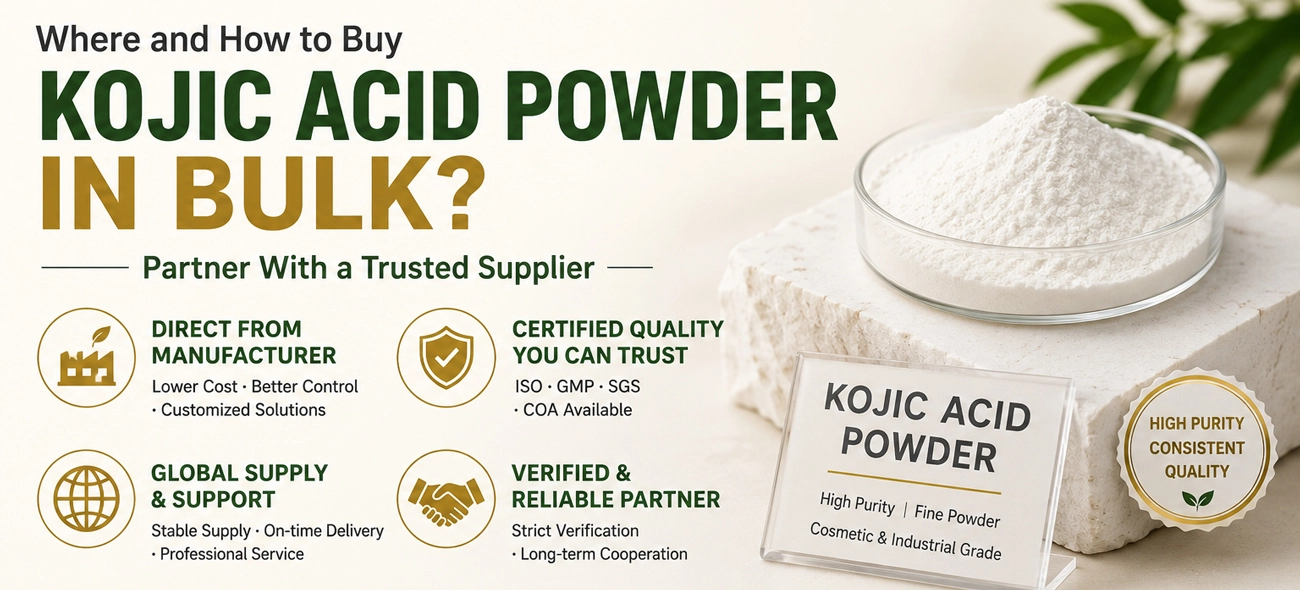
The global market for kojic acid powder is served by many sourcing channels, and each has its own pros and cons. A lot of the time, strategic buyers use a mix of direct contacts and platform-based research.
Direct Manufacturer Partnerships
Working closely with factories gives you the most power and information. When compared to multi-tier delivery routes, this method usually cuts total costs by 15 to 25 percent because it gets rid of distributor profits. Having direct relationships also makes it easier to make changes, like specifying particle size or special packaging needs. When talking about technical questions, stability problems, or the need for formulation help, communication works better. Shaanxi Bolin Biotechnology Co., Ltd. has set up its business to support direct business-to-business relationships. We have dedicated account managers who provide personalized service from the first inquiry to ongoing restocking. The most important thing to think about is the due diligence requirements. Buyers should do facility audits, either virtually or in person, make sure that certifications are real, and check references from past clients. This work costs money, but it builds the basis for strong relationships that last a long time.
B2B Marketplace Platforms
Online procurement platforms have changed how efficiently goods are sourced, especially when looking for suppliers and researching the market for the first time. These platforms bring together hundreds of suppliers so that specs, certifications, and business terms can be quickly compared. Transaction defenses, such as payment escrow and conflict settlement systems, lower the risks of doing business with sellers you don't know. But marketplaces have problems, like making it hard to verify information, having different suppliers with different levels of quality, and not having enough expert help. Smart procurement teams use these platforms to learn about the market and do their first screening. They then move potential candidates to direct contact channels for a more in-depth review. When you look at platform listings, pay close attention to the supplier verification badges, transaction history, and response quality.
Specialized Chemical Distributors
Regional wholesalers are very helpful, especially for buyers who need smaller amounts or packages of more than one item all at once. These middlemen keep local stock, make the import process easier, and offer billing in a single currency. When making new goods that need a lot of specialty ingredients from different places, distribution networks are especially helpful. The trade-off is higher costs and less insight into the production chain. Distributors may also limit the number of customization options or technical support you can get compared to working directly with the manufacturer. You should judge wholesalers by how well they handle their goods, how well they work with suppliers, and whether they offer value-added services like repackaging or blending.
Verifying Supplier Authenticity
The specialty chemicals market is plagued by fake materials and wrongly stated specifications. Put in place strict verification protocols to keep your operations safe. If you can, get your current certification papers straight from the organizations that issued them. Fake certificates are very common. Do incoming quality testing on the first orders and compare the results to the COAs provided by the supplier to make sure the analysis is correct. Industry references are very helpful—reliable providers are happy to put potential customers in touch with current customers who can vouch for their dependability and quality. Online proof tools, like databases for business registration and organizations for certifications, add more layers of security. Putting money into thorough screening stops expensive mistakes in quality, problems with regulations, and damage to the business later on.
Best Practices for Bulk Kojic Acid Powder Procurement
Strategic kojic acid powder procurement is more than just finding providers; it also includes managing relationships, making sure quality, and lowering risk. These steps separate programs that work from those that have problems like interruptions and poor quality.
Comprehensive Quality Control Protocols
Regardless of the supplier's reputation or certification, don't rely on their tests. Set up systems to inspect incoming items for purity using HPLC, heavy metals using ICP-MS or atomic absorption spectroscopy, and microbial contamination using standard pharmacopeial methods. Moisture affects stability—materials with more than 0.5% moisture break down during storage. Even tho it's subjective, glancing at something can instantly indicate quality. White to light brown crystalline powder without discolouration or caking is ideal. Contact impartial testing facilities that can do these analyses quickly. Testing all first orders and at least 20% of subsequent shipments and retesting if requirements change is recommended. This outlay, usually less than 2% of material costs, prevents production issues and market refunds, which are costly.
Avoiding Common Procurement Pitfalls
With experience, you can recognise repeating blunders that affect buying results. If you prioritise money over quality, you wind up with low-quality materials that need to be reformulated or discarded. Not preparing ahead puts unnecessary strain on your negotiating power and boosts the cost of hurrying things up. Even with good partnerships, maintain certified backup suppliers on standby to avoid supply disruptions. Unfinished paperwork can trick regulators. Complete paper trails with buy orders, COAs, shipping documentation, and quality test data for traceability. Include R&D early in source review to avoid mismatched specifications due to procurement and technical teams not communicating. Our account management approach addresses these issues with systematic onboarding, proactive communication, and technical assistance.
Building Strategic Supplier Relationships
Transactional buying models ignore long-term value opportunities. Strategic alliances bring benefits beyond what two parties agree to. A reputable supplier's chosen customers get priority when capacity is restricted, early warning of market developments, and the ability to solve difficulties jointly. These relationships enable customisation, from manufacturing customised grades for formulation needs to developing novel transportation techniques. Communication regarding demand expectations helps sellers organise production more efficiently, which may result in better terms and more materials. We strive to form partnerships with clients who care about our success. We may provide personalised technical support, faster sampling for new projects, and flexible payment arrangements as production increases. When you engage suppliers as strategic partners rather than vendors, you get competitive benefits beyond price negotiations.
Conclusion
A successful bulk purchase of kojic acid powder combines many factors, including the supplier's dependability, quality control, legal compliance, and the terms of the deal. There are many ways to source goods, from direct producers to specialized dealers. Each has its own benefits. As always, it's important to do your research before making a decision. Check the suppliers' certifications, run independent tests, and look at their whole business, not just their prices. Long-term value is created through supply security, technical collaboration, and operating efficiency in strategic relationships with qualified makers. The market for brightening agents is always changing because demand is rising and production technologies are getting better. Choosing the right supplier is becoming more and more important for staying competitive.
FAQ
Is This Ingredient Safe for Cosmetic Applications?
When kojic acid powder comes from approved sources who follow strict quality controls, it has a good safety profile. Dermatological studies show that the product is well tolerated at the suggested amounts. Adverse reactions only happen in sensitive people or when the product is used too much. Cosmetic formulas shouldn't go over the legal limits set in the target markets. For leave-on products, these limits are usually 1%. The right pH range (between 3.5 and 5.5) and the addition of antioxidants that stabilize the formula make it even safer and more effective. Always do patch testing while making a product, and make sure the end users have the right directions for how to use it.
How Does Raw Powder Differ from Finished Formulations?
Bulk powder is the pure active ingredient that needs to be mixed into finished products by ensuring the right processes for dissolving and stabilizing it. The active ingredient is mixed with carriers, preservatives, and other useful ingredients in finished goods like creams, serums, and lotions. Manufacturers buy base materials so they can be flexible with their formulations and save money at the same time. Brands that don't have the ability to formulate their own goods get finished products from OEM partners. The best way to source materials is to know what your technical capabilities are and how you make things.
What Testing Verifies Product Purity?
Certificates of Analysis (CoA) show proof of testing for a specific batch. Key tests include HPLC for finding out how pure something is, ICP-MS for finding out how much heavy metal is present, and microbial testing for finding out how contaminated something is. If you want to be even more sure, have your supplies tested by a third party on a regular basis, even if you trust the supplier. Suppliers with a good reputation will gladly share all of their testing results. On the other hand, if a seller refuses to share thorough analytical results, it could mean that there are quality issues that need to be carefully looked into.
Partner with a Trusted Kojic Acid Powder Manufacturer
Partner with a reputable company that makes kojic acid powder. Since 2012, Shaanxi Bolin Biotechnology Co., Ltd. has been providing plant extracts and active ingredients that have been scientifically proven to work to the global skincare, pharmaceutical, and nutraceutical industries. Our cutting-edge production center is certified by ISO 22716, GMP, and HACCP, which means that every batch meets the highest quality standards around the world. We provide cosmetic-grade materials that have been tested and proven to be more than 99% pure. All of our testing results are backed up by full paperwork and can be tracked from the raw materials to the final package. Our expert team helps clients speed up product development while staying in compliance by giving them advice on formulation, stability, and regulatory paperwork. Flexible minimum order quantities work for both new brands and well-known companies that need container-load volumes. You can talk to our sales team at sales1@bovlin.com about your special needs, ask for product samples, or set up a virtual tour of our site. You can look at our full line of botanical actives and functional ingredients at bolinbiotech.com. Discover the difference that working with a supplier who is dedicated to your success can make.

References
1. Burnett, C. L., et al. (2010). "Final Report on the Safety Assessment of Kojic Acid as Used in Cosmetics." International Journal of Toxicology, 29(6 Suppl), 244S-273S.
2. Draelos, Z. D. (2019). "The Science Behind Skin Lightening: A Review of Depigmentation Agents." Journal of Cosmetic Dermatology, 18(4), 1005-1015.
3. European Commission. (2021). "CosIng Database – Cosmetic Ingredient Regulation in the European Union." Health and Consumer Protection Directorate-General.
4. Kim, Y. J. and Uyama, H. (2005). "Tyrosinase Inhibitors from Natural and Synthetic Sources: Structure, Inhibition Mechanism and Perspective for Future." Cellular and Molecular Life Sciences, 62(15), 1707-1723.
5. Lajis, A. F. B., et al. (2017). "Fermentation of Selected Malaysian Rice Cultivars for the Production of Kojic Acid." Food Science and Biotechnology, 26(2), 393-401.
6. U.S. Food and Drug Administration. (2020). "Cosmetics: Prohibited and Restricted Ingredients." Center for Food Safety and Applied Nutrition, Office of Cosmetics and Colors.