Brown Rice Protein Powder for Sports Nutrition: Key Formulation Considerations
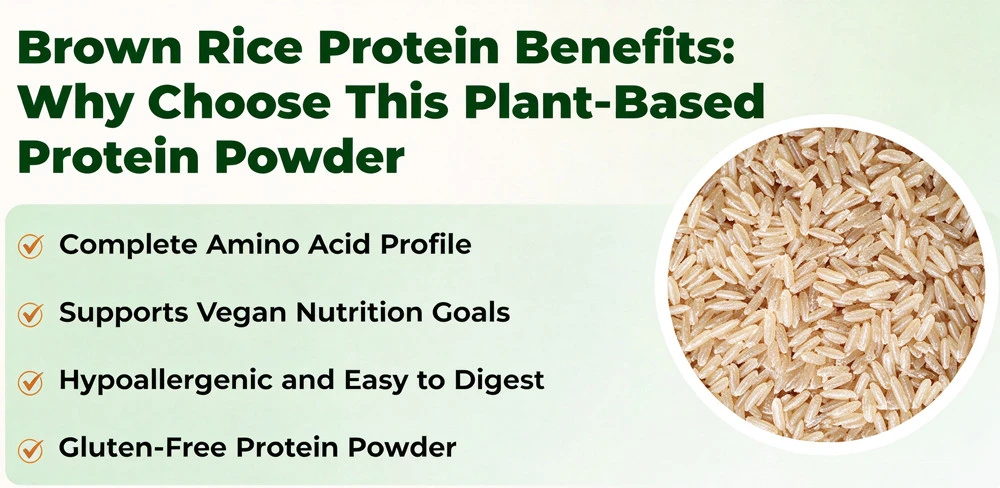
If you’re looking for plant-based protein sources for sports nutrition products, brown rice protein is worth a look. Bulk brown rice protein powder is enzymatically extracted from whole grain brown rice, offering 80% protein (dry basis, NX6.25), a neutral taste, a fine particle size of 300-600 mesh, and zero hexane residues. It’s fantastic in RTD drinks, protein bars, meal replacement powders, and functional baked products. This guide contains everything you need to know before placing an order for procurement managers and R&D teams balancing ingredient performance with cost and label requirements.
Understanding Brown Rice Protein Powder and Its Nutritional Profile
What It Is and How It Is Made
The brown rice protein is made by isolating the protein from the carbs of whole grain brown rice. Modern enzymatic hydrolysis does not use chemical solvents to break down starches, yielding a more concentrated protein portion. It is a fine, light brown powder with moisture content not more than 8% and a shelf life of 24 months under optimal storage conditions.
Amino Acid Composition and BCAA Content
The bulk brown rice protein powder contains two sulfur-rich amino acids (methionine and cysteine) in greater proportions than pea protein. It's also a good source of branched-chain amino acids (BCAAs), including leucine, isoleucine, and valine, which are vital for muscle development and recuperation after training. The inclusion of pea protein dramatically increases the PDCAAS score to around 1.0.
How It Compares to Whey and Pea Protein
A 2013 study in the Journal of the International Society of Sports Nutrition indicated that rice protein supplements after resistance training had the same impact on developing muscle mass and power as whey protein supplements. Brown rice protein is not made from whey, and it has no dairy, soy, or gluten, so athletes with typical dietary allergies may use it. It has a higher sulfur-containing amino acid content than pea protein, but the combination has a better total lysine content.
Key Formulation Considerations for Sports Nutrition Products
Solubility, Texture, and Mouthfeel
Early rice protein products were thought to be gritty owing to large particle size. Bolin’s plant-based protein concentrate, at 300 to 600 mesh, disperses well in hot and cold beverages, removing the chalky residue that has troubled product makers for years. This particle standard is particularly crucial for RTD drinks, since consumers have poor tolerance for variations in texture.
Protein Blending Strategies
No plant protein has all the amino acids that the body requires. To make it practical, a 70:30 blend of bulk brown rice protein powder and pea protein gives a profile comparable to dairy-based choices. Hemp seed protein adds omega-3 fatty acids, whereas pumpkin seed protein adds zinc and magnesium. These combinations enable marketers to create a well-rounded product while keeping an ingredients list clean.
Thermal Stability and Processing Compatibility
Bolin’s brown rice protein powder is stable to 90°C, so it preserves its integrity during pasteurization, hot-fill beverage processing or baking applications. This heat resilience enables formulators to develop a larger variety of product forms, without concern about loss of functionality or protein denaturation during production.
Here are the primary application categories where this ingredient regularly works well:
- RTD protein beverages: Fine mesh and neutral flavor maintain a smooth and appealing drink without masking agents.
- Baking offers thermal stability, which maintains the protein proportion on the final label. High-protein snack bars
- Meal replacement powders: Use with pea or hemp protein to provide a complete amino acid profile for weight control recipes.
- Functional baked goods: Incorporate into dry mix systems with low moisture content (≤8%) readily without affecting water activity.
All of these forms benefit from the advantages of a protein ingredient that is stable, neutral-tasting, and clean-label – all features that directly affect the risk of reformulation.
Quality, Sourcing, and Supplier Evaluation
Certifications That Matter in B2B Procurement
Certification status is a must when sourcing ingredients for the US and EU markets. Bolin Biotechnology holds ISO9001, ISO22000, HALAL, USDA Organic, and KOSHER certifications. Each certification targets a different buyer segment—organic certification supports premium positioning, HALAL and KOSHER certifications open doors to observant consumer markets, and ISO standards meet the audit requirements of major retail buyers.
Six-Stage Quality Control Process
For procurement managers who have experienced the effects of protein overstatement or lot-to-lot volatility, consistent batch quality is the number-one goal. The bulk brown rice protein powder manufacturing at Bolin goes through a defined 6-stage quality control process:
- Only raw material verification: certified brown rice
- Screening for heavy metals and pesticides to comply with EU norms
- Microbiological safety test – E. coli, Salmonella, and total plate count
- Protein % by HPLC/UPLC assay
- Supplier checks upstream for continuous traceability of raw materials
- Third-party SGS independent verification
This sequence eliminates the guesswork from every manufacturing phase and offers documentation that procurement teams can confidently take to their own quality departments.
|
Item |
Specification |
Result |
|
Appearance |
Off white to pale yellow powder |
Complies |
|
Protein |
75%~90% |
80% |
|
Fat |
NMT3% |
1.3% |
|
Water |
NMT10% |
6.2% |
|
Fibre |
NMT10% |
7.2% |
|
Impurities And Solvents Residue |
<0.05% |
Complies |
|
Loss On Drying |
≤5.0% |
3.35% |
|
Ash |
≤5.0% |
3.42% |
|
Sulphate |
0.5% Max |
Complies |
|
Heavy Metals |
< 5PPM |
COMPLIES |
|
Arsenic(As) |
< 0.5ppm |
Complies |
|
Lead(Pb) |
< 0.5ppm |
Complies |
|
Cadmium(Cd) |
< 0.05ppm |
Complies |
|
Mercury(Hg) |
Not Detected |
Complies |
|
Chrinium(Vi) |
<0.5ppm |
Complies |
|
Microbiological Test |
|
|
|
Total Plate Count |
<1000cfu/g |
Complies |
|
Yeast And Mold |
<100 cfu/g |
Complies |
|
Salmonella |
Negative |
Complies |
|
E.Coli |
Negative |
Complies |
|
Staphylococcus |
Negative |
Complies |
|
Conclusion: Conform With In House Standard |
||
Comparing Supplier Options
The market includes several recognized names in rice protein supply. At the B2B level, what distinguishes one provider from another is the protein verification method, particle size specification, solvent-free process confirmation, and certification breadth. Bolin sources brown rice from 25,800 acres of traceable growing areas in Shaanxi, China, with soil and water quality records available for review. Sample availability is confirmed so procurement teams can request samples before committing to volume.
Procurement Best Practices
Evaluating Lead Times and Stock Availability
Supply chain interruption is a genuine operational risk. Bolin has stock available for regular orders, packed in 10kg, 20kg, and 25kg bags. The logistics team takes care of all the required customs papers for purchasers in North America and Europe, reducing clearance delays.
Volume Pricing and OEM Flexibility
Working with vendors who provide tiered pricing and customisation might help you enhance procurement ROI. Bolin can change protein percentage up to 85%, add flavors and sweeteners, modify texture, and provide private-label packaging with comprehensive branding documentation. This is critical for firms needing a one-stop-shop connection for bulk brown rice protein powder and final product development help.
Building a Resilient Sourcing Agreement
Monthly or quarterly purchase agreements provide protection against price exposure and assure supplier continuity. First-time purchasers tend to go through a decision cycle of four to eight weeks, from requesting a sample, to a small-batch trial, to a framework agreement. Bolin has an R&D and customer support staff of over 80 professionals who answer technical queries and specification requests in a timely manner.
Future Trends in Plant-Based Sports Nutrition
Clean Label and Organic Demand
Consumer desire for openness of ingredients pushes businesses toward shorter labels and verified sources. Solvent-free extraction is no longer the distinction; it’s the expectation. Suppliers unable to prove hexane-free manufacturing will face growing pressure from brand owners and merchants that publicly disclose their ingredient criteria.
Protein Blend Innovation
The next generation of sports nutrition formulae may very well have three or more plant proteins combined to reach particular amino acid objectives. These multi-protein structures are a good match for bulk brown rice protein powder with its methionine strength and neutral flavor. Increasing consumer knowledge of amino acid profiling will lead to an increase in demand for bespoke blend specifications.
Sustainability as a Sourcing Criterion
Nutrition, cost, and increasingly sustainability objectives are also the responsibility of procurement teams. Brown rice protein from documented agricultural land with validated water sources is aligned with the ESG reporting requirements that big retailers and brand groups are demanding of their ingredient supply chains.
Conclusion
Bulk brown rice protein powder is a useful and well-studied ingredient for sports nutrition product development. Its neutral taste, tiny particle size, heat stability, and clean-label credentials make it a feasible match across drinks, bars, and powders. That amino acid deficit is readily supplied by combination with comparable plant proteins. The choice of supplier is the decision that drives quality downstream for procurement teams focusing on protein correctness, batch consistency, and certification depth.
FAQ
1. What protein content does Bolin's brown rice protein powder contain?
Bolin's brown rice protein powder contains 80% protein on a dry basis, measured using the NX6.25 conversion factor. Each batch is verified by HPLC/UPLC analysis and third-party testing through SGS.
2. Is this ingredient suitable for USDA Organic certified products?
Yes. The product carries USDA Organic certification, along with ISO 9001, ISO 22000, HALAL, and KOSHER. This combination supports both conventional and certified organic formulas.
3. What particle size does the powder come in, and why does it matter?
The powder is milled to 300–600 mesh. This range improves dispersibility in liquid systems and removes the gritty texture associated with coarser rice protein grades, which directly affects consumer experience in RTD beverages and shakes.
4. Can the protein content be customized for specific formulas?
Yes. Bolin's OEM service supports protein concentration adjustments up to 85%, as well as blending with pea, hemp, or pumpkin seed proteins to match specific amino acid or functional targets.
5. How long does the typical procurement process take?
First-time buyers typically move from sample request to framework agreement within four to eight weeks, covering sample evaluation, small-batch trials, and quality documentation review.
Request a Sample from Bolin Biotechnology — Your Trusted Bulk Brown Rice Protein Powder Supplier
Bolin Biotechnology has supplied plant-based protein ingredients to brands across 30+ countries since 2012. As a verified bulk brown rice protein powder manufacturer, we back every shipment with full certification documentation, HPLC batch reports, and SGS third-party verification. Samples are available upon request. Reach out to our team at sales1@bovlin.com to discuss specifications, pricing tiers, and OEM options.
References
1. Joy, J. M., et al. "The effects of 8 weeks of whey or rice protein supplementation on body composition and exercise performance." Nutrition Journal, 2013.
2. van Vliet, S., Burd, N. A., & van Loon, L. J. C. "The skeletal muscle anabolic response to plant- versus animal-based protein consumption." Journal of Nutrition, 2015.
3. Babault, N. et al. "Pea protein oral supplementation promotes muscle thickness gains during resistance training." Journal of the International Society of Sports Nutrition, 2015.
4. Gorissen, S. H. M., et al. "Protein content and amino acid composition of commercially available plant-based protein isolates." Amino Acids, 2018.
5. Messina, M., Lynch, H., & Wharton, C. M. "Plant-based protein sources for active adults." Nutrients, 2020.
6. He, J., et al. "Physicochemical and functional properties of brown rice protein concentrates produced by enzymatic hydrolysis." Food Chemistry, 2021.