Where Does Andrographolide Come From? Understanding Its Botanical Source
Andrographolide powder is a highly pure labdane diterpenoid isolated from the stems and leaves of the medicinal plant Andrographis paniculata, native to South Asia and extensively grown in the tropics. The plant is historically known as the "King of Bitters" and has been utilized for ages in Ayurvedic and traditional Chinese medicine. The isolated chemical, molecular formula C20H30O5, CAS number 5508-58-7, is currently a sought-after active pharmaceutical ingredient (API) internationally in pharmaceutical, nutraceutical, and functional food manufacturing.
What Is Andrographolide? A Botanical and Chemical Overview
The Plant Behind the Compound
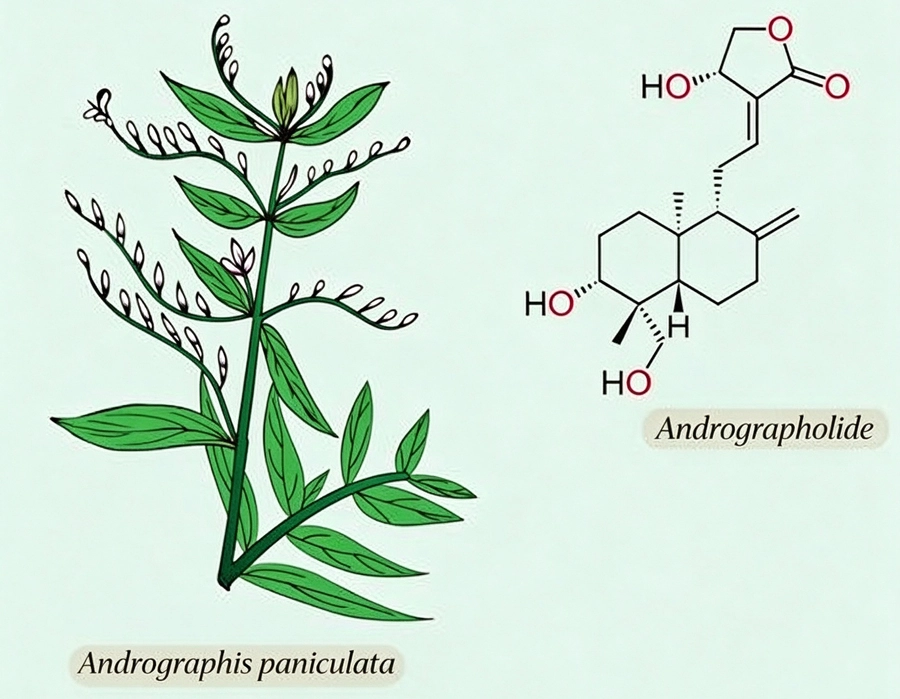
Andrographis paniculata is an annual herb belonging to the family Acanthaceae. It is mostly cultivated in warm and wet areas of India, Sri Lanka, Thailand, and certain parts of southern China. The plant matures in 90 to 120 days. When the plant is harvested, the quantity of active chemicals in the stems, leaves, and other portions of the plant that grow above ground is determined.
Molecular Profile and Stability
The material has a molecular weight of 350.45 g/mol and a freezing point of 228 to 232 °C. Store it periodically to keep it stable. It is a solid powder because it is lipophilic and does not dissolve readily in water. In the absence of water, ethanol has an optical rotation between -124° and -127°. You may verify this physical attribute using scientific procedures that fulfill the criteria of the pharmacopeia.
Pure Extract vs. Crude Herb Powder
You should be aware of the difference between separate andrographolide powder and crude andrographis plant powder. There are a lot of distinct chemicals in raw plant mixes, but most of them are less than 2%. Dozens of additional chemicals are also present. Alternatively, purified andrographolide may be extracted at 5%, 10%, 50%, or 98% using HPLC. This provides accurate control of dosage by formulators that cannot be obtained from raw ingredients.
Health Benefits and Uses of Andrographolide
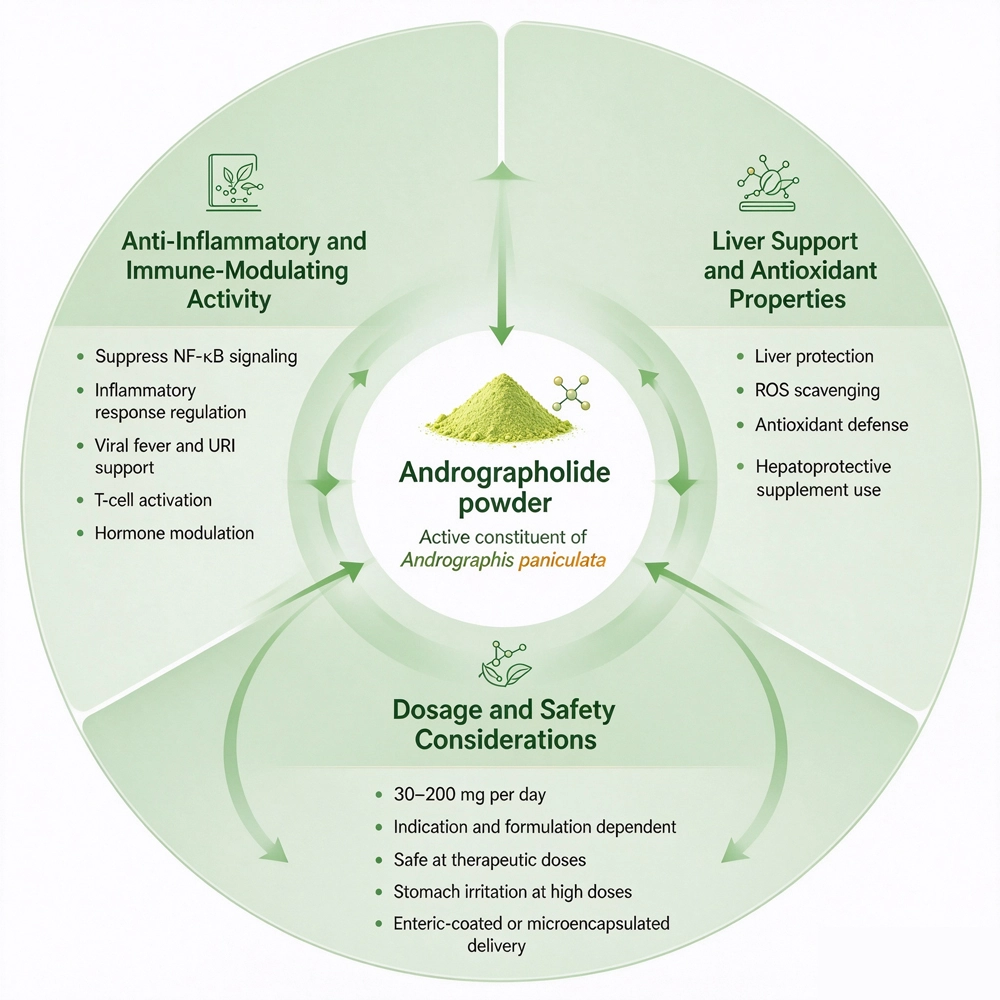
Anti-Inflammatory and Immune-Modulating Activity
Andrographolide powdersuppresses the NF-κB signaling pathway, as confirmed by drug-reviewing journals. This is a crucial component of the inflammatory response. Due to the way it works, it may be used in medications to treat viral fevers, upper respiratory tract infections (URIs), and long-term swelling and discomfort. Clinical research has revealed that it may also modify the immune system, activating T cells, modulating hormones, etc.
Liver Support and Antioxidant Properties
New research on phytochemicals has shown that Andrographis paniculata may assist in preserving the liver. It is a known antioxidant that works by scavenging reactive oxygen species (ROS). And that’s one reason you see it in liver health supplements. This biological function is widely recognized and is why certain supplement firms have lines of hepatoprotective products.
Dosage and Safety Considerations
Andrographolide is used as a medication, commonly taken in doses between 30 mg and 200 mg. These numbers depend on what it is for and how it was created. The chemical is recognized to be safe at regular therapeutic levels; however, it may damage your stomach in big amounts. That is why oral transport is commonly done using enteric-coated tablets or microencapsulated forms.
Comparing Andrographolide Powder with Alternative Solutions
Pure Powder vs. Standardized Extracts
Extracts of Andrographis paniculata that have been standardized normally have between 10% and 30% andrographolide, along with other phytochemicals like neoandrographolide and dehydroandrographolide. People who want to improve their overall health might find these extracts useful. If you need pharmaceutical-grade formulation accuracy, you can only use andrographolide powder that is at least 98% pure. This is especially true for drug uses where known impurity profiles are needed.
Organic vs. Conventional Sourcing
People who grow their crops without using pesticides and have proper organic certification paperwork can sell andrographolide that has been approved as organic. Some groups of people trust organic sources more, but the cost of approval and the needs of the group should both be taken into account when deciding what to buy. To use a medicinal API, it's more important to follow the rules set by the CP/USP/EP pharmacopeia than to just get organic approval.
Quality Benchmarks for Supplier Evaluation
When procurement teams look at different suppliers, they should at least check that these things are true:
A full impurity analysis with limits for dehydroandrographolide and neoandrographolide shows that the product is at least 98% pure by HPLC/UPLC. It must be in line with CP, USP, or EP standards and have a COA, COO, and MSDS that can be shown to be in line with those standards.
- Purity ≥ 98% by HPLC/UPLC with full impurity profiling, including dehydroandrographolide and neoandrographolide limits
- Pharmacopoeia compliance with documented COA, COO, and MSDS aligned to CP, USP, or EP standards
- Third-party validation from recognized bodies such as SGS, with traceable batch records for audit readiness
These things directly keep things stable from batch to batch and lower the risk of regulatory action during product registration.
Procurement Guide: Buying Andrographolide Powder for B2B Clients
Supplier Verification and Certification Checks
Trustworthy providers of andrographolide powder should have ISO 22000 and cGMP certifications and be open to on-site checks. Buyers should ask for more than just licenses. They should also ask for data from a stability study and proof that the process is safe. Approvals for KOSHER and HALAL make it easier for product lines made for Jewish and Middle Eastern customers to reach new customers. These two groups are buying more plant-based medicines.
Traceability from Field to Final Batch
Always being able to keep an eye on their supply lines is important for drug businesses. As required by the EU Pharmacopeia, the best seller makes sure that the raw materials come from a listed growing base and checks the plants for heavy metals (Pb, As, Cd, and Hg) when they arrive. They also send full batch paperwork with every package. It is safer to do checks and simpler to send regulatory dossiers to more than one market when they can be tracked to this level.
Logistics, Volume, and Lead Time Planning
For B2B buyers who make plans for production, being able to supply is just as important as being pure. Medium- to large-sized pharmaceutical companies can feel safe about their supply when they can make 3,000 kg per month. Nutraceutical brands that aren't as big can order as little as 50 kg to test out formulas before going big. From 1 kg paper bags to 25 kg fiber drums, there are different ways to package goods that can work with different supply chains.
Future Outlook in Andrographolide Production and Demand
Advances in Extraction and Bioavailability Technologies
The trouble with andrographolide is that it doesn’t mix well with water. This makes it more difficult to consume by mouth in its typical forms. To overcome this difficulty, research and development teams are adopting cyclodextrin complexation, liposome encapsulation, and nanoemulsion delivery. These methods increase the rate of absorption without affecting the fundamental structure of the molecules. Therefore, the ideal thing to start out with for the following phase in the formulation process is high-purity powder.
Rising Global Demand for Natural Immune Actives
After 2020, people in North America, Europe, and Southeast Asia all needed further evidence to support natural immune-boosting substances. Botanical trade data suggests that the number of new immune supplement products containing Andrographis paniculata ingredients introduced from 2011 to 2020 was less than the number introduced in the ten years from 2021 to 2024. Drug and supplement makers are seeking long-term supply agreements with manufacturers they can trust as a consequence of this trend.
Regulatory and Market Access Developments
Plant-based APIs face stricter regulations in both the US and EU. Pharmacopoeia-matching documentation helps customers get new items registered quicker, keeping suppliers ahead of the competition. FDA and EMA are both becoming more rigorous in ensuring that botanical goods can be traced. Those buyers who have already begun working with suppliers ready for inspections have a clear time-to-market advantage.
Conclusion
Andrographolide powder paniculata is a botanical source of andrographolide. The herb has been utilized medicinally for many hundreds of years and has increasing modern clinical evidence. For B2B purchasers, like medication formulators or nutritional brands or API merchants, it doesn't matter what sort of plant it originates from. It’s about how nice the item is that you get from it. The trick is to choose a source with a track record of farming, pharmacopeia compliance, a clear impurity profile, and documents ready for an audit. That’s the difference between an effective supply chain and one that suffers and spends a lot of money.
FAQ
1. What purity grade is appropriate for pharmaceutical API use?
Pharmaceutical API applications require andrographolide at ≥98% purity with full impurity profiling. This includes controlled levels of dehydroandrographolide and neoandrographolide. Batch-specific COA documents and pharmacopoeia compliance (CP/USP/EP) are mandatory for regulatory submissions.
2. Can andrographolide powder be used in functional beverages?
Yes, but solubility must be addressed first. Because the compound is lipophilic with low water solubility, functional beverage applications require bioavailability enhancement technologies such as nano-emulsion or cyclodextrin complexation to achieve stable, homogeneous dispersion in liquid matrices.
3. What documentation should I request from a supplier?
Request a COA, COO, MSDS, HPLC chromatogram, heavy metal test results, microbial safety data, and third-party lab certification (e.g., SGS). For pharmaceutical buyers, stability study data and batch manufacturing records are also necessary for dossier preparation.
4. What is the minimum order for custom concentrations?
Most reputable manufacturers accept small-batch custom orders starting at 50 kg for non-standard concentrations. This allows R&D teams to conduct formulation trials before committing to commercial-scale production volumes.
5. Is andrographolide safe for long-term commercial use?
At standard therapeutic dosages, andrographolide has a recognized safety profile supported by clinical literature. High-dose formulations may require enteric coating to minimize gastric effects. Buyers should review safety data sheets and consult regulatory guidelines relevant to their target market before commercialization.
Partner with Bolin Biotechnology — Your Trusted Andrographolide Powder Supplier
Plant-based goods that have been checked for quality have been made by Shaanxi Bolin Biotechnology since 2012. We have andrographolide powder that is 5%, 10%, 50%, or 98% pure. It can be produced in quantities up to 3,000 kg per month and has undergone six steps of quality checks. It is ISO 22000/cGMP approved. From 50 kg and up, our technical team can help you make your own concentrations, and you can get samples. You can email us at sales1@bovlin.com to get specs or begin the process of going through suppliers.
References
1. Akbar, S. (2011). Andrographis paniculata: A Review of Pharmacological Activities and Clinical Effects. Alternative Medicine Review, 16(1), 66–77.
2. Chandrasekaran, C. V., et al. (2010). Dual inhibitory effect of andrographolide on NF-κB. Biochemical Pharmacology, 80(10), 1571–1583.
3. Puri, A., et al. (1993). Immunostimulant agents from Andrographis paniculata. Journal of Natural Products, 56(7), 995–999.
4. Jarukamjorn, K., & Nemoto, N. (2008). Pharmacological aspects of Andrographis paniculata on health and its major diterpenoid andrographolide. Journal of Health Science, 54(4), 370–381.
5. World Health Organization. (2002). WHO Monographs on Selected Medicinal Plants, Vol. 2. WHO Press.
6. United States Pharmacopeia. (2023). Andrographolide Monograph. USP–NF, United States Pharmacopeial Convention.