_1745226507162.webp)

Cordycepin Powder Quality Standards: Purity, Testing, and Extraction Process
When sourcing high-grade 3'-deoxyadenosine from Cordyceps militaris, understanding the interplay between cordycepin powder purity benchmarks, analytical validation, and upstream processing is non-negotiable. At Bolin Biotechnology, we recognize that product formulators and regulatory teams demand more than marketing claims—they need verifiable assay data, traceable extraction lineage, and compliance documentation that aligns with ISO, GMP, and pharmacopeia standards. Our food-grade cordycepin powder extract (CAS 73-03-0) spans a customizable purity range of 1% to 98%, validated through High-Performance Liquid Chromatography (HPLC), ensuring that every kilogram shipped meets the exacting requirements of nutraceutical, pharmaceutical, and functional food applications.
Understanding Cordycepin Powder Purity
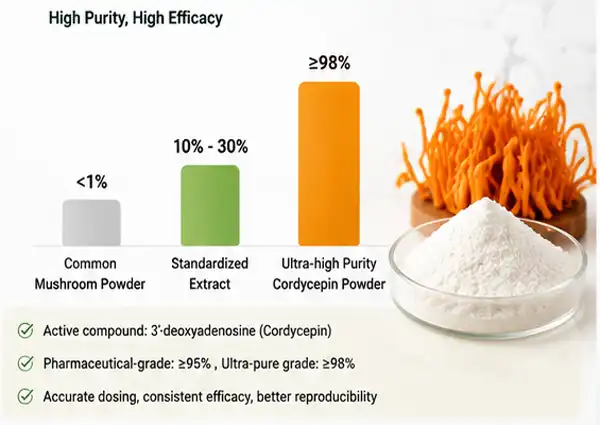
Purity is the most important factor that determines how much active 3'-deoxyadenosine is in the matrix. It also has a direct effect on how well the therapy works and how the government approves it. Pharmaceutical-grade material usually has amounts above 95%, and ultra-pure grades reach 98% or higher. This is in contrast to cheap mushroom powders, which usually have less than 1% active nucleosides. This accuracy gets rid of the guessing that comes with using raw wood to make medicines, so the doses can be used correctly and the clinical results can be repeated.
Factors Influencing Purity Levels
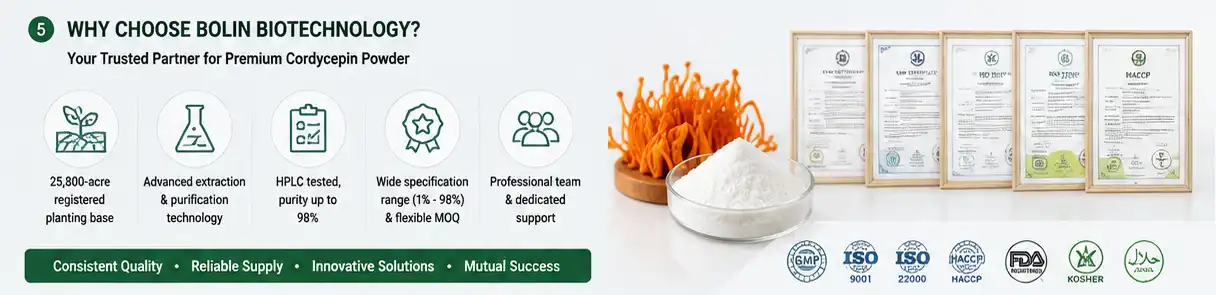
There are a number of factors that affect the final assay value. The source of the raw material is very important. Cordyceps militaris fruiting bodies grown under controlled conditions on our 25,800-acre registered planting base regularly do better than wild-harvested options in terms of both active compound density and contaminant control. The way the sample is extracted is also very important; the yield and selectivity are determined by the polarity of the solvent, the temperature profiles, and the purification chromatography steps. During the whole supply chain, molecular structure is kept safe by following storage rules like keeping moisture levels below 5% and keeping things out of the light and heat.
Typical Purity Benchmarks Across Applications
Depending on the end use, different purity levels are needed. In order to balance cost-effectiveness with bioactivity, nutritional pills and tablets that aim to boost the immune system usually list 10% to 30% standardised extracts. For pharmaceutical study purposes, especially those looking into stopping RNA synthesis or changing AMPK, ultra-high purity grades (≥98%) are needed to keep other substances from interfering too much. Cosmetic serums use mid-range purities (40% to 60%), where polysaccharides work together to boost the antioxidant effects of nucleosides. Bolin Biotechnology has a broad specification range (1%–98%) that lets us make the molecular profile fit the exact bioavailability and label-claim needs of your product.
Testing Standards and Protocols for Cordycepin Powder
Strong analytical validation turns raw data into buying information that can be used. We use techniques that are standard in the industry to make full compositional fingerprints that meet the needs of both internal quality management systems and regulatory scrutiny from outside the company.
Core Analytical Methods
High-performance liquid chromatography (HPLC) is the best way to measure the amount of 3'-deoxyadenosine present. Using different retention times, this chromatographic method separates the target nucleoside from matrix components, giving a measured peak area that is directly related to concentration. Our HPLC methods are based on pharmacopeial guidelines, and we use reversed-phase columns with UV measurement at 260 nm to get detection levels below 0.01%. Mass spectrometry (LC-MS) gives unbiased confirmation by finding the exact molecular weight (267.24 g/mol for the free base). This helps tell the real thing apart from structural isomers or breakdown products.
UV-Visible spectroscopy is a quick way to check for the stability of cordycepin powder from batch to batch, but it doesn't give you enough information to be sure of the quality. When UV spectral matching is used with HPLC, it confirms the identity of cordycepin powder and signals possible adulteration.
Critical Quality Parameters Beyond Purity
Safety and longevity depend on factors other than the quantity of the active compound. The moisture level must stay below 5% to stop the growth of microbes and hydrolytic breakdown. ICP-MS testing for heavy metals makes sure that amounts of lead, cadmium, mercury, and arsenic are within USP <232> limits, which is a must for products used in food and medicine. Total aerobic plate counts, yeast and mold counts, and pathogen screening (E. coli, Salmonella) are all parts of microbial testing. The results are written down in every Certificate of Analysis (CoA). Gas chromatography analysis of the residual solvent makes sure that the ethanol or acetone used for extraction stays within the limits set by ICH Q3C Class 3.
Interpreting Certificates of Analysis
A well-organised CoA turns raw test data into trust in the buying process. Some important parts of the report are the batch identification (lot number, production date), the test results with acceptance criteria, method references (for example, "USP <621> Chromatography"), and signs of stability like peroxide value or chromatographic purity. Third-party laboratory validation from certified bodies with ISO/IEC 17025 certification adds an extra layer of independence that reduces provider bias. At Bolin Biotechnology, we provide full traceability paperwork that connects every batch to the place where it was grown and the run of extraction. This lets quality control managers do full checks of the whole supply chain.
|
Items |
Specification |
Result |
Method |
|
Cordycepin |
≥5.0% |
5.09% |
HPLC |
|
Physicochemical Control |
|||
|
Appearance |
Fine Powder |
Complies |
Sense |
|
Color |
Pale brown |
Complies |
Sense |
|
Odor&Taste |
Characteristic |
Complies |
Sense |
|
Loss on Drying |
≤8.0% |
4.23% |
GB5009.3 |
|
Ash |
≤8.0% |
3.78% |
GB5009.4 |
|
Particle Size |
95% pass 80 mesh |
Complies |
CP2020 |
|
Heavy Metals |
|||
|
Heavy Metals |
≤10ppm |
Complies |
Colorimetric |
|
Pb |
≤2.0ppm |
Complies |
GB5009.12 |
|
As |
≤2.0ppm |
Complies |
GB5009.11 |
|
Hg |
≤0.1ppm |
Complies |
GB5009.17 |
|
Cd |
≤1.0ppm |
Complies |
GB5009.15 |
|
Microbiological Control |
|||
|
Total Plate Count |
≤1000cfu/g |
Complies |
GB4789.2 |
|
Mold & Yeast |
≤100 cfu/g |
Complies |
GB4789.15 |
|
E. Coli |
Negative |
Complies |
GB4789.38 |
|
Salmonella |
Negative |
Complies |
GB4789.4 |
|
Conclusion: Conform with Specification |
|||
Extraction Processes for High-Quality Cordycepin Powder
From the growing body of Cordyceps militaris to pure nucleoside powder, there is a series of unit processes that are meant to maximize yield while keeping molecular integrity. Many people still use the old hot water and ethanol extraction methods, but they aren't very selective and end up removing polysaccharides, proteins, and colours along with the main ingredient, which makes the final product less concentrated.
Modern Extraction Technologies
At temperatures close to 31°C and pressures above 73.8 bar, supercritical CO₂ extraction can happen. At these conditions, carbon dioxide has the solvating power of a liquid and the diffusivity of a gas. This method is very good at getting rid of water-soluble impurities while keeping lipophilic and semi-polar molecules behind, but it costs a lot of money. Ultrasonic-assisted extraction (UAE) uses high-frequency sound waves to break up cell structures. This makes it easier for solvents to get into the cells and cuts processing time by up to 50%. Ultrasound creates mechanical cavitation that improves mass transfer without thermal breakdown. This makes UAE a great choice for nucleosides that are sensitive to heat.
A mixed method that combines enzymatic pre-treatment (to break down cell wall polysaccharides) with gradient ethanol extraction and then macroporous resin chromatography has been fine-tuned. This method gets extraction rates of more than 85% while keeping a particle size distribution (100% through 80 mesh) that makes sure the drug flows smoothly during packaging and tableting.
Process Control Parameters
Controlling the temperature is very important because long-term exposure of cordycepin powder above 60°C speeds up the adenosine deamination and Maillard browning reactions. Choosing the right solvent balances how well the extraction works with how easy it is to clean up later. For example, ethanol concentrations between 60% and 80% v/v give the best nucleoside solubility while minimizing pigment co-extraction. The length of the extraction process and the ratios of solids to liquids are adjusted to get the most out of the first pass. This cuts down on the need for repeated extraction rounds, which are more expensive and bad for the environment. Our biotech team of more than 80 professionals is always improving these factors by using Design of Experiments (DoE) methods to find important process gaps.
Comparison of Cordycepin Powder Quality: Organic vs. Synthetic and Other Variants
When managing the supply environment, procurement experts have to weigh the pros and cons of materials that come from nature versus those that are made in a lab, as well as isolated nucleosides versus whole-mushroom extracts.
Organic vs. Synthetic Sources
Organic extracts from approved Cordyceps militaris cultivation are seen as high-end and fit with customer trends toward clean labels. The full phytochemical matrix, which includes polysaccharides, sterols, and trace minerals, is good for these materials and may give them additive bioactivity. Synthetic 3'-deoxyadenosine is made through a multi-step organic synthesis process from adenosine precursors. It has theoretical benefits in terms of purity (usually exceeding 99%) and batch uniformity, but it lacks the co-factors that are found in natural extracts and could be closely regulated in markets that value botanical authenticity.
Bolin Biotechnology crosses this gap by growing Cordyceps militaris according to organic standards and using cutting-edge extraction methods to separate pure nucleosides while keeping helpful co-compounds. This method gives you the consistency of man-made materials with the market draw and governmental acceptance of natural ones.
Isolated Nucleoside vs. Whole-Mushroom Extracts
Whole-mushroom powders usually have between 0.5% and 2% active nucleosides, which means that dose amounts at the gram level are hard to put into capsules and taste good. Our standardised extracts increase the active part by 50 times or more. This allows milligram-level dosing, which lowers the number of pills a patient has to take and makes them more likely to take them. Isolated material also makes intellectual property strategies easier to defend, since formulation patents are easier to defend when they are based on defined active pharmaceutical ingredients instead of complex botanical matrices.
| Comparison | Organic Cordycepin Powder | Synthetic Cordycepin (3'-DA) | Whole-Mushroom Extract |
|---|---|---|---|
| Active Content | 10% - 98% | ≥ 99% | 0.5% - 2% |
| Source | Cordyceps militaris (Organic cultivation) | Chemical synthesis from adenosine | Whole mushroom powder |
| Advantages | Natural matrix, co-compounds, better market acceptance | Ultra-high purity, high consistency | Lower cost, minimal processing |
| Considerations | Requires advanced extraction | Lacks co-factors, may face regulatory limitations | Low active content, high serving size |
| Best For | Premium supplements, pharmaceutical & cosmetic applications | Pharmaceutical research, high-purity formulations | General nutrition, immunity products |
Procurement Considerations for Cordycepin Powder
To be successful at sourcing, you need to look at more than just unit prices. You also need to look at the supplier's skills, quality infrastructure, and logistical dependability as a whole.
Certification and Compliance Landscape
When a factory gets GMP approval, it shows that they follow strict rules for hygiene, process validation, and paperwork. ISO 9001 approval means that the quality management system is strong, and ISO 22000 (food safety) and HACCP procedures deal with keeping things from getting contaminated. For pharmaceutical uses, following FDA 21 CFR Part 111 (cGMP for dietary supplements) or Part 210/211 (cGMP for drug manufacturing) may be necessary. Customers can look at our full audit trails, which include records of each batch of output, equipment calibration logs, and studies into deviations, whenever they want to.
Quality vs. Cost Optimization Strategies
When you only look at the cost per gram of cordycepin powder, you can't see what the real value is. High-purity cordycepin powder materials make serving sizes and ingredient lists simpler, which makes up for higher purchase costs by making the product more profitable and setting it apart in the market. Sample evaluation programs, like the ones we offer at Bolin Biotechnology, where we give away free samples for validation testing, lower the risk that comes with moving providers. Bulk buying agreements with varying delivery plans balance the costs of keeping inventory against bulk savings. On the other hand, consignment agreements allow payment to be delayed until the material is used in production.
Logistics and After-Sales Support
From order approval to port delivery, the lead time is usually between 14 and 28 days, but this depends on the purity grade and any customization needs. Pharmaceutical-grade double polyethylene bags inside fiber drums (10 kg or 25 kg net weights) or foil pouches for smaller amounts can be used for packaging. We work with skilled freight forwarders to help you with customs paperwork (like phytosanitary certificates and export licenses) and finding the best shipping routes. Technical support doesn't stop with the sale. After the sale, our applications team helps with regulatory dossiers, formulation advice, and stability study methods. This builds long-term relationships based on mutual success.
Conclusion
Nucleoside procurement is complicated, so you need a supplier partner who can provide more than just basic ingredients. The highest standard level for your finished goods is set by how well you grow the plants, how well you extract the oils, and how well you test the results. If procurement teams know about the factors that affect purity, the different analytical methods, and the different extraction technologies, they can make choices that are based on facts and that combine regulation compliance, formulation performance, and the ability to make money. Our integrated approach at Bolin Biotechnology, which includes controlled planting bases, HPLC-verified batches, and flexible MOQ structures, takes the guesswork out of your supply chain so you can focus on new ideas and growing your business.
FAQ
What purity level is optimal for nutraceutical formulations?
Nutraceutical uses usually aim for 10% to 30% standardized extracts, which strike a balance between beneficial dose and cost-effectiveness. Higher purities (50% or more) allow for smaller pills and lower loads of excipients, which makes the product more acceptable to consumers. To separate the nucleoside's pharmacological effects from matrix interference in pharmaceutical research, the purity must be very high (≥98%).
How can I verify HPLC test results from suppliers?
You should ask for full chromatograms, not just summary data, that show the retention time, peak area, and system suitability parameters. Check the specifics of the method (column type, mobile phase makeup, and detection wavelength) against pharmacopeial papers that have already been released. Third-party lab testing through ISO 17025-accredited facilities gives independent proof and lowers the risk of CoA fraud.
Are there bioavailability differences between purity grades?
It is best to use ultra-high-purity isolates (>95%) for clinical studies because they have reliable pharmacokinetics. The middle level of purity (40% to 70%) still has polysaccharides and other phytochemicals that may help absorption through interactions with the gut microbiome, but this effect is still being studied. The spray-drying process lets us control particle size and crystalline form, which in turn affects how quickly the particles dissolve and how much they are exposed to the body's systems.
Partner with a Trusted Cordycepin Powder Supplier
Bolin Biotechnology can help you improve your product line by providing 3'-deoxyadenosine extracts in the form of cordycepin powder that have been thoroughly tested and HPLC-verified. These extracts range in purity from 1% to 98%. Our ISO-certified production center is based on 25,800 acres of approved cultivation grounds and is home to more than 80 dedicated biotech professionals. It ensures stability from batch to batch, which makes formulation development easier. We can help you speed up your go-to-market strategy whether you're launching an immune-support supplement line, advancing pharmaceutical research, or coming up with new ideas in cosmeceuticals. We offer technical documentation, a flexible MOQ starting at 1 kg, and a free sample program. Get in touch with our applications team at sales1@bovlin.com to talk about your unique needs, ask for more information, and experience the dependability that makes Bolin Biotechnology a leading producer in the botanical extract business around the world. Visit bolinbiotech.com to learn more about our full range of ingredient solutions.
References
1. Cunningham, K. G., Manson, W., Spring, F. S., & Hutchinson, S. A. (1950). Cordycepin, a metabolic product isolated from cultures of Cordyceps militaris. Nature, 166(4231), 949–950.
2. Holliday, J. C., & Cleaver, M. P. (2008). Medicinal value of the caterpillar fungi species of the genus Cordyceps. International Journal of Medicinal Mushrooms, 10(3), 219–234.
3. Yue, K., Ye, M., Zhou, Z., Sun, W., & Lin, X. (2013). The genus Cordyceps: A chemical and pharmacological review. Journal of Pharmacy and Pharmacology, 65(4), 474–493.
4. Tuli, H. S., Sandhu, S. S., & Sharma, A. K. (2014). Pharmacological and therapeutic potential of Cordyceps with special reference to cordycepin. 3 Biotech, 4(1), 1–12.
5. Liu, Y., Wang, J., Wang, W., Zhang, H., Zhang, X., & Han, C. (2015). The chemical constituents and pharmacological actions of Cordyceps sinensis. Evidence-Based Complementary and Alternative Medicine, 2015, Article ID 575063.
6. Ashraf, S. A., Elkhalifa, A. E. O., Siddiqui, A. J., Patel, M., Awadelkareem, A. M., Snoussi, M., Ashraf, M. S., Adnan, M., & Hadi, S. (2020). Cordycepin for health and wellbeing: A potent bioactive metabolite of an entomopathogenic medicinal fungus Cordyceps. Molecules, 25(12), 2735.