_1745226507162.webp)

How Ashwagandha Extract Is Made: Extraction Process and Quality Control
To make ashwagandha root extract powder, complex methods are used to turn raw plant material into useful ingredients that are standardized and can be used in cosmetics, medicines, and nutraceuticals. The process is based on carefully controlling the extraction process to get only the active chemicals, called withanolides, while getting rid of any other substances that aren't needed. Understanding this production process helps business-to-business buyers judge the skills of suppliers, predict changes in quality, and choose materials that meet the strict formulation needs of their final goods.
Understanding Ashwagandha Root Extract Powder
Withania somnifera roots are carefully extracted to make ashwagandha root extract powder, which is a strong medicinal ingredient. In contrast to plain ground root powder, the extract goes through a process that levels out the withanolide content so that it is always the same amount, usually between 2.5% and 10%. This makes the bioactivity profiles reliable, which is important for commercial products.
What Differentiates Extract Powder from Raw Root Material?
Concentration and uniformity are what make the difference. Naturally, raw ashwagandha root extract powder has between 0.3% and 0.8% withanolides. However, there is a lot of variation from batch to batch because of growing conditions, harvest timing, and soil makeup. Solvent-based processing of extract powder focuses these beneficial molecules while getting rid of fiber, starch, and other inactive parts. This process of concentration makes a product that contains a certain amount of withanolides, which is important for formulators making supplements with regular doses.
Analytical verification is used in standardization methods to make sure that each production batch meets the required amounts of potency. Because it is reliable, drug companies can figure out exactly how much of an active ingredient to put in tablets or pills, which they couldn't do with unstandardized raw powder. The extract also dissolves better than raw powder, which is especially important for drinks and liquid vitamins, where the powder would not dissolve but stay in suspension.
Key Bioactive Compounds and Their Industrial Significance
Withanolides are a group of steroidal lactones that give ashwagandha its adaptogenic effects. Withanolide A and Withaferin A are the ones that have been studied the most, but good extracts contain dozens of linked chemicals that work together to make them stronger. A chemical called Withanolide A can lower stress by changing the hormone cortisol, and another chemical called Withaferin A can reduce inflammation, but too much of either one could be harmful.
Root-only extracts naturally have higher amounts of Withanolide A and less Withaferin A, which is in line with both traditional Ayurvedic methods and current safety standards. Leaf-inclusive extracts often have high amounts of Withaferin A, which is sometimes used to falsely boost total withanolide percentages, even though it might be harmful to cells. Business-to-business buyers should check the botanical source standards because these differences have a big effect on the safety and effectiveness of finished goods. HPTLC fingerprinting and DNA barcoding provide accurate recognition, which stops tampering that would damage the purity of the formulation.
Extraction Process of Ashwagandha Root Extract Powder
To make ashwagandha root extract, you have to go through a series of steps that all add to the quality of the end result. Extracts that meet international pharmacopoeia standards are made in modern centers that combine traditional knowledge with advanced analytical controls. This is done while keeping the natural diversity of the plant.
Raw Material Sourcing and Preparation
Quality extraction starts with choosing the right variety and picking it at the right time. After 150 to 180 days of growing, premium ashwagandha roots have the highest quantity of withanolide. They are usually picked when they are dormant, when they store the most bioactive compounds. Good Agricultural Practices (GAP) allow suppliers to control the amount of heavy metals in the soil, the cleanliness of the irrigation water, and the use of pesticides. These are all things that directly affect the safety ratings of extracts.
Roots are cleaned very well to get rid of dirt, stones, and other unwanted matter after they are picked. Washing methods balance getting rid of contamination with losing bioactive material, since too much water can leach out chemicals that dissolve in water. After the roots are cleaned, they are mechanically cut or ground to make them smaller. This increases the surface area so that the solvent can reach the roots more easily during extraction. The rate of extraction is affected by the distribution of particle sizes. For best results, processing should produce regular 2–5 mm pieces that allow consistent solvent contact without too many fines that make filtration harder.
Solvent Selection and Extraction Methodology
The choice of solvent has a big impact on the makeup of the extract, how well it dissolves, and whether it is suitable for a certain purpose. Hydro-ethanol systems (usually 50–70% ethanol) are the standard in the business because they successfully extract withanolides while keeping handling costs low. The quantity of ethanol affects selectivity; higher percentages remove more lipophilic chemicals, while higher water content improves the extraction of polar constituents. Manufacturers find the best amounts based on the goal withanolide profiles and the uses that are planned.
Usually, the following steps make up the extraction process:
• Maceration or percolation methods involve submerging ground roots in a liquid at controlled temperatures (40 to 60°C) for 6 to 24 hours. Temperature increase needs close attention; too much heat breaks down withanolides that are sensitive to heat, and not hot enough results in partial extraction. Multiple extraction processes with a new solvent increase output, and the used material is examined to make sure that all compounds are removed.
• Supercritical CO2 extraction uses carbon dioxide under high pressure (usually 200–400 bar) and low temperature (40–50°C) as an option that doesn't need a solvent. This method makes extracts that don't contain any leftover solvents, which is especially useful in pharmacy settings where strict USP residue limits are required. The technology only targets withanolides that are lipophilic, leaving behind tannins and other polar parts that could make the stomach hurt. Even though it costs more, luxury brands that focus on clean labels and environmental sustainability like supercritical extraction.
After being extracted, liquid extracts are filtered to get rid of any particles and then concentrated by vacuum evaporation. Low-pressure devices work at temperatures below 60°C, which stops thermal breakdown and gets rid of chemicals. The concentrated extract looks like a thick paste or liquid that has 20–40% solids in it.
Drying and Standardization Procedures
Controlled drying technology is needed to turn liquid concentrate into a stable powder. The most common way is to use spray drying, which involves putting atomized concentrated extract into a hot room and quickly evaporating the water to make fine powder particles. Inlet temperatures (160–180°C) and exit temperatures (80–90°C) need to be carefully managed because too much heat breaks down withanolide and not enough cooling leaves behind moisture that makes the material less stable.
For heat-sensitive mixtures, vacuum tray drying is an option that works at lower temperatures when it's under pressure. This method is slower and costs more, but it keeps delicate compounds safe and works well for small batches of unique goods. The extract powder that is made usually has between 3 and 5 percent moisture, which is just the right amount to stop microbes from growing while still letting the powder move easily.
Standardization is done by mixing batches to get the right amount of withanolide. HPLC testing shows how potent something really is, which helps makers figure out the right amounts for mixing. To always meet standards, products that are regulated to 5% withanolides might mix batches with high potency (testing at 7-8%) and batches with middling potency (testing at 3-4%). This method guarantees stability from lot to lot, which is very important in pharmaceutical uses where formulas depend on guaranteed amounts of active ingredients.
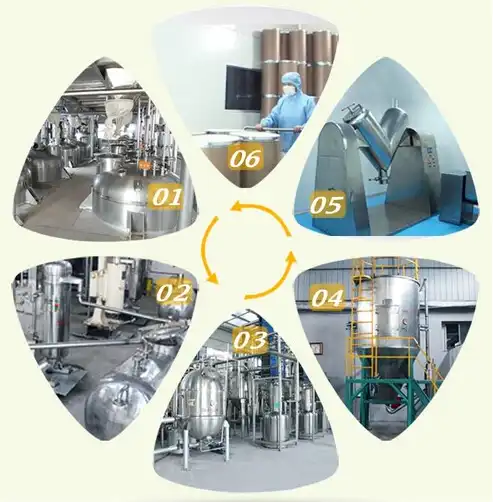
Quality Control Measures in Ashwagandha Extract Production
Premium sellers can be told apart from commodity makers by strict analytical methods. Full quality control includes checking ashwagandha extract powder raw materials all the way through to releasing finished products, keeping track of all the important factors that affect safety and effectiveness.
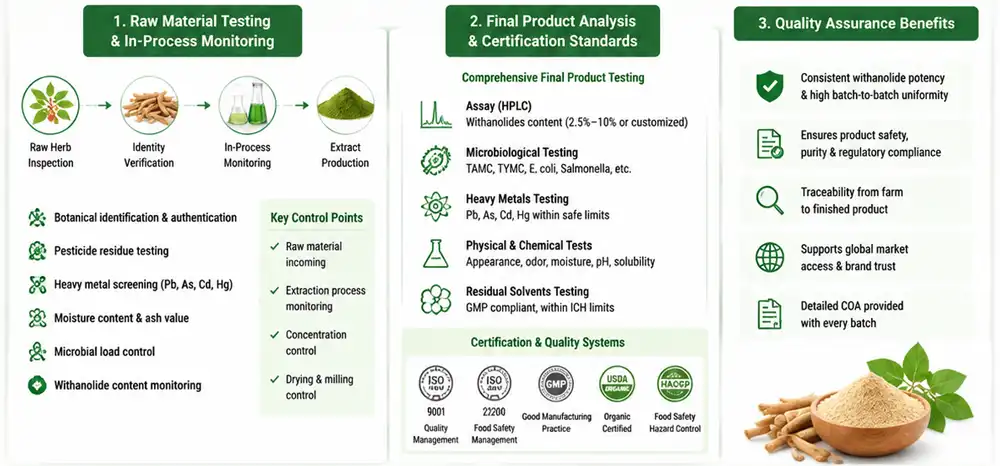
Raw Material Testing and In-Process Monitoring
The first step in incoming root inspection is to identify the plants using both large and small-scale research. Quality control staff who have been trained look at the shape of the roots and compare samples to real reference standards. DNA barcoding gives genetic proof, finding changes or contamination with species that are linked. For financial reasons, cheaper plants could be mixed in with ashwagandha packages, but this check stops that from happening.
ICP-MS (Inductively Coupled Plasma Mass Spectrometry) screening for heavy metals measures the amount of harmful elements present. Lead levels stay below 0.5 ppm, Arsenic levels stay below 1 ppm, Cadmium levels stay below 0.3 ppm, and Mercury levels stay below 0.1 ppm in premium products. These are lower standards than what California Proposition 65 allows. The geographic source has a big effect on heavy metal profiles; areas with naturally occurring soil layers or industrial pollution need close tracking. By using controlled farming methods, building ties with approved organic growers can help lower your exposure to heavy metals.
GC-MS and LC-MS are used for pesticide residue research to look for hundreds of crop chemicals. Manufacturers that want to sell their goods abroad must follow EU Maximum Residue Levels (MRLs), which are usually stricter than US EPA limits. Multi-residue methods can find organophosphates, pyrethroids, and neonicotinoids with a sensitivity of only one part in a billion, making sure that all foreign markets are following the rules.
In-process controls keep an eye on the liquid ratios, extraction temperatures, and processing times while the extraction is happening. By sampling at various steps, operators can make sure that parameters stay within the acceptable ranges. Total Aerobic Microbial Count (TAMC) and Total Yeast and Mold Count (TYMC) tests are done during the concentration steps to find contamination that needs to be fixed before the final drying.
Final Product Analysis and Certification Standards
Before it goes on sale, finished extract powder goes through a lot of tests. Assay measurement is the most important part of research; proven HPLC methods are used to measure the amount of withanolide present. The USP guidelines spell out the conditions for separation, how to make the reference standard, and how to do the calculations in a way that eliminates method differences. Gravimetric methods, on the other hand, weigh all the precipitated material, which is not very specific and is often used to make claims about strength that are two to three times higher than the real values.
Microbiological testing, which looks for harmful organisms like E. coli, shows that the food is safe. Salmonella, Pseudomonas aeruginosa, Staphylococcus aureus, and E. coli. The fact that these pathogens are not found in 10-gram samples is a basic requirement for release. Total aerobic plate counts below 1,000 CFU/g and yeast/mold counts below 100 CFU/g are signs of good cleanliness in the production process and control of wetness levels.
Analysis of residual solvents makes sure that ethanol and other industrial solvents stay below the ICH Q3C Class 3 limits, which are usually 5,000 parts per million for ethanol. When it comes to pharmaceutical uses, USP monograph limits must be met, which are often much lower than ICH levels. Gas chromatography with flame ionization detection (GC-FID) is a precise way to measure amounts, and headspace sampling methods make it very sensitive to volatile leftovers.
Documentation that certifies a supplier's quality systems gives purchasing managers faith in those systems. Structured quality management is shown by ISO 9001 certification, and food safety rules are shown by ISO 22000 and HACCP certification. GMP approval, especially to NSF/ANSI 455 standards, shows that the factory uses methods for making medicines that are safe and effective. Organic standards, like USDA Organic, EU Organic, and India Organic, require third-party proof of how the food is grown and processed. This makes them appealing to natural product brands and customers who want to buy organic food.
Conclusion
Understanding how ashwagandha root extract powder is made sheds light on the factors that determine quality and set elite ingredients apart from common materials. The extraction method, from getting the botanicals to making sure they are all the same, makes goods with very different properties, safety profiles, and uses. Using advanced analytical methods in quality control routines ensures that the drugs' potency stays the same, that safety standards are met, and that there is proof that the drugs are in line with regulations in all global markets. Business-to-business buyers can get better deals when they look at all of a supplier's skills, including how well they can do basic pricing and how advanced their industrial, analytical, and legal knowledge is. This all-around method finds partners who can help with product development from the idea stage to economic success, reducing formulation risks while boosting chances to stand out in the market.
FAQs
What withanolide concentration is optimal for supplement formulations?
In clinical studies, ashwagandha root extract powder products standardized to 5% withanolides are mostly used at amounts of 300 mg to 600 mg per day, showing that they are effective for lowering stress and supporting hormones. This concentration strikes a good mix between bioactivity and capsule size, so 1-2 capsules can be used for efficient dosing. Higher concentrations (7–10%) work best for uses that need a small amount of material, while lower standardization (2.5–3%) saves money for goods that are used by more people, like powders or useful foods.
How does extraction method affect product safety?
Choice of solvent has a direct effect on the amount of leftover chemical present. For ethanol extraction, it's important to make sure that any solvents left over stay below USP standards. For supercritical CO2 extraction, however, solvents are completely removed. Chemical issues are avoided when only water is used for extraction, but withanolide amounts are usually lower. Heavy metal partitioning is also affected by the factors used for extraction; using the right method can lower the metal content from the raw material levels, while using the wrong method may increase contaminants.
What documentation should buyers request from ashwagandha extract suppliers?
There are many things that are included in full procurement packages. These include: Certificate of Analysis with HPLC withanolide assay, heavy metal testing, pesticide screening, and microbiology results; Allergen statements and GMO status declarations; ISO, GMP, and organic certifications as needed; Stability data showing how long the product will last in certain storage conditions; Safety assessments including toxicology summaries; and Regulatory status documentation for target markets. This paperwork helps with due research and speeds up the process of getting regulatory permission.
Partner with Bolin Biotechnology for Premium Ashwagandha Root Extract Powder
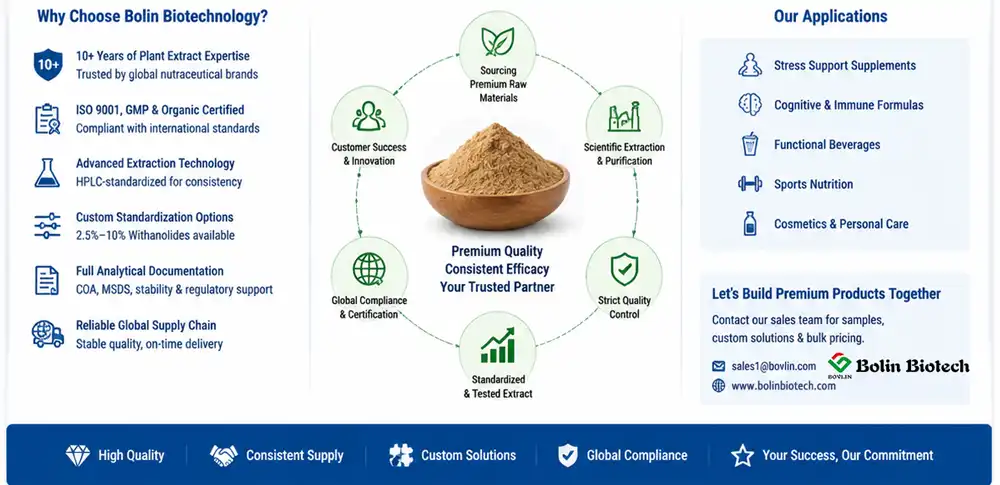
Shaanxi Bolin Biotechnology has been extracting plants for more than ten years and is a world leader in the nutraceutical business. As a specialized ashwagandha root extract powder manufacturer, we make sure that every batch meets the strict standards that supplement and pharmaceutical companies have by keeping quality systems that are approved to ISO 9001, GMP, and organic standards. Our cutting-edge factory uses standardization that has been checked by HPLC to make extracts ranging from 2.5% to 10% withanolides that are sure to be effective and have little batch difference. We offer full analytical paperwork, stability studies, and legal help that is tailored to the needs of your market. Our expert team works together to help you choose the best extracts and make the best products, whether you're making stress-relieving supplements, useful drinks, or cosmetics. Get in touch with our purchasing agents at sales1@bovlin.com to talk about your ashwagandha root extract powder for sale needs, ask for samples, or look into custom standardization options that will help your goods stand out in crowded markets.
References
Chandrasekhar, K., Kapoor, J., & Anishetty, S. (2012). "A prospective, randomized double-blind, placebo-controlled study of safety and efficacy of a high-concentration full-spectrum extract of ashwagandha root in reducing stress and anxiety in adults." Indian Journal of Psychological Medicine, 34(3), 255-262.
Mishra, L. C., Singh, B. B., & Dagenais, S. (2000). "Scientific basis for the therapeutic use of Withania somnifera (ashwagandha): a review." Alternative Medicine Review, 5(4), 334-346.
Sangwan, R. S., Chaurasiya, N. D., Misra, L. N., Lal, P., Uniyal, G. C., Sharma, R., Sangwan, N. S., Suri, K. A., Qazi, G. N., & Tuli, R. (2004). "Phytochemical variability in commercial herbal products and preparations of Withania somnifera (Ashwagandha)." Current Science, 86(3), 461-465.
Kulkarni, S. K., & Dhir, A. (2008). "Withania somnifera: An Indian ginseng." Progress in Neuro-Psychopharmacology and Biological Psychiatry, 32(5), 1093-1105.
Mirjalili, M. H., Moyano, E., Bonfill, M., Cusido, R. M., & Palazón, J. (2009). "Steroidal lactones from Withania somnifera, an ancient plant for novel medicine." Molecules, 14(7), 2373-2393.
Kuboyama, T., Tohda, C., & Komatsu, K. (2005). "Neuritic regeneration and synaptic reconstruction induced by withanolide A." British Journal of Pharmacology, 144(7), 961-971.