_1745226507162.webp)

Why Red Dragon Fruit Powder Is Becoming a Popular Natural Alternative to Synthetic Food Dyes?
Due to its amazing capacity to provide bright natural coloring without the legal issues and customer backlash associated with synthetic dyes, red dragon fruit powder has caught the attention of B2B procurement professionals across the food and supplement sectors. This natural colorant comes from the deep red pulp of the pitaya fruit. It gives bright red and pink shades thanks to betalain pigments, and it also has antioxidant benefits that man-made options can't match. As rules on artificial food additives get stricter in major markets and more and more people want clean-label goods, this plant ingredient meets both compliance needs and market positioning needs well.
Understanding Red Dragon Fruit Powder and Its Advantages Over Synthetic Dyes
This natural colorant is made by changing fresh pitaya fruit by drying it slowly and grinding it into tiny pieces. This way, the pigment and nutrient substances are kept intact. The red dragon fruit powder that is made contains a lot of betalains and anthocyanins, which are water-soluble pigments that give the fruit its bright color. Researchers who wrote papers in food science journals found that betalains work well in a range of pH conditions, which makes them very useful for teams working on new products.
Nutritional Profile and Bioactive Components
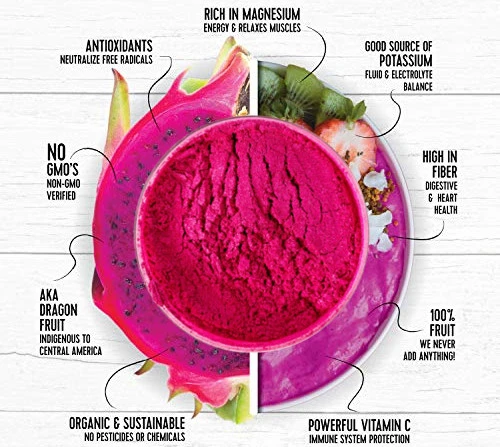
This botanical ingredient does more than just add color; it also has measured functional effects. The red dragon fruit powder has polyphenolic ingredients, vitamin C, and dietary fiber that make finished goods more antioxidant. Manufacturers of functional foods or dietary supplements like this dual function because it lets them keep health claims while simplifying ingredient lists. Oxygen radical absorbance capacity (ORAC) numbers from studies show that this ingredient has strong antioxidant properties, making it more than just a coloring agent.
Regulatory Landscape Favoring Natural Alternatives
Regulatory bodies around the world are becoming more and more interested in synthetic food dyes. In the European Union, goods with certain artificial colorants have to have warning signs. In North America, consumer interest groups are still pushing brands to change their recipes so they don't use these chemicals. This legal environment causes real business risks for companies that use conventional colors. On the other hand, natural dyes made from fruit sources tend to get better ratings and approval from customers.
Comprehensive Comparison: Red Dragon Fruit Powder vs. Synthetic and Other Natural Dyes
Product formulators who are looking at different coloring choices can benefit from learning about how different types of ingredients work. Synthetic dyes, such as Red 40 or Allura Red, can give foods bright colors even when they are used in small amounts. However, they are not good for you and can hurt how people think of your brand. On the other hand, natural options have different performance patterns that procurement teams need to carefully look at.
Performance Metrics Across Colorant Categories
Red pitaya powder is a famous natural red colorant that is better at keeping its color and pH stability than beetroot powder. Betalain pigments stay more constant in color from pH 3 to 7, while beetroot-derived pigments lean toward purple-red tones and can change noticeably in acidic conditions. This advantage of stability is especially useful in drinking and acidic food systems where color uniformity has a direct effect on how well people like the product.
Turmeric and carrot products give off yellow to orange tones, but they can't make a real red color, which limits how they can be used. Anthocyanin-rich products from berries or purple sweet potatoes can change the color from red to purple, but they need to be used at higher rates and with care to keep the pH level from dropping too low so the color doesn't fade. One of the best things about organic red dragon fruit powder is that it can give your recipes a bright, stable red color with little trouble.
Certification Impact on Procurement Decisions
When going after high-end customers or certain retail outlets, organic approval has a big effect on how buyers see the product and how easy it is for them to get into the market. Products that are certified organic get a lot of attention from companies that sell natural and organic goods. Procurement managers should think about whether the people they want to buy from them are worth the cost of certification. For example, organic versions usually need proof of good farming methods all along the supply chain, which can easily be given by sellers with strong quality management systems.
Practical Applications and Usage Guidelines for Red Dragon Fruit Powder in Food Products
Figuring out the best conditions for use is important for integrating products successfully while keeping costs low. When reviewing new ingredients, food scientists like getting clear instructions on dosage levels, processing issues, and compatibility issues.
Application Categories and Formulation Techniques
Here are some useful things to think about when adding this natural colorant to different types of products:
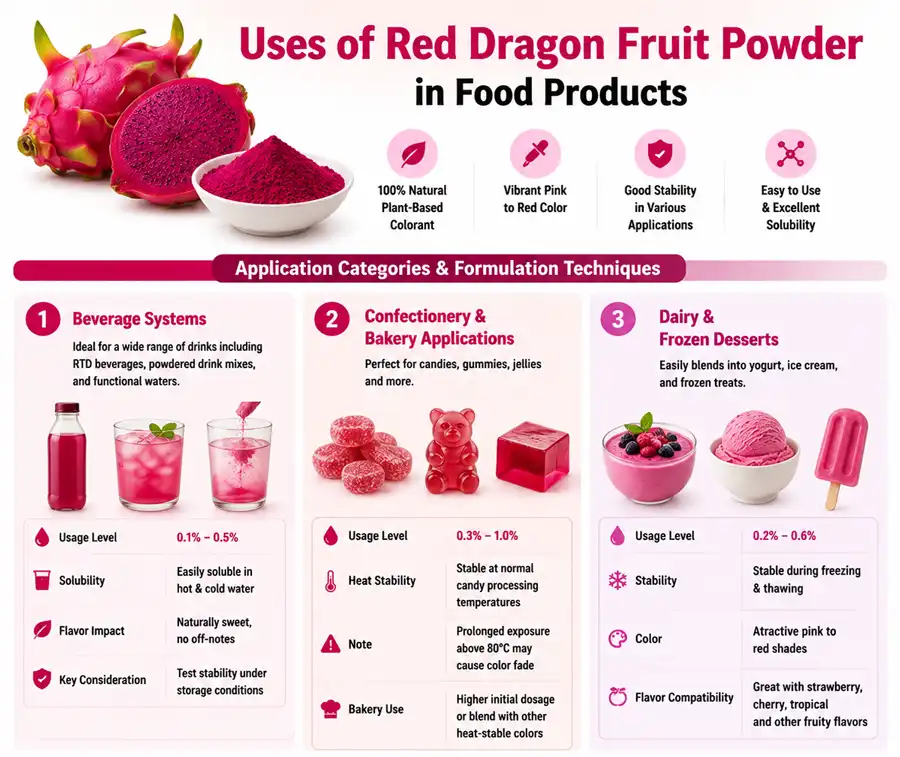
- Beverage Systems: Depending on the level of color strength you want, the normal usage rates are between 0.1% and 0.5%. The powder mixes easily with both cold and hot water, so it can be used in ready-to-drink drinks, powdered drink mixes, and useful water products. The naturally sweet fruit base goes well with a lot of different drink flavors without adding any unwanted notes. However, formulators should test the stability of the mixture in the conditions it will be stored in.
- Confectionery and Bakery Applications: This colorant works well in hard sweets, gummies, and jellies at rates of 0.3% to 1%. The heat stability of betalains lets them be processed at temperatures that are normal for making candy. However, if they are exposed to temperatures above 80°C for a long time, some of the color may fade. High baking temperatures make it harder to use natural colorants in bakery uses. You need to use higher doses at first or mix them with other heat-stable natural colorants.
- Dairy and Frozen Desserts: The powder mixes easily into yogurt, ice cream, and other frozen treats, and it stays stable when it freezes and thaws. When you use between 0.2% and 0.6%, you get pretty pink to red colors that people associate with fruity tastes. Flavors like strawberry, cherry, and tropical go well with this ingredient.
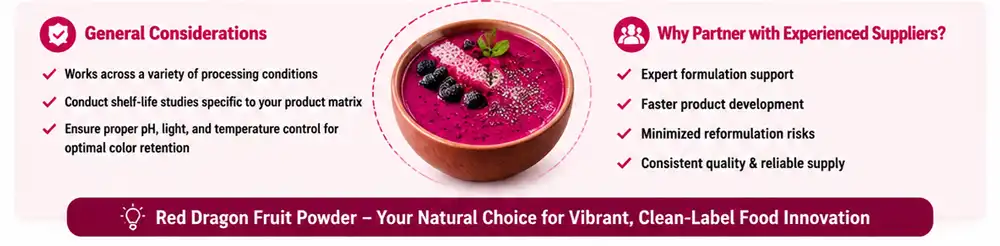
These uses show that they can work in a variety of working settings. However, quality assurance teams should do shelf-life studies that are specific to their product matrices. When you work with experienced providers, you can get expert help that speeds up formulation development and lowers the risks of reformulation.
Color Stability Optimization Strategies
Paying attention to a few things will help you get the best color retention over the course of a product's shelf life. Because betalain pigments break down most quickly when exposed to light, opaque or UV-protective packing is important for goods that need to last longer. Adding antioxidants, like ascorbic acid, can make some recipes more stable for colors. Managing temperature during processing and marketing also has an effect on color retention. In general, items that are kept in the fridge keep their color better than those that are kept at room temperature.
Sourcing and Procurement Insights for Red Dragon Fruit Powder
People in charge of buying things in the natural ingredients market who need to find reliable suppliers should know how to tell the difference between good sellers and dishonest ones.
Supplier Qualification Framework
Getting to know manufacturers who have widely accepted certifications lowers the risk at every step of the supply chain. ISO 9001 certification shows that you handle quality in an organized way, and HACCP certification shows that you know how to keep food safe. GMP approval is especially important when sending ingredients, including organic red dragon fruit powder, to be used in food supplements, where the rules are the same as those for pharmaceuticals. To get organic approval from the USDA, the EU, or a similar program, suppliers must keep detailed records and undergo frequent audits. This shows that they are committed to being open and honest.
A production capacity review stops the problems that can happen when providers can't keep up with rising demand. Manufacturers who have their own processing facilities and well-established networks for getting raw materials are more reliable than brokers or sellers who don't have direct control over production. To make sure that the planned needs are met, procurement teams should ask for information about yearly production numbers, lead times, and capacity distribution.
Cost Structures and Packaging Considerations
Knowing what makes prices go up or down helps you negotiate better and make more accurate budgets. The quantity of raw materials changes with the seasons, and the time of harvests affects how the supply works. Processing difficulty, licensing fees, and quality standards all play a role in how much things cost in the end. When sellers commit to buying more, they can usually get better prices, but they have to weigh the benefits of saving money against the costs of keeping supplies and the need to keep products fresh.
The types of packaging should match the size of the business and the people who can handle the goods. Medium-sized businesses can use 20- to 25-kilogram cartons for bulk packing, while big businesses may find that tote bins or super sacks are easier to move their goods around in. Suppliers who offer lower minimum order amounts during the commercialization phase are flexible, which is good for small businesses that are making new items.
Future Trends and Market Outlook for Natural Food Dyes with Focus on Red Dragon Fruit Powder
The use of natural colorants is growing faster because of government, market, and technological factors that are changing how ingredients are chosen in the food and drink industries.
Market Growth Drivers and Innovation Directions
People are still very concerned about their health, and clean-label goods are steadily getting market share in developed markets. Food ingredient market research companies predict that natural colorants will continue to grow at double-digit rates for the next ten years, with betalain-based choices becoming more popular. North American and European markets are leading this change, but Asia-Pacific markets are becoming more interested as middle-class customers put safety and quality of food first.
Strategic Integration Recommendations
B2B clients who want to get ahead in the competition should think about a number of different strategy methods. When brands use natural colorant technology early on, they become stars in innovation and build formulation knowledge that makes it harder for competitors to enter the market. Creating different versions of a product with a clean label strategy attracts customers who are ready to pay more for what they think are health benefits. Diversifying the supply chain by working with several qualified providers lowers the risk of disruptions and keeps the purchasing power.
Conclusion
The switch to natural colorants isn't just a short-term change in the market; it's a reflection of big changes in customer values, regulations, and the way competition works in the food and supplement industries. Naturally occurring colors from fruits and vegetables and red dragon fruit powder have real benefits over man-made ones when it comes to safety, nutrition, and brand positioning. When manufacturers add these botanical ingredients, they get in line with the direction of the market and meet both legal standards and customer tastes at the same time. To be successful, you need to work with providers who know what they're doing and can provide regular quality, expert support, and reliable logistics that let you make choices about formulation with confidence.
FAQs
Is red dragon fruit powder safe for use across all food and beverage categories?
This natural colorant is generally thought to be safe (GRAS) in the US and is also accepted in most other countries as long as it is used in the normal colorant dose amounts. Its safety is supported by the fact that it comes from fruit and has been eaten for a long time. For certain uses, it's important to make sure that they follow local rules, especially in places with strict rules about natural colorants.
How does the cost structure compare with synthetic alternatives?
To get the same level of color strength, natural colorants usually need to be used more often than manufactured dyes. This changes the cost per unit. The total cost varies on the type of application, the color strength that is wanted, and the amount that is needed. Many producers find that the higher prices that can be charged for clean-label goods more than make up for the differences in the costs of the ingredients. This makes the business case better when looked at as a whole, rather than just looking at the costs of the ingredients.
What certifications should procurement teams prioritize when qualifying suppliers?
Organic approval, GMP compliance, ISO 9001 quality management, and HACCP food safety credentials are some of the things that quality-focused buying looks for. It is also important for supplement makers to make sure that their sources know the rules about food supplements and keep good records. Third-party testing proof and traceability documents give customers even more faith in the authenticity and dependability of the products and suppliers they buy from.
Partner with Bolin Biotechnology for Premium Red Dragon Fruit Powder Supply
Shaanxi Bolin Biotechnology Co., Ltd. has been making plant extracts for over ten years and works with companies around the world in the nutraceutical, medicinal, functional food, and cosmetics businesses. We sell red dragon fruit powder that is certified to meet the highest international quality standards. It has a long list of certifications, such as ISO, GMP, and organic credentials, that make it easy to buy. We keep our production capacity steady so that we can meet both the small amounts needed for product development and the full-scale business supply needs. Our technical support teams are also quick to respond and understand the formulation problems that come up in a wide range of applications. Long-term partnerships with top names in North America and Europe have been formed thanks to our dedication to quality control, openness in the supply chain, and customer partnership. Email our team at sales1@bovlin.com to talk about your unique needs, ask for samples, or find out how our plant ingredient solutions can help you reach your goals for product innovation. We're excited to become your reliable source for red dragon fruit powder.
References
Stintzing, F.C., & Carle, R. (2004). Functional properties of anthocyanins and betalains in plants, food, and in human nutrition. Trends in Food Science & Technology, 15(1), 19-38.
Wybraniec, S., & Mizrahi, Y. (2002). Fruit flesh betacyanin pigments in Hylocereus cacti. Journal of Agricultural and Food Chemistry, 50(21), 6086-6089.
Polturak, G., & Aharoni, A. (2018). La Vie en Rose: Biosynthesis, Sources, and Applications of Betalain Pigments. Molecular Plant, 11(1), 7-22.
Paśko, P., Galanty, A., Zagrodzki, P., Luksirikul, P., Barasch, D., Nemirovski, A., & Gorinstein, S. (2021). Dragon fruits as a reservoir of natural polyphenolics with chemopreventive properties. Molecules, 26(8), 2158.
Codex Alimentarius Commission. (2019). General Standard for Food Additives (GSFA) - Natural Food Colorants. Food and Agriculture Organization of the United Nations.
Martins, N., Roriz, C.L., Morales, P., Barros, L., & Ferreira, I.C. (2016). Food colorants: Challenges, opportunities and current desires of agro-industries to ensure consumer expectations and regulatory practices. Trends in Food Science & Technology, 52, 1-15.