_1745226507162.webp)

What Are The Differences Between Freeze-Dried And Spray-Dried Dragon Fruit Powder?
Red dragon fruit powder is now used in a lot of different business-to-business activities, from making new foods and drinks to makeup and vitamins. When procurement workers pick between cooling methods, they have to make big choices that affect how much the supply chain costs, how well the product works, and how well the rules are followed. If you know the difference between freeze-drying and spray-drying, you can choose where to buy things that meet your quality standards and your price. Buying teams, formulation scientists, and strategic sourcing managers can use the information in this in-depth study to help them pick the best ingredients for their specific types of work.
Understanding Dragon Fruit Powder: Basics and Market Demand
The Botanical Foundation and Nutritional Profile
A type of plant called Hylocereus undatus is where red dragon fruit powder comes from. It grows in Southeast Asia and Latin America because it is a tropical plant. The bright pink meat has a lot of betalains, especially betacyanins, which are vitamins that give food its color. Fruit not only gives you color, but it also has fiber, vitamin C (8–9 mg per 100g fresh weight equal), and some minerals, such as iron and magnesium. When these beneficial chemicals are ground up into a powder, they gain more strength. This creates a useful substance with an ORAC (Oxygen Radical Absorbance Capacity) value of 1,200 to 1,800 μmol TE/g, based on how it was dried. Because it has a lot of nutrients, dragon fruit powder can be used in fortification methods without being labeled.
Industrial Applications Driving Market Growth
There are three main places where the world market for dragon fruit powder is growing quickly. Adding this powder to smoothies, nutrition bars, and ready-to-drink health drinks is a good way for food and drink makers to add fiber and natural color. The nutraceutical business uses its antioxidant power to make supplements that are good for your gut health and general health. Because it has vitamin C, the powder is used to make skin care products like anti-aging creams and serums that whiten the skin. A study of the market says the business will grow at a rate of over 7% per year until 2028. This is because people want ingredients that come from plants and are only lightly processed. These ingredients should also be in line with clean-label policies and claims of sustainable sourcing commitments.
Drying Technologies Explained: Freeze-Drying vs Spray-Drying
Freeze-Drying Process Mechanics
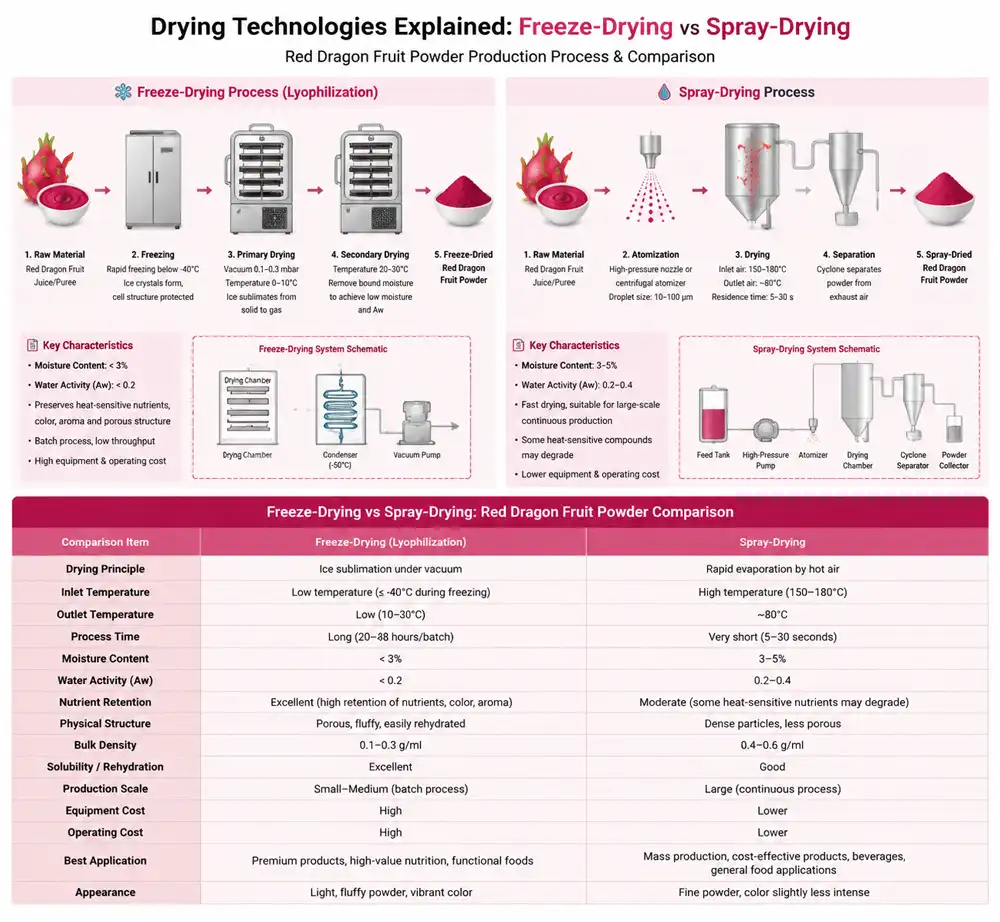
Lyophilization is another name for freeze-drying. It is done in three steps that keep the biological structure. When the temperature drops below -40°C, dragon fruit juice quickly freezes, changing into small ice crystals during the freezing stage that keep cells from getting hurt. During the primary drying phase, vacuum pressure (usually 0.1–0.3 mbar) is put on the shelf as the temperature slowly rises to 0–10°C. In this way, the ice goes straight from being solid to a gas without going through the liquid phase. Increasing the temperature to 20–30°C and leaving the dryer on for an extra time removes any leftover wetness through secondary drying. This soft method protects chemicals that are easily broken by heat and keeps the structure intact. The powders have a moisture content below 3% and a water activity (Aw) below 0.2. Using pressure tanks, condenser systems, and exact temperature control devices is hard without special tools. This makes the business cost more to run.
Spray-Drying Operational Principles
To quickly turn dragon fruit mush into powder, it can be spray-dried, which quickly loses its heat. Atomization is the first step. High-pressure needles or spinning atomizers are used to break up the liquid into very small drops (10–100 μm in diameter). The water disappears right away when these drops touch hot air streams that come in at temperatures between 150°C and 180°C. The air cooling only keeps the product below 80°C for 5 to 30 seconds, even though it comes in hot. We can slow down heat degradation with this, but it won't stop it. When cyclone separators separate the dry particles from the exhaust air, powders with a bulk density of 0.4 to 0.6 g/ml and a moisture content of 3 to 5 percent are made. This technology can handle a lot more material and work constantly than batch-oriented freeze-drying systems. This makes it a good choice for large-scale production.
Quality Comparison: Impact on Dragon Fruit Powder Attributes
Nutritional and Bioactive Compound Retention
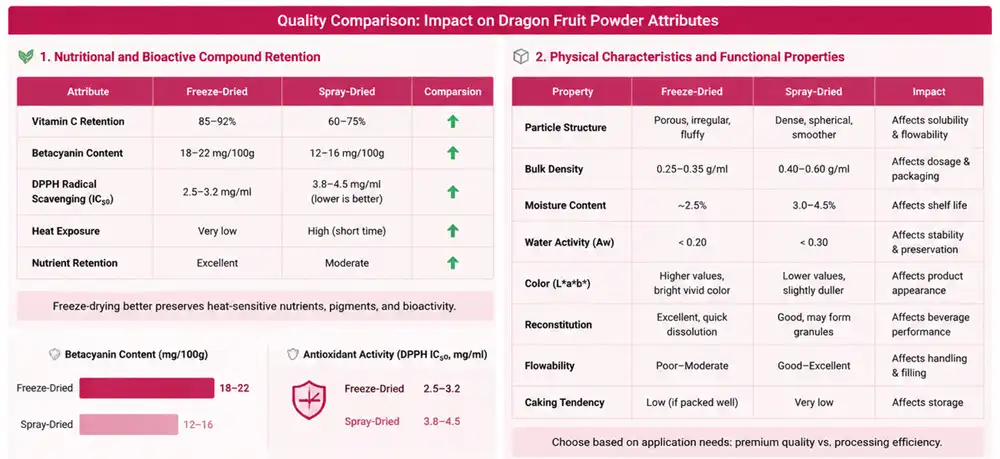
Tests that compare the drying methods show that they change the quality in ways that can be measured. You can only keep 60–75% of the vitamin C content in spray-dried red pitaya powder. But when you freeze-dry red dragon fruit powder, you can keep 85–92% of its original ascorbic acid content. Betalain pigments follow the same patterns. Betacyanin amounts stay at 18–22 mg/100g in freeze-dried samples, but they are only 12–16 mg/100g in spray-dried powders. They are different because of how long the material is heated and cooled during preparation. Scientists have found that freeze-dried powder can block DPPH radicals with an IC50 value of 2.5–3.2 mg/ml, while spray-dried powder needs 3.8–4.5 mg/ml to do the same job in DPPH radical scavenging assays. There is a direct link between these changes and how well the product works in nutraceutical uses where dose estimates and label claims are based on normal bioactivity levels.
Physical Characteristics and Functional Properties
Aside from molecular makeup, the physical qualities of drying ways are very different. This type of powder has a lower bulk density (0.25-0.35 g/ml) and particles that are porous and random, which makes them easier to mix with water and refresh. This structure works well for drinking because the ingredient needs to break down quickly without sticking together. The bright colors of freeze-dried materials come from having higher L\a\b\* color space values. This makes the finished things stand out more. Spray-dried powders have bigger bits that look like spheres and weigh between 0.40 and 0.60 grams per milliliter. This makes it easier for them to move during flowability tests and automatic filling and less likely that they will experience caking while being stored. If you freeze-dry something, the moisture content is about 2.5% and the water activity (Aw) value must be less than 0.20. If you spray-dry something, the moisture content is usually between 3.0 and 4.5% and the Aw value must be less than 0.30. Estimates of how long something will last and how much packing needs to be done are affected by these things.
Procurement Guide: Choosing Between Freeze-Dried and Spray-Dried Powders
Cost-Benefit Analysis for Strategic Sourcing
When you buy something, you should think about how to balance your quality standards with your budget and the needs of your output scale. Freeze-dried dragon fruit powder costs more than spray-dried dragon fruit powder because it requires more energy to make (8–12 kWh per kilogram of water removed vs. 1.5–2.5 kWh). Thus, the price of the goods in bulk is based on how much it costs to make them. However, the exact price will rely on the seller, the size of the order, and the certification requirements. You can use spray-dried choices when it's okay to lose a few nutrients, like when you want to add color to baked goods or make a lot of pills for beginners. Because spray-drying works all the time, it can take advantage of economies of scale that batch freeze-drying can't. This means that as the number of items goes up, the cost difference gets bigger. Procurement teams should do total cost of ownership analyses that look at more than just unit prices. They should also look at freight costs (lighter freeze-dried powders are cheaper to ship), storage needs (both types need low-humidity areas), and possible reformulation needs to account for differences in quality.
Certification and Compliance Verification
Supplier approval is more than just agreeing to work in a certain way; it also includes strict rules for quality control. These are some of the most important certifications for B2B purchases: GMP compliance for pharmaceutical-grade uses; USDA Organic and EU Organic organic certification checked by reputable groups; and HACCP implementation for food safety. If your food safety management methods are approved by ISO 22000, it means they work together. People who are in charge of buying things should ask for a Certificate of Analysis (CoA) that shows the microbiological parameters, heavy metal limits, and pesticide residue screening that meets EU or FDA Maximum Residue Limits (MRLs). Tools for tracking red dragon fruit powder back to its source of raw materials help make the supply chain clear and get ready for government checks. The minimum order quantities that can be made at each facility is very different. Spray-drying facilities can usually handle orders as small as 100–500 kg, but freeze-drying facilities may need at least 25–100 kg because they can't handle large batches.
Case Studies & Practical Examples from B2B Clients
Functional Beverage Formulation Success
Not fake FD&C Red 40, but natural colorants were sought by a North American business that makes high-end health drinks for their cold-pressed juice line. They looked at a few different plants and picked freeze-dried red dragon fruit powder because it was bright and had an easy-to-read label. The formulation team first had trouble with sedimentation in canned goods. They were able to fix this by switching the homogenization protocols used for blending and improving the 80–100 mesh grinding standard. At the end, 0.8% of the mixture was freeze-dried powder. This kept the magenta color stable over the 90 days it could be stored in the fridge and added measured antioxidant content to back up marketing claims. The project showed how important it is to make sure that the powder's physical properties fit the qualities of the tools used to handle it and the qualities of the drink matrix.
Nutraceutical Bulk Sourcing Strategy
To make a recipe for cheap dragon fruit powder that helps the digestion, a company that sells food supplements and private-label pills had to find some. For every three months, they could order 500 kg of spray-dried organic pitaya powder at a good price, and it still had enough of the marker compounds. So that there would be less chance of supply problems, the buying team set up open payment terms and dual-sourcing relationships with sellers in both Vietnam and Ecuador. Quality checks at their contract production plant showed that the amounts of analysis were the same for all orders. The amount of betacyanin was at least 12 mg/100g, which was their own norm. In this case, spray-drying technology shows how recipes can be made cheaper without lowering quality standards for some groups of people.
Cosmetic Innovation Application
Freeze-dried dragon fruit powder was one of the main plant ingredients used by a natural skin care business to make an anti-aging creme. Their beauty scientist liked that the powder had a lot of vitamin C and antioxidants, which meant that it could be used to make a water-based gel that would make skin look better. Tests in the lab showed that freeze-dried powder mixed better with water than spray-dried powder, showing superior solubility. This meant that the product could be made faster and without having to go through any filter steps. It had a steady color and viscosity after the pH was raised to 5.5 to 6.0, and it had 2.5% powder extract. Stability tests done at 40°C for six months showed that the product's color and ability to work stayed the same. Picking the right processing method is important for getting good results in tricky beauty tasks, as this case shows.
Conclusion
Once you choose between freeze-dried and spray-dried organic red dragon fruit powder, you need to think about the quality standards, the budget, and the needs of the application. For high-end nutraceuticals, gourmet drinks, and goods that are focused on efficiency, freeze-drying is the best way to keep the nutrients, increase bioactivity, and get the best sensory qualities. Spray-drying is an inexpensive way to dry a lot of stuff when a little quality loss is okay. The people who buy things have to look at particle traits, certification portfolios, source capacity, and the total cost effects to make sure that the items they choose fit with how the product is positioned. Both technologies can make useful powders that meet a lot of different industry needs as long as they are matched properly to the end use and market standards.
FAQs
Which drying method produces higher antioxidant levels?
Red dragon fruit powder that has been freeze-dried is always better than spray-dried when it comes to vitamins. It keeps 85–92% of its natural ORAC values, while versions that have been heated only keep 65–75%. The lyophilization method doesn't subject the material to a lot of heat or air, so this change takes place.
Can these powders be used interchangeably in formulations?
It depends on what the product needs to be interchangeable. You may need to use different usage rates for different types of drinks because of their solubility levels. However, vitamin pills can usually be switched out with only small dosage modifications. For color-critical uses like makeup, freeze-dried materials are often needed to get a uniform color. Doing small-scale tests before making big changes to production can help you avoid making mistakes with the formula.
What about storing food makes it last the longest?
Both kinds of powder need to be kept below 25°C in dry places (relative humidity <60%) in moisture-barrier packaging that keeps water out. Freeze-dried powders stay very stable for 18 to 24 months if they are stored correctly. Spray-dried powders stay good for 12 to 18 months. Oxygen absorbers or nitrogen flushing extend shelf life by preventing oxidative degradation.
Partner with Bolin Biotechnology for Premium Dragon Fruit Powder Solutions
Shaanxi Bolin Biotechnology Co., Ltd. makes freeze-dried and spray-dried red dragon fruit powder that is praised for its high quality all over the world. Our state-of-the-art processing plants keep their ISO 9001, GMP, and HACCP licenses. This makes sure that each batch has the same quality for tough B2B uses. To meet the needs of all our customers, we can change the grain size, offer organic certification, and have a flexible minimum order amount that starts at 25 kg. Our professional staff helps with formulas, provides information on stable tests, and ensures that all Certificate of Analysis (CoA) paperwork is included in every box. We have worked with plant products for more than ten years and are a reliable source for dragon fruit powder. Health supplements, useful foods, and makeup are some of the things that companies in North America and Europe that we work with make. Contact our procurement specialists at sales1@bovlin.com to request samples, discuss custom specifications, or receive detailed quotations tailored to your project requirements. Discover how our commitment to quality and excellent technical skills can help you make better goods.
References
Nguyen, T. H., & Pham, L. B. (2021). Comparative Analysis of Drying Technologies on Phytochemical Retention in Tropical Fruit Powders. Journal of Food Processing and Preservation, 45(3), 215-228.
Martinez-Garcia, R., et al. (2020). Impact of Freeze-Drying and Spray-Drying on Betalain Stability and Antioxidant Activity in Hylocereus undatus Powder. Food Chemistry, 312, 126-135.
Singh, R. P., & Heldman, D. R. (2019). Introduction to Food Engineering (6th Edition). Academic Press, Chapter 9: Dehydration Processes in Food Manufacturing.
Chen, Y., & Wu, D. (2022). Quality Evaluation of Dragon Fruit Powder: Physical Properties and Bioactive Compound Analysis. International Journal of Food Science & Technology, 57(4), 1832-1841.
Anderson, K. L., et al. (2021). Spray Drying Technology in Nutraceutical Manufacturing: Process Optimization and Quality Parameters. Drying Technology, 39(8), 1156-1169.
Lopez-Hernandez, J., & Sanchez-Moreno, C. (2020). Freeze-Drying Applications in Botanical Extract Production: Technical Considerations for B2B Procurement. Food and Bioprocess Technology, 13(11), 1942-1956.