_1745226507162.webp)

How Is Liposomal Apigenin Made? Understanding the Encapsulation Process
The natural flavonoid apigenin is put into liposomes, which are vesicles made of phospholipid bilayer membranes, in a controlled encapsulation process. This is what liposomal apigenin is. This method of delivery is a direct response to the fact that apigenin is in BCS Class II, which means it doesn't dissolve well in water (about 1.35 µg/mL) and isn't very bioavailable when taken by mouth. The lipid shell protects the active chemical from being broken down in the gut and first-pass metabolism in the liver. This lets cells take it up through processes that are similar to how normal membranes move. Buyers of ingredients and people who make brands need to know about this process before they can make an informed choice about where to get their ingredients.
What Liposomal Apigenin Is and Why It Matters
The Flavonoid Behind the Technology
Plants like chamomile, parsley, and celery all have apigenin (4',5,7-trihydroxyflavone) in them. Researchers have found that it can protect neurons, fight free radicals, and change the way GABA receptors work. Because of this, it's a good choice for formulas that help the brain, sleep, and fight ageing. This is because its crystal structure makes it harder for the body to process in supplement form.
Why Encapsulation Changes the Equation
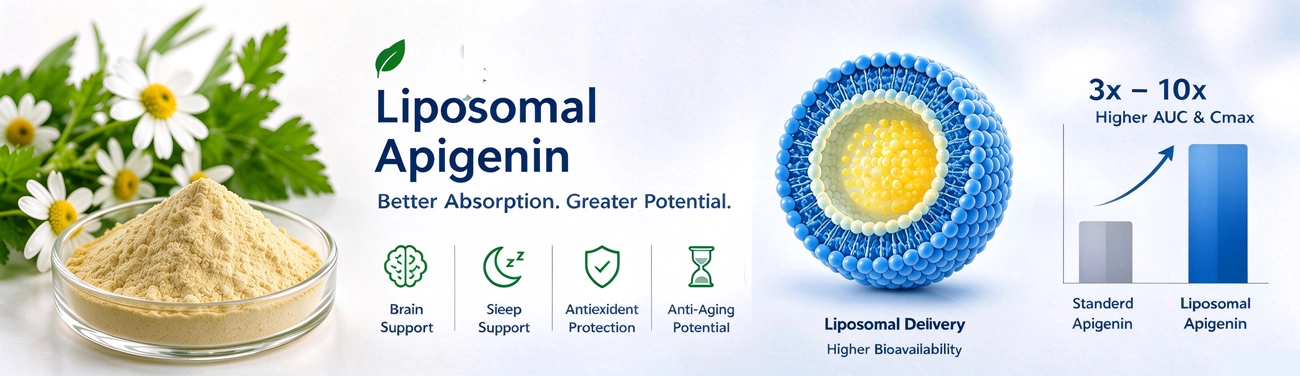
Apigenin gets a phospholipid shell that looks like the membranes of living cells when it is put inside a liposome. Because of this molecular similarity, the vesicle can get around normal barriers to absorption. Pharmacokinetic studies on liposomal flavonoids usually show a 3x to 10x rise in AUC (Area Under the Curve) and Cmax compared to non-encapsulated versions. These numbers are very important when you're making a claim about how well a product works.
The B2B Case for Liposomal Delivery
The difference in performance between normal apigenin and encapsulated apigenin is directly linked to business value for brands and OEM makers that buy in bulk. Consistent absorption data, a shelf life of two years, and a powder form that dissolves in water all lower formulation risk and back up the claims of effectiveness that premium supplement brands rely on.
Why Traditional Apigenin Falls Short
The Solubility Problem
About 1.35 µg/mL of raw apigenin dissolves in water. This means that most of a standard dose is broken down in the digestive system and doesn't get into the bloodstream. That absorption gap is both a regulatory and a reputational risk for a supplement brand that makes claims of clinical strength.
Stability During Storage and Transit
When conventional apigenin powder is introduced to heat, light, or water, it breaks down. Loss of stability before the product even gets to the manufacturer is a real problem in bulk supply chains where ingredients may go through several warehouses with different climates.
The Market Demand Shift
In the past five years, people have become much more aware of bioavailability. People who are concerned about their health now actively look for words like "liposomal apigenin" and "encapsulated" on product labels. The demand for phospholipid-encapsulated botanicals keeps growing in both the US and EU markets. This is because brands that find better delivery formats put their products ahead of competitors that use cheaper ones.
Core Steps in the Liposomal Encapsulation Process
In the encapsulation process, science and good manufacturing meet. Bolin Biotechnology uses an organized, quality-controlled process to make VesilipoTM Liposomal apigenin, from choosing the raw materials to the final packing.
The main steps in the encapsulation process are listed below:
- Sources of Raw Materials: The production process starts with pharmaceutical-grade phosphatidylcholine made from non-GMO sunflower or soy and high-purity apigenin (70% specification). At this point, the quality of the lipid source is important because it changes the stability of the membrane and the makeup of fatty acids.
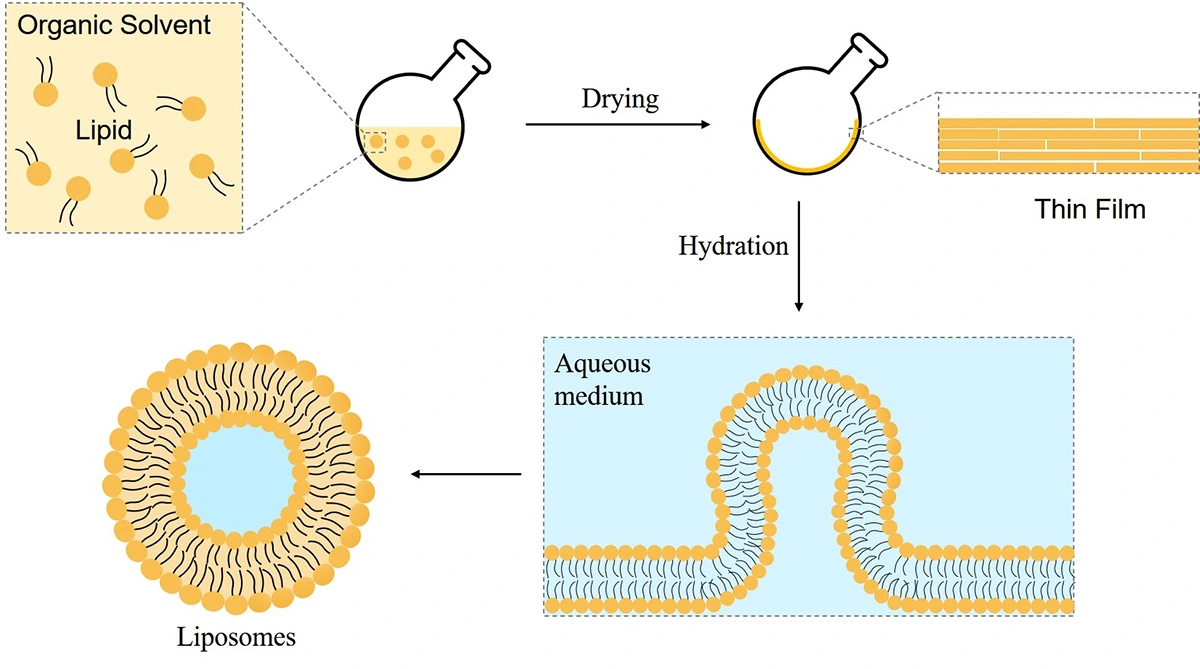
- The main way liposomes are made is through thin-film hydration, in which apigenin and phospholipids are dissolved in a solvent, the solvent is then evaporated to leave behind a thin lipid film, and the film is then hydrated to form multilamellar vesicles (MLVs) on its own. Depending on the target particle size and encapsulation efficiency (EE%), ethanol injection and reverse-phase evaporation can be used together or separately.
- Cutting down on particle size: Hydrated raw vesicles are usually too big to be absorbed properly. Sonication and microfluidization lower the size of particles to a Z-average of 100nm to 300nm, with a Polydispersity Index (PDI) of less than 0.3. This means that the particles are evenly distributed and will absorb the substance in a predictable way.
- Purification and Concentration: Ultracentrifugation or dialysis are used to get rid of the free apigenin that is not enclosed. This step is necessary to get an encapsulation efficiency above 85%, which means that most of the active compound is inside the vesicle and not just floating around in the solution.
- Drying and Changing to a Powder: Lyophilization (freeze-drying) or spray drying is used to turn the liquid liposomal solution into a stable powder. Cryoprotectants, like trehalose, may be added to freeze-dried versions to keep the vesicles from breaking during the freezing process. The result is the light yellow powder characteristic of Vesilipo™.
You can't skip any of these steps; each one, from the phospholipid ratio to the cooling temperature, has a direct effect on the stability, dispersibility, and shelf life of the finished product. "False liposomes," which are just apigenin and lecithin mixed together, get on the market by skipping or shortening any step. Transmission Electron Microscopy (TEM) shows that a real liposomal product has spherical bilayer structures that are different from a simple blend.
Liposomal Apigenin vs. Standard Apigenin and Other Encapsulated Actives
Absorption and Efficacy Comparison
Standard apigenin pills don't always work because intake depends on the person's gut environment. This variable stays stable thanks to liposomal formats, which keep the payload safe until it gets to the absorption site. Compared to curcumin and quercetin, which are also liposomal bioactives, apigenin encapsulation fills in a big solubility gap. This is because raw apigenin dissolves less easily in water than either of those two compounds.
Powder vs. Liquid Format Considerations
The powder version is better for OEM makers and companies that make gummies. VesilipoTM comes in 1 kg bags or 25 kg drums as a light yellow powder. It dissolves in water to form a stable liquid solution and can be used in production lines for capsules, tablets, and gum without any special tools. Even though liquid liposomal apigenin formats work, they are hard to transport in large amounts, need to be kept cold, and have to be managed for a long time. Keep in mind that temperatures above 60°C for a long time can break down the phospholipid bilayer, so adding it after processing is suggested for use in drinks.
Zeta Potential and Colloidal Stability
A zeta potential below -30mV means that particles are strongly repelling each other electrostatically, which stops them from sticking together when they are reconstituted. This technical factor tells the difference between liposomal ingredients that are really stable and ones that were badly designed and clump or separate on the shelf.
| Comparison Item | Liposomal Apigenin | Standard Apigenin | Liposomal Curcumin/Quercetin |
|---|---|---|---|
| Absorption Stability | High | Low (depends on gut environment) | High |
| Water Solubility | Improved after encapsulation | Extremely poor | Moderate (still better than apigenin) |
| Dosage Form Flexibility | Both powder and liquid available | Mainly powder | Both powder and liquid available |
| Production Convenience | Powder requires no special equipment | Conventional powder | Powder requires encapsulation process |
| Transport & Storage | Powder is convenient; liquid requires cold chain | Convenient | Powder is convenient; liquid requires cold chain |
| Heat Sensitivity | Phospholipid bilayer degrades above 60°C for extended periods | Relatively low | Similar |
| Colloidal Stability Indicator | Zeta potential < -30mV | None | Zeta potential < -30mV |
| Core Advantage | Fills the solubility gap for apigenin; stable absorption | Low cost but inconsistent efficacy | Established solution, but apigenin is harder to solubilize |
Quality and Safety Standards in Production
Certifications That Matter in B2B Procurement
Bolin Biotechnology's ISO-certified buildings are where VesilipoTM is made according to cGMP guidelines. The item has SGS, HALAL, HACCP, and ISO22000 certifications, which are sets of paperwork that meet the rules for both US and EU distribution channels. These certificates make it easier for brand founders to look at new ingredient suppliers and speed up the internal compliance review process.
Six-Step Testing Protocol
They follow a systematic test protocol for each production batch, which includes selection of raw materials, screening for heavy metals & pesticides as per EU norms, product safety for microbes, quantification of active ingredients by HPLC/UPLC, supplier audit & third-party approval. As part of this procedure, the integrity of the phospholipids is tested, including the peroxide value. The oxidized lipids in the carrier produce inflammation. This is a quality failure point that serious manufacturers must manage.
Batch-to-Batch Consistency
When purchasing teams are in charge of multiple SKU product lines, batch stability is just as important as original specification. Bolin Biotechnology has a fully integrated supply chain that includes a registered planting base of 25,800 acres, in-house extraction, and encapsulation. This ensures that there is clear paperwork at every stage of production, which can be used for CoA requests, third-party checks, and regulatory files.
Conclusion
Liposomal apigenin encapsulation solves a known problem with apigenin's pharmacokinetics by keeping the molecule safe during digestion and increasing plasma levels in a way that can be measured. A stable substance with a high EE% level requires a lot of technical work during the manufacturing process. This includes choosing the raw materials, making vesicles, reducing the size of the particles, cleaning, and drying in controlled conditions. A true liposomal product is different from a plain phospholipid mix when a company makes high-end formulas for brain health, sleep, antioxidants, or anti-aging. The difference comes down to quality and trust in the customer. The best way to get a product that works and sells is to buy it from a company that has certificates that can be checked, testing that is clear, and items that can be customised.
FAQ
1. How can I confirm a product is truly liposomal and not just a phospholipid blend?
Reconstitute the powder in water. A genuine liposomal ingredient forms a stable, milky colloidal suspension rather than separating or precipitating. Definitive confirmation requires TEM imaging to visually identify spherical bilayer vesicle structures.
2. What encapsulation efficiency should I require from a supplier?
Industry standards for credible liposomal ingredients require an EE above 85%, confirmed by ultracentrifugation followed by HPLC analysis of free versus encapsulated apigenin fractions.
3. Is Vesilipo™ suitable for gummy and heat-processed formulations?
The powder format integrates well into solid-dose and gummy production. Because phospholipid bilayers can degrade above 60°C, we recommend adding Vesilipo™ after any high-temperature processing step to protect vesicle integrity.
4. What certifications does Vesilipo™ carry?
Vesilipo™ is produced under cGMP and carries ISO, SGS, HALAL, HACCP, and ISO22000 certifications—supporting compliance documentation for US and EU market distribution.
5. What is the minimum order quantity?
Vesilipo™ ships in 1kg bags for sampling and development stages, and in 25kg drums for commercial-scale orders. Custom MOQs are available based on formulation requirements.
Partner with Bolin Biotechnology — Trusted Liposomal Apigenin Manufacturer
Since 2012, Bolin Biotechnology has provided confirmed plant-based ingredients to well-known names around the world. You can order our VesilipoTM liposomal apigenin in bulk or under your own brand name. You can change the dosage form, mesh size, and packaging to suit your needs. Our team can help you make pills, powders, or sweets. We can help you from the sample stage all the way through full-scale production. To get a sample or technical datasheet, email us at sales1@bovlin.com.
References
1. Bonechi, C., et al. "Apigenin: A Natural Flavonoid with Biological Properties and Therapeutic Potential." Natural Product Communications, 2021.
2. Telange, D. R., et al. "Formulation and Characterization of an Apigenin-Phospholipid Phytosome Complex for Improved Solubility, In Vitro and In Vivo Bioavailability." European Journal of Pharmaceutical Sciences, 2017.
3. Akbarzadeh, A., et al. "Liposome: Classification, Preparation, and Applications." Nanoscale Research Letters, 2013.
4. Shinde, U. A., & Nagarsenker, M. S. "Characterization of Gelatin-Sodium Alginate Complex Coacervates and Evaluation of Their Potential for Liposome Encapsulation." Indian Journal of Pharmaceutical Sciences, 2009.
5. Chaudhary, A., et al. "Lyophilization of Liposomes: A Review." Asian Journal of Pharmaceutics, 2014.
6. Walle, T. "Absorption and Metabolism of Flavonoids." Free Radical Biology and Medicine, 2004.