_1745226507162.webp)

How to Choose a Bulk Boswellia Serrata Extract Powder Supplier
Choosing the right bulk Boswellia serrata extract powder supplier is one of the most consequential decisions a joint health or sports nutrition brand can make. The wrong source exposes your formulations to batch inconsistency, missing certifications, and supply disruptions that stall product launches. The right supplier delivers standardized boswellic acid content, verified through HPLC and third-party testing, alongside certifications that open doors in the US, EU, and beyond. This guide walks through every stage of that decision — from defining your needs to requesting your first sample.
Understanding the Decision Scenario for Boswellia Extract Procurement
Before talking to a single supplier, your team needs to be sure of what you need. Which source works best for your business depends on the type of application, the concentration grade, and the regulatory scope.
Define Your Application First
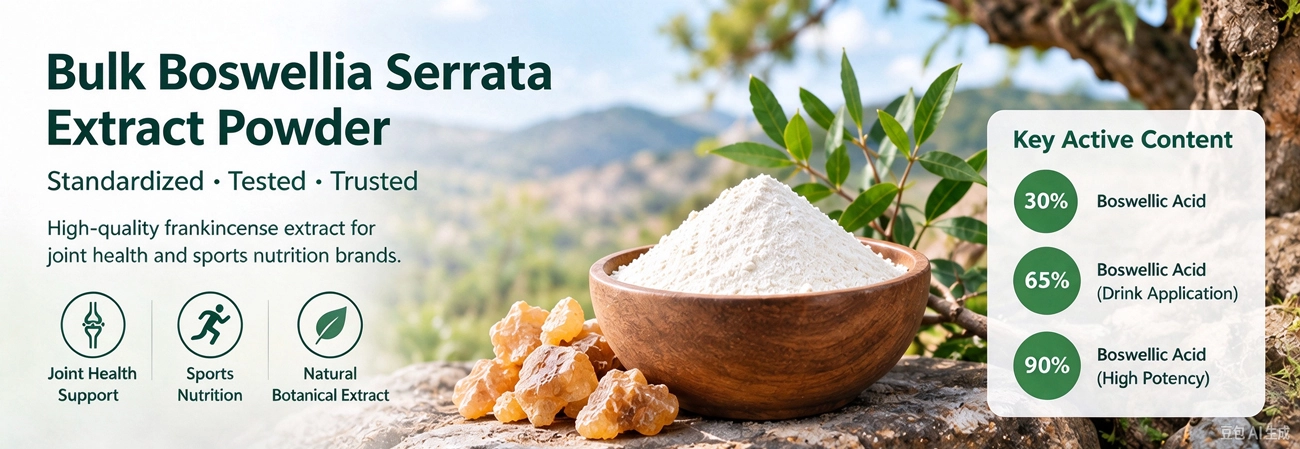
Joint health capsules, healing mixes for after a workout, and functional drinks all have different technical needs. One grade of 65% boswellic acid stays stable from pH 3.5 to 7.0, which makes it a good choice for ready-to-drink drinks. A score of 90% is given for high-potency encapsulation, and label claims rely on the exact amount of AKBA present.
Match Concentration to Your Label Claims
"5-LOX inhibition" or "joint inflammation support" are regulatory terms that need a measured extract, not a rough resin. Studies in humans usually show that taking 300 mg to 500 mg of a bulk boswellia serrata extract powder that is standardized to at least 30–40% boswellic acids every day is a good idea. Make sure that the grade you've chosen matches the written proof that your R&D team plans to use.
Assess Volume and Scalability Needs
Make a plan of your expected yearly output before you start negotiating. You can be sure that your supply chain will stay connected if you can find a supplier that can handle trial orders of 25 kg and yearly deals for multiple tons without any lead-time gaps. Early lock-in of a single-source arrangement lowers the risk of having to change the formula in the middle of the cycle.
Key Criteria to Screen and Evaluate Indian Frankincense Extract Suppliers
There are a lot of different sellers in the market, from verified botanical makers to repackagers who make it hard to track their products. Here are some things that make a partner trustworthy or not.
When judging a supplier, the following things are the most important:
- Raw material origin and traceability: Suppliers operating their own certified planting base — rather than purchasing open-market resin — offer documented lot-level traceability from field harvest through final packaging. This matters for organic and HALAL certification continuity.
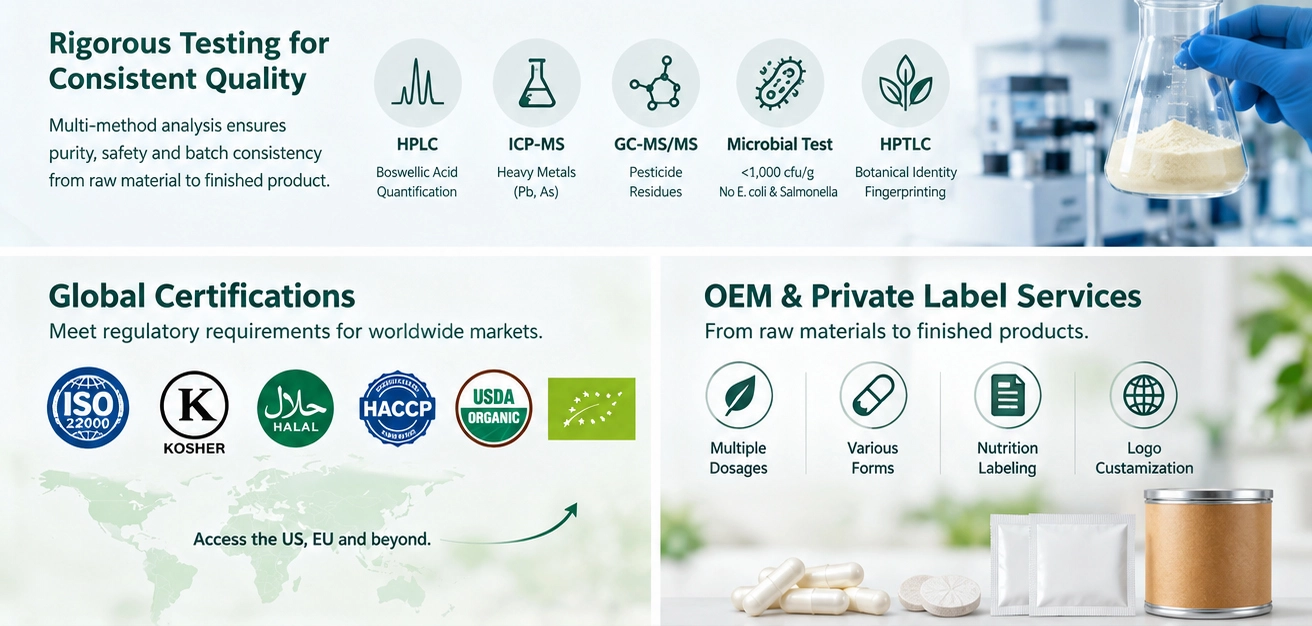
- Testing depth and methodology: A credible supplier runs, at minimum, HPLC quantification for boswellic acid content, ICP-MS for heavy metals (Pb <3.0 ppm, As <2.0 ppm), and GC-MS/MS for pesticide residues. Microbial counts below 1,000 cfu/g and absence of E. coli and Salmonella should appear on every Certificate of Analysis.
- Third-party verification: Internal test results must be independently confirmed. Request third-party lab reports alongside the supplier's own CoA before committing to a trial order.
All of these criteria work together to give procurement teams a solid audit trail in case regulators look closely at a finished product. Do not use copies of certifications instead of looking over real test results.
Certification Coverage for Multi-Market Distribution
A provider with ISO 22000, KOSHER, HALAL, HACCP, and Organic standards makes it much easier for brands that sell in the US and EU to follow the rules. Each approval adds a new market area. For example, HALAL opens up retail in the Gulf and Southeast Asia, and KOSHER targets certain retail outlets in North America.
Manufacturing Process and Extraction Method
Purity and batch consistency are directly affected by the extraction method. For high-concentration boswellic acid powder, solvent extraction with strict residue testing is still the usual method. Make sure that the particle size (usually 80–100 mesh) and moisture content (≤5.0%) are right for the tools you are using to encapsulate or mix the material.
Comparative Analysis of Boswellia Serrata Product Variants
There are different kinds of Boswellia extracts on the market. Buyers often find that grades are not what they seem to be, especially when comparing titration-based and HPLC-based concentration reports.
Titration vs. HPLC Grading
A titration result of 65% shows the total amount of organic acids, which includes ones that aren't doing anything. A 65% number from HPLC separates certain boswellic acids, making an ingredient that is significantly more powerful and repeatable. When a product makes promises about clinical effectiveness, it is important to always ask for AKBA proportion and HPLC-verified content.
Pure Extract vs. Blended Formulas
When it comes to preparation, pure bulk boswellia serrata extract powder gives you the most options. When brands are making joint support mixtures with glucosamine, chondroitin, or MSM, they should get the boswellia part separately so that they can control the amount of each ingredient used. That accuracy is limited by pre-blended products, and label compliance across different markets is made harder.
Organic Certified vs. Conventional Grade
Organic certification comes with a higher price tag, but it opens up new retail outlets and meets customer desire for clean-label goods. Check to see who issued the certification, when it expires, and whether it covers the lot you are buying as well as the facility.
Procurement Process Best Practices for Bulk Botanical Extracts
A structured procurement process keeps your brand safe and cuts down on the time it takes from the first contact to the first production run.
Get a free sample first and send it to your own contracted lab to be checked out before you place a paid order. Several well-known makers fully back this action. Bolin Biotechnology, for instance, gives away free samples of its 30%, 65%, and 90% boswellic acid types along with full proof.
Talk about MOQ terms that fit the size of your sample production. A minimum order quantity of 25 kg lets you test a realistic pilot batch without committing too much inventory. Once it is proven that the recipe is stable, move on to annual volume deals that lock in prices and delivery times.
For foreign shipments, make sure the seller gives you export paperwork, a phytosanitary certificate if needed, and nitrogen-flushed, sealed containers to keep the goods from going bad while they're in transit.
Trusted Certified Suppliers: What Bolin Biotechnology Brings to the Table
The 2012-founded Shaanxi Bolin Biotechnology Co., Ltd. runs a 25,800-acre certified planting base for growing Boswellia serrata. Before any batch ships, the company's more than 80 experts go through a six-step testing process. This includes HPTLC botanical identity fingerprinting, HPLC quantification, ICP-MS heavy metal screening, GC-MS/MS pesticide analysis, microbial verification, and physical property testing.
30%, 65%, and 90% boswellic acid are available in the form of a yellow-white powder (80–100 mesh, ≤5.0% moisture, 24-month shelf life). There are certificates for ISO 22000, KOSHER, HALAL, HACCP, and organic for all grades. The 65% grade is made to be stable between pH 3.5 and 7.0, making it perfect for useful beverage applications.
OEM and private label services cover the whole product launch process, from the raw ingredients to the labeled finished goods. They include pill, tablet, sachet, and large drum forms, as well as nutritional panels in multiple languages and logo placement.
Conclusion
There are three things you can check about a supplier of bulk boswellia serrata extract powder: standardized active content confirmed by HPLC, certification coverage that matches your target markets, and a supply chain that can be tracked back to the source. Your operational risk is greatly reduced when you work with suppliers who invest in their own cultivation base, do multi-method analytical testing, and support OEM production. Before signing an annual agreement, make sure you get samples, look over third-party COAs, and make sure the service can be scaled up. A good supplier screening process will pay off in the long run with regular product performance and fewer legal headaches.
FAQ
1. What boswellic acid concentration should I specify for joint health products?
Published clinical study backs up taking 300–500 mg of a product that is standardized to contain at least 30–40% boswellic acids every day. For strong forms, a grade that has been 90% HPLC-checked may work at lower doses (around 100 mg). Always make sure that the concentration matches the published evidence that the label says it is based on.
2. How do I verify a supplier's boswellic acid content claim?
Get a COA from the source and a lab report from a third party that is not connected with the provider for the same lot. Make sure the percentage you're given is based on HPLC measurements and not titration results. This will make sure that the percentage you get is accurate and includes all the active boswellic acid, including AKBA.
3. Is the 65% grade suitable for functional beverage formulations?
Yes. If you prepare 65% boswellic acid the right way, it stays stable between pH 3.5 and 7.0. This means it can be used in ready-to-drink health shots and green tea. Talk to your supplier about how the solubility will behave before you start making large batches.
4. What certifications should a US/EU-facing supplier hold?
At the very least, you need ISO 22000 for managing food safety, HACCP for controlling the process, and either KOSHER or HALAL for your distribution channels. In the US natural channel, organic approval is becoming more and more important. Before buying, make sure you know when each certificate is valid and what it covers.
5. What is a reasonable MOQ for initial trial orders?
A 25 kg MOQ lets you do a realistic trial production run without taking on too much inventory risk. If a supplier is willing to take this amount for a first order and help it grow to bigger annual volumes, that shows they want to build a long-term business relationship.
Partner with Bolin Biotechnology for Your Next Sourcing Cycle
Certified boswellic acid extract from Bolin Biotechnology has been sold to names in joint health and sports nutrition for more than 12 years. Our bulk boswellia serrata extract powder maker offers 30%, 65%, and 90% grades, as well as full OEM services and six stages of quality control, so your brand can have an ingredient source that can be tracked and is ready for audit. You can get a full set of instructions when you ask for your free sample today. You can email our team at sales1@bovlin.com to look at the details and start the request process.

References
1. Siddiqui, M. Z. (2011). Boswellia serrata, a potential anti-inflammatory agent. Indian Journal of Pharmaceutical Sciences, 73(3), 255–261.
2. Abdel-Tawab, M., Werz, O., & Schubert-Zsilavecz, M. (2011). Boswellia serrata: An overall assessment of in vitro, preclinical, pharmacokinetic, and clinical data. Clinical Pharmacokinetics, 50(6), 349–369.
3. Sengupta, K., et al. (2010). Cellular and molecular mechanisms of anti-inflammatory effect of Aflapin: A novel Boswellia serrata extract. Molecular and Cellular Biochemistry, 354(1–2), 189–197.
4. Kimmatkar, N., et al. (2003). Efficacy and tolerability of Boswellia serrata extract in treatment of osteoarthritis of the knee. Phytomedicine, 10(1), 3–7.
5. United States Pharmacopeia (USP). (2023). Dietary Supplement General Chapters: Botanical Ingredient Identity Testing. USP-NF.
6. Nutraceuticals World. (2022). Sourcing botanical extracts: Quality standards and supplier qualification in the US supplement market. Nutraceuticals World, 25(4), 38–44.