_1745226507162.webp)

What Is Liposomal Apigenin? Benefits, Formulation, and Delivery
Liposomal apigenin is a next-generation apigenin delivery system, a naturally occurring flavonoid present in chamomile, parsley, and celery, in which the active chemical is contained in phospholipid vesicles that imitate biological cell membranes. Standard apigenin is a BCS Class II chemical, which means it has low water solubility (about 1.35 µg/mL) and poor oral absorption. The encapsulation method encapsulates apigenin in a lipid bilayer, which shields the molecule from digestive breakdown, skips first-pass hepatic metabolism, and greatly raises the plasma concentration, making every milligram substantially more potent than its traditional equivalent.
Understanding Liposomal Apigenin: Definition and Mechanism
What Is Apigenin?
Flavonoids are a large group of compounds. Apigenin (4',5,7-trihydroxyflavone) is a flavonoid. It is shown to have anti-inflammatory and antioxidant effects. It naturally occurs in chamomile tea, parsley, and a variety of popular vegetables. For years, standard apigenin extracts have suffered from a lack of absorption by the body, despite decades of study showing that they are physiologically active.
How Liposomal Encapsulation Works
Liposomes are circular phospholipid bilayers that transport the apigenin molecules. They work very much like the outer membrane of a human cell. The liposome fuses directly with the cell membrane of the intestinal wall and releases the payload, without needing to dissolve it in water first. This technique avoids the major absorption barrier that keeps ordinary apigenin from functioning.
What the Science Shows
Pharmacokinetic studies on liposomal flavonoids demonstrate that AUC (Area Under the Curve) and Cmax are always 3–10 times better than free flavonoid isolates. True liposomal powder, when combined with water, will not settle or separate, but instead will create a stable, homogeneous colloidal suspension. This is a large visual contrast to basic phospholipid mixtures. The easiest technique to confirm the quality is to use TEM imaging, which may show the presence of actual bilayer particles.
Key Benefits of Liposomal Apigenin for Health and Wellness
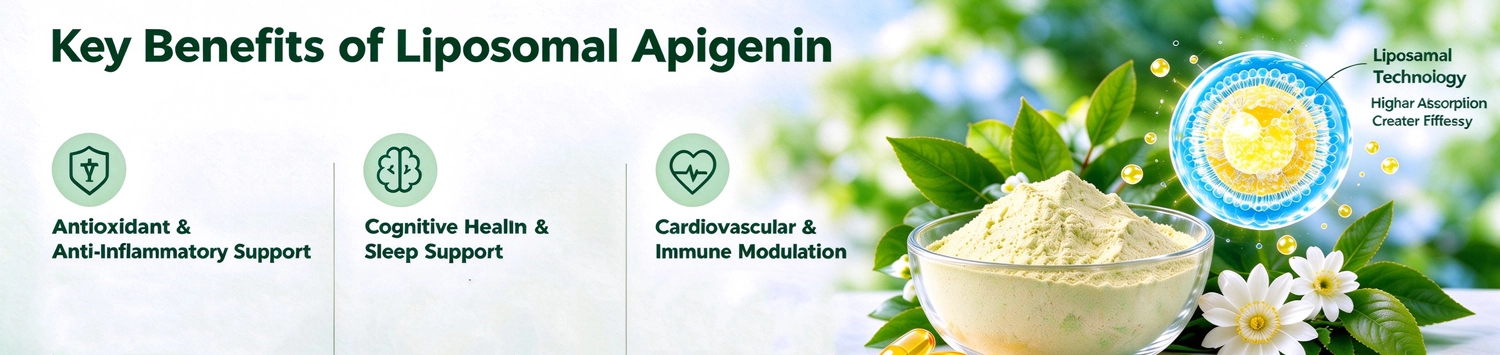
Antioxidant and Anti-Inflammatory Support
Apigenin is a scavenger of reactive oxygen species and modulates pathways leading to the production of inflammatory cytokines. Since it is in a liposomal form, more of it gets into the bloodstream, and so the antioxidant impact per dosage is larger. This implies firms that create formulae for anti-aging or cellular health may make greater claims about their goods that are backed up by data on absorption.
Cognitive Health and Sleep Support
This is typical. Apigenin binds to GABA-A receptors, which are associated with reducing anxiety and regulating sleep. That’s why you’ll see it so commonly in high-end sleep and relaxation mixes. Encapsulated apigenin offers a more constant delivery to the circulation, enabling manufacturers of evening wellness products or nootropic mixes to achieve a more homogeneous functional profile per dosage.
Cardiovascular and Immune Modulation
Apigenin may maintain a healthy balance of inflammation and keep the heart performing effectively, new research reveals. For now, it also seems like it might help modify the immune system. Researchers are still studying these use cases, but they do provide a strong scientific narrative for those who create functional foods and nutraceuticals to construct their products upon.
Formulation and Delivery: Why the Vesicle Structure Matters
Phosphatidylcholine as the Carrier
Liposomal apigenin is usually carried by high-purity phosphatidylcholine (PC), which is usually derived from non-GMO soy lecithin or sunflower lecithin. In sensitive product lines, PC made from sunflowers is chosen. A well-formulated product will have a zeta potential below -30mV, which means the particles are electrostatically stable and won't stick together when they're reconstituted. The particle size is usually between 100nm and 300nm, and the polydispersity index (PDI) is less than 0.3. These are both signs of a uniform spread of vesicles.
Liposomal vs. Standard Delivery
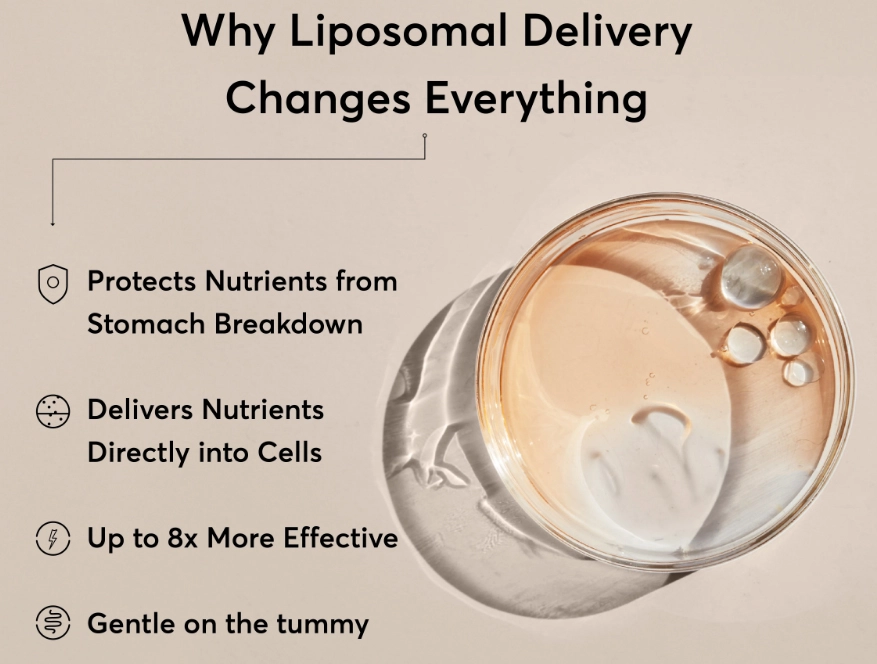
Standard apigenin breaks down quickly in the stomach's acidic environment and goes through a lot of first-pass processing in the liver. On the other hand, the phospholipid bilayer blocks digestive enzymes and acid, keeping the active compound whole until it reaches the epithelium of the intestine. This mechanism of protection is the main reason why liposomal flavonoids, like curcumin and quercetin made with the same technology, always do better in absorption studies than their free-form counterparts.
Thermal Stability for Formulators
One thing that OEM manufacturers and food technologists should keep in mind is that phospholipid bilayers can break down above 60°C. This means that the powder should be added after the liquid has been pasteurized if it is to be used in a drink, or it should be used in solid-dose forms like pills or gummies where the heat exposure is managed. Bolin Biotechnology's VesilipoTM Liposomal apigenin comes in the form of a light yellow powder that contains 70% apigenin. This powder is better at dispersing in water, making it useful for a wide range of formulations.
Market Insights and Procurement Guide
What to Look for in a Supplier
For business-to-business uses, getting encapsulated apigenin involves checking it on more than one level. These are the main things that set a qualified supplier apart from a simple phospholipid blend producer:
- Encapsulation efficiency (EE%): A credible product should demonstrate EE above 85%, confirmed through ultracentrifugation followed by HPLC analysis. Any supplier unable to provide this data is not offering a verified liposomal product.
- Morphology documentation: TEM or SEM imaging should confirm the presence of actual spherical bilayer structures. Without this, a product may simply be apigenin mixed with lecithin — not a true liposomal system.
- Residual solvents and heavy metals: Gas Chromatography should confirm solvent levels below USP <467> limits. Heavy metal content should meet pharmacological grade standards (Lead < 0.5 ppm, Arsenic < 1 ppm).
- Third-party certification: Look for ISO, cGMP, HACCP, HALAL, and SGS certifications as a baseline. These documents carry real weight in EU and US regulatory environments.
These standards make sure that your product is honest and give your brand the proof it needs to back up claims of effectiveness in regulated markets.
Packaging and Supply Chain Considerations
For smaller orders, VesilipoTM comes in 1 kg aluminum foil bags. For larger orders, it comes in 25 kg fiber drums with food-grade poly-bag liners. Both types can be kept for two years if they are kept in a cool, dry place out of direct sunlight. OEM clients can get custom packaging, private labeling, and label design in more than one language.
Strategic Recommendations: Building Your Product Around This Ingredient
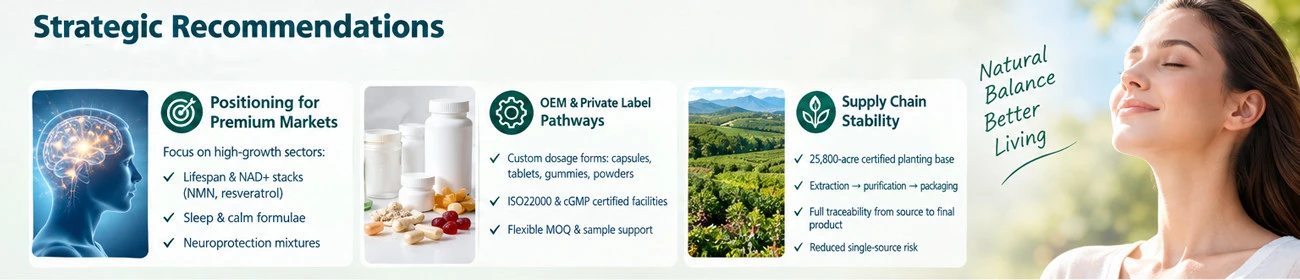
Positioning for Premium Markets
The three high-growth sectors of the U.S. supplement industry that encapsulated apigenin should be targeted at are: lifespan and NAD+ stacks (typically combined with NMN or resveratrol); sleep and calm formulae; and neuroprotection mixtures. Both groups have a strong demand signal from clients and allow businesses to tell the bioavailability narrative in a manner that makes high costs make sense.
OEM and Private Label Pathways
Bolin Biotechnology’s OEM and ODM services allow companies to bring VesilipoTM to market fast without setting up their own facilities. We produce unique dosage forms, including pills, tablets, gummies, and powder mixtures in ISO22000- and cGMP-approved facilities. Flexible minimum purchase quantities and availability of samples can reduce the time needed to get an idea from concept to marketplace.
Supply Chain Stability
Bolin Biotechnology controls the output of a recognized planting base of 25,800 acres, through extraction, purification, and final packaging. This vertical combination lessens the danger of a single source supply, a recognized problem for purchasers in the EU and the US who have struggled to secure adequate ingredients recently. Each batch is traceable throughout the whole manufacturing process.
Conclusion
Liposomal apigenin is a flavonoid that has been widely investigated and has shown biological effects, but is hard for the body to absorb in its usual form. That equation alters in a measurable manner with improved plasma concentrations, verified vesicle shape, and protection against digestive breakdown. For companies in the cognitive health, sleep, anti-aging, or beauty-from-within sectors, this ingredient offers both a functional narrative and a differentiator. The difference between a product that really works and a product that simply claims to function is picking a proven manufacturer with complete documentation and flexible OEM possibilities.
FAQ
1. How does liposomal apigenin differ from standard apigenin extract?
Standard apigenin extract doesn't mix well with water and isn't very bioavailable when taken by mouth. The active compound is protected from stomach acid and digestive enzymes in the liposomal form, which is made up of two layers of phospholipids. Pharmacokinetic tests on liposomal flavonoids show 3–10 times higher plasma concentrations than the same substances that are not enclosed.
2. How do I verify that a product is truly liposomal and not just a blend?
Ask the supplier to do TEM imaging. Under an electron microscope, real liposomal products look like spherical bilayer vesicles. A simple mix of phospholipids will separate in water, but a real liposomal product will make a stable solution of milky particles.
3. Is this ingredient heat-stable enough for gummy or beverage applications?
Above 60°C, the phospholipid membrane can break down. Standard processing temperatures are fine for candies and solid-dose forms. For drinks, the ingredient should be added after the product has been pasteurized. After the samples are taken, the team at Bolin Biotechnology can give advice on the preparation factors.
4. What certifications should I require from a supplier?
For most markets in the US and EU, you need at least ISO, cGMP, HACCP, and HALAL. Third-party testing results from SGS and a full CoA with HPLC verification are common forms of proof for qualified buying.
Partner With Bolin Biotechnology for Verified Liposomal Apigenin
Bolin Biotechnology has been providing plant-based products to well-known brands around the world since 2012. They make everything themselves, are certified by ISO and cGMP, and offer custom manufacturing services for powders, pills, and gummies. As a direct producer of liposomal apigenin, we can provide samples, make sure that supplies can be tracked, and help with private labeling for markets in the US and EU. To get a sample or technical datasheet, email our team at sales1@bovlin.com.
References
1. Salehi, B., et al. "The Therapeutic Potential of Apigenin." International Journal of Molecular Sciences, 2019.
2. Sharma, A., et al. "Liposomal Drug Delivery Systems and Their Clinical Applications." Journal of Drug Delivery Science and Technology, 2021.
3. Pasarin, D., et al. "Liposomal Encapsulation of Plant Polyphenols: Stability and Bioavailability." Food Chemistry, 2022.
4. Bhatt, D.L., et al. "Flavonoid Bioavailability and Approaches to Improve Pharmacokinetic Profiles." Nutrients, 2020.
5. McClements, D.J. "Encapsulation, Protection, and Release of Hydrophilic Active Components: Potential and Limitations of Colloidal Delivery Systems." Advances in Colloid and Interface Science, 2017.
6. Kopec, A., et al. "Phospholipid-Based Drug Delivery: Liposome Stability, Encapsulation Efficiency, and In Vivo Performance." European Journal of Pharmaceutics and Biopharmaceutics, 2023.