_1745226507162.webp)

How to Choose a Liposomal Apigenin Supplier
Choosing the right liposomal apigenin supplier is one of the most consequential sourcing decisions a supplement brand or nutraceutical manufacturer can make. Unlike standard apigenin, the liposomal form encapsulates this flavonoid within phospholipid bilayers, dramatically improving oral absorption and stability. Because encapsulation quality varies widely across the market, the supplier you select directly determines whether your finished product delivers on its efficacy claims. This guide walks through every evaluation stage — from technology verification to long-term partnership strategy — so your procurement team can move forward with confidence.
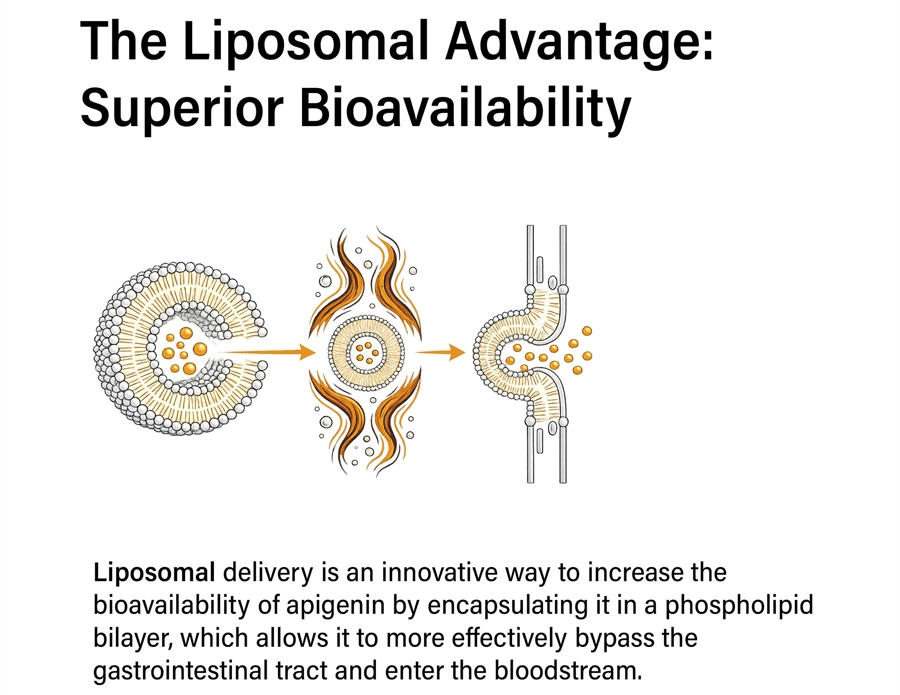
Understanding the Market for Liposomal Apigenin
Why the Encapsulated Form Commands Attention
Standard solid apigenin is a BCS Class II molecule, which means it doesn't dissolve well in water (about 1.35 µg/mL) and isn't very bioavailable when taken by mouth. This is directly addressed by liposomal release. Liposomal flavonoids consistently show a 3x to 10x increase in AUC (Area Under the Curve) compared to non-encapsulated forms. This makes them a good ingredient story for high-end supplement brands that want to make products that improve sleep, cognitive health, and anti-aging effects.
Market Applications Driving B2B Demand
The nutrient is really popular in a lot of areas that are growing quickly. A main factor driving growth is cognitive health stacks, especially those that combine apigenin with NMN or resveratrol to help with aging. Apigenin's known ability to bind to GABA receptors is also used in sleep and calming goods. It is being used in beauty-from-within products and supplements by cosmeceutical formulators, and pharmaceutical research teams are looking for high-bioavailability grades for preclinical studies.
Sourcing Complexity You Need to Anticipate
It's not always true that products labeled "liposomal" contain vesicular structures. A basic mixture of liposomal apigenin and lecithin will separate quickly in water, but real liposomes will stick together and make a stable suspension. This difference is very important for claims about quality and effectiveness. Compliance requirements for both the US and EU markets should also be taken into account by procurement teams. These include non-GMO status, halal approval, and EU guidelines for pesticide residue limits.
Core Criteria for Evaluating Liposomal Apigenin Suppliers
Technology Verification Comes First
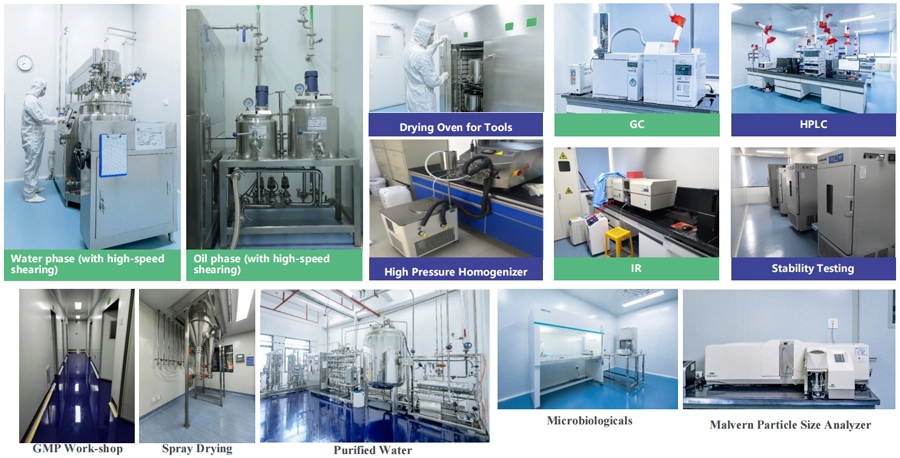
Ask the supplier for Transmission Electron Microscopy (TEM) images to make sure that the vesicles are really forming before you look at the prices. Ask for information on encapsulation efficiency (EE%) as well; performance should be higher than 85% according to industry standards. Both particle size distribution (Z-average between 100nm and 300nm, PDI below 0.3) and zeta potential (usually below -30mV) are good signs of a stable, well-made product.
Quality Documentation That Protects Your Brand
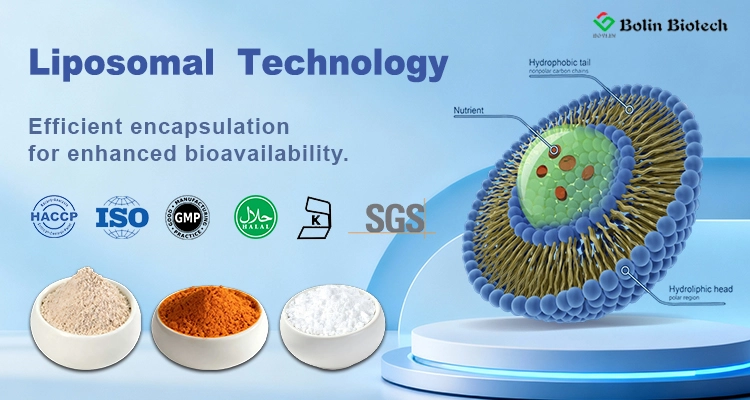
As a real provider, every company should give you a Certificate of Analysis that shows the active ingredient content (HPLC/UPLC-verified), heavy metal screening results (Lead below 0.5ppm, Arsenic below 1ppm), microbial safety data, and residual solvent analysis via Gas Chromatography. Batch control is a must, from where the raw materials come from to how they are packaged at the end. Suppliers with ISO, cGMP, HACCP, and third-party certifications like SGS and HALAL are more likely to follow the rules.
Formulation Flexibility and Capacity
Not only should they handle your current SKU, but they should also take care of your product plan. Check to see if they can make different dosage types, like powder, capsules, tablets, and gummies, and if you can change the amounts of content, the mesh size, and the particle diameter. During the pilot phase, the ability to change the minimum order quantity is very important. Before signing a supply agreement, make sure you know how long it will take to make both small test batches and full commercial runs.
Strategic Comparison of Liposomal Apigenin Supply Options
Liposomal vs. Standard Apigenin: A Procurement Perspective
Picking between liposomal and non-liposomal sources isn't just a matter of cost; it's also a matter of how to place the product. Even though standard liposomal apigenin extract costs less per kilogram, your marketing team can't make as many claims about how well it works because it has a bioavailability ceiling. Because liposome grades support clearer structure/function language and can support a higher retail price, brands that want to stand out always choose the encapsulated form.
Manufacturer vs. Distributor Trade-Offs
Direct manufacturers offer consistent batches, full traceability, and the chance to work out special requirements. Distributors make things easier to get and require smaller sales, but they also add a layer of profit and could leave technical paperwork holes. When buying between $150,000 and $600,000 a year, working directly with a maker almost always leads to better cost-per-gram results and faster problem settlement.
Evaluating International Suppliers
A number of well-known companies that make liposomal ingredients are based in Asia, especially in China's Shaanxi area, which is known for having a lot of experts in extracting plants. When working with foreign suppliers, make sure they follow the rules for export paperwork, can handle customs issues, and have experience shipping to markets in the US and EU. As part of any formal agreement with a supplier, there should be temperature-controlled shipping options and dependable lead time promises.
Matching Supplier Selection to Your Business Needs
Align Specifications to Your Application
A brand of sleep aids needs different kinds of technology help than a brand of beauty products. For making gummies, thermal stability data is very important. Liposomal phospholipid bilayers can break down above 60°C, so your supplier needs to either suggest cold-process gummy ways or offer a heat-stable version. When making capsules, mesh size and flowability data are the most important things to think about. Before you decide on a supplier, ask for technical sheets that are specific to your application.
This is the list of the most important measures to rank when making your source scorecard:
- Encapsulation technology validation — TEM imaging, EE%, particle size data, and zeta potential results confirm whether a product is genuinely liposomal or merely a lecithin blend.
- Regulatory documentation depth — Suppliers with ISO, cGMP, HALAL, HACCP, and SGS certifications reduce your compliance burden in both US and EU markets.
- Dosage form range and customization capability — Powder, capsule, tablet, and gummy production under one roof allows your product line to scale without switching suppliers.
- MOQ and trial batch policy — A supplier willing to provide samples and accept smaller initial orders signals confidence in their product and flexibility for your development cycle.
All of these things show if a supplier is a short-term vendor or a long-term manufacturing partner that will grow with your business.
Build the Relationship Before You Need It
When buying liposomal ingredients for the first time, the process usually takes six to twelve weeks. This includes technical discussions, sample requests, trial production, and testing the product on the market. Starting that process with a provider that offers quick technical support, clear paperwork, and honest communication about wait times will cut down on the time it takes and prevent mistakes later on. Once a track record is established, volume discount arrangements and collaborative R&D help can be used.
Procurement Process and Best Practices
Structure Your RFQ for Maximum Clarity
A well-written Request for Quotation lists the amount of apigenin, the necessary EE%, the particle size range, the accepted phospholipid source (non-GMO sunflower or soy), the dosage form, the packaging style, and the amount of the product that is needed. By making your compliance requirements clear from the start, especially any limits on pesticide residues and licensing needs, you can get rid of sellers who can't meet your standards before you spend time evaluating them.
Sample Testing Protocol
Once the samples arrive, have a third-party lab check them against the supplier's COA. Check the amount of apigenin using HPLC, the size of the particles using dynamic light scattering, and the integrity of the phospholipids by looking at the PC content and peroxide values. Oxidized phospholipids cause inflammation and are a sign of bad production or storage conditions, so this result rules the product out.
Ongoing Supplier Management
For quality management after launch, batches should be retested on a regular basis, updated COAs should be looked over, and suppliers should be audited once a year if the volume warrants it. Before you place your first business order, make sure you have a clear way to handle batches that don't meet your requirements.
Conclusion
It takes more care to find the right source for a packaged flavonoid ingredient such as liposomal apigenin than it does to get raw materials. The quality marks can be measured, the technology claims can be checked, and the effect on the effectiveness of your product is clear. Give more weight to providers who have clear technical documents, certifications that are known around the world, and real formulation flexibility. Your brand and the way your product does in the market will be protected by a relationship with a supplier based on checked data and open communication.
FAQ
1. What makes liposomal apigenin more effective than the standard form?
The liposomal transport method wraps apigenin in a phospholipid bilayer, which keeps it from breaking down in the digestive system and helps cells absorb it directly. Pharmacokinetic studies show that this method can increase plasma levels three to ten times more than using apigenin that is not enclosed.
2. How do I verify that a supplier's product is genuinely liposomal?
Ask for TEM imaging to see the structures of vesicles, encapsulation efficiency data above 85%, and particle size analysis with a Z-average between 100 and 300 nm and a PDI below 0.3. A real liposomal powder doesn't settle on top of water; instead, it makes a stable colloidal solution.
3. What certifications should a reliable supplier hold?
At the very least, look for ISO, cGMP, HACCP, SGS, and HALAL approvals. These show that they meet foreign safety and production standards that are important for entering both the US and EU markets.
4. What are typical MOQs for bulk procurement?
A lot of suppliers let you order 1 kg of samples for testing purposes and 25 kg drums for large-scale production. If a supplier has flexible MOQ rules during the trial phase, it means they are sure of the quality of their product.
5. Is liposomal apigenin powder stable in heat-processed formats like gummies?
The phospholipid bilayer can be damaged by heat that lasts for a long time above 60°C. Before finishing a formulation for a gummy product, talk about cold-process manufacturing choices or ask for thermal stability data that is relevant to your processing circumstances.
Partner with Bolin Biotechnology for Your Liposomal Apigenin Supply
Bolin Biotechnology has been making plant-based ingredients since 2012. Our VesilipoTM liposomal apigenin is a light yellow powder that contains 70% apigenin and comes in 1 kg bags and 25 kg drums. It is the result of more than 10 years of experience in extracting and encapsulating apigenin. We are certified by ISO, cGMP, HACCP, SGS, and HALAL, and we allow full creation of dosage forms, packing, and private labeling. As a direct manufacturer of liposomal apigenin, we avoid the costs of going through middlemen and can keep track of every batch. You can get a sample or talk about technical issues right now by emailing sales1@bovlin.com.
References
1. Salehi, B. et al. "Apigenin: A potential dietary supplement for the treatment of inflammation." Biomolecules, 2019.
2. Torchilin, V.P. "Recent advances with liposomes as pharmaceutical carriers." Nature Reviews Drug Discovery, 2005.
3. Allen, T.M. & Cullis, P.R. "Liposomal drug delivery systems: From concept to clinical applications." Advanced Drug Delivery Reviews, 2013.
4. Riva, A. et al. "Improved oral absorption of quercetin from quercetin phytosome: A comparative pharmacokinetic study." European Journal of Drug Metabolism and Pharmacokinetics, 2019.
5. Shukla, S. & Gupta, S. "Apigenin: A promising molecule for cancer prevention." Pharmaceutical Research, 2010.
6. McClements, D.J. "Encapsulation, protection, and delivery of bioactive proteins and peptides using nanoparticle and microparticle systems." Advances in Colloid and Interface Science, 2018.