_1745226507162.webp)

Sodium Hyaluronate vs Hyaluronic Acid: Key Differences Explained
When selecting ingredients for cosmetics, pharmaceutical or nutraceutical formulations, it is vital to grasp the difference between Sodium Hyaluronate and Hyaluronic Acid. These names are commonly used interchangeably. Sodium Hyaluronate Powder is the sodium salt derivative of Hyaluronic Acid and has advantages in terms of solubility, stability and skin penetration. Therefore, it is the favored option for B2B producers constructing sophisticated formulations. This book also explores their chemical variances, functional advantages and procurement issues to assist decision-makers in maximizing product development and sourcing strategies.
Introduction
Hyaluronic Acid and Sodium Hyaluronate are important in skin care, pharmaceuticals, and biomedicine. Although these compounds have varied chemical structures and functions, they are employed equally in marketing. These changes greatly affect formulation performance, rule compliance, and end-user satisfaction.
B2B buyers, product developers, and manufacturers must understand these shifts beyond school. It affects supply chain decisions, cost management, and product competitiveness. To achieve worldwide quality standards, cosmetic active, functional drink, and nutritional supplement formulators must manage varied molecular weights, solubility profiles, and certification requirements.
This detailed analysis clarifies the product's purpose, manufacturing requirements, and optimal purchase. If you know these distinctions, you may pick anti-aging serums, nutritional gummies, or pharmaceutical APIs judiciously to optimize product performance and company efficiency.
What Are Sodium Hyaluronate and Hyaluronic Acid?
Defining Hyaluronic Acid and Its Biological Role
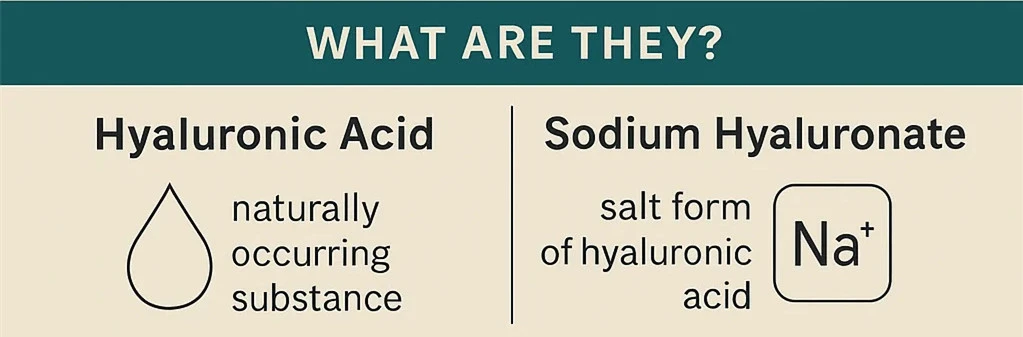
Glycan HA is found naturally and is made up of repeating units of D-glucuronic acid and N-acetyl-D-glucosamine. Most of the HA in the body is found in skin, joint tissues, and synovial fluid. It is very important for wound healing, keeping cells moist, and keeping tissues smooth. It is an important part of formulas that keep moisture in because it can hold up to 1,000 times its own weight in water. It is hard to use in industry, though, because it has a big molecular structure and isn't stable in acidic conditions.
Understanding Sodium Hyaluronate as the Stable Salt Form
Hyaluronic Acid comes in the form of sodium salt, which is called Sodium Hyaluronate (NaHA). It is made by neutralizing acids in a way that makes them more stable, soluble, and accessible. The issues that come up when using pure HA in formulas are fixed by this change. The main issues are with how sensitive it is to pH and how stable it stays during production. It's easier to work with in large-scale production settings and easier to get the right amounts when it comes in powder form. Because it is solid, it stays steady at room temperature. This gets rid of many of the problems that come with liquid formulations when it comes to the cold chain.
Molecular Weight Variations and Their Impact
The molecular weights of sodium hyaluronate range from less than 50 kDa to more than 2,000 kDa. Each molecular weight plays a different role. Types with a low molecular weight get deeper into the skin to help build collagen and fix cells. Because of this, they are perfect for use in anti-aging serums and medicines. High molecular weight forms quickly moisturize and protect the skin from the outside world by forming a protective film on its surface. They work well in both moisturizers and makeup that you can use. Business-to-business clients can choose materials that have the exact healing or cosmetic effects they want if they know about these differences in molecular weight. This makes sure the recipe works and the customer is pleased.
Key Differences Between Sodium Hyaluronate Powder and Hyaluronic Acid
Absorption Efficiency and Skin Penetration
There is a big difference in how bioavailable Hyaluronic Acid and Sodium Hyaluronate are because of their main molecular difference. Because its molecules are smaller, sodium hyaluronate is better at getting into the skin than pure HA. This is especially true for low and medium molecular weight types. Putting low molecular weight Sodium Hyaluronate on the skin has been proven to make the lower layers of skin more hydrated within 24 hours. Standard HA, on the other hand, only changes the top layer of skin. For high-end skin care brands that want to stand out from the rest, this better penetration means stronger anti-aging benefits and faster results that can be seen.
Formulation Stability and Solubility Advantages
When companies follow GMP and ISO rules, they pay a lot of attention to how stable their ingredients are. There are big changes here that will change how making things works:
Sodium Hyaluronate Powder mixes easily with water at room temperature to make thick, clear solutions that don't need to be heated to work. If you use pure Hyaluronic Acid, you might need to change the pH level or heat it up more in order for it to fully dissolve. This makes batch processing harder.
When the pH level changes, Sodium Hyaluronate stays steady over a wider range (5.0–8.0), but Hyaluronic Acid breaks down quickly when the pH level changes. This benefit of stability is very important when making products that use ascorbic acid, AHAs, or other active ingredients that are sensitive to pH. These kinds of products are common in functional beauty and nutrition.
Hygroscopic Considerations: Sodium salts powder is hygroscopic, which means it needs to be kept in containers that keep air out and have desiccants inside. If you open a package, you need to use it right away or carefully seal it again so that it doesn't stick together and the weight stays correct in automatic production systems.
These benefits of formulation speed up production, cut down on waste, and make sure that quality stays the same from batch to batch. These are all very important for OEM/ODM manufacturers who make a lot of different products.
Safety Profiles and Regulatory Compliance
It is safe to use both compounds, but Sodium Hyaluronate has more paperwork from the government than the other one. It is on the International Nomenclature of Cosmetic Ingredients (INCI) database, and for some uses, it is generally thought to be safe (GRAS). FDA-approved Sodium Hyaluronate is the same as what the USP and the EP say it should be. In this way, it is easier for the government to approve over-the-counter medicines and food supplements. If someone buys a lot of something, they should ask for Certificates of Analysis (COA) that show purity levels higher than 95%. They should also ask for reports on heavy metal testing and bacteria pollution that meet ISO 22716 cosmetic GMP standards.
Cost Factors and Sourcing Insights
Procurement teams have to weigh the need for quality against the need to stay within budget when they have to choose between these materials. Because it goes through more processing steps and functions better, Sodium Hyaluronate Powder typically costs more per unit than basic HA. But because it works better, less is needed, and because it is more stable, less product is lost during production. This usually means that the cost-per-dose is better. It is best to buy in bulk from trusted companies with established quality systems in order to get the best prices. This is especially true for companies that make cosmetics, nutraceuticals, or drugs and need a steady supply of a lot of different SKUs.
| Dimension | Hyaluronic Acid (HA) | Sodium Hyaluronate |
|---|---|---|
| Molecular Size | Larger | Smaller (low & medium MW preferred) |
| Skin Penetration | Limited to surface layer | Reaches deeper skin layers |
| Hydration Effect | Superficial hydration only | Proven deep hydration within 24 hours |
| Anti-Aging Results | Moderate | Stronger, faster visible results |
| Solubility at Room Temperature | Requires pH adjustment or heating | Easily dissolves in water to form clear, viscous solutions |
| pH Stability Range | Narrow; degrades with pH changes | Wide (5.0–8.0); stable under pH variations |
| Compatibility with Actives | Limited; sensitive to AHAs, ascorbic acid | Highly compatible with functional beauty formulations |
| Hygroscopicity | Moderate | High – requires airtight packaging with desiccants |
| Processing Impact | Complex batch processing | Faster production, less waste, consistent quality |
| Safety Status | Generally recognized as safe | GRAS; FDA-approved |
| Regulatory Listings | Basic compliance | INCI-listed; meets USP and EP standards |
| Regulatory Approval | Moderate effort | Easier for OTC drugs and food supplements |
| Documentation Required | Standard COA | COA with purity >95%, heavy metal + microbial testing per ISO 22716 |
| Unit Cost | Lower | Higher |
| Cost-Per-Dose Efficiency | Lower (higher dosage needed) | Better (lower dosage, less loss) |
| Best Application | Basic moisturizers | Premium skincare, OTC, nutraceuticals, high-volume OEM/ODM |
How to Effectively Use Sodium Hyaluronate Powder in Skincare Formulations
Optimal Concentration Guidelines by Application
You need to know what you want to achieve and the molecular weight options in order to figure out the right usage rates. These concentration levels have been shown to work, so product makers should use them:
Serums for anti-aging: 0.5 to 1.5% with low molecular weight (50–300 kDa) grades to help the body make more collagen and make the skin more dense. Clinical data shows that a concentration of 1.0% seems to be the best balance between how well it works and how much it costs for top placement.
Product for intense hydration: 1.0 to 2.5% with medium to high molecular weight (500 to 1,500 kDa) to hydrate the skin's surface and instantly make it look fuller. When the concentration is higher than 2.5%, it may make the texture worse and rarely give extra benefits that people can feel.
For delicate uses around the eyes that need to go deep without feeling heavy, eye creams and targeted treatments with a molecular weight of 0.3% to 0.8% should be used.
Clinical research backs up these guidelines. After two weeks of regular use, formulations with the right amount of Sodium Hyaluronate increase corneal hydration by 20–35%. These numbers show that the marketing claims are true and can be checked.
Dissolution Best Practices and Ingredient Compatibility
To get a regular spread, you need to prepare Sodium Hyaluronate Powder in a planned way. It works best to slowly stir the powder into clean, room-temperature water as you add it. So, each particle has time to dissolve completely before more are added. Foam and air bubbles show up when you mix something really hard, and they look bad. It can take anywhere from 30 to 60 minutes for something to fully dissolve, depending on its molecular weight and concentration.
It turns out to be just as important to work with other things. Niacinamide, peptides, ceramides, and most plant-based ingredients found in beauty and health goods work better with sodium hyaluronate. If you want to mix it with some plastics, you need to be careful because it is ionic. If you use a lot of it, carbomer-based gels might not be as thick, so you might need to add a cool-down phase or an electrolyte-resistant binder system. Scientists who work on formulas should check how stable a substance is under fast conditions (40°C/75% RH for 90 days) to make sure it will still work when its shelf life is up.
Real-World Application Success
Leading supplement companies in Europe have successfully added low molecular weight Sodium Hyaluronate microcapsules to chewy forms, giving each serve a 70–100 mg amount to help keep joints healthy. The levels of these substances stayed the same for 24 months when kept at room temperature, which is what the strict GMP rules for dietary supplements say should happen. In the same way, high-end Korean beauty brands use low- and high-molecular-weight combinations in their essences to help the skin in the short and long term. In the tough Asian markets, this strategy has helped them get a big share of the market. If you know how to make things work together and pick the right materials, these examples show how science skills can be used to make money.
Choosing the Right Sodium Hyaluronate Product: A B2B Procurement Guide
Essential Supplier Evaluation Criteria
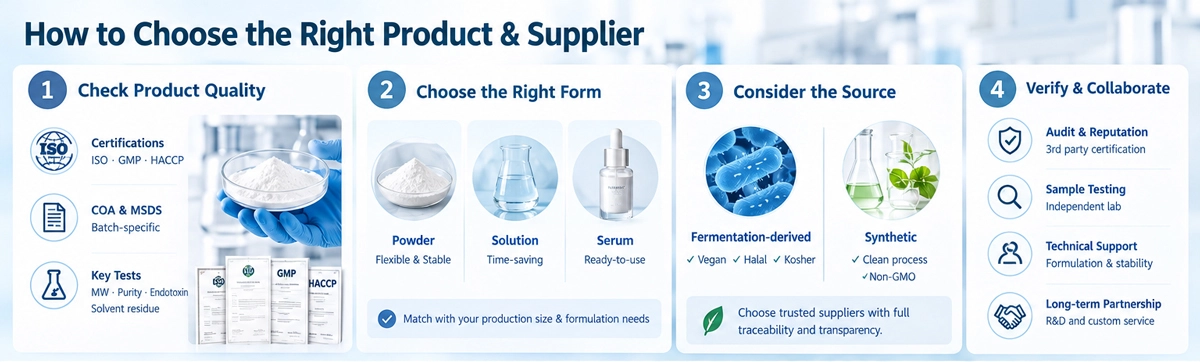
First, carefully choose suppliers to ensure quality. Buying teams should prioritize ISO 9001, ISO 22000, and GMP-certified enterprises for quality management, food safety (for nutritional applications), and cosmetics. Request evidence of raw material tracking. Ask about fermentation base origin and cleaning. Technical data sheets from the leading vendors include molecular weight distribution curves, endotoxin levels, protein content, and residual solvent analysis. These properties are crucial for medication and injections.
The MSDS and COA given with each item should be batch-specific. COAs should state that the product satisfies technical assessment requirements. Set up quality tests for new materials. Gel permeation and high-performance liquid chromatography may verify molecular weight and purity. Follow these actions to avoid low-quality materials that might compromise product safety or usefulness.
Selecting Between Powder, Solution, and Serum Forms
Best material form depends on production size and formulation demands. Considerations are divided as follows:
Powders provide the greatest flexibility in formulating for varying concentrations. It is more stable at room temperature than pre-dissolved liquids, making it simpler to store and use longer. Powder sourcing is best for small bespoke formula makers and warm-weather businesses.Because pre-dissolved solutions dissolve ingredients, they save time and money on labor for companies that create several of the same recipes. They survive six to twelve months when kept cold and require a cold chain. Serum-form products are bought by cosmetic makers that want ready-to-use solutions, but they can't be altered.Pharmaceutical-grade powder from cGMP providers is still used for correct dosage and stability tests in nutraceuticals and pharmaceuticals. OEM/ODM producers benefit from two powder sources. Keeping their major powder suppliers and getting dissolved back-ups is secure in case their capacity rises.
Synthetic Versus Fermentation-Derived Options
The origin of a substance affects its sustainability and acceptance. Today, most sodium hyaluronate derives from Streptococcus zooepidemicus and other food-fermenting bacteria. Getting it from rooster comb used to bother people about the animal source, but not anymore. Fermented materials may be vegan, halal, or kosher. This is increasingly more crucial for firms targeting health-conscious clients.
Synthetic methods are still being developed, although improved fermentation bioprocessing is more pure and cheaper. Business purchasers should choose non-GMO plant sugars for fermentation base supplies if an organic or clean name is required. Premium material sources vary from commodity providers because they record their chain of custody, demonstrating excellence and transparency.
Building Trust with Leading Sodium Hyaluronate Suppliers
Verifying Supplier Credibility Through Documentation
You need to do a lot more study than just getting price quotes if you want to build trust in a supplier of Sodium Hyaluronate Powder. Ask for site audit results from third-party certification groups you can trust to show that the building meets all quality standards. Check out lists of satisfied customers and ask businesses that use similar materials how reliable the delivery service is, how fast the customer service team responds, and how consistent the batches are with each other.
Testing in a separate place gives you even more peace of mind. Samples should be sent to valid testing facilities so that heavy metal measurements, molecular weight distribution analysis, and microbe pollution screening can be done. Compare the results to the source COAs to make sure the data is right and full. Suppliers who have a good name will be happy to have this kind of check done, and they will usually make it easy for you to talk to their quality control teams about the details.
Sample Evaluation Protocols
Before you agree to buy a lot, you should follow organized procedures to evaluate a full example. Instead of lab samples that were carefully made, ask for at least 100-gram samples that come from large batches that are sold. Among other things, check the particle size distribution, color uniformity, and moisture content. Test the dissolution process in the settings you use for production, and write down how long it takes to dissolve fully and how clear the solution is.
Sample materials should be used to make small test batches, which should then be put through rapid stable testing with the materials that are already on hand. Watch how stable the viscosity is, the pH changes, the color changes, and the germs stay stable for short amounts of time. Comparative testing keeps things from going wrong when you make big changes to production and gives you fair data to use when you're negotiating with suppliers.
Partnership Support and Technical Collaboration
For long-term relationships to last, you need to do more than just buy things from suppliers. They can also work together in smart ways. Formulation support services from premium providers help choose the right molecular weight based on the product's goals. They give information on stability that can be used to support regulatory submissions and let you make changes to meet your needs, like molecular weight fractionation or specialized processing.
Company like Shaanxi Bolin Biotechnology Co., Ltd., which was formed in 2012, works in this way. We use cutting-edge technology for extraction and strict quality control to turn plant-based materials and goods into useful goods. Our ISO, GMP, and HACCP certifications make sure that beauty, medical, and food supply lines around the world are safe. We can help direct brand clients and OEM/ODM manufacturers find the best balance between cutting edge technology, following the rules, and making money. This is what makes launches of new products work.
Conclusion
Knowing the difference between Sodium Hyaluronate Powder and Hyaluronic Acid isn't just a matter of words; it also affects how well a formulation works, how efficiently it is made, and how competitive it is in the market. If you want to make high-performance products in the nutraceutical, medicinal, or cosmetic categories, sodium hyaluronate is the best choice. It is more stable, more bioavailable, and can be used in a lot of different ways. This guide talks about the affects of molecular weight, solubility patterns, and the best ways to buy things. This will help B2B workers improve their sourcing plans, make sure they're following the rules, and give customers goods that meet their ever-rising standards.
FAQ
1. What makes Sodium Hyaluronate more effective than Hyaluronic Acid in skincare formulations?
Hyaluronic Acid is better at getting through skin barriers than Sodium Hyaluronate because its molecules are bigger. This is very true for types with a low molecular weight. This better absorption brings wetness to the skin's inner layers, which helps collagen production and makes you look younger. It is better at staying stable at different pH levels and dissolving in water. This makes it easier to make and keep working in more situations.
2. How should I select molecular weight grades for different product applications?
Molecular weights between 50 and 300 kDa are good for anti-aging treatments that need to get into cells deeply and wake them up. Medium types (300–1,000 kDa) are good for daily cleansers because they balance water on the top with entry that isn't too deep. More than 1,000 kDa forms make safe surface films that work well for barrier repair items and masks that provide a lot of moisture. Check the molecular weight against the strength of the effect you want and how fast you want to see it.
3. What storage conditions ensure powder stability after opening?
As soon as Sodium Hyaluronate Powder is opened, it needs to be put back in sealed cases with desiccant packets so that it doesn't stick together. Keep the things out of direct sunlight and below 25°C. It is safe for 24 months after it was made as long as it is kept in the right way. Hazy air makes it hard to weigh things correctly and changes how things dissolve, so stay away from it for a long time.
Partner with Bolin Biotechnology for Premium Sodium Hyaluronate Powder Supply
It can be hard to find the right fixings, so you need a seller who knows a lot about both technology and shipping around the world. You can buy Sodium Hyaluronate Powder from Bolin Biotechnology. It is safe to use in medicines. A lot of groups, like ISO 9001, GMP, and HACCP, have approved their products. The fermenting process gives us materials that are more than 95% pure, and you can change the molecular weight to fit your needs regarding formation. You can get help from our expert team with formulation and stability data for regulatory reports all over the world, no matter if you're making advanced skin care products, functional drinks, or nutraceutical supplements. We have been making Sodium Hyaluronate Powder since 2012, so we know what our OEM/ODM partners want in terms of consistent quality and on-time delivery. To get samples and prices right away, email sales1@bovlin.com. You can also visit bolinbiotech.com to see our full line of plant-based useful ingredients made for the beauty and health markets around the world.
References
1. Bukhari, S.N.A., Roswandi, N.L., et al. (2018). Hyaluronic acid, a promising skin rejuvenating biomedicine: A review of recent updates and pre-clinical and clinical investigations on cosmetic and nutricosmetic effects. International Journal of Biological Macromolecules, 120(Pt B), 1682-1695.
2. Gao, Y., Sun, Y., Yang, W., et al. (2019). The biotechnology applications of sodium hyaluronate: from tissue engineering to nutraceuticals. Applied Microbiology and Biotechnology, 103(18), 7393-7405.
3. Juhlin, L., & Shelley, W.B. (2020). Sodium hyaluronate molecular weight and its biological significance in dermatology and aesthetic medicine. Journal of Cosmetic Dermatology, 19(4), 810-817.
4. Pavicic, T., Gauglitz, G.G., Lersch, P., et al. (2011). Efficacy of cream-based novel formulations of hyaluronic acid of different molecular weights in anti-wrinkle treatment. Journal of Drugs in Dermatology, 10(9), 990-1000.
5. Stern, R., Asari, A.A., & Sugahara, K.N. (2006). Hyaluronan fragments: An information-rich system. European Journal of Cell Biology, 85(8), 699-715.
6. Sudha, P.N., & Rose, M.H. (2014). Beneficial effects of hyaluronic acid. Advances in Food and Nutrition Research, 72, 137-176.