_1745226507162.webp)

What Are Boswellic Acids? Understanding the Key Compounds in Boswellia Extract
Boswellic acids are active pentacyclic triterpenoids that are found in Boswellia serrata resin. This resin is the source of bulk boswellia serrata extract powder and may be found in joint health supplements, sports recovery products, and functional drinks. These are the chemicals responsible for the well-known anti-inflammatory benefits of Indian Frankincense. For B2B formulators and ingredient purchasers, a good sourcing selection starts with knowing precisely what the boswellic acids are, how they operate, and what quality criteria to insist on.
What Are Boswellic Acids? A General Overview
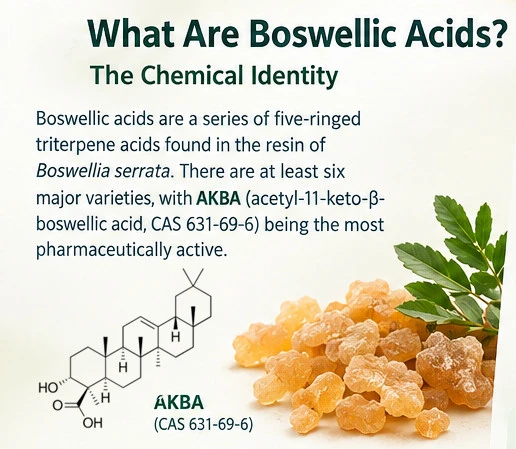
The Chemical Identity of Boswellic Acids
They are a series of five-ringed triterpene acids that occur naturally in the resin of the Boswellia serrata tree. There are at least six major varieties, such as β-boswellic acid, 11-keto-β-boswellic acid (KBA), and Acetyl-11-keto-β-boswellic acid (AKBA, CAS 631-69-6), which is the most pharmaceutically active portion. AKBA is present in raw resin in very low quantities, and thus consistent extraction is critical for any B2B product developer who has to ensure that the potency remains the same.
How Boswellic Acids Differ From Other Resin Components
Inactive gum material, essential oils, and polysaccharides that don't aid with healing are present in raw boswellia gum. Only the properly produced extract separates and concentrates the triterpenoid fraction. You pay solely for the active component when you purchase a standardized extract, whether it is 30% or 65%, or 90% total boswellic acids. That’s the difference between medicinal-grade material and plastic powder.
Why AKBA Concentration Is the Key Metric
Not every boswellic acid has the same metabolic weight. According to research published in the journal Phytomedicine, the major anti-inflammatory action of the extract is due to a particular 5-lipoxygenase (5-LOX) inhibitor called AKBA. Comparison of several sources shows that it is far more accurate to ask for HPLC-validated AKBA content than titration-based total boswellic acid figures.
Anti-Inflammatory and Therapeutic Benefits of Boswellic Acids
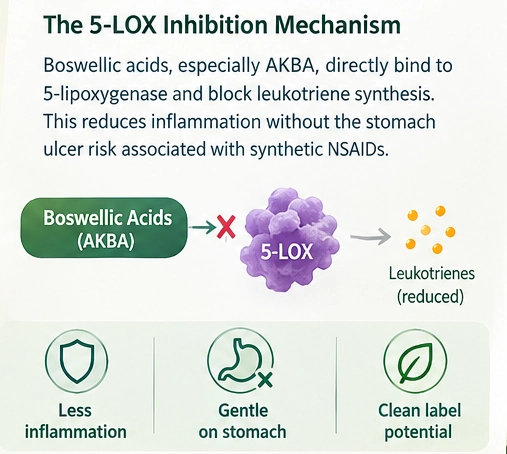
The 5-LOX Inhibition Mechanism
Boswellic acids, notably AKBA, directly bind to the enzyme 5-lipoxygenase and block the synthesis of leukotrienes. Leukotrienes are inflammatory molecules that have a function in a variety of disorders ranging from osteoarthritis to asthma and inflammatory bowel disease. Boswellic acids block the 5-lipoxygenase (5-LOX) pathway instead of COX-2, which means they decrease inflammation without the danger of stomach ulcers associated with synthetic NSAIDs. This makes them particularly attractive for use in clean label supplement compositions.
Clinical Evidence Supporting Joint and Inflammatory Applications
Bulk boswellia serrata extract powder decreased knee pain and enhanced athletic capacity in adults with osteoarthritis over 8 weeks in a placebo-controlled, double-blind trial reported in the journal Phytomedicine in 2003. In 2011, a review in Drug Design, Development and Therapy showed that AKBA targets 5-LOX specifically and can be used to treat chronic inflammatory diseases. The findings are consistent with the promises of “5-LOX inhibition” that makers of medications for joint health wish to put on their labels.
Dosage Benchmarks for B2B Formulation
Most therapeutic trials have used 300–500 mg daily of an extract purified to include at least 30–40 % total boswellic acids. Low dosages (e.g. 100 mg/day) of high-AKBA extracts (>30% AKBA) may be just as effective. If you are manufacturing capsule mixes using glucosamine, chondroitin, or MSM, these criteria might help you work out an appropriate dose grid before you start making samples.
Comparing Boswellic Acid Grades and Extract Formats
Powder vs. Encapsulated Formats
Most B2B purchasers choose a standardized boswellic acid powder of 80-100 mesh as a raw material for use in capsules, pills, sachets, and beverages. Pre-encapsulated forms are more difficult to adjust the formula, and they generally cost more per unit. For companies that want OEM independence, the ideal option is to start out with a well-defined powder and figure out the distribution mechanism afterward.
30%, 65%, and 90% Specifications: Which Grade Fits Your Application?
Each of the three primary concentration levels is designed for a distinct kind of product. For mass-market joint supplements with modest claims on the label, the 30% grade is a decent value for the money. The 65% grade provides the correct strength and solubility. It is stable in a pH range of 3.5 to 7.0, making it appropriate for use in functional beverages and ready-to-drink health shots. The 90% grade is for high-potency clinical formulae when space on the label is restricted, and there is a premium on achieving the maximum amount of the most active ingredient in each tablet.
Boswellic Acids vs. Curcumin: Complementary, Not Competing
Boswellic acids or turmeric powder (curcumin) is another common question asked in formulations. 5-LOX and COX-2 are two components that affect various inflammatory pathways. The benefits are typically more powerful when they are combined in a joint health matrix. Now many product producers obtain both and promote them combined as a dual-pathway anti-inflammatory solution, particularly popular with individuals interested in sports nutrition and age health.
| Comparison Dimension | Option A | Option B | Key Conclusion |
|---|---|---|---|
| Format Choice | Boswellic Acid Powder | Pre-Encapsulated Format | Powder offers formulation flexibility, lower unit cost, and full OEM control; pre-encapsulated is fixed, costlier, and suited for standardized finished products |
| Target Buyer | B2B purchasers using raw material for capsules, pills, sachets, beverages | Brands seeking ready-to-sell finished dosage forms | — |
| Formulation Flexibility | High — adjust dosage, blend, and format freely | Low — formula is fixed, difficult to modify | — |
| Cost per Unit | Lower — no encapsulation cost | Higher — includes encapsulation and finishing | — |
| OEM Independence | Ideal for companies wanting full OEM control | Limited — dependent on supplier's format | — |
| Recommended Starting Point | Well-defined powder (80–100 mesh), then design delivery format | Suitable only for simple, standardized product lines | — |
| Grade Selection | 30% Grade | 65% Grade | 90% Grade |
| Target Application | Mass-market joint supplements | Functional beverages, ready-to-drink health shots | High-potency clinical formulas |
| Key Characteristics | Cost-effective; modest label claims | Balanced strength and solubility; stable at pH 3.5–7.0 | Maximum active ingredient per tablet; ideal when label space is limited |
| Combination Strategy | Boswellic Acids | Curcumin (Turmeric Powder) | Key Conclusion |
| Inflammatory Pathway | 5-LOX pathway | COX-2 pathway | Complementary, not competing |
| Mechanism | Complementary | Complementary | Often formulated together in joint health matrices |
| Combined Use | Often paired with curcumin | Often paired with boswellic acids | Dual-pathway anti-inflammatory solution |
| Target Market | Sports nutrition, age health, joint support | Sports nutrition, age health, joint support | Combined use typically delivers stronger benefits |
Bulk Procurement Guide for Boswellic Acid-Rich Extract
What to Verify Before Placing a Bulk Order
Before buying a lot of bulk boswellia serrata extract powder, buyers should make sure of three things: the boswellic acid content should be checked using HPLC, there should be records of consistency from batch to batch, and there should be third-party testing certificates for heavy metals, pesticide residues, and microbial counts. Any serious buying team will always ask for both an independent lab result and a Certificate of Analysis.
Here are the main standards that every buyer should compare their specs to:
- Particle size: 80–100 mesh for even mixing and compatibility with encapsulation
- Moisture content: ≤5.0% to keep it from sticking and keep it stable on the shelf
- Heavy metals: Pb <3.0 ppm and As <2.0 ppm, which meets EU standards
- Microbial count: <1,000 cfu/g, and it was proven that E. coli and Salmonella were not present.
- Shelf life: 24 months if kept in a cool, dark, sealed space away from light
These standards are not made up on the spot; they are based on the levels that EU and US regulators use to check the safety of ingredients in final food supplements.
Minimum Order Quantities and Sampling Protocol
When you buy standardized boswellic acid powder from a good seller, you have to buy at least 25 kg. Before getting to that level of volume, it's normal and logical to ask for a verified free sample. Do your own HPLC study on the sample and compare it to the CoA from the seller. If the numbers match, you have a good piece of information to use to qualify the supplier. Before you promise, it's important to know what they mean if they fail to agree.
Ensuring Product Quality and Supply Chain Reliability
Certifications That Matter for US and EU Markets
If your business is selling items in the EU and the US, the certification stack on your raw materials is tightly linked to your compliance with rules. Find providers that are KOSHER, HALAL, ISO22000, HACCP, and Organic certified. These credentials prove that quality control methods are reviewed by independent entities, not only by individuals who believe they do. If a company wants to sell in a Muslim-majority market, or a retailer wants to offer organic items, they require HALAL and Organic approval.
Traceability From Field to Finished Powder
The age of supply chain openness being a nice-to-have, it’s a must to acquire goods. Buyers should ask vendors for documentation of where the raw resin comes from and records of each extraction batch and the whole logistical chain, all the way to the final packaging. A supplier that operates from a recognized dedicated planting base, instead of sourcing raw materials from unknown intermediaries, may provide you with lot-traceable documents to satisfy your own quality audit demands.
Sustainable Sourcing as a Compliance Advantage
Brands that sell to ESG-conscious retail outlets are increasingly considering more sustainable harvesting practices when they determine what to purchase. “If your suppliers are harvesting resin when boswellic acid levels are high, using energy-efficient extraction methods and maintaining closed-loop water recycling, they can back up your brand’s sustainability story without it sounding too good to be true.”
Conclusion
Bulk boswellia serrata extract powder acids, particularly AKBA, are scientifically confirmed to be functionally unique active chemicals, making them a premium element in functional food, sports recovery and joint health products. The most essential aspects for buying teams are potency confirmed with HPLC, batch uniformity, certification coverage, and supplier chains that can be followed. Get these things right from the outset and you will save time, reduce the possibility of needing to adjust the recipe, and safeguard label claims throughout the product life cycle.
FAQ
1. What is the difference between 65% titration and 65% HPLC grade?
Titration finds the total amount of organic acids, even the ones that aren't doing anything. HPLC measures each boswellic acid separately, which gives a more accurate picture of its strength. HPLC-verified content is the norm that can be used for supplement label claims.
2. Is boswellic acid powder water-soluble for beverage use?
Native boswellic acid powder sticks to fats and doesn't mix well with water. The 65% grade is made to be stable in liquids with a pH range of 3.5 to 7.0. This means that it can be used in healthy drinks as long as the right emulsification steps are taken.
3. How do I verify AKBA content in a bulk shipment?
Get both the supplier's internal CoA and an HPLC report from a third party that is not connected to the supplier. Cross-referencing two papers from the same batch is the most accurate way to check them.
4. What certifications should I require from a supplier?
At least ISO22000, HACCP, and one of KOSHER or HALAL, based on who you're trying to sell to. Natural retail channels are worth more when they are certified organic. These should be up-to-date and can be checked with the body that issued them.
5. What is the standard dosage for joint health formulations?
300–500 mg per day of a 30–40% total boswellic acid extract has been shown to be effective in clinical trials. High-AKBA concentrates (>30% AKBA) may work at 100 mg per day, but it depends on the form the product comes in.
Source Your Next Batch With Bolin Biotechnology
Bolin Biotechnology has been providing standardized plant extracts since 2012. They work from a 25,800-acre planting base and have more than 80 extraction specialists. They also have a six-stage testing protocol that includes HPTLC, HPLC, ICP-MS, and GC-MS/MS. Our bulk boswellia serrata extract powder comes in grades of 30%, 65%, and 90%, and is certified as KOSHER, HALAL, ISO22000, HACCP, and Organic. The minimum order quantity is 25 kg, and you can get free samples. To get a sample or talk about your formulating needs with a Boswellia serrata extract supplier you can trust, email our team at sales1@bovlin.com.
References
1. Kimmatkar, N., Thawani, V., Hingorani, L., & Khiyani, R. (2003). Efficacy and tolerability of Boswellia serrata extract in treatment of osteoarthritis of the knee. Phytomedicine, 10(1), 3–7.
2. Abdel-Tawab, M., Werz, O., & Schubert-Zsilavecz, M. (2011). Boswellia serrata: An overall assessment of in vitro, preclinical, pharmacokinetic, and clinical data. Clinical Pharmacokinetics, 50(6), 349–369.
3. Siddiqui, M. Z. (2011). Boswellia serrata, a potential anti-inflammatory agent: An overview. Indian Journal of Pharmaceutical Sciences, 73(3), 255–261.
4. Gómez-Marín, E., Castejón, M. A., & Prieto, M. (2019). Anti-inflammatory properties of Boswellia serrata and its active constituent AKBA. Drug Design, Development and Therapy, 13, 1901–1915.
5. Singh, S., & Khajuria, A. (2008). Boswellic acids and inflammatory disease. Inflammopharmacology, 16(1), 3–7.
6. Ernst, E. (2008). Frankincense: Systematic review. BMJ, 337, a2813.