10% vs 50% vs 98% Andrographolide: How Do the Specifications Differ?
The quality grade of andrographolide powder is very important when you're looking to use it in pharmaceutical, nutraceutical, or functional food items. It affects everything from how well the dose is calculated to how well the rules are followed. There are three parameters that are always 10%, 50%, and 98%. You can't change them. There are different amounts of active compounds in each, as well as different ways to get them out and use them. Buyers can use this guide to learn about the differences and match the right grade with the right product need.
Understanding Andrographolide Powder and Its Specifications
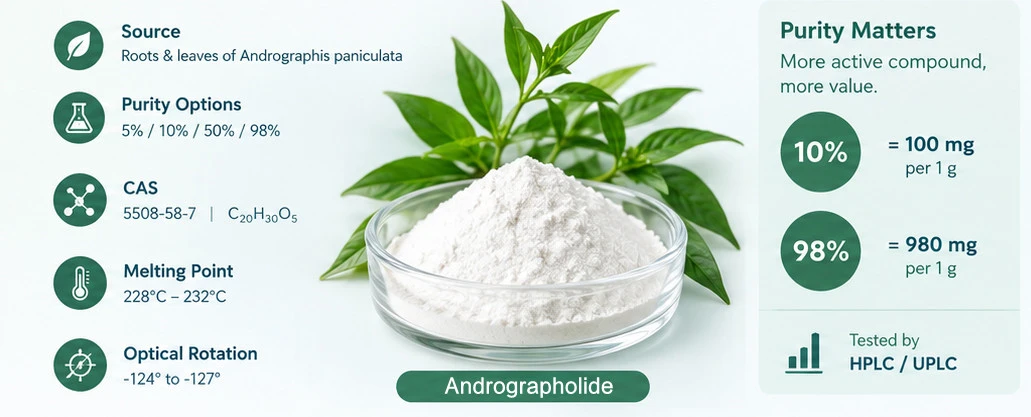
It is made from the roots and leaves of the plant Andrographis paniculata. It is a labdane diterpenoid. It has the formula C₂H₀O₅ (CAS 5508-58-7) and a weight of 350.45 g/mol. The white powder is made up of crystals. It melts at 228°C to 232°C and spins at -124° to -127° in the optical plane. These properties directly affect how to prepare it because it is lipophilic and doesn't dissolve well in water.
Why Purity Percentage Matters
The purity percentage shows how much confirmed andrographolide is in the whole powder. This can be proven with HPLC or UPLC tests. At 10%, one gram has 100 mg of active compound, and at 98%, it has 980 mg. This difference affects how doses are estimated, how much they cost per active unit, and whether they can be used in pharmacy settings that follow strict rules.
How Purity Is Measured and Verified
Chromatography and UPLC are acceptable ways to test things for purity. These methods separate Neoandrographolide and Dehydroandrographolide from other materials that were recovered at the same time. This gives a precise purity number that quality control and regulatory teams can check.
Specification Grades Available from Bolin Biotechnology
Bolin Biotechnology makes all of its goods in a factory that is ISO 22000 and cGMP-certified and is located in Shaanxi, China. It has four common grades: 5%, 10%, 50%, and 98%. As much as 3,000 kg of weed can be grown every month, and all of it comes from a known 25,800-acre growing base.
Comparing 10%, 50%, and 98% Andrographolide — Key Differences and Applications
Each pure grade moves along the chain in a different way. If buying teams know the difference between them and the rules, they can avoid making mistakes that cost a lot of money.
10% Grade: Cost-Effective Entry for General Wellness
Even so, the 10% grade had a wider range of polyphenols and andrographolide powder. If you want to boost your immune system with more than just one active ingredient, this is a good choice for herbal mixes, traditional medicines, and general things that do that. The number of pills and weight of the mixture will change if the dose amount per serve is raised. This grade is great for things where the rules aren't too tight and saving money is very important.
50% Grade: Balanced Potency for Nutraceutical Applications
The 50% level is a good compromise between cost and concentration. This is the grade that most nutraceutical companies use when making immune-boosting pills, liver-health supplements, or anti-inflammatory functional foods. It cuts down on the amount of medicine in each tablet while keeping the cost of making them low. The 50% grade also makes it easier for OEM customers working on branded health products to hide bitterness, which is a known problem with formulation, because they need fewer raw materials per serving to get the right dose.
98% Grade: Pharmaceutical-Grade API for Drug Development
An active pharmaceutical ingredient (API) should be at least 98%. Pharmacopoeias CP, USP, and EP all say that it is safe, and its regulated residue profile includes Dehydroandrographolide and similar compounds. Researchers in journals like "Phytomedicine" and "Journal of Ethnopharmacology" say that andrographolide's ability to stop NF-κB is what makes it anti-inflammatory and antiviral. For this process to work successfully in the clinic, it needs to be reliable in how much it is dosed and how pure it is. This grade is used by people who make enteric-coated tablets, softgels, or injectables to treat upper respiratory tract infections (URIs) and to help the liver.
How to Choose the Right Purity Grade for Your Business Needs
It is both a business and a professional choice to choose a standard. What grade you need depends on the rules your business has, the job, and how your supply chain is set up.
Match Grade to Regulatory Requirement
Medicines that need to be approved by the government need materials that are 98% API grade and come with all the necessary paperwork, such as COA, COO, MSDS, and impurity profile data. The DSHEA sets the rules for how nutrition companies can sell food additives in the US. Most of the time, a 50% or 10% score is enough. It is risky and costs money to not properly connect purity and legal category.
Evaluate Bioavailability and Formulation Compatibility
No matter how pure the andrographolide is, it is hard to take by mouth because it doesn't mix well with water. Technologies that make absorption better, like liposomal encapsulation, cyclodextrin complexation, or nano-emulsion, work well for higher-grade concentrates, especially 98%. The research and development team at Bolin Biotechnology helps OEM customers make these delivery systems, from testing small batches (at least 50 kg) to mass production.
Consider MOQ, Lead Time, and Supplier Auditability
Stable supply lines are just as important as high standards for products. The most important factors in buying are the amount of work that can be done each month, how regularly each batch is made, and the readiness to allow on-site checks. Bolin Biotechnology offers different types of packaging, from 25 kg fibre drums to 1 kg foil bags. They also offer private labelling and make sure that each shipment has batch records in case of an audit.
Market Comparison: Andrographolide Powder vs Other Botanical Extracts
Andrographolide powder stands out in the market for plant extracts compared to whole-herb pills and other immune-supporting botanicals.
Andrographolide vs. Whole Andrographis Extract
There are a lot of different compounds in the whole herb powder from Andrographis, and their concentrations are not all the same. There is a known amount of active ingredient in one gram of standardised andrographolide extract. This is important to make sure that the product description, dosing claims, and paperwork sent to the government are correct. For business-to-business users, this means more stability because they don't have to worry about batch-to-batch variations when they buy raw plant materials.
Andrographolide vs. Turmeric and Echinacea
Common immune-boosting and pain-relieving herbs in the US supplement market include turmeric's curcumin and echinacea. Unique in that it inhibits NF-κB signaling directly, andrographolide has been shown to be effective in the treatment of URTIs. There was a 2021 Cochrane review that revealed clinical evidence of andrographolide reducing the duration and severity of common cold symptoms. This is distinct from items in the same category based on curcumin.
Andrographolide vs. Synthetic Alternatives
Synthetic alternatives to natural APIs may be purer and more consistent, but they also cost more to create, cannot make as many natural product claims, and are regulated differently. Standardized andrographolide powder from a recognized organic source still offers major financial and legal advantages for enterprises that represent their products as plant-based or natural.
Partnering with Trusted Suppliers for Quality Andrographolide Powder
There is more to choosing a source for a controlled botanical API than just looking at the details on a datasheet. The systems, documentation, and responsiveness of the provider all have an impact on the quality of your product and your ability to pass governmental review.
Certifications and Documentation Standards
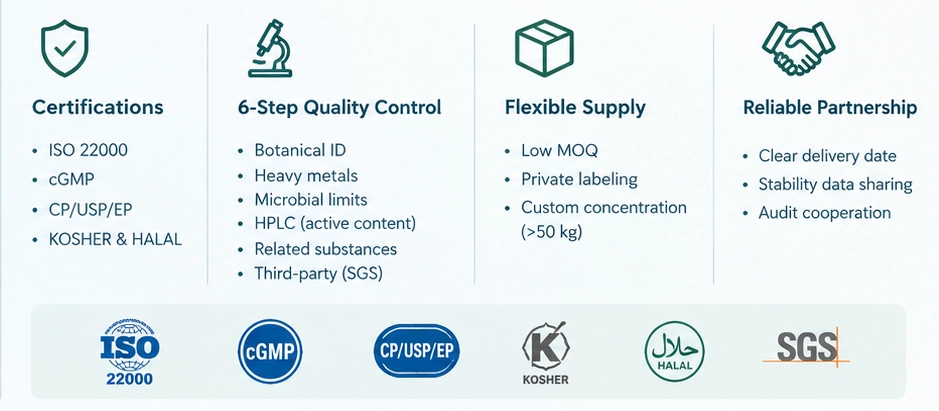
As a starting point, look for ISO 22000, cGMP approval, and pharmacopeia compliance (CP/USP/EP). Validation from a third party, like SGS certificates for heavy metals, pesticides, and microbial limits, adds an extra layer of independent checking that makes your own quality documentation stronger. Products aimed at KOSHER and HALAL consumers can reach more markets thanks to their certifications.
Quality Assurance Across Six Testing Stages
Every batch at Bolin Biotechnology goes through a six-step quality process. It includes making sure the plants are what they say they are, testing for heavy metals (Pb, As, Cd, and Hg up to the limits set by the EU Pharmacopoeia), checking for microbes according to HACCP guidelines, measuring the amount of active ingredient using HPLC, checking for impurities in related substances, and getting independent third-party certification from SGS. This order is meant to meet the documentation needs of pharmaceutical procurement teams doing technical due diligence.
Negotiating Terms That Protect Your Supply Chain
Low minimum order quantities (MOQs), private labeling, and the ability to request custom concentrations (for orders over 50 kg) lower the risk of development. When you sign a contract, make sure there are clear delivery dates, agreed-upon stability study data sharing, and audit cooperation terms. This will help your buying relationship grow as your product line does.
Conclusion
The difference between 10%, 50%, and 98% andrographolide powder is not simply a figure, but it illustrates how the extract is meant to be used, how it should be processed, and how well it fits regulatory criteria. 10 % for general health items gives you a lot of possibilities for an inexpensive cost. 50% is the optimum amount of strength and cost for nutraceutical formulae. The only permissible material to make medical medicines is 98% API grade material. The proper botanical ingredients imply the correct standard for the right application and require solid documentation and a dependable supply chain.
FAQ
1. What is the difference between 10% and 98% andrographolide in practical terms?
The amount tells you how much andrographolide is in one gram of extract. If you take 10%, you get 100 mg of active per gram. If you take 98%, you get 980 mg. This changes how to figure out the amount, how much to fill the pill, and how much impurity control is needed. For pharmaceutical applications, 98% of the full pharmacopeia documentation is needed.
2. Can I request a custom purity level between standard grades?
For orders of 50 kg or more, Bolin Biotechnology does take custom concentration requests. The R&D team can change the amounts of purity and make recipes that work for different types of products, like functional drinks, capsules, and tablets.
3. How do I verify the purity of andrographolide extract before purchasing?
Ask for a Certificate of Analysis (COA) with HPLC or UPLC data and SGS approval from a third party. When buying drugs, you should also ask for impurity profile data that includes Dehydroandrographolide and Neoandrographolide.
4. What is the minimum order quantity for Bolin Biotechnology?
Sample amounts are available for the first evaluation. For business orders, there are different packaging choices that run from 1 kg to 25 kg. Custom OEM production starts with at least 50 kg.
5. Does andrographolide powder meet US supplement regulations?
The product made by Bolin Biotechnology meets CP, USP, and EP norms. It is certified as ISO 22000, cGMP, KOSHER, and HALAL, which helps with regulatory submissions in the US, EU, and other markets.
Request Samples or a Quote from Bolin Biotechnology
Bolin Biotechnology has been making plant extracts that are safe for use in medicine since 2012. They can make up to 3,000 kg of them every month and have paperwork ready for inspection for every batch. Our team can help you with your needs from the sample stage all the way through business supply, whether you need 98% API-grade material for making drugs or a provider of custom-concentrated andrographolide powder for OEM production. You can email us at sales1@bovlin.com to ask for a sample or talk about your buying needs.

References
1. Akbar, S. (2011). Andrographis paniculata: A review of pharmacological activities and clinical effects. Alternative Medicine Review, 16(1), 66–77.
2. Hossain, M. S., et al. (2014). Andrographolide: A natural compound with diverse pharmacological activities. Journal of Ethnopharmacology, 158, 116–128.
3. Saxena, R. C., et al. (2010). A randomized double-blind placebo-controlled clinical evaluation of extract of Andrographis paniculata in patients with uncomplicated upper respiratory tract infection. Phytomedicine, 17(3–4), 178–185.
4. Tan, W. C., et al. (2017). Andrographolide as a potential cancer therapeutic agent: A review of its anti-tumor activity. Journal of Ethnopharmacology, 196, 173–190.
5. European Pharmacopoeia Commission. (2023). European Pharmacopoeia (11th ed.). European Directorate for the Quality of Medicines.
6. United States Pharmacopeial Convention. (2023). United States Pharmacopeia and National Formulary (USP–NF). USP.