_1745226507162.webp)

Low Molecular Weight vs High Molecular Weight Sodium Hyaluronate Powder
Your formulation aims will determine whether you use low or high molecular weight Sodium Hyaluronate Powder. Low molecular weight variations (usually below 50 kDa) readily penetrate skin layers, enabling deep hydration and supporting anti-aging claims in serums and injectables. High molecular weight grades (> 1,000 kDa) provide moisture-retentive coatings on the surface and are perfect for creams, lubricants and protective barriers. Such insights help procurement teams align molecular weight specifications with product performance needs, regulatory compliance and target application effectiveness for nutraceutical, pharmaceutical, cosmetic and functional food businesses.
Understanding Sodium Hyaluronate Powder and Molecular Weight
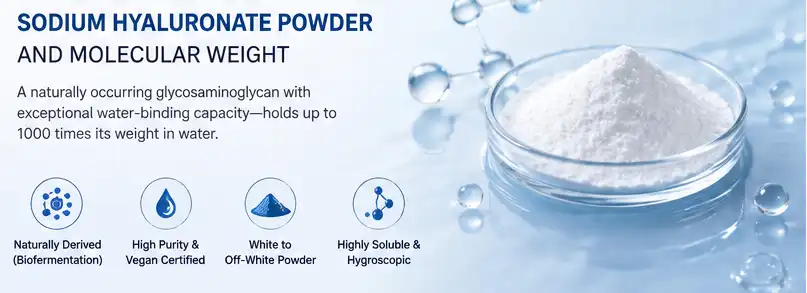
It is a naturally occurring glycosaminoglycan present in joint fluid, skin and connective tissue. Hyaluronic acid sodium salt is the sodium salt of hyaluronic acid. It is a biopolymer of repeating disaccharide units. It is incredibly robust and can retain 1000 times its weight in water. That’s why it is significant in various fields such as pharmaceuticals, food supplements, beneficial drinks and makeup.
Chemical Nature and Sourcing
Most often synthetic bacterial platforms or strains of Streptococcus zooepidemicus are employed for processing germs to produce sodium hyaluronate. This biological process ensures high purity, batch-to-batch consistency and absence of animal-derived pollutants in the product. It is clearly labeled and vegan certified. It forms a white to off-white powder which is extremely soluble in water and very hygroscopic. So it may be blended with a lot of various things.
Molecular Weight Classification and Impact
The physical and biological activity of sodium hyaluronate is determined by the molecular weight expressed in Daltons (Da) or kiloDaltons (kDa). In business, the molecular weight is divided into three primary categories: low (below 50 kDa), intermediate (50–1,000 kDa) and high (beyond 1,000 kDa). Low molecular weight grades penetrate deeper into the skin and aid the cells in retaining moisture. This creates more collagen. Medium molecular weight types are suitable for gel-based solutions, since they blend surface water with moderate penetration. Types with a high molecular weight provide solutions that are both thick and safe. They keep the surface of eye drops and supplements for joint health wet and smooth for a long period.
If B2B buyers know of these molecular weight ranges, they may choose substances that will provide the texture, absorption rates and medicinal benefits they are looking for. This applies to those who produce, those who interface with regulators and those involved in strategic sourcing. Quality standards such as ISO 9001, GMP and HACCP are making suppliers more trustworthy by demonstrating that they are identifiable and compliant. This is critical for APIs used in the pharmaceutical industry, nutritional supplements and cosmetics.
Low Molecular Weight vs High Molecular Weight Sodium Hyaluronate Powder: Key Differences
The manner low and high molecular weight grades function varies, and that’s the basis for the best ways to utilize them, and how effectively they work. If business people who purchase items know about these variances, they can select the right grade for the recipe and the final client.
Physicochemical Characteristics
Sodium Hyaluronate Powders with low molecular weight easily dissolve in water to provide low-viscosity liquids which are simpler to transport. The smaller polymer chains may penetrate deeper into the dermis. This stimulates the fibroblasts, which speeds up the healing process. Molecular weight fractions with small quantities have been demonstrated to affect inflammatory responses and promote tissue regrowth. Therefore, it may be employed in medicines and high-tech skin care products for reducing fine wrinkles and increasing skin elasticity.
When you blend high molecular weight grades, they form thick, gel-like solutions. They are superior at holding water and making films. Most of them just sit on top of the skin, creating a layer that allows air through but traps in moisture and smooths out texture. They also perform excellently in lotions, eye creams and joint health products that require maintaining skin soft and smooth for a lengthy period of time.
Functional Performance in Formulations
The low molecular weight variations are ideal for light serums, ampules and transdermal delivery methods that need to act fast and effectively. They are supposed to delay aging by making skin more flexible, reducing water loss from the skin surface and promoting collagen formation. These effects are in accordance with the scientific evidence. In medicine, low molecular weight types make it simpler to administer medications and in wound care items they assist wounds to heal quicker.
Thick creams, emulsions and dermal fillers that are injected and need to keep the skin wet and preserve its form for a long period have high molecular weight sodium hyaluronate as the major constituent. Their behaviors enhance the texture, flavor and shelf life of a food. High molecular weight grades replicate the naturally occurring composition of synovial and vitreous fluid that keeps joints moving and eyes healthy in functional beverages and nutraceutical capsules.
Safety and Regulatory Considerations
There is quite a bit of chemical knowledge to support the notion that both groups with different molecular weights are safe. They may be used in soap, food and pharmaceuticals. Lower molecular weight grades go deeper into the skin and some already highly sensitive persons may feel a bit irritated. This is why patch testing and the correct concentration are vital. “High-molecular-weight types are more suitable for applications used by people with sensitive skin because they are less damaging to the skin.
Regulations vary by product and location. The sodium hyaluronate used in cosmetics must be GRAS under the EU Cosmetics Regulation and FDA guidelines for food purposes. Products for use in medicine must conform to rigorous standards of purity, endotoxin and microorganisms established by the USP, EP or JP pharmacopeia. Certificates of Analysis (CoA) and third-party testing examine molecular weight dispersion. This ensures that all the rules are fulfilled and the outcome is the same from batch to batch.
| Molecular Weight Category | Specific Molecular Weight Range | Efficiency | Application |
|---|---|---|---|
| Low molecular weight | 3000~5000 | Transdermal absorption, deep moisturizing, repair after sun |
1. Skin care products: Cream, lotion, make-up water, essence, gel, mask, etc 2. Make-up products: Foundation make-up, lipstick, eye shadow, etc 3. Cleaning products: Cleanser, shower gel, etc 4. Hair Products: Shampoo, conditioner, hair gel, hair restorer, etc |
| Low molecular weight | 8000~50000 | Transdermal absorption, deep moisturizing, repair after sun | |
| Low molecular weight | 50000~100000 | Nourishing skin, lasting moisture | |
| Low molecular weight | 0.1m~0.5m | Nourishing skin, lasting moisture | |
| Medium molecular weight | 0.5m~0.8m | Excellent lubricity and film-forming properties; moisture retention; sunscreen effect | |
| Middle molecular weight | 0.8m~1.5m | Excellent lubricity and film-forming properties; moisture retention; sunscreen effect; | |
| High molecular weight | 1.5m~2.0m | Locking water, promoting tissue cell regeneration and excellent lubricity; film-forming; moisturizing; sunscreen effect; thickening and stabilizing | |
| High molecular weight | More than 2.0m | Locking water, promoting tissue cell regeneration and excellent lubricity; film-forming; moisturizing; sunscreen effect; thickening and stabilizing |
How to Choose the Right Molecular Weight for Your Product
When choosing the optimum molecular weight grade, it’s important to consider your formulation objectives, application and end-user experience. Good decisions include a balance between technical performance, the dependability of the source and quality control.
Application-Specific Molecular Weight Matching
Weight classes from 10 to 50 kDa are ideal for light face serums and essences that aim to profoundly hydrate and combat aging. They take in water fast and release it at the cellular level. These will work fast and will not leave your skin feeling sticky. They will also enhance the appearance of your skin.
High molecular weight sodium hyaluronate (1,000–2,000 kDa) is suitable for barrier repair creams, moisturizing creams and body lotions because it provides a luxurious feel to the skin and keeps the skin surface wet. The thickness effect makes it easier to distribute and more stable as a product, which is something purchasers like.
The choice of molecular weight has an influence on the effectiveness of therapies in the drug and medical industry. Low molecular weight fractions accelerate the healing process for wounds, decrease swelling and assist medications to enter the body via injections and lotions. These are high molecular weight substances used in the treatment of osteoarthritis and as eye lubricants, where they must be biocompatible and remain in the eye for a long period.
Supplier Reliability and Certification Standards
Working with suppliers who are GMP, ISO 22000 and HACCP certified guarantees the quality and traceability of goods and compliance with the standards. The molecular weight distribution should be appropriate, the purity should be more than 95%, the endotoxin concentration should be minimal, and the product should be safe for bacteria. You can reduce the risks and speed up the time to bring a product to the market by working with a trusted provider. Technical data sheets, stability studies and formulation advice are available.
People who are paid to purchase products should assess whether a vendor can manage big orders, has flexible MOQs (minimum order quantities) and has excellent customer service. Developing long-term partnerships with reliable suppliers helps to reduce supply chain risks and keep costs low.
Procurement Insights: Bulk Buying and Supplier Selection for Sodium Hyaluronate Powder
Good procurement practices enhance cost, quality and the dependability of the supply chain. To comprehend the market you need to know about the various sellers, how to assess the quality of the items and what affects the costs.
Pricing Factors and Market Dynamics
The price of Sodium Hyaluronate Powder is also affected by the molecular weight, purity grade, approvals and amount of powder bought. Low molecular weight kinds are often more expensive since they need more procedures to be cleaned and separated. Powders created for medications that have to fulfill rigorous pharmacopeia criteria are more costly than powders made for food or cosmetics. Yearly contracts and bulk purchase agreements and long-term contracts all keep the costs the same.
Different packaging types such as foil-walled drums and nitrogen-flushed bags affect the stability of the contents and the shipping costs. Suppliers may provide special packaging to meet particular handling and storage requirements, which can help to ensure the purity of the powder throughout the supply chain.
Quality Verification and Testing Protocols
Bulk sales should be checked by stringent quality control procedures. Information on reports of analysis on molecular weight distribution using gel permeation chromatography (GPC), quantity of water present, pH range, heavy metal limitations, number of bacteria should be available. Testing by third-party, accredited laboratories provides purchasers with confidence by verifying the findings independently of the supplier.
We can always test the quality … as long as we have the equipment on-site to test, including FTIR spectroscopy for verifying identification, viscosity measurements. If sample review processes are established up before to placing full-scale orders, then the probability of batch variation or non-compliance is reduced.
Global Supplier Landscape and Logistics
China, Europe and the US are important industrial clusters. Each has merits and downsides. Chinese manufacturers are generally a suitable alternative for large orders that need to remain low-cost, due to their often low costs and large production quantities. European providers emphasize compliance with standards, organic certifications and rigorous quality monitoring. That's why premium companies choose to deal with them:“US producers want clear supply chains, fast delivery and support that is close to home.
You have to consider about sending the items (air freight for urgent orders, sea freight for lower prices), the time it will take and the documentation for customs. You may experiment with various formulations and see how well they perform with sample orders before you purchase a lot of anything. “The ability to store goods and deliver them as needed makes it easier to track supplies, and gives operations more freedom.”
Maximizing Performance: Formulation Tips and Best Practices
To get the most out of Sodium Hyaluronate Powder, pay attention to how it dissolves, the pH ranges it operates in, how it is blended and how it is kept stable. Such practices make customers pleased and keep the quality of items high.
Dissolution Techniques and Handling
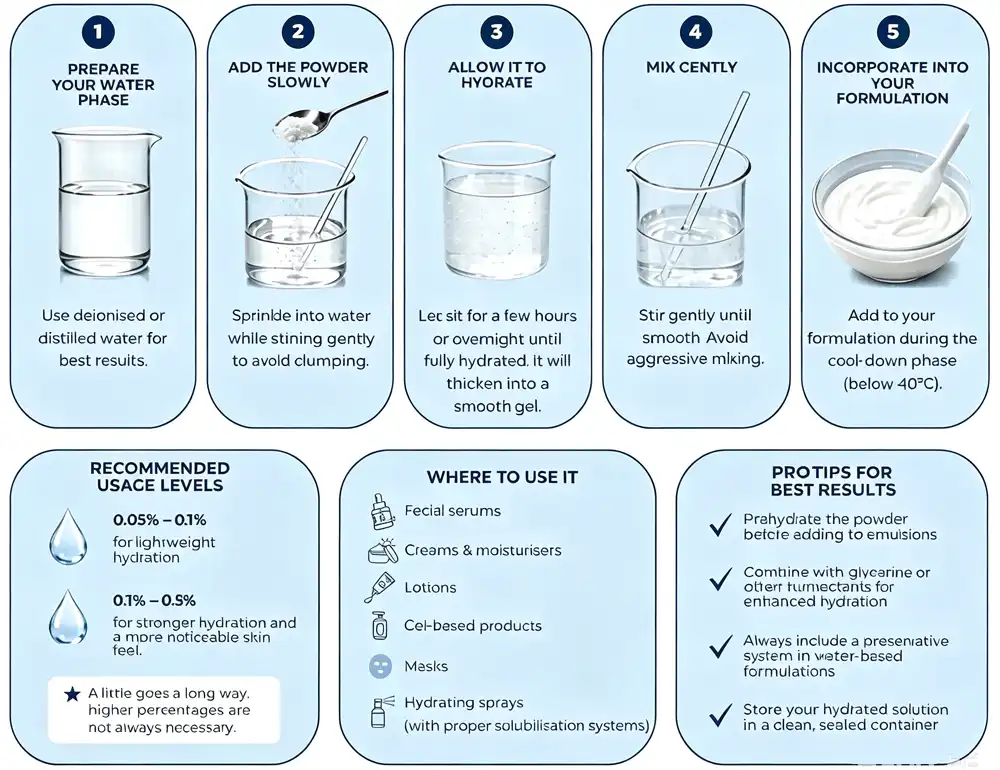
Sodium Hyaluronate Powder is very hydrophilic and may absorb a lot of water, thus it has to be handled carefully so that it does not become wet and clump together. If you add the powder gently to the water, it will dissolve more uniformly, as long as the water is at room temperature (20-25°C). Do not use high-pressure mixing, since it may break down polymer chains. Giving the material ample time to soak, generally one to two hours, guarantees that it will be completely dissolved and will reach optimum density.
Sodium hyaluronate is added to hot mixes as they cool so that they do not break down due to heat. The powder should be added into the water phase prior to emulsification, so that the combination is stable and uniform.
Recommended Concentration Ranges
The concentrations influence the texture, how effectively it works and how much it costs. Average use is between 0.1% and 3.0% depending on the app. Light serums include a little quantity of sodium hyaluronate (0.5% to 1.0%) to help the skin absorb them rapidly and leave it feeling silky. They are kept thick and wet with rich creams, high molecular weight grades of 1.0% to 2.0%. There is clinical evidence that nutraceutical capsules may support joint health. Dosage may be 50 mg to 200 mg each time.
You will normally make the formulation more costly and not make it operate any better by using more than the prescribed quantities. The product that strikes the right balance between performance and cost is the more competitive offering.
Blending Low and High Molecular Weight Grades
When mixing low and high molecular weight sodium hyaluronate more water is desirable. People who desire more than one layer of moisture will prefer this blending method since it provides deep moisture immediately and long-lasting surface protection. The ratio of low molecular weight to high molecular weight is often 1:2 or 1:3. The range is excellent for texture and flavor.
Mixed formulations have been shown in case studies to keep skin moisturized for longer, making it smoother and more elastic than single molecular weight variations. This technique enables goods to differentiate themselves in crowded marketplaces, resulting in improved placement and recurring business.
Stability Considerations and Storage Protocols
Store Sodium Hyaluronate Powder in well-closed containers protected from air, light and moisture. Store below 25°C. Antioxidants like tocopherol or ascorbic acid molecules prevent the harm of air. Between pH 5.5 and 7.5, the polymers will not break down and will operate with the skin’s natural processes.
Food may be placed in nitrogen flushed bags or vacuum sealed boxes to extend its shelf life. It will keep for 24 to 36 months under optimal circumstances. Formulated products remain stable because they are not exposed to air or UV radiation to the same extent as they are in airless pumps and sealed packaging.
Conclusion
If you know the difference between low molecular weight and high molecular weight Sodium Hyaluronate Powder, you may choose a source that best meets your recipe objectives, legal requirements and market position. Low molecular weight types penetrate well into the skin and help slow down the aging process. High molecular weight types trap moisture in the top layer of skin and soften the texture. When you acquire anything you have to balance quality control, reliability of source, and cost-effectiveness. When you are working with authorized manufactures you are guaranteed that the goods always operate effectively and respect the standards in nutraceutical, pharmaceutical, cosmetic and functional food purposes. This helps the product perform properly and generates confidence with the consumers .
FAQ
1. What molecular weight should I choose for a facial serum targeting anti-aging?
Serums that fight aging should have sodium hyaluronate with a molecular weight of 10–50 kDa. Because its polymer chains are smaller, they can reach deeper into the dermis. This makes the skin more flexible, increases collagen production, and smooths out fine lines. Clinical tests have shown that skin looks and feels better when it has between 0.5% and 1.5% of it.
2. Can I blend different molecular weight grades in one formulation?
Yes, it is common and often a good idea to mix grades with low and high molecular weight. The low molecular weight parts of this mix hydrate deeply right away, and the high molecular weight parts keep the surface moist for a long time. A common number of 1:2 makes sure that the feel, absorption, and pleasure for the senses are all equal.
3. How do I verify the quality of bulk sodium hyaluronate powder orders?
A Certificate of Analysis (CoA) should be given to you. This should show the molecular weight distribution using gel permeation chromatography, as well as the purity levels, moisture content, pH, heavy metal limits, and microbe counts. Proof that something is true comes from tests that are done by outsiders in approved labs. Before large orders are made, samples are used to make sure that the rules are followed and that the recipes work.
4. Is sodium hyaluronate powder suitable for vegan and halal-certified products?
Yes, vegan or halal supply chains can use sodium hyaluronate that is made from bacteria fermenting plant-based sugars like corn and sugar cane. Make sure the seller can show you proof that the goods were made using fermentation and don't have any ingredients or tools that came from animals.
Partner with Bolin Biotechnology for Premium Sodium Hyaluronate Powder
Getting sodium hyaluronate can be hard, but it's easy if you work with a supplier who has done it before. Bolin Biotechnology has been around since 2012 and makes high-quality plant extracts and bioactive ingredients that are used in cosmetics, medicines, nutraceuticals, and functional foods. Strict groups like ISO, GMP, and HACCP have approved our Sodium Hyaluronate Powder. We follow all the rules and make sure that every batch is the same. We have flexible MOQs, ways to buy in bulk, and full technical support to help you get your product to market faster. No matter if you need low or high molecular weight types, our quality control methods make sure that the molecular weight is correct and the purity is kept. You can get samples and talk to our expert team about your formulation needs by emailing sales1@bovlin.com or visiting bolinbiotech.com.

References
1. Bukhari, S. N., Roswandi, N. L., Waqas, M., Habib, H., Hussain, F., Khan, S., ... & Rashid, M. A. (2018). Hyaluronic acid, a promising skin rejuvenating biomedicine: A review of recent updates and pre-clinical and clinical investigations on cosmetic and nutricosmetic effects. International Journal of Biological Macromolecules, 120, 1682-1695.
2. Fallacara, A., Baldini, E., Manfredini, S., & Vertuani, S. (2018). Hyaluronic acid in the third millennium. Polymers, 10(7), 701.
3. Kogan, G., Šoltés, L., Stern, R., & Gemeiner, P. (2007). Hyaluronic acid: a natural biopolymer with a broad range of biomedical and industrial applications. Biotechnology Letters, 29(1), 17-25.
4. Litwiniuk, M., Krejner, A., Speyrer, M. S., Gauto, A. R., & Grzela, T. (2016). Hyaluronic acid in inflammation and tissue regeneration. Wounds, 28(3), 78-88.
5. Papakonstantinou, E., Roth, M., & Karakiulakis, G. (2012). Hyaluronic acid: A key molecule in skin aging. Dermato-Endocrinology, 4(3), 253-258.
6. Sze, J. H., Brownlie, J. C., & Love, C. A. (2016). Biotechnological production of hyaluronic acid: a mini review. 3 Biotech, 6(1), 67.