_1745226507162.webp)

What Is Andrographolide Powder? A Complete Guide for Ingredient Buyers
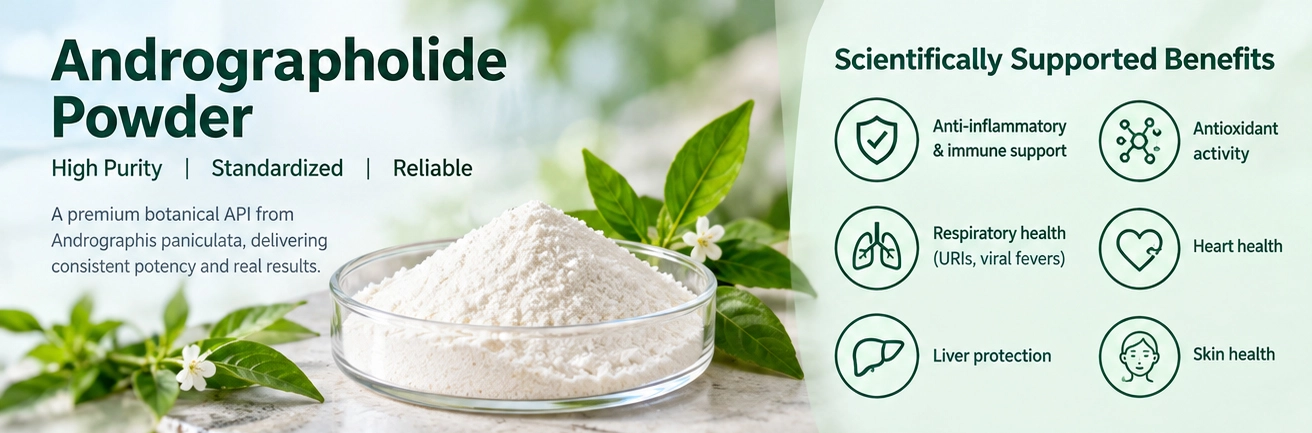
Andrographolide powder is a high-purity labdane diterpenoid active pharmaceutical ingredient (API) extracted from the stems and leaves of Andrographis paniculata. This white to off-white crystalline powder has a chemical formula of C₂₀H₃₀O₅ (CAS 5508-58-7) and a molecular weight of 350.45 g/mol, providing standardized bioactive potency that crude herbal ratios just cannot provide. It overcomes three longstanding issues in the business for B2B customers in medicines, nutraceuticals, and functional food: Batch variability; low oral bioavailability from raw extracts; and dosage imprecision that compromises clinical credibility.
Understanding Andrographolide Powder: Composition, Benefits, and Uses
Chemical Identity and Purity Standards
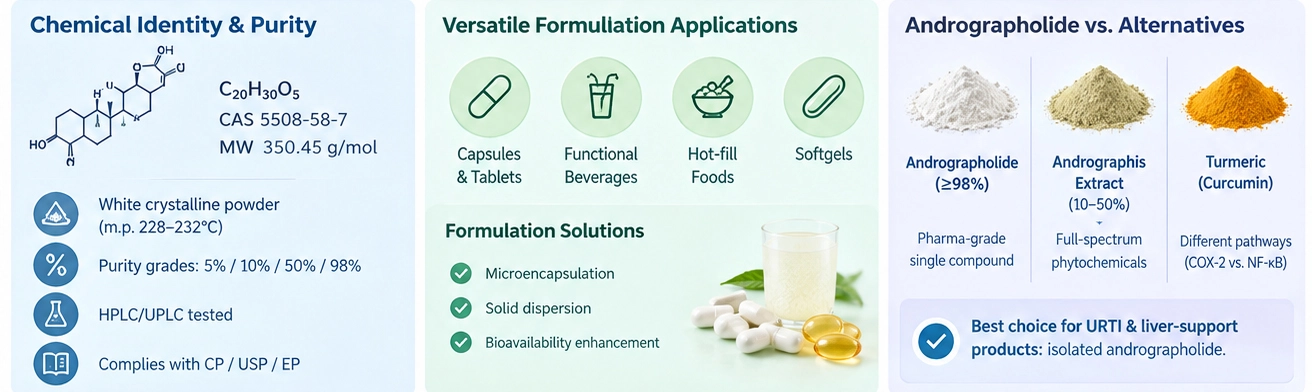
This chemical is a white solid crystal that melts at 228–232°C and spins optically at -124° to -127° in anhydrous ethanol. It is lipophilic and has poor solubility in water, and this directly influences the strategy of preparation. You may choose purity grades of 5%, 10%, 50%, or 98%; all have been confirmed by HPLC or UPLC. The 98% standard complies with the criteria of the CP, USP, and EP pharmacopeias. This makes it suitable for restricted medication usage where it is important to control impurities such as dehydroandrographolide and neoandrographolide.
Scientifically Supported Health Benefits
Andrographolide is proven to be an effective NF-κB inhibitor. This is why it has anti-inflammatory and immune-modulating action on cells. Studies have shown it may aid with upper respiratory tract infections (URIs), viral fevers, liver protection, and keeping the immune system in balance. An additional advantage is that it has antioxidant action to combat free radicals and decrease oxidative cell damage, and is used in solutions for heart health and skin health. These well-proven techniques provide formulators with a legitimate basis they may utilize to substantiate product claims.
Formulation Applications and Dosage Guidance
The powder is thermally stable, i.e., it can tolerate high processing temperatures without losing any of its bioactivity. This implies it may be used to manufacture functional beverages, hot-fill food products, pills and capsules. It is the primary active ingredient in antiviral and anti-inflammatory medicines available in tablet and softgel form. It is typically combined with zinc or vitamin C and found in nutraceuticals for immune support. They are often formulated for oral delivery using microencapsulation, solid dispersion, or bioavailability-enhancement methods to address the bitter taste and limited water solubility, which we shall describe in more depth further in the text.
Andrographolide Powder in Comparison: Making Informed Ingredient Choices
Andrographolide vs. Andrographis Extract vs. Turmeric
The anti-inflammatory ingredient may be isolated andrographolide, standardized Andrographis paniculata extract, or turmeric (curcumin), depending upon the aims of the formulation. The ≥98% pure andrographolide powder is vital for pharmaceutical-grade purposes, allowing for correct dosing by a single molecule. A standardized extract of Andrographis (often 10-50%) works well in supplement forms that can handle a larger spectrum of phytochemicals. Turmeric's curcumin targets various inflammatory pathways (COX-2 vs. NF-κB) and has its own bioavailability issues. The best option for government-approved URTI and liver-support products is isolated andrographolide.
Quality Assessment Criteria That Matter
Not all plant extracts come with the same kind of paperwork. These qualities show which food sources are trustworthy and which ones are not:
- Purity verification: HPLC or UPLC analysis with a certificate of analysis (COA) showing the active compound percentage and impurity profile, not just a label claim.
- Third-party testing: Independent SGS certificates confirming heavy metal limits (Pb, As, Cd, Hg) within EU Pharmacopoeia thresholds and microbial safety per HACCP standards.
- Pharmacopoeia compliance: Explicit conformity with CP, USP, or EP monographs, supported by COO and MSDS documentation for regulatory submissions.
These factors do more than just protect the quality of the product; they also show whether your formulation document will pass regulatory review in target markets.
Synergistic Pairing and Risk Considerations
Andrographolide is well suited to zinc and vitamin C in immunological formulations. It combines nicely with silymarin (milk thistle) in liver support products. Formulators should be mindful that its considerable bitterness implies that it must be disguised in any oral use. It is lipophilic, and hence, before being used in greater quantities, it needs to be tested for compatibility with excipients. Starting with a well-recognized, well-purified ingredient dramatically reduces the risk of formulation as opposed to starting with raw herb powders that might vary in strength.
Procurement Considerations for Andrographolide Powder: Sourcing and Supply Chain
Reliable Procurement Channels
B2B purchasers have three primary sources of pharmaceutical-grade botanical APIs: API and botanical ingredient merchants, regional distributors, or direct producers. Often, when you get directly from the manufacturer, you have better access to audits, better batch monitoring, and more extensive documentation. If you need an ingredient like andrographolide powderand need pharmacopeia compliance and impurity control, your best bet is to obtain it directly from a cGMP-certified manufacturer that sources its own raw materials. That removes a major level of supply chain uncertainty.
Cost Drivers and Volume Planning
Some key cost drivers include the purity grade (98% is more expensive to produce than 50%), the quantity of orders, and the expenses of certifications such as KOSHER, HALAL, and pharmacopeia compliance assessments. Most reputable manufacturers have minimum order quantities starting from 50 kg for bespoke ratios. Standard packing sizes vary from 1 kilogram foil packs to 25 kg fiber drums. Tracking lead times is crucial. A supplier that can generate 3,000 kg per month is a strong buffer against variations in seasonal raw materials and unanticipated surges in demand.
Verifying Supplier Credentials Before Committing
As part of due diligence, procurement teams should ask for the following before making their first order:
- GMP and ISO certificates (ISO 22000 and cGMP are minimum benchmarks for pharmaceutical-grade botanical APIs)
- Full batch documentation: COA, COO, MSDS, and impurity profile reports
- Third-party audit reports or willingness to accommodate on-site factory inspections
- Stability study data demonstrating shelf-life performance under standard storage conditions
If a supplier isn't sure about any of these things, they create a legal and quality risk that is hard to handle once production starts.
How to Choose the Best Andrographolide Powder Supplier: A B2B Buyer's Guide
Evaluation Criteria for Long-Term Reliability
The most crucial thing is not the lowest price a supplier can provide, but consistency from one batch to the next. The greatest evidence that a provider has control of the process is when they can demonstrate that optical rotation, melting point, and HPLC purity are consistent across several manufacturing batches i.e., optical rotation: -124° to -127°; melting point: 228-232°C. “Knowing exactly what registered growing area a batch came from helps keep things consistent and gives regulatory bodies the proof they need more and more. “Being able to trace back the raw ingredients.
The Role of Technical Partnership
Good connections with suppliers are more than simply discussing specifications. They also envisage serious technological co-operation. Formulators appreciate suppliers sharing testing methodology, pharmacokinetic data, and aid in designing stable trials. This is particularly essential in the case of bioavailability issues. For example, liposomal encapsulation, cyclodextrin complexation and nano-emulsion need much more information about ingredients than transactional vendors typically provide. A scientific team that can pool resources to develop delivery technologies and resolve formulation issues before scaling up is worth more than a little cheaper cost per kilogram.
Audit-Ready Documentation as a Competitive Asset
If you are a buyer looking to sell into regulated markets in Europe, North America, or the Middle East, you must have audit-ready documents. A seller becomes an asset to the government with KOSHER, HALAL, and pharmacopeia compliance certifications and complete batch records from field harvest to final packaging. They often invest in automated closed-loop production with real-time quality checks that lead to more uniform paperwork. This may shorten the time it takes regulators to certify your goods.

Conclusion
Pharmaceutical-grade andrographolide powder, compliant with all pharmacopeia requirements and accompanied by traceable documentation, is one of the most scientifically reliable botanical APIs available for anti-inflammatory, immune-support, and liver-health formulations. The ingredient is clearly described; the differentiator is always the quality of the provider. Buyers who value batch consistency, impurity control, audit access, and technical assistance will create more defensible goods and more robust supply chains. Please do check credentials, request samples with complete analytical data, and make supplier selection a technical choice and not simply a commercial one.
FAQ
1. What is the typical dosage range used in supplement formulations?
Clinical studies on andrographolide-containing products typically use andrographolide doses ranging from 30 mg to 200 mg per day for immune and respiratory support. The appropriate dose depends on the purity grade used and the target indication. Formulators working with 98% purity material can achieve precise dosing with smaller tablet or capsule sizes compared to lower-concentration extracts.
2. Can andrographolide be combined with other herbal ingredients?
Yes, but compatibility testing is essential. It pairs well with zinc, vitamin C, silymarin, and elderberry in immune and liver formulas. Formulators should test for physical and chemical compatibility with excipients, particularly in hot-fill or high-humidity processing environments, given its low water solubility and bitter taste profile.
3. How do I verify the purity and authenticity of a supplier's material?
Request a COA showing HPLC or UPLC quantification of the active compound alongside identified impurities. Cross-reference with a third-party SGS certificate. Ask for the optical rotation value (-124° to -127°) as a secondary authentication marker, since this specific physical property is difficult to falsify and confirms correct molecular identity.
Partner with Bolin Biotechnology for Reliable Andrographolide Powder Supply
Andrographolide doses of 30 mg to 200 mg per day are usually used in clinical tests on goods that contain andrographolide powder to help the immune system and lungs. The right amount relies on the level of purity and the purpose of the drug. Formulators who work with 98% pure materials can get more accurate doses with smaller capsules or tablets than with extracts that aren't as concentrated. To get a sample or talk about your sourcing needs, email our team at sales1@bovlin.com right now.

References
1. Gupta, S., et al. "Andrographolide: A Review of Its Pharmacological Activities and Clinical Applications." Journal of Ethnopharmacology, 2017.
2. Kianbakht, S., & Dabaghian, F. H. "Improved Glycemic Control and Lipid Profile in Hyperlipidemic Type 2 Diabetic Patients Consuming Banaba and Andrographis paniculata Extracts." Journal of Medicinal Plants, 2013.
3. Hossain, M. S., et al. "Andrographolide: A Prospective Cure to COVID-19 and Cancer." Frontiers in Pharmacology, 2021.
4. Okhuarobo, A., et al. "Harnessing the Medicinal Properties of Andrographis paniculata for Diseases and Beyond." Asian Pacific Journal of Tropical Disease, 2014.
5. United States Pharmacopeia (USP). Botanical Ingredient Standards: Andrographis. USP, 2022.
6. Puri, A., et al. "Immunostimulant Activity of Dry Fruits and Plant Materials Used in Indian Traditional Medical System for Mothers After Child-birth and Invalids." Journal of Ethnopharmacology, 1993.